

Authors
The ruins of civilisation
31 August 2012 | Authors, Reviews
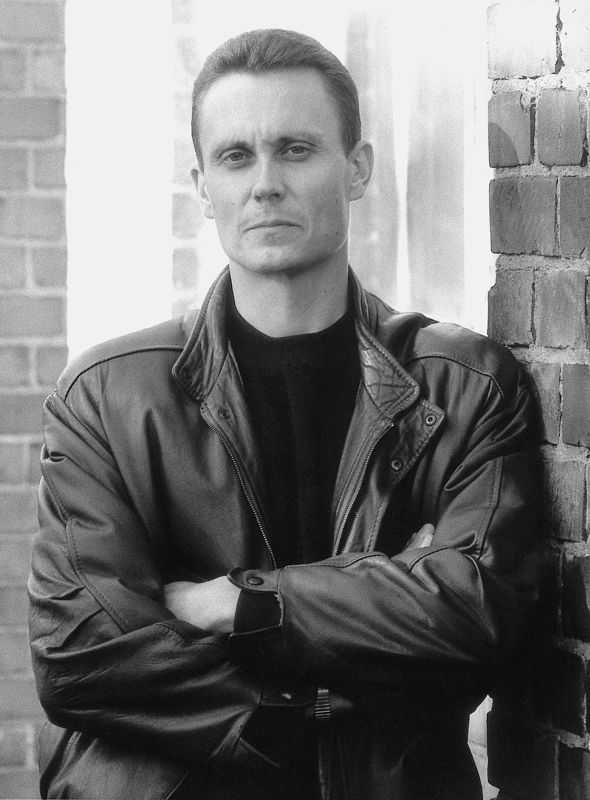
Juha Seppälä. Photo: WSOY
The eponymous central character of Juha Seppälä’s new novel Mr. Smith (WSOY, 2012) is almost an omnipotent man who moves freely in time and space, from Tsarist Russia to contemporary Los Angeles. He claims that he is a ‘sovereign individual’; sovereignty and individuality are traits that Seppälä’s protagonists have always striven towards.
On the other hand, he also says that he is a ‘necessary evil’ fulfilling the role of a protagonist in a novel. His name refers to anyone and everyone; he is, in a way, a minimalist relic of an individual.
On one level there is the suggestion that he is the alter ego of his creator: the author’s surname refers to a smith (seppä). More…
Special effects
14 June 2012 | Authors, Reviews
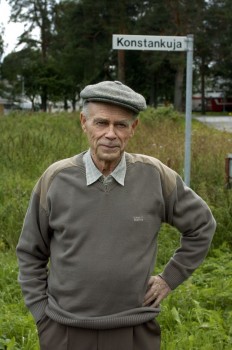
Veikko Huovinen. Photo: Harri Nurminen
Depictions of simple country folk who live close to nature, diabolical satire of the powers that be, playful rambling tales.
The humour of Veikko Huovinen has two dimensions: it is learned, intelligent, and insightful, but it is also exuberant and folksy. Critics have made comparisons to Nikolai Gogol and Mark Twain, and not without reason.
Huovinen (1927–2009) began writing stories in 1949 and published his final work in 2007, two years before his death. This half century saw the birth of a broad and multifaceted library, including a good number of works that do not fit any genre as such – Huovinen called his works that lay in the interstices between the short story, causerie and satire ‘short specials’. More…
In the same boat
29 May 2012 | Authors, Interviews, Reviews
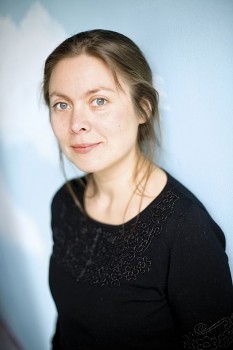
Pauliina Haasjoki. Photo: Tommi Tuomi
For the poet Pauliina Haasjoki, a writing process can begin in many ways, but particular periods – residencies, for example – are dedicated to writing. She attempts to create a cross-swell of influences in which she may read, watch movies, listen to music, have conversations and wander, collecting memories.
In the end, beginning to write becomes easy. Haasjoki may put music on to play, for example, for a certain time and use it to write ‘the poetry that belongs to that time, which sort of jostles there, waiting, because I have put it there.’
Haasjoki’s writing career began in Turku in the 1990s: she was studying literary theory at the university and was a witness to the birth of the poetic movement that developed there. Haasjoki has published five volumes of poetry, of which the latest, Aallonmurtaja (‘Breakwater’), was published in 2011. More…
Madness and method
10 May 2012 | Authors, Reviews
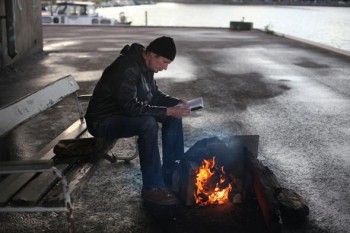
Juha Hurme. Photo: Stefan Bremer
One day during Advent in Helsinki the narrator in the novel Hullu (‘The lunatic’, Teos, 2012), a middle-aged man, goes mad.
Complete confusion fills his mind. He thinks he must be dead, but nevertheless manages to knock on the door of the mental hospital. To his amazement, he is admitted to the yellow building.
Because the boundaries between reality and self are, for him, completely blurred, he believes that the people in the hospital know absolutely everything about his unsuccessful life, and that he must expect humiliations and punishments. The people in white coats are aliens, or perhaps holograms. More…
Movies and mores
16 April 2012 | Authors, Interviews
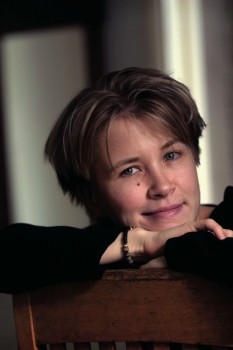
Tuuve Aro. Photo: Liisa Takala
Interview with Tuuve Aro, author of Himokone (‘Desire machine’): in these short stories she borrows titles and ambiance from the silver screen
A dark theatre, the smell of popcorn, expectation quivering in the air. Since childhood, the author and film critic Tuuve Aro (born 1973) has loved that magic moment when a new, exciting story is about to begin once again on the silver screen.
The stories in her fourth short story collection Himokone (‘Desire machine’, WSOY, 2012) have taken their names from films – Vertigo, Alien, and Invasion of the Body Snatchers, for example. The book’s title comes from a certain Dr Samuel L. Brimstone, member of the ‘Royal Film Academy of Suffolk’: according to him, a film projector is a desire machine: it doesn’t give anything, it only shows, and for that very reason it is hard to resist. More…
A gay fantasy on national themes
19 March 2012 | Authors, Reviews
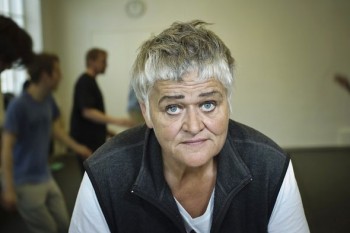
Pirkko Saisio. Photo: Laura Malmivaara
Why does the private become political? Who makes it happen? Why should religious doctrines define private matters such as sexuality? Why should those who wield power in the political system define personal sexuality?
Pirkko Saisio (born 1949), a theatremaker as well as a prolific and versatile author of plays, novels, film and television scripts, has written a play for the Finnish National Theatre entitled HOMO! and subtitled, ‘An anarchist musical farce’.
Answers to the above questions – and they are complicated – are to be found in, for example, historical, psychological and sociological research.
In the last century, Stalin and Hitler condemned gays. Thirty years ago homosexuality was considered an sickness in Finland; forty years ago it was a crime. Today, it is still illegal in more than 75 countries: punishments vary from flogging to life imprisonment or death. In democratic societies, the ‘gay problem’ is a question of human rights, and hence a subject for public debate – for example, in a musical play, for of course the issue also involves that eternally fascinating and entertaining feature of human life, love. More…
The edge of wordlessness
1 March 2012 | Authors, Reviews
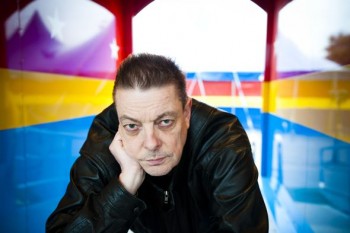
Harri Nordell. Photo: Veikko Somerpuro
The poems of Harri Nordell are a mystery to me. Each time I open one of his books, my reading begins afresh. I have analysed and translated his poems, but the texts have still not become familiar. I have not begun to comprehend them. They always speak to me as if for the first time.
I could not wish for a greater gift from a poem. These poems create a special state of being; I could call it not-knowing or marvelling. I feel I am involved in an unfolding event.
Nordell’s poems open me up, but I am unable to prise them open. I do not want to interpret cryptic expressions, or seek out more explicit meanings for them. I would not wish to write on top of these poems, to mute silence with superfluous words. More…
The balance of grief
19 December 2011 | Authors, Reviews
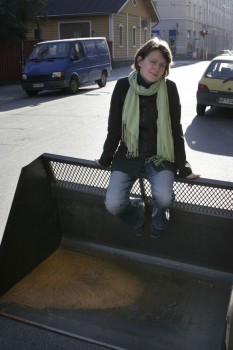
Henriikka Tavi. Photograph: Heini Lehväslaiho
In recent years volumes of contemporary Finnish poetry have offered readers the chance to enjoy excellent cover artwork. Right down to the typographical layout, the visual aspects of recently published volumes of poetry – by small and large publishers alike – have turned these books into highly refined, almost holistic works of art.
In such a way the poetics of the language and, in particular, the thematic starting point of the poems are lent a platform that both enhances and strengthens them.
Decorated with images of butterflies, the mournful grey jacket sleeve of Toivo (‘Hope’, Teos 2011), the third volume of poetry by Henriikka Tavi (born 1978), conceals the book’s bright yellow covers and an illuminated woodland path winding its way across them.
In this way the troubled central theme of this multi-disciplinary, collage-style work is immediately reflected in Camilla Pentti’s cover design. More…
All beauty
17 November 2011 | Authors, Reviews
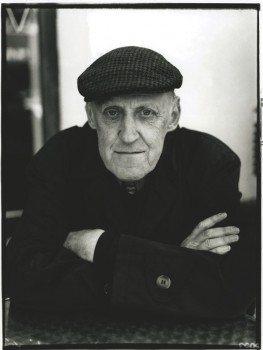
Bo Carpelan. Photo: Ulla Montan
The epigraph to Bo Carpelan’s prose work, Blad ur höstens arkiv. Tomas Skarfelts anteckningar (‘Leaves from autumn’s archive. The notes of Tomas Skarfelt’) is a quotation from Goethe: Zum Erstaunen bin ich da (‘To marvel I am here’). The world is a wonder to behold, one’s curiosity ought to be satisfied with less. It could stand as a motto for the whole of Carpelan’s literary work.
That work is now complete. Bo Carpelan died in February this year at the age of 84. He had made his debut in 1946 with the poetry collection Som en dunkel värme (‘Like an obscure warmth’).
In his prose as in his poetry, Carpelan built on a process of heightened and unconditional perception. Where others see only trees or forest, he saw a complex, branching light. His poetic ‘I’ could even watch itself perceiving, as when one autumn evening Tomas Skarfelt writes of a long-eared owl: ‘The yellow eyes looked at me attentively for a moment: a rather large, feather-clad camera.’ Carpelan often complained of having a poor memory, but it was a photographic one. More…
Blog-jam
24 October 2011 | Authors, Reviews
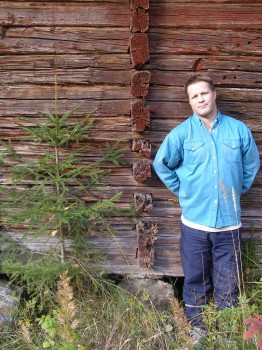
Jouni Tossavainen. Photo: Like
Poet and writer Jouni Tossavainen has directed his verbal curiosity towards blog writing in his eighth prose work, entitled Sivullisia (‘Outsiders’, Like, 2011); it consists of a collection of (fictional) blog posts, which seem to contain plenty of junk as well as treasures.
The book is a dizzying linguistic playground; it includes posts, around a page in length, from 157 ‘outsiders’. Escaping the familiar structures of language usage gives rise to snapshots of estrangement.
The narrator of the book claims to have assembled his material from a collection of blog posts received from the greater Helsinki region. Individual fragments of views and facts are like codes that have lost what they were meant to unlock. Mocking, satirical jibes emerge from the texts, accompanied by a sneaking suspicion of understanding and solace, as there ought to be in a true carnival. More…
On the Trans-Siberian express
3 October 2011 | Authors, Reviews
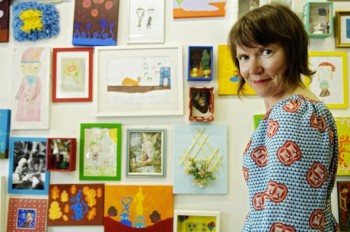
Rosa Liksom. Photo: Veikko Somerpuro
A Finnish girl studying archaeology in Moscow finds herself sharing a train compartment with a Russian man on the long journey from Moscow through Siberia to Ulan Bator. The girl travels for weeks to see the region’s ancient rock-paintings; the man’s destination is a big building site. The drama of the enclosed space is built of two people and two worlds that cannot escape one another.
The story, in Hytti no 6 (‘Compartment number 6’) by Rosa Liksom, develops through small stories and reminiscences as the backgrounds of the girl and the man open up. At the places where the train stops, other people from the steppe and cities of Russia become intertwined with the narrative.
The career of the Lapp writer Rosa Liksom spans more than 25 years and demonstrates a rare ability to master various fields of both writing and the visual arts. In the history of contemporary Finnish prose, her novels and collections of short prose are a fantastic chapter of originally developed Nordic localism and post-modernist world citizenship. Liksom’s first book, short prose, was published in 1985; her work has been translated into 14 languages. More…
Between life and death
23 September 2011 | Authors, Reviews
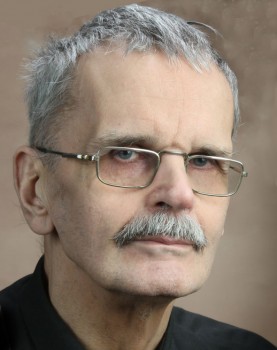
Gösta Ågren. Photo: Studio Paschinsky
The latest poems by Gösta Ågren, in the collection I det stora hela (‘On the whole’, Söderströms, 2011), are a continuation of the poet’s lifelong striving to unite the realm of private and personal experience with the domain of the shared, the social and the universal.
Ågren, born in 1936 in Ostrobothnia, on the west coast of Finland, has published twenty-eight collections of poetry. I det stora hela is the latest in an apparently inexhaustible series of books that reflect upon life and death, mostly in terse, aphoristic blocks that are hewn out of the poet’s own existence.
In the background of nearly all his poems is an Ostrobothnian childhood which, in its remoteness and solidarity with his close relatives, sets him apart in the same way as the Swedish language in which he writes sets him apart within a Finnish cultural context, though perhaps not in a Finland-Swedish one – for he shares not only its linguistic heritage, but also its traditional concern with the polarity and ultimate reconciliation of the individual and the community. More…
Science and fiction
15 September 2011 | Authors, Interviews
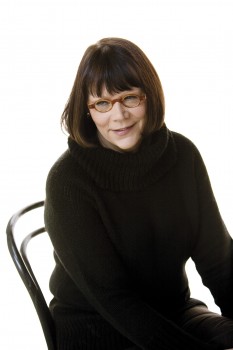
Kristina Carlson. Photo: Tommi Tuomi
Interview with Kristina Carlson, author of William N. Päiväkirja (‘William N. Diary’, Otava, 2011)
‘Monsieur W. Nylander had died alone, his head resting against his desk. We’d known for a long while that your beloved relative was not well, but whenever he was walking along the street and someone enquired as to his health, he always replied that he felt fit and well.’
Finnish-born Monsieur William N. lives in Paris at the end of the 19th century. The grumpy old scientist spends his days studying lichens in his small, dusty apartment and writing bitter comments in his diary about the way of the world, all things meaningless, and the glory and reputation that he never achieved.
William Nylander (born Oulu, 1822 – died Paris, 1899) is a historical figure who truly existed, and the remarks quoted above are taken from a letter sent by William’s housekeeper to his sister Elise in Finland, but other than this William’s diary is entirely the work of Kristina Carlson. The hermetic botanist has now become the protagonist of a novel written in 2011. More…
Weird and proud of it
5 September 2011 | Authors, Essays, Non-fiction, On writing and not writing
In this series Finnish authors ponder their profession. Johanna Sinisalo, detests literary pigeonholes: in her opinion, the genre isn’t the point, the story is. Instead of having her books labelled ‘fantasy’ or ‘science fiction’, she would like to coin a new term: Finnish weird
I’ve got a problem, and it’s a problem I share with my agent, my publisher, book retailers and librarians.
Nobody really knows which literary pigeonhole my works belong to. Almost without exception my stories include some element that is mystical, magical or otherwise at odds with our everyday reality, or they might be set in the future.
‘Doesn’t that make it fantasy?’ some might ask. ‘Or science fiction?’
Seasoned readers will of course appreciate that both ‘fantasy’ and ‘science fiction’ are very broad concepts that can encompass a whole variety of different texts. Even so, I still don’t want my works to be bunched into either of these categories. Why not? More…
Truths to tell
1 June 2011 | Authors, Interviews
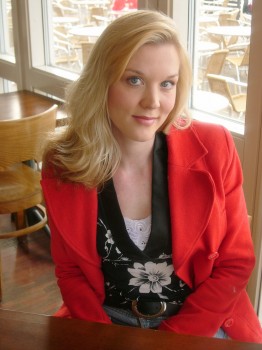
Johanna Holmström. Photo: Irmeli Jung
‘In my writing I try to give as many angles as possible, and my agenda is to show that there’s not just one truth, that there are always several ways of seeing what one perceives at first sight. So I often have more than one main narrator. I constantly aim to question accepted truths. My stories always begin with indignation about something I feel I must write about. Fiction is a way of distancing oneself. After all, books are literary, invented things. When you work on the subject of a literary text it becomes less personal.’
This is how Johanna Holmström (born 1981) describes her approach to writing. Since her first collection of short stories published in 2003 she has produced a book every two years: three short story collections and one novel. Her books have been variously described as imaginative, committed and uncomfortable. Her short story ‘Stormen’ (‘The storm’) is a precisely observed account of a day when everything changes for its young protagonist.