

Fiction
Bonfires in the garden
6 March 2014 | Fiction, poetry
Poems from Inga stjärnor i natt, sir (‘No stars tonight, Sir’, Schildts & Söderströms, 2012). Introduction by Jukka Koskelainen
With us on the cruise was
an old, old man.
We wondered what
he was doing there.
He sat at a table by himself.
Silent. Drinking water.
Never turned up at the cabaret
or the ballroom.
Once he asked the receptionist,
rumour had it, if it was possible
to go out into the fresh air,
there beneath the stars.
‘No stars tonight, sir!’
said the man in the hatch.
The old man wasn’t seen again
until we reached land.
Wonder what happened to him.
Not that it’s any of our business.

Once upon a time
27 February 2014 | Children's books, Fiction
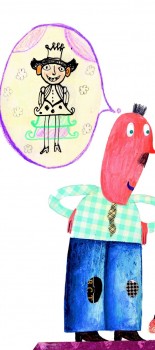 Stories from Kirahviäiti ja muita hölmöjä aikuisia (‘The giraffe mummy and other silly adults’, Teos, 2013), illustrated by Martina Matlovičová. Interview of Alexandra Salmela by Anna-Leena Ekroos
The monkey princess
Adalmiina’s life was not an easy one. Her parents decided to prepare her for her career as a princess when she was a little girl: when Adalmiina was three she was sent to ballet school, at four she started taking lute lessons and at five she went on a course in magic-mirror gazing.
When Adalmiina turned six, she received a giant suitcase full of princess clothes and shoes.
‘Put them on, darling, we want to see you in all your lovely beauty!’ her mother sparkled, waving a muslin veil.
‘I want to go to the jungle!’ Adalmiina demanded. ‘Without any clothes!’
‘Will we have to force you to dress in all your glory?’ her parents snapped.
‘You’ll have to catch me first!’ Adalmiina announced, running into the garden. More…
Air, blue and gold
16 January 2014 | Fiction, poetry
Poems. Introduction by Tuula Hökkä
The arch bridge
From Ylitse vuoren lasisen (‘Over the glass mountain’, 1949)
And God said: to others I’ll give other tasks, but the task I’ll give to you
is to make a curving bridge, my child, with an arch that’s round and true.
For everywhere around the earth human beings are laden with gloom,
and they’ll come to cross an arching bridge in their anguish and their doom.
Make a bridge that spans the precipice, a bridge over the abyss,
one that shines to my glory with radiance, sparkling like this.
I said: They will come with heavy boots, and heels caked with clay –
how can my bridge withstand their weight, yet also shine this way,
not tarnish or break apart as their crowding presence nears?
And God said: well, it can only be done by means of blood and tears.
Your heart is stronger than mountain rock, the ore that’s buried there –
Put a piece of it into the bridge support, and you’ll get the bridge to bear.
Add a piece of the hearts of those you love, and I know they won’t condemn,
but will surely grant you forgiveness if you make a bridge for them.
Make a bridge to the glory of God, my child, make a bridge with arching light
that will span the depths and shine for ever, with radiance sparkling bright.
Don’t lock the sorrow out of your heart as the bridge you make appears.
Nothing gleams more beautifully than the brilliance of pure tears. More…
Reading matters? On new books for young readers
9 January 2014 | Articles, Children's books, Non-fiction
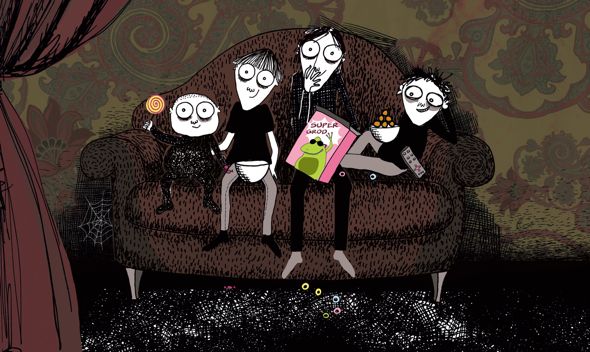
The Pixon brothers don’t read books, they love the telly: story by Malin Kivelä, illustrations by Linda Bondestam (Bröderna Pixon och TV:ns hemtrevliga sken, ‘The Pixon brothers and the homely shimmer of the telly’)
Finnish picture books for children have long been reliable export goods around the world. In the last few years, a number of novels for children have come along in their wake: works by authors such as Timo Parvela and Siri Kolu have been translated into a good many languages.
Now young adult literature has also blazed a trail on to the international market – in what also seems to be almost a matter of precision timing with regard to the Frankfurt Book Fair 2014. Finnish publishers have been investing in their home-grown lists of children’s and young adult books ever since the turn of the millennium, and now the time has come to harvest the fruits of their long-term efforts.
The last Christmas tree
19 December 2013 | Fiction, Prose
A short story from Reikä (‘The hole’, Like, 2013)
A four-litre saucepan should last the whole holiday, Honkkila calculates, throwing a bay leaf into the borscht.
Borscht is excellent at Christmas, as it blends the traditional Finnish dishes – beetroot salad, baked roots, ham.
At the same time Honkkila remembers the tree. He’s always had a tree, for forty years. When he was a child his dad brought it in from the back forest. Since then Honkkila has fetched his tree from various places, from the market and last Christmas from the shopping centre parking lot, but for this Christmas he has no tree.
Honkkila looks at the clock. The shopping centre is open for another hour. Honkkila takes the soup off the hob and goes out.
The shopping centre loudspeakers are beeping out electronic Christmas tunes; there are patches of spruce needles on the empty parking lot.
‘Is there anything left?’ Honkkila asks the assistant. More…
Bring on the white light
12 December 2013 | Fiction, Prose
Extracts from the novel Auringon ydin (‘The core of the sun’, Teos, 2013). Introduction by Outi Järvinen
Jare, March 2017
‘We call the chilli the Inner Fire that we try to tame, just as our forefathers tamed the Worldly Fire before it.’
Mirko pauses dramatically, and Valtteri interrupts. ‘Eusistocratic Finland offers us unique opportunities for experimentation and development. Once all those intoxicants affecting our neurochemistry and the nervous system have been eradicated from society, we will be able to conduct our experiments from a perfectly clean slate.’
‘We fully understand the need to ban alcohol and tobacco. These substances have had significant negative societal impact. And though in hedonistic societies it is claimed that drinks such as red wine can, in small amounts, promote better health, there is always the risk of slipping towards excessive use. All substances that cause states of restlessness and a loss of control over the body have been understandably outlawed, because they can cause harm not only to abusers themselves but also to innocent bystanders,’ Mirko continues.
This is nothing new to me, but I must admit that the criminalisation of chillies has always been a mystery to me. By all accounts it is extremely healthy and contains all necessary vitamins and antioxidants. A dealer that I met once told me that people in foreign countries think eating chillies can lower blood pressure and cholesterol levels – and even prevent cancer. If someone makes a pot of tom yam soup, sweats and pants over it and enjoys the rush it gives him, how is that a threat, either to society or to our health? More…
Tales of the night
22 November 2013 | Comics, Fiction
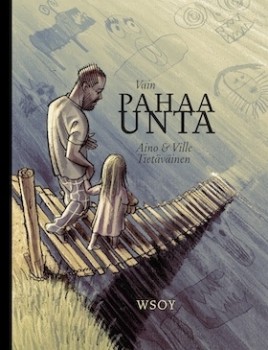 The father is woken up in the middle of the night because his small daughter suffers from nightmares. He asks her to tell him about them so they won’t frighten her any longer. Giant bunnies wearing high heels chase little Aino, a scary three-eyed gnome pours apple jam onto her, Daddy has turned into a dog….
Graphic artist Ville Tietäväinen began writing down Aino’s dreams when she was three, and together they illustrated them. The result is a graphic storybook entitled Vain pahaa unta (‘Just a bad dream’, WSOY, 2013).
Visible in the background are selected quotations from books on dreams and nightmares.. Aino’s nightmares are certainly produced by a lively imagination, making this an excitingly quirky book.
It was selected as one of the six runners-up of the Finlandia Junior Prize 2013; the winner will be announced on 26 November. (We tend to think, though, that Vain pahaa unta is definitely a more interesting read for daddies than kiddies.)
When I’m ninety-four
14 November 2013 | Fiction, Prose
An extract from the novel Kuolema Ehtoolehdossa (‘Death in Twilight Grove’, Teos, 2013). Minna Lindgren interviewed by Anna-Leena Ekroos
At the Health Clinic, Siiri Kettunen once more found a new ‘personal physician’ waiting for her. The doctor was so young that Siiri had to ask whether a little girl like her could be a real doctor at all, but that was a mistake. By the time she remembered that there had been a series of articles in the paper about fake doctors, the girl doctor had already taken offence.
‘Shall we get down to business?’ the unknown personal physician said, after a brief lecture. She told Siiri to take off her blouse, then listened to her lungs with an ice-cold stethoscope that almost stopped her heart, and wrote a referral to Meilahti hospital for urgent tests. Apparently the stethoscope was the gizmo that gave the doctor the same kind of certainty that the blood pressure cuff had given the nurse.
‘I can order an ambulance,’ the doctor said, but that was a bit much, in Siiri’s opinion, so she thanked her politely for listening to her lungs and promised to catch the very next tram to the heart exam. More…
Pomp and circumstance
31 October 2013 | Fiction, Prose
Extracts from the novel Bär den som en krona (‘Wear it like a crown’, Schildts & Söderströms, 2013). Sanna Tahvanainen interviewed by Janina Orlov
A kick in the stomach – yes, that is what it feels like each time I catch a glimpse of the Crystal Palace. The miniature on Albert’s desk has finally grown to maturity. The great greenhouse towers where once the elms stood. On a clear day the sun dances along the glass, making it glisten, the whole place all but blinding us. One is forced to squint on approaching it. One reaches out a hand, and when it touches the glass and steel, one knows one is there.
The grand opening is a mere five days hence. I step inside, he will be there somewhere. He is unaware of my arrival; it is to be a surprise. These last months he has been gone long before I have woken, and arrives home only once I am asleep. He seems quite indefatigable, neither sleeps nor eats properly. These last weeks there has been nothing else on his mind but the Great Exhibition. More…
A fleeting scent
24 October 2013 | Fiction, poetry
Poems from Öar i ett hav som strömmar (‘Islands in a flowing sea’, Schildts and Söderströms, 2013). Introduction by Michel Ekman
A fig wasp’s life
She squeezes in. The opening closes and the world overflows. She swims in the sweet flowing moisture. In the sycamore fig tree, a myriad of delicate white blossoms have burst out. For her eyes alone, a damp garden, alabaster-clear. The home she’s been longing for. There she lays her eggs, empties her pouches. Tiny little pollen grains for the tiny little blossoms. Membranes form round the eggs, they live off the sweetness, it rocks them gently. Fine, frail swaying thicket of embryos More…
Solid, intangible
26 September 2013 | Fiction, poetry
Poems from Mot natten. Dikter 2010 (‘Towards the night. Poems 2010’, Schildts & Söderströms, 2013). Introduction by Michel Ekman
Memory
If you give me time
I don’t weigh it in my hand:
it’s so light, so transparent
and heavy as the thick
shining darkness
in the backyard gateway
to memory
AZ661748
19 September 2013 | Fiction, Prose
A short story from Novelli palaa! Matkanovelleja (‘The short story returns! Travel stories’, edited by Katja Kettu and Aki Salmela; WSOY, 2013)
Mum didn’t want to travel abroad. Mum wanted to tend her rose garden and her pea beds, which sloped down the hill towards the lake. In mum’s opinion, the view from the porch was the best view in the world.
Dad wanted to travel. He never got very far, because Mum wouldn’t go. Dad got as far as the neighbouring forest. In Mum’s opinion, there was no better long-haul destination than the lake at the bottom of the slope and the grove around the house, which was full of blueberries and raspberries and, in the spring, morel mushrooms.
In Dad’s opinion, the forest was full of mosquitoes and flies and ants and mites.
On the lake, the loons dived and called on late summer evenings, Mum thought it was the best sound in the world. Beautiful and harrowing, at the same time. The lamentations of the loon demonstrated that a living creature can be so completely happy that its cry is full of grief. Her children’s crying and whingeing and desire to go to the Linnanmäki funfair in Helsinki were, to Mum, a sign that they are ecstatically happy at home.
Little loons, Mum said to us. More…
Piranesi
30 August 2013 | Fiction, Prose
An extract from the novel För många länder sedan (‘Many lands ago’ Schildts & Söderströms, 2013; Finnish edition: Monta maata sitten; Otava, 2013). Introduction by Pia Ingström
‘I assume your father wanted you to become a doctor?’ asked Igor at the beginning of our life together. My parents did indeed want me to become a doctor. Not a pathologist, but a general practitioner. I became an art historian instead. There was a time when my area of research aroused curiosity in Igor.
‘Why Piranesi?’ he wondered.
‘As a child I devoured classic novels about pale, emaciated families living in a cellar,’ I explained jokingly. ‘I became interested in catacombs and vaults. That’s why I wanted to study the history of drawing.’
I’ve always had a fascination for underground spaces. I’m drawn to them like a homing missile. This interest of mine must have genetic roots. My mother was born in a bomb shelter during the first German air raid over Leningrad. More…
Writing silence
6 June 2013 | Fiction, poetry, Reviews
In contemporary poetry the ‘lyric I’ of previous decades often hides behind language; the poem’s speaker is not the poet him/herself, narrative is not the norm. The website of a Finnish family magazine in 2007 discussed this: ‘OMG, this thing called contemporary poetry – crap!’; ‘Who knows what kind of psychopharma the writer’s on!’; ‘No meanings, just words one after the other. Why can’t people write something sensible?’ But the writer – and the reader – of contemporary poetry deliberately ventures onto the boundaries of language, and art requires readers (listeners, viewers) to make the decision of what they consider ‘sensible’. Mervi Kantokorpi explores and interprets two new collections of poetry
I read two of this spring’s new collections of poetry one after the other: Kivirivit (‘Stone lines’, Otava 2013) by Harry Salmenniemi and Pysty hiljaisuus (‘Vertical silence’, Teos 2013) by Miia Toivio. The experience was perplexing.
These two works are completely different from one another as regards their individual poetics, and yet the similarities between the themes that arise from them was arresting. Both works seem to inhabit an internal world of sorrow and depression, a world where the function of poetry is to forge and show its readers a path out of the anxiety. In their silence – and even emptiness – both collections have two faces: one lit up, the other darkened by grief. More…
Within the mirror
 An extract from Kivirivit (‘Stone lines’, Otava, 2013). Introduction and commentary, Writing silence,
by Mervi Kantokorpi
Then, not now. White birches against the white
sky. A vase in the middle of the room.
An attempt to make contact, but with what? The room slowly
fills with whisper and touch. A woman,
turning to catch herself in the mirror,
is afraid the phone will start ringing and startle
her. A gap-closer, not an equaliser.
Beneath the bridges, faces around the fire, these, those. More…