

Essays
Ulla Jokisalo & Anna Kortelainen
Pins and needles
11 May 2011 | Essays, Non-fiction
In these pictures by Ulla Jokisalo and texts by Anna Kortelainen, truths and mysteries concerning play are entwined with pictures painted with threads and needles. Jokisalo’s exhibition, ‘Leikin varjo / Guises of play’, runs at the Museum of Photography, Helsinki, from 17 August to 25 September.
Words and images from the book Leikin varjo / Guises of play (Aboa Vetus & Ars Nova and Musta Taide, 2011)
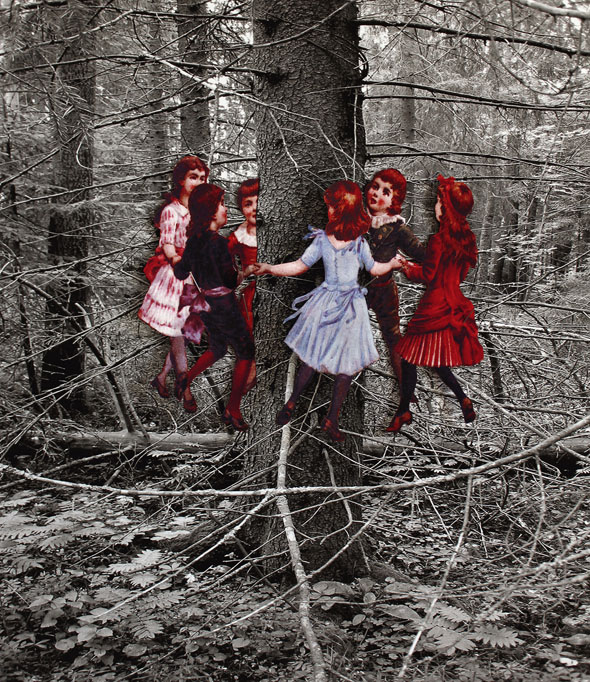
‘Ring dance’ by Ulla Jokisalo (pigment print and pins, 2009)
That’s life
4 March 2011 | Authors, Essays, Non-fiction, On writing and not writing
In this series Finnish authors ponder their profession. If this is writing, there’s no method in its madness: Markku Pääskynen finds he wants to write as life allows, not bend his life to suit his writing
I was born in 1973. I’ve written six novels, and I’m working on my seventh. I’ve written short stories and essays, and translated. That may sound productive, but it isn’t: I can’t stand to sit in front of the computer for more than a couple of hours a day.
My work is elsewhere – in everyday chores: going to the store, taking out the trash, fixing meals, washing dishes, cleaning, playing with the kids. Normal days are full of work and messing around. And my literary work has to fit in with that. I don’t have it in me to write methodically. I do know how to keep deadlines and meet contracts, but the methodicalness is lacking. More…
On the rocky road to a good translation
19 November 2010 | Essays, Non-fiction
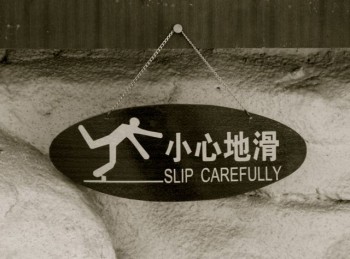
You get the picture? A translation error in China. Photo: Leena Lahti
Why just three per cent? Translator Owen Witesman seeks an explanation for the difficulties of selling foreign fiction to the self-sufficient Anglo-American market. Could there be anything wrong with the translations?
I am a professional translator, and I have a secret: I don’t read translations.
I’m not alone. The literary website Three Percent draws its name from the fact that only about 3 per cent of books published in the United States are translations (the figure for Germany is something like 50 per cent). There are various opinions about why this is, including this one from Three Percent’s Chad Post writing at Publishing Perspectives.
Why do I say it’s a secret that I don’t read translations? Because people expect me to read translations, as if as a translator it were my sacred duty to show solidarity with my professional community. Or maybe I can’t be cosmopolitan otherwise. More…
Horror on the first line
15 October 2010 | Authors, Essays, Non-fiction, On writing and not writing
In this series, Finnish authors ponder their profession. In his radical youth, the poet and author Ilpo Tiihonen thought blind rage was what fuelled poetry. As he later found it’s a lot more complicated, he began to invent ways of loosening literary tension
When I was a little more than 20, when I thought I had completed the manuscript of my first volume of poems, everything was going to hell.
I wanted life to be political, exotic, inspired, but the Finnish way of life, with its instructions and its home loans crushed people into a stiff and monopositional way of being. One of submission. I protested. We made an underground magazine whose cover showed Nixon peeing on South America. We founded a propaganda theatre which raged against the colonels’ junta in Greece. And there was plenty to vilify about the Finnish bourgeoisie, too. I hated capitalism, TV advertisements and the high prices of bus tickets. And there was no hot water in my rented digs. The main thing was to protest. More…
Garden graft
2 September 2010 | Essays, Non-fiction
A chapter from Vapaasti versoo. Rönsyjä puutarhasta (‘Freely sprouting. Runners from the garden’, Kirjapaja, 2010)
If you sit in your garden and feel a bit like you’re tucked uncomfortably at the end of the dock in a guest berth, the reason is this: the garden hasn’t yet found a place in your muscle memory. Because it is only at the point when the garden has settled into your muscle memory, into your senses in as many ways as possible, that it will feel like your own. And that, of course, takes working in the garden, not just sitting in it.
So you should know your rose – not just its lovely smell but also the memory that you get from the shovel handle of when you planted it, or even the memory of the prick of its thorn on your finger. You can anchor every little detail in your senses, and it doesn’t even take much imagination. The scent of thyme on your fingertips, the downy fluff of a pasque flower against your palm, the silken glow of a peony opening in the morning sunlight – or the sumptuous mist of the wee hours of a summer morning twining over everything, and the rare experience of wading through it. More…
My friend Erik Hansen
Short prose from Muita hyviä ominaisuuksia (‘Other good characteristics’, Otava, 2010)
On the first day we played getting-to-know-you games. On the second day we played real Finnish baseball out behind the university. On the third day we travelled to the countryside. Classes started sometime at the end of the second week. We watched the movie One Flew Over the Cuckoo’s Nest. The professor slurped Coke, chain smoked, and rewound the video back and forth: Nurse Ratched’s plump face filled the screen and then in the next image where her face had been there was a basketball Jack Nicholson was squeezing.
It was the autumn of 1992, and I was studying film and communications theory in Copenhagen.
The excursion to the country frightened me, a shy bacteriophobic neurotic. The Danes thought the camping centre’s shared mattresses and group cooking were hygge – cozy. There is no way a dictionary translation could ever cover all the forms of cosiness the Danes achieve together. I fled the camping centre on the first morning. On the train to Copenhagen I recognised all the usual post-escape feelings: shame, fear, guilt, loneliness and overwhelming euphoria. More…
Slowly does it – or not?
9 April 2010 | Authors, Essays, Non-fiction, On writing and not writing
In this series, Finnish authors ponder their profession. One day Kristina Carlson – a self-confessed slow writer – found her imagination so strongly inhabited by one of her own, as yet non-existent, characters that she was finally impelled to complete her novel
‘The answer grows like the spring light. / In my desk drawer there’s something, important. / I slowly remember it.’ I wrote these words in my first published work, my collection of poetry Hämärän valo (‘Light of dusk’) from 1986. I was born in 1949, so I was something of a late bloomer.
Still I had been writing ever since I was a child. After a ten-year break, I published my first children’s book under a pseudonym. In the space of three years after that, a total of twelve books appeared in the Anni series. In 1999 I published my first novel, Maan ääreen (‘To the end of the earth’). Another ten years passed; my second novel, Herra Darwinin puutarhuri (‘Mr Darwin’s gardener’), was published last autumn.
I’ve often been asked – more often than I have asked myself – why I publish so rarely. I don’t find writing difficult, but it is difficult to write well. For me, writing well involves clarity, precision, brightness, finding just the right mood and rhythm. If it were simply a case of the classic ‘murder your darlings’ problem, it could easily be resolved through a process of sufficiently pruning the text, but such pruning would leave us with nothing but a bare tree.
Writing is such a synthetic process that it is hard to describe, as it is inherently bound up with one’s own language and mind. More…
Living inside language
23 February 2010 | Essays, Non-fiction
Jyrki Kiiskinen sets out on a journey through seven collections of poetry that appeared in 2009. Exploring history, verbal imagery and the limits of language, these poems speak – ironically or in earnest – about landscapes, love and metamorphoses
The landscape of words is in constant motion, like a runner speeding through a sweep of countryside or an eye scaling the hills of Andalucia.
The proportions of the panorama start to shift so that sharp-edged leaves suddenly form small lakeside scenes; a harbour dissolves into a sheet of white paper or another era entirely. Holes and different layers of events begin to appear in the poems. Within each image, another image is already taking shape; sensory experiences develop into concepts, and the text progresses in a series of metamorphoses. More…
In the detail?
11 December 2009 | Essays, Non-fiction
 Extracts from Kuoleman ja unohtamisen aikakirjat (‘Chronicles of death and oblivion’, WSOY, 2009)
What’s the meaning of life? There are those who seek it in religion, while for others that is the last place to look. The scientist Kari Enqvist ponders why some people, including himself, seem physiologically immune to the lure of faith. Perhaps, he suggests, we should look for significance not in the big picture, but in the marvel of the fleeting moment
As a young boy I must have held religious beliefs. However, I cannot pinpoint exactly when they disappeared. At some point I eventually stopped saying my evening prayers, but I am unable to remember why or when this happened. ‘I was born in a time when the majority of young people had lost faith in God, for the same reason their elders had had it – without knowing why,’ writes the Portuguese poet Fernando Pessoa in The Book of Disquiet. More…
In search of the spirit
13 November 2009 | Authors, Essays, Non-fiction, On writing and not writing
In this series, Finnish authors ponder their trade. Tuomas Kyrö – author of the extraordinary novelistic chronicle of the birth of capitalism Benjamin Kivi, which you can read here – found himself lost for words. Liberation came with the realisation that, unlike in television, in books it is the writer, and the reader, who are in charge, and the only limits are those of the human imagination
In May 2009, after a year of writing, I held in my hand the manuscript of a novel whose plot and characters were complete. There was a subject, theme and the occasional good passage, but something was badly wrong.
When I swapped roles, writer for reader, I realised that my text did not touch the skin, and certainly did not get under the skin. I had wanted do more than raise a smile; I had thought I was writing a book that would make its readers want to turn the page, I had wanted to provoke, to cause laughter and even perhaps tears. Now all that my text provoked in the reader – me – was embarrassment and boredom.
What was wrong? More…
Marginal notes
4 June 2009 | Essays, Non-fiction
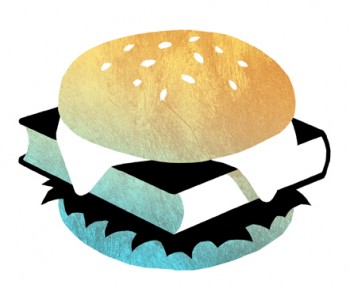
Fast food for thought? Culture meets business. – Illustration: Joonas Väänänen
Extracts from a collection of writings, Ulkona (‘Outside’, Siltala, 2008)
Literature – and ‘serious’ writing in particular, the kinds of texts we publish in Books from Finland – is often seen as lost, irrelevant, pushed out to the edge of mainstream popular culture. But, argues Hannu Raittila, the margin is actually the area of greatest freedom. Everything worthwhile happens there – and business would do well to imitate art, rather than the other way round
It is easy to see culture as a marginal part of society, if viewed from an economic perspective. It is easy to see literature, for its part, as a marginal phenomenon even when compared with other areas of culture – pop music, for example. More…
In praise of melancholy
28 May 2009 | Authors, Essays, Non-fiction, On writing and not writing
In this series, Finnish authors ponder the difficulties of their profession. Sirpa Kähkönen, author of six novels, gives an account of going unseen – the painful initiation, triggered by the lukewarm reception of one of her books, of a more mature and profound phase in her life as a creative writer
I found myself in a temporary but intense period of creative crisis in the spring of 2006. The crisis was expressed outwardly in the classic manner – as an emptiness, a desertification. Suddenly I was unable to get to the place between dream and reality where an artist operates. Something was missing from my writing; the spark, the vibration, the lifeblood. More…
Digital dreams
4 February 2009 | Essays, Non-fiction
In this specially commissioned article, the first for the new Books from Finland website, Leena Krohn contemplates the internet and the invisible limits of literature.
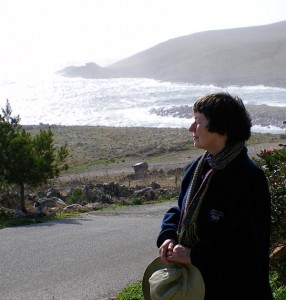
Leena Krohn on the way to Cape Tainaron, Southern Peloponnese, Greece; this is where Europe ends. Her novel entitled Tainaron appeared in 1985. – Photo: Mikael Böök (2008)
The world wide web, whose services most of us now use for work or entertainment, is a greater invention than we have, perhaps, realised up till now: according to the writer Leena Krohn, it is nothing less than an evolutionary leap
Technology combats the limitations of our senses, geography, and time. The human eye can’t compete with the visual acuity of an eagle, or even a cat, but with the best telescopes it can see into the early history of the universe, with new electron microscopes it can distinguish individual atoms.
The human senses nevertheless have an unbelievably broad bandwidth. About a million times more data flows to our brains by means of our senses than we could ever grasp consciously. More…
Trial and error?
Issue 4/2008 | Archives online, Essays, On writing and not writing
If you want to write, you need to do it every day, says the author Monika Fagerholm. Trial and error are necessary for her – and so is not being afraid of getting lost in the woods in the process, because only then can amazing things be found
Writers write and writers write every day. I remember seeing this in one of those inspirational guides on writing I enjoy reading – even if they don’t necessarily help you in pursuing your daily writing as much as you would hope. At the worst, they give you a kind of exhausting energy which just leaves you drained. And yes, turning to these kinds of manuals almost always involves an element of desperation; you don’t need advice when everything is going great. More…
Boys Own, Girls Own? –
Gender, sex and identity
30 December 2008 | Essays, Non-fiction
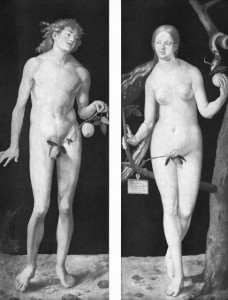
Knowing good and evil: Adam and Eve (Albrecht Dürer, 1507)
In Finnish fiction of the present decade, both in poetry and in prose, there seems to be at least one principle that cuts across all genres: an overt expression of gender, writes the critic Mervi Kantokorpi in her essay
Relationships and family have always been central concerns of literature; questions about gender and individual identity have received a new emphasis in Finnish literature from one season to the next. The gender roles represented in contemporary literature appear to become ever more stereotypical. The question is no longer only of the author consciously setting his or her gender up as the starting point for expression, as has already long been the case with modern literature written by women. More…