
Tag: ebooks
Kirja muuttuvassa tietoympäristössä [The book in a changing information environment]
21 August 2014 | Mini reviews, Reviews
 Toim. [Ed. by] Markku Löytönen, Tommi Inkinen, Anne Rutanen
Helsinki: Suomen tietokirjailijat ry. [The Finnish Association of Non-Fiction Writers], 195 p., ill.
ISBN 978-952-67356-3-4
paperback; available also online:
http://www.suomentietokirjailijat.fi/jasenyys/julkaisut/kirja-muuttuvassa-tietoymparisto/
In the Western world the experience of reading is undergoing a critical change. There is even talk of a third information revolution. Books are increasingly acquiring electronic form, and the future of the printed book is being called into question. Kirja muuttuvassa tietoympäristössä contains the considered opinions of 18 experts on what is taking place in the field of non-fiction, and gives an overview of the literature on the current situation, which is seen from the point of view of the bookstore, the library, the author and the publisher. There is a discussion of intellectual property issues, developments in technology, and changes in the use of teaching materials, language, and reading habits. Finland is a leading country in both literacy and reading. The number of books has slowly declined in recent years, but it seems that the country’s youth has maintained an interest in books, and in fiction in particular. Although printed reference works of the encyclopedia type have given way to the information provided by the Internet, it is likely that literature and reading will preserve their status as a part of human culture.
Translated by David McDuff
Online, offline?
17 April 2014 | Articles, Non-fiction
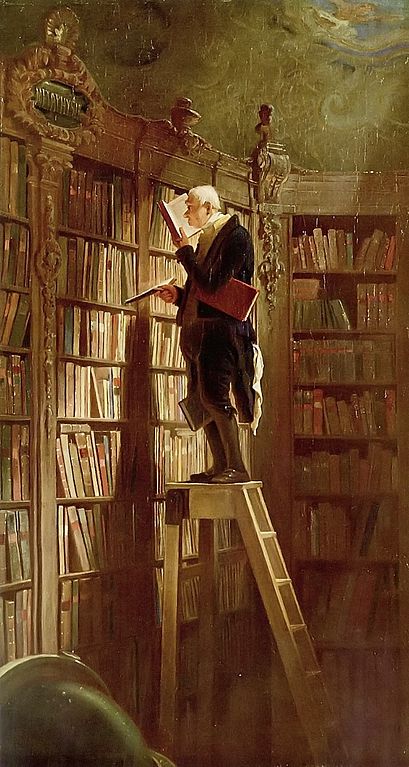
‘The bookworm’ (old-fashioned) by Carl Spitzweg, ca. 1850. Museum Georg Schäfer. Photo: Wikimedia
Ebooks are not books, says Teemu Manninen, and publishers who do not know what marketing them is about, may eventually find they are not publishers any more
At least once a year, there is an article in a major Finnish newspaper that asks: ‘So, what about the ebook?’ The answer is, as always: ‘Nothing much.’
It’s true. The revolution still hasn’t arrived, the future still isn’t here, the publishers still aren’t making money. In Finland, the ebook doesn’t seem to thrive. The sales have stagnated, and large bookstores like the Academic Bookstore are closing their ebook services due to a lack of customers.
Why is Finland such a backwater? Why don’t Finns buy ebooks?
The usual explanation is that Finland is a small country with a weird language, so the large ebook platforms like Amazon’s Kindle and Apple’s iBook store have not taken off here. Another patsy we can all easily blame is the government, which has placed a high 24% sales tax on the ebook. If that isn’t enough, we can always point a finger at the lack of devices and applications or whatever technical difficulty we can think of. More…
How much did Finland read?
30 January 2014 | In the news
 The book year 2013 showed an overall decrease – again: now for the fifth time – in book sales: 2.3 per cent less than in 2012. Fiction for adults and children as well as non-fiction sold 3–5 per cent less, whereas textbooks sold 4 per cent more, as did paperbacks, 2 per cent. The results were published by the Finnish Book Publishers’ Association on 28 January.
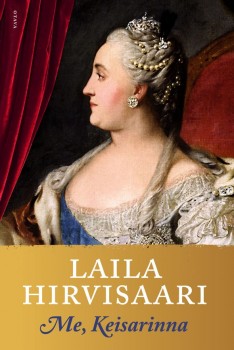
The overall best-seller on the Finnish fiction list in 2013 was Me, Keisarinna (‘We, tsarina’, Otava), a novel about Catherine the Great by Laila Hirvisaari. Hirvisaari is a queen of editions with her historical novels mainly focusing on women’s lives and Karelia: her 40 novels have sold four million copies.
However, her latest book sold less well than usual, with 62,800 copies. This was much less than the two best-selling novels of 2012: both the Finlandia Prize winner, Is, Jää (‘Ice’) by Ulla-Lena Lundberg, and the latest book by Sofi Oksanen, Kun kyyhkyset katosivat (‘When the doves disappeared’), sold more than 100,000 copies.
The winner of the 2013 Finlandia Prize for Fiction, Riikka Pelo’s Jokapäiväinen elämämme (‘Our everyday life’, Teos) sold 45,300 copies and was at fourth place on the list. Pauliina Rauhala’s first novel, Taivaslaulu (‘Heaven song’, Gummerus), about the problems of a young couple within a religious revivalist movement that bans family planning was, slightly surprisingly, number nine with almost 30,000 copies.
The best-selling translated fiction list was – not surprisingly – dominated by crime literature: number one was Dan Brown’s Inferno, with 60,400 copies.
Number one on the non-fiction list was, also not surprisingly, Guinness World Records with 35,700 copies. Next came a biography of Nokia man Jorma Ollila. The winner of the Finlandia Prize for Non-Fiction, Murtuneet mielet (‘Broken minds’, WSOY), sold 22,600 copies and was number seven on the list.
Eight books by the illustrator and comics writer Mauri Kunnas featured on the list of best-selling books for children and young people, with 105,000 copies sold. At 19th place was an Angry Birds book by Rovio Enterntainment. The winner of the Finlandia Junior Prize, Poika joka menetti muistinsa (‘The boy who lost his memory’, Otava), was at fifth place.
Kunnas was also number one on the Finnish comic books list – with his version of a 1960s rock band suspiciously reminiscent of the Rolling Stones – which added 12,400 copies to the figure of 105,000.
The best-selling e-book turned was a Fingerpori series comic book by Pertti Jarla: 13,700 copies. The sales of e-books are still very modest in Finland, despite the fact that the number of ten best-selling e-books, 87,000, grew from 2012 by 35,000 copies.
The cold fact is that Finns are buying fewer printed books. What can be done? Writing and publishing better and/or more interesting books and selling them more efficiently? Or is this just something we will have to accept in an era when books will have less and less significance in our lives?
So many words
25 April 2012 | Articles, Non-fiction
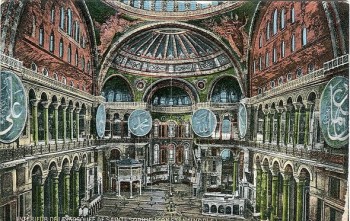
Hagia Sofia, Istanbul: from basilica to cathedral to mosque to museum. Postcard, c. 1914. Photo: Wikipedia/Xenophon
Sacred spaces, repositories of free speech, places of healing? Teemu Manninen awaits the day when libraries become virtual, enabling anybody to visit them, without having to travel across land and sea
The Bodleian Library in Oxford, the Vatican Library, the Bibliotheque Nationale in Paris, New York Public Library, the British Museum Reading Room, the Real Gabinete Portugues De Leitura in Rio De Janeiro, the Library of Congress and the National Library of Finland.
What do all of these have in common, except the obvious fact that they are all famous libraries? To put it another way: why are these famous libraries so famous?
It is not because they have books in them, although that has become one of the main tasks of the library system in the modern world. But a library is not simply an archive. If we in the West are a culture of the book – a culture of the freedom of information and expression – then a library is the architectural incarnation of our way of life: a church built for reading. More…
Out of my hands
10 November 2011 | Articles, Non-fiction
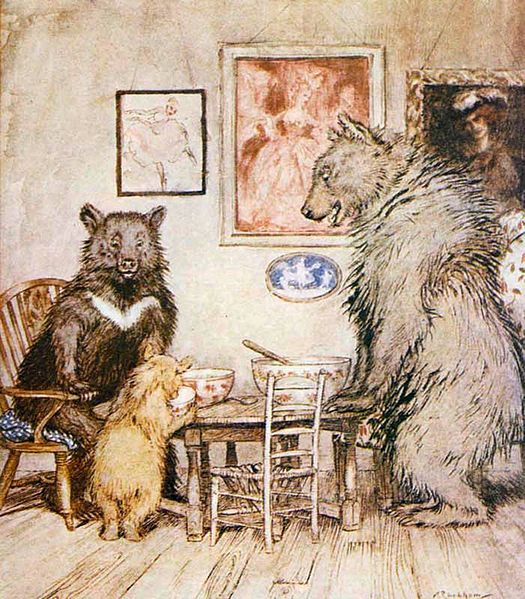
Who's been eating my porridge? From ‘English Fairy Tales’ by Flora Annie Steel (1918), illustrated by Arthur Rackham. The Project Gutenberg e-Book
In the classic fairy-tale, on finding their belongings were not as they had left them, the three bears exclaimed: ‘Who’s been eating my porridge?’ When our technology correspondent Teemu Manninen found someone else’s underlinings in the electronic text he was reading, he wondered: ‘Who’s been tampering with my ebook?’ Which led him to ponder how similar books and their virtual counterparts really are – and could his ebook really be called ‘his’?
A few months ago I was reading an ebook on my iPad when I came across an underlined passage. For a moment I felt strangely disturbed. My initial thought was that I had not made the underlining, and therefore this had to be a glitch, an error in the computer program that was the book, which meant that there was something wrong with my book. What made this thought disturbing was the realisation that the kinds of harm that can befall digital books – and the measures that one can take to prevent them – are no longer ‘in my hands’: that the book is no longer physical, but virtual. More…
The pirate’s friend
11 March 2011 | Articles, Non-fiction
Intellectual property was hot stuff half a millennium ago, and not much has changed: Teemu Manninen takes a look at piracy and mercenaries in the age of electronic books
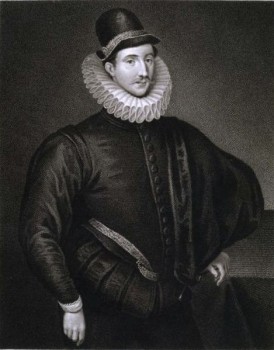
Sir Fulke Greville, 1st Baron Brooke (1554–1628) by Edmund Lodge. Photo: Wikimedia
In November 1586 Fulke Greville (later 1st Baron Brooke) sent Queen Elizabeth’s spymaster Sir Francis Walsingham a letter complaining about some ‘mercenary printers’‘ plans to print the romance novel Arcadia written by his friend (and Walsingham’s son-in-law) Sir Philip Sidney, who had died that very same year. This ‘mercenary book’ needed to be ‘stayed’, i.e. censored by the authorities, so that Sidney’s friends and relatives might take control, and also because publishing his works without consulting Greville or someone close to Sidney might damage his reputation or even his ‘religious honors’.
I rehearse this ancient tale because of its exemplary value for us today. From our point of view there seems nothing extraordinary about Greville’s actions: he is seeking to defend his friend’s literary estate from ‘mercenaries’ who steal intellectual property (IP): pirates. More…
Kai Ekholm & Yrjö Repo: Kirja tienhaarassa vuonna 2020 [The book at the crossroads in 2020]
10 December 2010 | Mini reviews, Reviews
 Kirja tienhaarassa vuonna 2020
[The book at the crossroads in 2020]
Helsinki: Gaudeamus, 2010. 205 p., ill.
ISBN 978-952-495-158-6
€29, paperback
This book looks at Finnish book publishing and its likely rate and direction of change. The future of the Finnish industry looks slightly more favourable than similar international forecasts have made out, although there have been some shake-ups in the Finnish book world too. The authors point out that while the decrease of reading as a leisure pursuit appears to be part of a long-term international trend, many feared for the future of the book in previous centuries as well. Book production and distribution, as well as changes undergone by various genres, are illustrated through a variety of statistics. They also go a long way towards explaining whether the publishing industry’s current difficulties are intrinsic or extrinsic in origin. The authors strive to find new perspectives to get away from a fear of the online world. The renewable publishing and reading culture envisioned by the authors will benefit from the novelty and efficiency of electronic publishing and will reinforce traditional knowledge. Professor Kai Ekholm is the Director of the National Library of Finland; Yrjö Repo is a researcher and statistician.
On reading, books and horses
4 June 2010 | Articles, Non-fiction
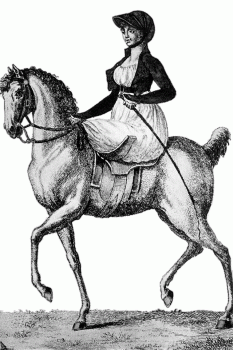
Ladylike: woman riding sidesaddle (Journal des Dames, 1799)
Horses, women, cars, men and reading: Teemu Manninen takes a look at the changes that illogical history makes
I have a friend who is an avid reader and who also talks about the books he reads. But being a staunch conservative when it comes to reading habits, I just cannot consider him a true friend of literature. The reason: he only reads non-fiction books. To me, ‘being a reader’ means reading fiction and poetry.
But increasingly it seems that real literature is becoming more and more marginal, whereas non-fiction (self-help, history, travel guides, popular science, popular economics, cookbooks) is what sells and keeps the industry afloat. The recent Finnish ‘essay-boom’ is an example of this development, with young writers like Antti Nylén or Timo Hännikäinen gaining recognition as important contemporary authors solely through their work as essayists; Hännikäinen has also written poetry, but Nylén is strictly a non-fiction writer. More…
Second nature
15 February 2010 | Articles, Non-fiction
 We hear a lot about how the internet is going to transform the reading and the marketing of books. But what about the act of writing? Teemu Manninen reports from the frontline of a new generation of authors for whom life has always been digital
When we think of the future of publishing in these times of electronic reading devices, audiobooks, and the internet, when it seems as if the whole material being of literature is about to be transformed, we may ask how the marketing of books will change.
What happens when publishing goes online? How will authors cope with the new culture of the internet? More…
What’s so great about paper?
17 September 2009 | Articles, Non-fiction
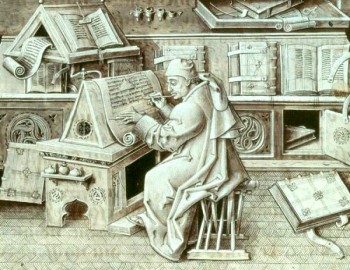
High-tech: the ultimate gadgets of the 15th century, parchment and pen. A portrait of Jean Miélot, the Burgundian author and scribe, by Jan Tavernier (ca. 1456)
The day will soon come when commuters sit on a bus or train with their noses buried in electronic reading devices instead of books or newspapers. Teemu Manninen takes a look at the digital future
Most people interested in books are aware of the arrival of electronic reading devices such as the Amazon Kindle, a kind of iPod — the immensely popular portable music listening device made by the company Apple — for electronic books. For a literary geek like me, the Kindle and e-readers should be the ultimate gadget: a whole library in a small, paperback-sized device. However, I’ve been wondering why digital reading hasn’t become as popular as digital listening. I myself have not invested in an e-reader, although I ought to be exactly the desired kind of customer. After all, I read all the time. Even the mp3 player I have is mostly used for listening to audio books. More…