

Tag: music
Living with a genius
23 June 2015 | Extracts, Non-fiction
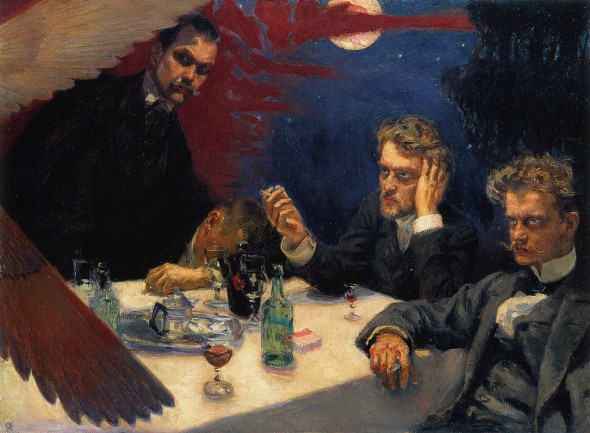
Akseli Gallen-Kallela’s painting Symposium (1894). From left: Akseli Gallen-Kallela, the composer Oskar Merikanto, the conductor Robert Kajanus and Jean Sibelius. Aino Sibelius was not pleased with this depiction of her husband depicted during a drinking session with his buddies
It is 150 years since the birth of Finland’s ‘national’ composer, Jean Sibelius. Much has been written about his life; Jenni Kirves’s new book casts light on his wife, Aino (1871–1969), and through her on the composer’s emotional and family life.
Aino, Kirves remarks in her introduction, has often been viewed as an almost saintly muse who sacrificed her life for her husband. But she was flesh and blood, and the book charts the difficulties of life with her brilliant husband from the very beginning – his unfaithfulness during their engagement, how to deal with a sexually transmitted infection he had contracted, his alcohol problem, the death of a child. It was Aino’s choice, time and again, to stand by her man; she felt it was her privilege to support her husband in his work in every possible way. ‘For me it is as if we two are not alone in our union,’ she wrote, far-sightedly, as a young bride. ‘There is also an equally rightful third: music.’
Aino’s own family, the Järnefelts, were a considerable cultural force in Finland, supporters of Finnish-language education and the growing independence movement. Her brothers included the writer Arvid Järnefelt, the artist Erik Järnefelt and the composer Armas Järnefelt. It was Armas who introduced her to his friend Jean Sibelius.
Aino bore Sibelius – known in family circles as Janne – six daughters, and offered her husband her unfailing support through 65 years of married life. ‘I must have you,’ Sibelius wrote, ‘in order for my innermost being to be complete; without you I am nothing… For this reason you are as much an artist as I am – if not more.’
As an old lady, Aino remarked of her own life that it had been ‘like a long, sunny day.’

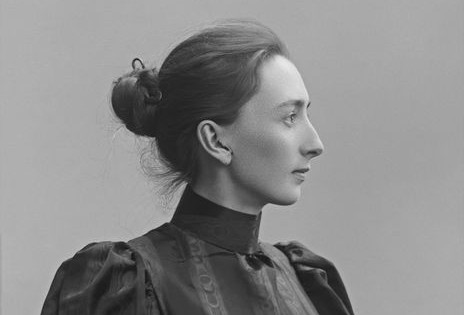
Aino Sibelius, 1891. Photo: National Board of Antiquities – Musketti.
An excerpt from Aino Sibelius: Ihmeellinen olento (‘Aino Sibelius: wondrous creature’, Johnny Kniga, 2015). We join the young couple in 1892 as they prepare for their long-awaited wedding.
At last, the wedding!
In the spring of 1892 the wedding really began to seem possible, as Janne’s symphonic poem Kullervo was very favourably received and Janne finally began to believe that he could support Aino. His financial situation was still, however, far from brilliant, and there were only two weeks to the wedding, as Janne wrote on 27 May 1892: ‘All the same, we must really be very careful about money. You will keep the cashbox and we will decide on everything together.’ The wedding grew closer and three days later Janne wrote triumphantly:
Do you understand, Aino, that we shall be man and wife in 1 ½ weeks – that we shall be able to kiss each other however we like and wherever we like (!) – and live together and have a household together – eat and make coffee together – it’s just so lovely.
A couple of weeks before the wedding, however, Janne wrote to Aino about some wishes for Aino in the future:
A skill with which a married artist can be protected from regressing is that the ‘wife’ understands to make him as little as possible into a model citizen. The man must not be allowed to be a paterfamilias with a pipe in his mouth, drowsy and docile; he must continually seek as many impressions as before, that’s clear, isn’t it? The kind of marriage whose main goal is the bringing of children into the world is repugnant to me – there are most certainly other things to do for those who work in the arts. More…
Lovely black eyes
23 June 2015 | This 'n' that
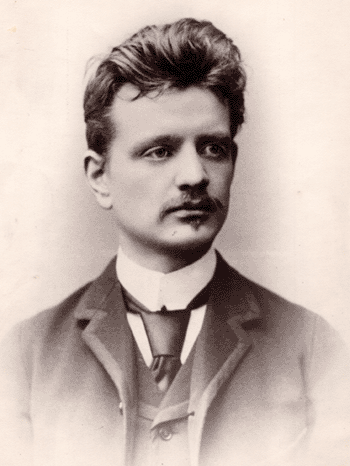
Agony uncle?: Jean Sibelius during his travels in Germany, in 1889
Jean Sibelius on how to keep your mojo
The main music critic of Päivälehti (‘The daily newspaper’) in the 1890s was the celebrated composer Oskar Merikanto, writes Vesa Sirén in Päivälehti’s successor, Helsingin Sanomat. Often, but not always, Merikanto praised first performances of works by the yet more stellar Jean Sibelius.
June 1895, however, saw the publication of Merikanto’s I sommarkväll (‘Waltz for a summer’s night’). ‘Tomorrow’s Päivälehti should have a review by Sibelius!’ wrote an excited Merikanto.
The short review duly appeared the following day, attributed not directly to Sibelius but to ‘a certain prominent composer’. In it, Sibelius hints that its uses may be more than strictly musical:
This waltz is extraordinarily pleasant and clever in both form and content. The introduction immediately reveals the composer’s intentions. This waltz contains an extraordinary passion. It is like our sky, which seems so grey, but which reflects that grey light that is born in black eyes when one is with one’s beloved. Everyone should buy it, for it is the shortest route to acceptance by one’s beloved and to one’s true desires.
Rock or baroque?
30 April 2014 | Extracts, Non-fiction
 What if your old favourites lose their flavour? Could there be a way of broadening one’s views? Scholar Olli Löytty began thinking that there might be more to music than 1980s rock, so he turned to the music writer Minna Lindgren who was delighted by the chance of introducing him the enormous garden of classical music. In their correspondence they discussed – and argued about – the creativity of orchestra musicians, the significance of rhythm and whether the emotional approach to music might not be the only one. Their letters, from 2009 to 2013, an entertaining musical conversation, became a book. Extracts from Sinfoniaanisin terveisin. Kirjekurssi klassisen musiikin maailmaan (‘With symphonical greetings. A correspondence course in classical music’)
Olli, 19 March, 2009
Dear expert,
I never imagined that the day would come when I would say that rock had begun to sound rather boring. There are seldom, any more, the moments when some piece sweeps you away and makes you want to listen to more of the same. I derive my greatest enjoyment from the favourites of my youth, and that is, I think, rather alarming, as I consider people to be naturally curious beings whom new experiences, extending their range of experiences and sensations, brings nothing but good.
Singing along, with practised wistfulness, to Eppu Normaali’s ‘Murheellisten laulujen maa’ (‘The land of sad songs’) alone in the car doesn’t provide much in the way of inspiration. It really is time to find something new to listen to! My situation is already so desperate that I am prepared to seek musical stimulation from as distant a world as classical music. I know more about the African roots of rock than about the birth of western music, the music that is known as classical. But it looks and sounds like such an unapproachable culture that I badly need help on my voyage of exploration. Where should I start, when I don’t really know anything? More…
Seppo Kimanen: Kimasen lento [Flight of the Humblebee]
7 November 2013 | Mini reviews, Reviews
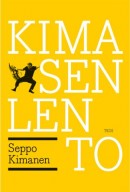 Kimasen lento
[Flight of the Humblebee]
Helsinki: Teos, 2013. 447 pp., ill.
ISBN 978-951-851-488-9
€ 28.40, hardback
Professor Seppo Kimanen (born 1949) is a cellist who has served as the director of the Helsinki Festival, held arts management positions in London and Japan, and in 1970 founded a summer music festival in Kuhmo, a small town in northern Finland, for which he continued to provide inspiring, innovative leadership for 35 years. The Kuhmo Chamber Music Festival has gone on to achieve international renown, attracting many celebrated performers. The success of the Kuhmo festival has encouraged the establishment of similar festivals in other locations. Kimanen has been supported in his work by his wife, the Japanese violinist Yoshiko Arai. In his lively, humorous musical memoir with a punning title – Kimanen’s surname is similar to kimalainen, the Finnish word for bumblebee – Kimanen gives a colourful account of the stages of his career in Kuhmo and elsewhere, including his work in the world of classical music and the important figures and leading performers he has been able to bring to Finland to perform.
Translated by Ruth Urbom
Cut time, paste space
12 September 2013 | Articles, Non-fiction

Back to basics. Parts of a musical note. Picture: Wikimedia
How different are the art of words and the art of sounds, author Teemu Manninen ponders, as he unexpectedly finds himself in the role of a musician in a performance. Time, space or both?
Some time ago I got the chance to participate in an unusual concert – as a performer: six players, myself included, were grouped around a table with a triangle in one hand and a glove in the other. Pieces of dry ice and a bucket of water were placed in front of each of us.
The performance began: we took a piece of dry ice and pressed it against the triangle. As the metal cooled, it burned through the ice, releasing gas, which in turn made the metal vibrate very fast. This produced a keening sound that filled the room. More…
Elitist versus pop?
8 August 2013 | Letter from the Editors
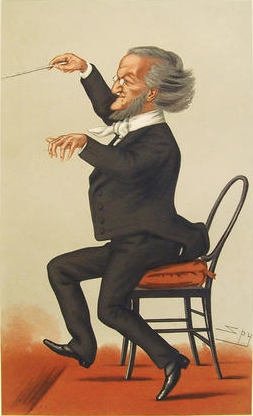
An elitist of his time? A caricature of Richard Wagner by Leslie Ward, published in Vanity Fair in 1877 (caption read ‘The Music of the Future’). Picture: Wikimedia
The old phrase ‘art for art’s sake’ has begun to sound like an appeal instead of an bohemian creed, without any negative ambiguity. Please let art be created for art’s sake!
In our times of neo-liberal ideologies, the criteria for assessing art include its capacity to generate profits to creative industries, to have export value, to be of assistance to business in general. But art, in essence, serves no ideology.
Technology now allows us to be more entertained than ever before, if we so choose. Art and entertainment alike come to us by the use of various devices. What has often been called ‘elitist’ art – opera, modern music, ballet – can be enjoyed lying on the sofa in the home. Money is not an obstacle.
Art, too needs money, of course: orchestras, theatres, training of artists and artists themselves need subsidies from society. Entertainment is by nature profitable business, as it attracts and involves large paying audiences. Smaller audiences want to listen to classical music, read books and see films that are not made solely in order to bring in as much money as possible. But why should these forms of art be called ‘elitist’? More…
All my loving
15 February 2013 | This 'n' that
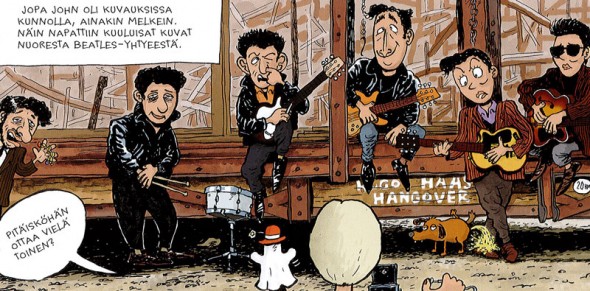
(Early days in Hamburg) Even John behaved himself in the photo sessions, at least almost. This is how the famous photos of the young Beatles were taken.
–Should I take one more? (Astrid the photographer)
One day in the antediluvian times of dawning Beatlemania, a schoolboy in a Finnish small town found himself smitten head over heels by the new pop songs by (probably) the most famous band in the world ever (so far). Like some two billion other teenagers, he learnt by heart every single song the Beatles recorded. Yeah!
The schoolboy grew up and became the illustrator and writer Mauri Kunnas (born 1950), whose storybooks, mostly for children, have now been translated into 30 languages.
But his interest in the Fab Four never left him, and last year he published his illustrated history of John, Paul, George and Ringo, from the day they were born to the day when Please, Please Me / Ask Me Why became number one in the British Top 20 in 1962. As the book is partly written in his native local dialect, its title is Piitles. Tarina erään rockbändin alkutaipaleesta (‘Beatles. The story of the first stage of a rock band’, Otava, 2012).
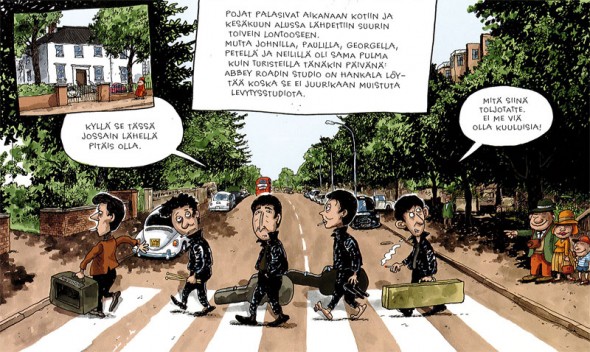
At last the boys came home from Germany, and in June 1962 they left for London with high hopes. But John, Paul, George, Pete and Neil had the same problems that tourists experience even today: The Abbey Road studio is hard to find because it doesn’t look like a recording studio. – It ought to be around here somewhere. – What are you staring at, we’re not famous yet!
In this 77-page graphic story the Beatles grow from babies into celebrities. The large number of hilarious visual details keeps the reader vigilant: for example, in their early days on Hamburg’s Reeperbahn John, Paul, George and Pete (Best) stay in lodgings behind a cinema that are less than hygienic, so on closer examination the lads turn out to be wearing underpants with yellow spots.

–To Eppy! –To my boys!
Julia Lennon, Klaus Voormann, Astrid Kirchherr, Stuart Sutcliffe, Cynthia, Brian Epstein, George Martin: the faces in the gallery of characters are instantly recognisable. Piitles illustrates how Beatlemania was born, and it is truly the work of a faithful fan.
Two to tango
3 August 2012 | This 'n' that
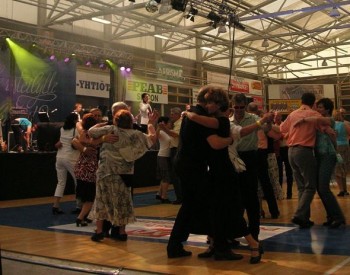
Tango: less romantic up north? Finns love it anyway. Photo: Orfeuz, Wikimedia
Picture the scene: it’s August, and the nightless days of midsummer have given way to darkening evenings. Candles are lit, and minds turn to the winter ahead.
The berries of the rowan trees are already turning bright scarlet and the purple rosebay willow herb catches the last of the sunset. From an outdoor dance floor across the meadow drift the melancholy strains of… the Finnish tango.
(The YouTube insert is from the film Tulitikkutehtaan tyttö [‘The matchbox factory girl’, 1990], by Aki Kaurismäki, featuring the actress Kati Outinen. Satumaa [‘Wonderland’ by Unto Mononen] is sung by Reijo Taipale.)
Cheesy as it is, we confess we have a liking for this most northerly cousin of the fiery Argentine original. So, it seems, does the BBC Magazine, in a recent article, Mark Bosworth goes to witness the traditional Tango Festival in Seinäjoki. Check it out. More…
Age before beauty?
5 April 2012 | This 'n' that
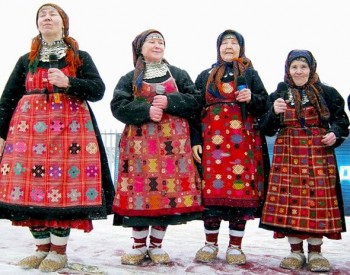
Buranovskiye Babushki: Udmurt originality. Photo: Wikipedia/Larisa Gorbunowa, 2011
We can’t be the only ones to have a secret fondness for the Eurovision Song Contest– however cheesy the offerings, however rigged or outright political the voting, however bored or drunken the presenters (or maybe that’s only in the UK). Camp, innocent, calculating, so ugly it’s beautiful (or vice versa). In fact, we suspect that’s why we like it so much.
In the 57th Contest, to be held in Azerbaijan in May, Russia is to be represented by the song ‘Party for everybody’ by a group of eight old ladies, the Buranovskiye Babushki, from the republic of Udmurtia, deep in the heartland of the Russian Federation, some 1400 kilometres from Moscow. More…
A gay fantasy on national themes
19 March 2012 | Authors, Reviews

Pirkko Saisio. Photo: Laura Malmivaara
Why does the private become political? Who makes it happen? Why should religious doctrines define private matters such as sexuality? Why should those who wield power in the political system define personal sexuality?
Pirkko Saisio (born 1949), a theatremaker as well as a prolific and versatile author of plays, novels, film and television scripts, has written a play for the Finnish National Theatre entitled HOMO! and subtitled, ‘An anarchist musical farce’.
Answers to the above questions – and they are complicated – are to be found in, for example, historical, psychological and sociological research.
In the last century, Stalin and Hitler condemned gays. Thirty years ago homosexuality was considered an sickness in Finland; forty years ago it was a crime. Today, it is still illegal in more than 75 countries: punishments vary from flogging to life imprisonment or death. In democratic societies, the ‘gay problem’ is a question of human rights, and hence a subject for public debate – for example, in a musical play, for of course the issue also involves that eternally fascinating and entertaining feature of human life, love. More…
In pursuit of a conscience
19 March 2012 | Drama, Fiction
‘An unflinching opera and a hot-blooded cantata about a time when the church was torn apart, Finland was divided and gays stopped being biddable’: this is how Pirkko Saisio’s new play HOMO! (music composed by Jussi Tuurna) is described by the Finnish National Theatre, where it is currently playing to full houses. This tragicomical-farcical satire takes up serious issues with gusto. In this extract we meet Veijo Teräs, troubled by his dreams of Snow White, who resembles his steely MP wife Hellevi – and seven dwarves. Introduction by Soila Lehtonen
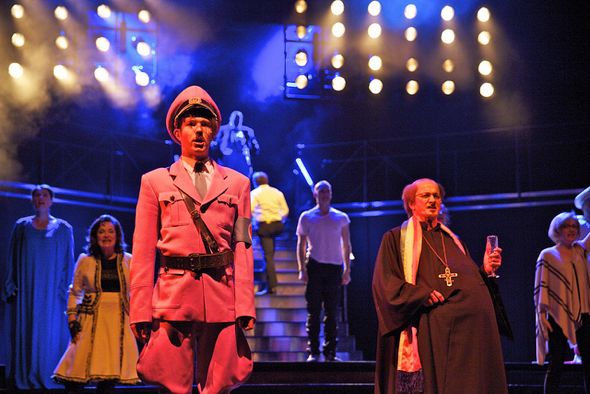
Dictators and bishops: Scene 15, ‘A small international gay opera’. Photographs: The Finnish National Theatre / Laura Malmivaara, 2011
CAST OF CHARACTERS
Veijo Teräs
Hellevi, Veijo’s wife and a Member of Parliament
Hellevi’s Conscience
Rebekka, Hellevi and Veijo’s daughter
Moritz, Hellevi and Veijo’s godson
Agnes af Starck-Hare, Doctor of Psychiatry
Seven Dwarves
Tom of Finland
Atik
The Bishop of Mikkeli
Adolf Hitler
Albert Speer
Josef Stalin
Old gays: Kale, Jorma, Rekku, Risto
Olli, Uffe,Tiina, Jorma: people from SETA [the Finnish LGBT association]
Second Lieutenant, Private Teräs, the men in the company
A Policeman
Big Gay, Little Gay, Middle Gay
William Shakespeare
Hermann Göring
Hans-Christian Andersen
Teemu & Oskari, a gay couple
The Apostle Paul
Father Nitro
Winston Churchill
SCENE ONE
On the stage, a narrow closet.
Veijo Teräs appears, struggling to get out of the closet.
Veijo Teräs is dressed as a prince. He is surprised and embarrassed to see that the audience is already there. He seems to be waiting for something.
He speaks, but continues to look out over the audience expectantly.
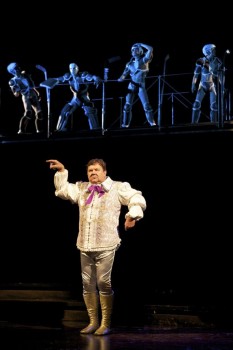
Snow White's spouse, Veijo (Juha Muje), and the dwarves. Photo: Laura Malmivaara, 2011
VEIJO
This outfit isn’t specifically for me, because… I mean, it’s part of this whole thing. This Snow White thing. I’m waiting for the play to start. Just like you are. My name is Veijo Teräs and I’m playing the point of view role in this story. Writers put point of view roles like this in their plays nowadays. They didn’t use to.
Just to be clear – this isn’t a ballet costume. I’m not going to do any ballet dancing, but I won’t mind if someone dances, even if it’s a man. Particularly if it’s a man. But I don’t watch. Ballet, I mean. Not at the opera house, or on television, or anywhere, and I have no idea why we had to bring up ballet – or I had to bring it up – because this is a historical costume, so it’s appropriate. This is what men used to wear, real men like Romeo and Hamlet, or Cyrano de Bergerac. But we in the theatre these days have a hell of a job getting an audience to listen to what a man has to say when he’s standing there saying what he has to say in an outfit like this. People get the idea that it’s a humorous thing, but this isn’t, this Snow White thing, where I play the prince. Snow White is waiting in her glass casket, she died from an apple, which seems to have become the Apple logo, Lord knows why, the one on the laptops you see on the tables of every café in town. More…
A musical advent calendar
9 December 2011 | This 'n' that
The Finnish Broadcasting Company has delved into its vast archives, and its website, YLE Areena, is throughout December featuring a series of musical numbers, many with reference to Christmas, sung or played Finnish singers and musicians. These inserts are being broadcast on each day, from 1 to 24 December, and they can be listened to via the Internet (although be warned, the information is given in Finnish only).
Among the Finnish composers are, among others, Oskar Merikanto (1868–1924), Erkki Melartin (1875–1937), Toivo Kuula (1883–1918) and Jean Sibelius. The sopranos Irma Urrila and Helena Juntunen are presented, singing Mozart and Gounoud respectively.
For example: on 6 December, the Finland’s Independence Day, one of the three inserts is a piano piece, entitled Pankakoski, by composer Heino Kaski (who died a day earlier than Sibelius, in September 1957), played by Juhani Lagerspetz (1995). The other two are Andante Festivo (1922), a work originally composed for a string quartet, by Jean Sibelius, played by the Radio Symphony Orchestra (1995) and a song from the 1970s opera Punainen viiva (‘The red line’) by Aulis Sallinen, sung by Matti Salminen (1984).
Fifteen more days to go…
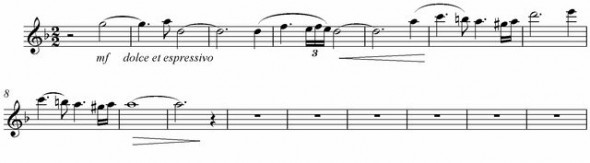
Dolce et espressivo: Violin concerto by Sibelius, 1st movement (1905). Photo: Wikimedia
The sound of music
2 September 2011 | This 'n' that
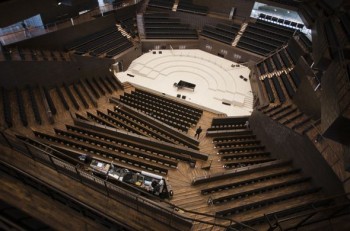
Helsinki Music Centre: the main hall. Photo: Arno Chapelle
The long-awaited new concert hall, Musiikkitalo (’Music house’, in English Helsinki Music Centre), in front of the Parliament house in the very heart of the city, was opened with a concert (this concert is available at YLE Areena until 30 September) featuring Sibelius and Stravinsky on 31 August.
Musiikkitalo finally provides a new home for two orchestras, the Helsinki Philharmonic Orchestra and the Finnish Radio Symphony Orchestra, as well as for the only Finnish university of music, the Sibelius Academy. It is owned by the Finnish government, the City of Helsinki and Finnish Broadcasting Company. The costs of the building rose from an original estimate of 98 million € in 2005 to 190 million €.
The acoustics designer is the renowned Japanese specialist Yasuhisa Toyota. The building, containing seven halls of various sizes, will provide specialised surroundings for different kinds of music and musicians, acoustics in the existing Finlandia Hall (designed by Alvar Aalto) and other local venues long having proved inadequate or faulty.
The site has remained misused for decades: the brick warehouses, dating from the late 19th and early 20th centuries, were finally abandoned by the national railway company in the 1980s and subsequently occupied by various artists’ and civil organisations, housing popular restaurants and flea markets. Many protests took place when the warehouses were doomed to demolition – and then the buildings were finally destroyed in 2006 in a fire.
The brand new concert hall in Reykjavik, Iceland, is called Harpa (‘Harp’). Wouldn’t it have been nice to give also Musiikkitalo a more exciting name to go by – maybe conduct a straw poll among listeners? Some of the rows of seats (1,704 in all) in the main hall resemble logs floating down in a river, so what about Log jam? Or does that have unfortunate connotations for a project that’s meant to provide Finnish music with a new dynamism?
Jean Sibelius kodissaan. Jean Sibelius, i sitt hem. Jean Sibelius at home
19 August 2011 | Mini reviews, Reviews
 Jean Sibelius kodissaan. Jean Sibelius, i sitt hem. Jean Sibelius at home
Toimittanut [Edited by] Jussi Brofeldt
Helsinki: Teos, 2010. 103 p., ill.
ISBN 978-951-851-364-6
€ 29, hardback
The composer Jean Sibelius (1865–1957) disliked being photographed. This book contains 50 stills selected from the documentary film Jean Sibelius at home, a compilation of cinematographic material in which the composer is seen at home in 1927 and 1945. Some of the shots were originally cut, and have not been previously published. The film was made by the brothers Heikki Aho and Björn Soldan, who were neighbours of Sibelius in their childhood – their father was the author Juhani Aho, a friend of the Sibelius family. Founded in the 1920s, the film company Aho & Soldan was influenced by the experimental spirit of the Bauhaus and became known for its commissioned work aimed at spreading the image of Finland abroad. The Sibelius film offers a rare peek into the composer’s home life at his villa of Ainola. In addition to the photographs, the trilingual book also contains seven articles on Sibelius and the film. Heikki Aho’s daughter, the pioneer photographer Claire Aho relates her own memories of the 1945 filming. Jussi Brofeldt, the book’s editor, is her son.
Translated by David McDuff
Juhani Koivisto: Suurten tunteiden talo. Kohtauksia Kansallisoopperan vuosisadalta [The house of great emotions. Scenes from a century of the Finnish National Opera]
30 June 2011 | Mini reviews, Reviews
 Suurten tunteiden talo. Kohtauksia Kansallisoopperan vuosisadalta
[The house of great emotions. Scenes from a century of the Finnish National Opera]
Helsinki: WSOY, 2011. 229 p., ill.
ISBN 978-951-0-37667-6
€ 45, paperback
2011 marks the one-hundredth anniversary of the founding of the Finnish National Opera. This richly illustrated and entertaining book describes events that have been absent from previous ‘official’ historical accounts. Readers will encounter over a hundred opera denizens who have made audiences – and, according to many anecdotes, each other – laugh and cry. The initial stages of the opera and ballet were modest in scope when viewed from outside, but the trailblazers involved were tremendous talents and personalities. The brighest star was the singer Aino Ackté, who enjoyed an international reputation. Gossip about intrigues and artistic differences at the opera house over the decades is confirmed in candid interviews with performers. The content of the book is based on archival sources, letters, memoirs, interviews and stories told inside the opera house. Juhani Koivisto, the Opera’s chief dramaturge, clearly has an excellent inside knowledge of his subject. Translated by Ruth Urbom