

Tag: publishing
Cool, not ice-cool
17 October 2013 | This 'n' that

Getting ready: book fair scenery, 2013. Photo: FILI
The Finnish book world is preparing for the big event of ‘F14’: Finland will appear as Guest of Honour at the Frankfurt Book Fair in October next year.
The slogan for this enterprise is Finnland. Cool.
The coordinating organ is FILI, the Finnish Literature Exchange, a part of the Finnish Literature Society. Co-operating with FILI are three ministries, literary organisations and publishers, the Finnish Embassy and Finnland-Institut in Berlin and the Goethe-Institut in Helsinki.
Last week a large proportion of the FILI staff – who now need to keep their cool for the next busy year – went to Frankfurt, and on 10 October (aptly, the memorial day of the national author Aleksis Kivi and also Finnish Literature Day) the press conference was opened by the Finnish Minister of Culture and Sport, Paavo Arhinmäki. On 13 October the 2013 Guest of Honour, Brazil, passed the baton to Finland. (More photographs here.)
The world’s largest book fair, Frankfurt, attracts some 300,000 visitors each year. Accessible to both professionals and the general public, the fair is also the biggest cultural event in Germany.
The Guest of Honour countries receive a vast amount of attention in the media, and the number of new translations from the respective languages into German, as well as other languages, will increase.
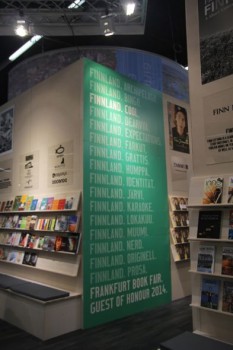
Finnland: arktik. Blondi. Cool. Demokratia. Einsam. Formula 1. Girji. Heimat. Ihminen. Joy…. Photo: FILI
The total Finnish budget for the years 2010–2015 is approximately four million euros, half of it money from the government. And the mission? Here are some warm words from the cool FILI agenda:
‘Why are Finns reading so much? Why are Finns so good at reading? Because we love it. Because reading plays such an important role in everyday life.
‘And because it is so important in Finland that everybody has access to reading – regardless of whether you are male or female, where you live, where you work, what your education or talent is. Fun, everyday life and for everyone – these are the main themes of the satellite programme for the Guest of Honour at the Frankfurt Book Fair 2014.’
Fatherlands, mother tongues?
12 April 2013 | Letter from the Editors

Patron saint of translators: St Jerome (d. 420), translating the Bible into Latin. Pieter Coecke van Aelst, ca 1530. Walters Art Museum, Baltimore. Photo: Wikipedia
Finnish is spoken mostly in Finland, whereas English is spoken everywhere. A Finnish writer, however, doesn’t necessarily write in any of Finland’s three national languages (Finnish, Swedish and Sámi).
What is a Finnish book, then – and (something of particular interest to us here at the Books from Finland offices) is it the same thing as a book from Finland? Let’s take a look at a few examples of how languages – and fatherlands – fluctuate.
Hannu Rajaniemi has Finnish as his mother tongue, but has written two sci-fi novels in English, which were published in England. A Doctor in Physics specialising in string theory, Rajaniemi works at Edinburgh University and lives in Scotland. His books have been translated into Finnish; the second one, The Fractal Prince / Fraktaaliruhtinas (2012) was in March 2013 on fifth place on the list of the best-selling books in Finland. (Here, a sample from his first book, The Quantum Thief, 2011, Gollancz.)
Emmi Itäranta, a Finn who lives in Canterbury, England, published her first novel, Teemestarin tarina (‘The tea master’s book’, Teos, 2012), in Finland. She rewrote it in English and it will be published as Memory of Water in England, the United States and Australia (HarperCollins Voyager) in 2014. Translations into six other languages will follow. More…
On the meaning of translation
28 February 2013 | This 'n' that
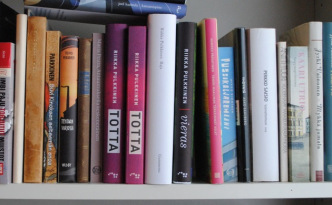 Translations of Finnish literature into English are booming, according to a new website set up by the Finnish-English Literature Translation Co-operative, or FELT.
Or at least there is a tiny boom, as translator Lola Rogers puts it in her contribution to ‘Reflections’ on the FELT website.
Whereas less than 20 translations were published between 1992 and 2002, the number of translations published in the decade from 2002 was more than 34.The reason, according to FELT, is the new availability of qualified literary translators, whom the new website has been created to represent; each of them (David Hackston, Emily Jeremiah, Kristian London, Lola Rogers, Owen Witesman) now have two or more published Finnish works of fiction under their belts.
A significant factor has been the training events organised by FILI, Finnish Literature Exchange, publisher of this magazine – and, we might dare to say, Books from Finland itself, which offers translators a forum (as well as payment) for translations of extracts from interesting or significant new work.
The FELT website is worth a visit by anyone with an interest in Finnish literature – or translation. As well as details of published and forthcoming work, there is a collection of essays on the art of translating particular works, from Kristina Carlson (also ex-Editor-in-Chief of Books from Finland) to the novelist Asko Sahlberg and the modernist poet Eeva-Liisa Manner.
Location, location, location
11 February 2013 | Articles, Non-fiction

Before GPS: compass and and gimbal, 1570. Picture: Wikimedia
Art that requires navigation systems? Whatever next. In his column poet and writer Teemu Manninen wonders whether literature can function as ‘locative’. How to blend technology and art? Perhaps literature too might expand from the printed word
What if the Romantic poet John Keats had never published his poetry in print – if his works had been distributed only in manuscript form and read only by his friends and acquaintances? Had that been the case, the only way of hearing his poetry would have been at the salons and informal clubs that took place in literary people’s homes, at coffee houses, or other meeting places.
Keats might not even have, most likely, been in attendance himself, but maybe someone had a copy of a copy of a fragment of a poem that they might read to the gathered intellectuals and gentlefolk. You would have to have known the right people, have to have been at the right place at the right time to hear ‘Ode to a Nightingale’ read for the first and perhaps for the last time ever.
Or, what if Joyce had never intended for Ulysses to be published for the great reading public at all? What if, instead, he had left copies of each chapter around Dublin in the places where those chapters take place; what if, page by page, he had distributed his work in the actual locations of the events as they happened in his imagination? More…
Sex, violence and horror, anyone?
20 September 2012 | Letter from the Editors
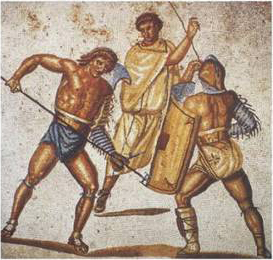
Gladiatorial entertainment: Mosaic from the Roman villa at Nennig (Germany), 2nd-3rd century AD. Picture: Wikipedia
In our last Letter, ‘Art for art’s sake’, we pondered how the efforts of making art (or design) profitable and exportable result, in public discourse, in the expectation that art (or design) should aid the development of business.
Not a lot is talked about how business can help art.
Art of course, is in essence ‘no use’, art doesn’t exist in order to increase the GDP (although nothing prevents it from doing so, of course).
The Finnish poet-author-translator Pentti Saarikoski (1937–1983) argued that art needs no apologies whatsoever: ‘What’s wrong with “Art for art’s sake”? – any more than bread for bread’s sake?
‘Art is art and bread is bread, and people need both if they are to have a balanced diet.’
Defining what is entertainment is and what is art is not always significant or necessary. The boundaries can be artificial, or superficial. But occasionally one wonders where the makers of ‘entertainment’ think it’s going. Entertainment for entertainment’s sake?
The Finnish Broadcasting Company (YLE) recently announced a new radio play series. It is, it said, a series that differs stylistically from traditional radio plays; it seeks a new and younger audience. The news item was headlined: ‘The new radio play drips with sex, violence and horror.’ In a television interview the director said that the radio dramaturge who had commissioned the series had described what the (new, younger) listeners should experience: ‘They should feel thrilled and horny all the time.’ More…
Nationalism in war and peace
3 May 2012 | Reviews
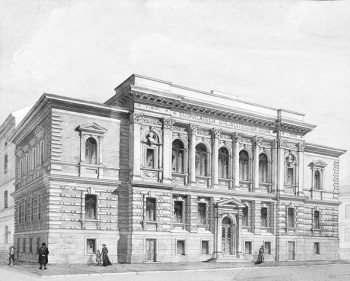
House of words: the Finnish Literature Society building in Helsinki. Architect Sebastian Gripenberg, 1890. Watercolour by an unknown Russian artist, 1890s
Kai Häggman
Sanojen talossa. Suomalaisen Kirjallisuuden Seura 1890-luvulta talvisotaan
[In the house of words. The Finnish Literature Society from the 1890s to the Winter War]
Helsinki: Suomalaisen Kirjallisuuden Seura, 2012. 582 p., ill.
ISBN 978-952-222-328-9
€54, hardback
The Finnish Literature Society has, throughout its history, played a multiplicity of roles: fiction publisher, research institute specialising in folklore studies, organiser of mass campaigns in support of national projects, literary gatekeeper, learned society, controller of language development.
The priorities of these areas of interest have changed from decade to decade, so Kai Häggman has taken on an exceptionally difficult subject to describe. He has, however, succeeded brilliantly in gathering the different threads together, using as as lowest common denominator the ideas of nationalism and nation whose role in global modernisation and European history have been studied, among others, by the British historians Ernest Gellner and Eric Hobsbawm. More…
The book and the rose
3 May 2012 | In the news
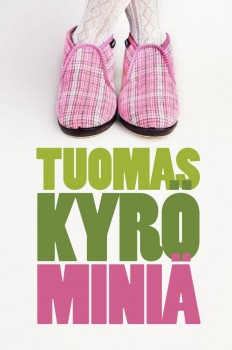 The twenty-third of April – Shakespeare’s birthday – is the international day of the book and the rose. The tradition derives, however, not from England but from Barcelona, where the tradition was for men to give women roses while women gave men books.
This year Finnish booksellers decided to celebrate the occasion by publishing a new novel which was given for free to all customers who made a purchase worth €10. This was the only way to get hold of a copy; the print run was 3,000 copies.
The chosen work was a new novel by Tuomas Kyrö, entitled Miniä (‘Daughter-in-law’). The narrator is the daughter-in-law of the main character of Kyrö’s two popular novels, Mielensäpahoittaja (‘Taking offence’) and Mielensäpahoittaja ja ruskeakastike (‘Taking offence: the brown sauce’). The grumpy old man from the country comes to stay with his son and his daughter-in-law in the capital – which inevitably results in practical (and mainly comical) discordance of various sorts.
Solzhenitsyn and Silberfeldt: Sofi Oksanen publishes a best-seller
25 April 2012 | In the news

Nobel Prize 1970: Aleksandr Solzhenitsyn
After falling out with her original publisher, WSOY, in 2010, author Sofi Oksanen – whose third novel, Puhdistus (Purge, 2008), has become an international best-seller – has founded a new publishing company, Silberfeldt, in 2011, with the aim of publishing paperback editions of her own books. Its first release was a paperback version of Oksanen’s second novel, Baby Jane.
Oksanen’s new novel, Kun kyyhkyset katosivat (‘When the pigeons disappeared’), again set in Estonia, will appear this autumn, published by Like (a company owned by Finnish publishing giant Otava).
However, in April Silberfeldt published a new, one-volume edition of the autobiographical novel The Gulag Archipelago by the Nobel Prize-winning author Alexandr Solzhenitsyn. This massive book was first published in the West in 1973, in the Soviet Union in 1989.
A Finnish translation was published between 1974 and 1978. Back in those days of Cold War self-censorship, Finnish publishers felt unable to take up the controversial book, and the first volume was eventually printed in Sweden. The work, finally published in three volumes, has long since been unavailable.
This time the 3,000 new copies of Solzhenitsyn’s tome sold out in a few days; a second printing is coming up soon. Oksanen regards the work as a classic that should be available to Finnish readers.
So many words
25 April 2012 | Articles, Non-fiction
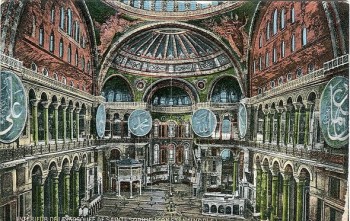
Hagia Sofia, Istanbul: from basilica to cathedral to mosque to museum. Postcard, c. 1914. Photo: Wikipedia/Xenophon
Sacred spaces, repositories of free speech, places of healing? Teemu Manninen awaits the day when libraries become virtual, enabling anybody to visit them, without having to travel across land and sea
The Bodleian Library in Oxford, the Vatican Library, the Bibliotheque Nationale in Paris, New York Public Library, the British Museum Reading Room, the Real Gabinete Portugues De Leitura in Rio De Janeiro, the Library of Congress and the National Library of Finland.
What do all of these have in common, except the obvious fact that they are all famous libraries? To put it another way: why are these famous libraries so famous?
It is not because they have books in them, although that has become one of the main tasks of the library system in the modern world. But a library is not simply an archive. If we in the West are a culture of the book – a culture of the freedom of information and expression – then a library is the architectural incarnation of our way of life: a church built for reading. More…
Success after success
9 March 2012 | This 'n' that
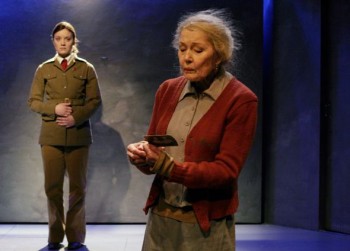
The women of Purge: Elena Leeve and Tea Ista in Sofi Oksanen's Puhdistus at the Finnish National Theatre, directed by Mika Myllyaho. Photo: Leena Klemelä, 2007
Sofi Oksanen’s Purge, an unparalleled Finnish literary sensation, is running in a production by Arcola Theatre in London, from 22 February to 24 March.
First premiered at the Finnish National Theatre in Helsinki in 2007, Puhdistus, to give it its Finnish title, was subsequently reworked by Oksanen (born 1977) into a novel – her third.
Puhdistus retells the story of her play about two Estonian women, moving through the past in flashbacks between 1939 and 1992. Aliide has experienced the horrors of the Stalin era and the deportation of Estonians to Siberia, but has to cope with the guilt of opportunism and even manslaughter. One night in 1992 she finds a young woman in the courtyard of her house; Zara has just escaped from the claws of members of the Russian mafia who held her as a sex slave. (Maya Jaggi reviewed the novel in London’s Guardian newspaper.) More…
Life is
16 February 2012 | Letter from the Editors
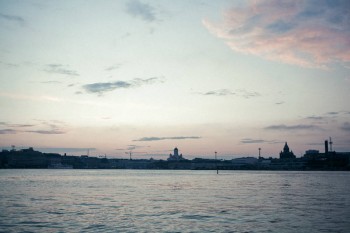
Helsinki silhouette. Photo: Valtteri Hirvonen, Eriksson&Company / World Design Capital Helsinki, 2011
Where is Books from Finland located?
In the old days, the answer was simple, although not unambiguous. Books came from its office in central Helsinki; it was written in various locations in Finland and abroad, and translated mainly in England and the United States; and it was published in the small town of Vammala, about 200 kilometres north of Helsinki.
It spread, in multiple paper copies, to readers throughout the world, to find its place on desks, on bedside tables, in briefcases and handbags, propping up table-legs or holding doors open – in London, England, Connecticut, New England, with a few in Paris, France, and Paris, Texas, maybe. More…
Once upon a time…
13 January 2012 | Articles, Non-fiction
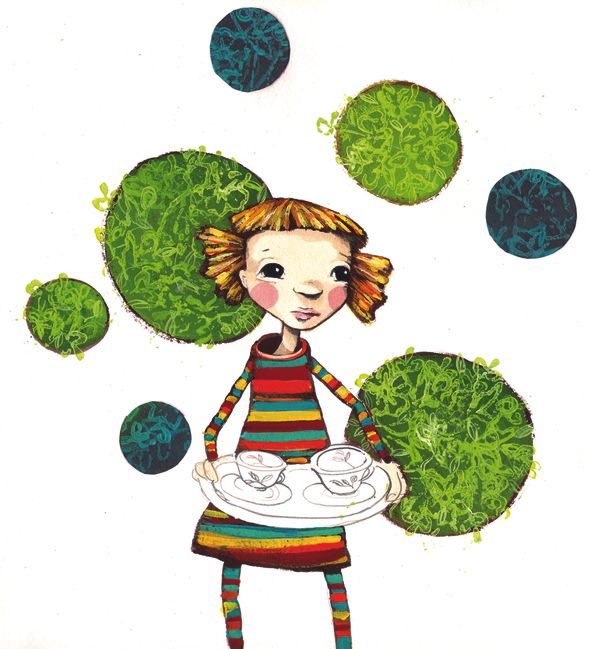
Sari Airola's illustration in Silva och teservisen som fick fötter (‘Silva and the tea set that took to its feet’, Schildts) by Sanna Tahvanainen
The future of book publishing is not easy to predict. Books for children and young people are still produced in large quantities, and there’s no shortage of quality, either. But will the books find their readers? Päivi Heikkilä-Halttunen takes a look at the trends of 2011, while in the review section we’ve picked out a selection of last year’s best titles
The supply of titles for children and young adults is greater than ever, but the attention the Finnish print media pays to them continues to diminish. Writing about this genre appears increasingly ghettoised, featuring only in specialist publications or internet chat rooms and blogs.
Yet, defying the prospect of a recession, Suomen lastenkirjakauppa, a bookshop specialising in children’s literature, was re-established in central Helsinki in autumn 2011, following a ten-year break. Pro lastenkirjallisuus – Pro barnlitteraturen ry, the Finnish society for the promotion of children’s literature, has been making efforts to found a Helsinki centre dedicated to writing and illustration for children. The society made progress in this ambition when it organised a pilot event in May 2011. More…
A new publishing company – and old
23 December 2011 | In the news
In the early months of 2012 Finland’s two old and time-honoured Swedish-language publishers, Schildts and Söderströms, will merge.
Söderströms will buy Schildts, whose owners (two non-profit associations, Svenska folkskolans vänner and Finlands svenska lärarförbund) will acquire a nearly 20 per cent share in the new company. The largest share in Schildts & Söderströms will be held by the art association Konstsamfundet (24 per cent), while the company’s third major owner will be Svenska Litteratursällskapet i Finland (15 per cent).
Both publishers have been operating with a loss in turnover of approximately half a million euros, though at the same time investment capital has brought them almost the same amount. Textbook publishing has been profitable for both, while general literature has been published at a loss.
With a turnover of slightly over six million euros, the new Schildts & Söderströms will employ a workforce of nearly 50.
 Holger Schildt founded the Finnish-Swedish publishing house of Schildts in 1913. Its most internationally famous and best-selling fiction writer is the mother of the Moomins, Tove Jansson (1914–2001). Edith Södergran, Runar Schildt, Bo Carpelan and Robert Åsbacka are, for example, Schildts’ authors.
 Werner Söderström founded the company that bears his name in 1878. Now known as WSOY, it originally published both Finnish and Swedish-language literature; the firm of Söderström & Co. was founded in 1891 for the exclusive publishing of Swedish-language literature. Söderström’s authors have included Gunnar Björling, Jörn Donner, Monika Fagerholm and Kjell Westö, among others.
It is thought that the merger may lead to a reduction in the number of fiction and poetry titles published – but there are also hopes that there may be an improvement in their quality.
Helsinki Book Fair 2011
2 November 2011 | In the news
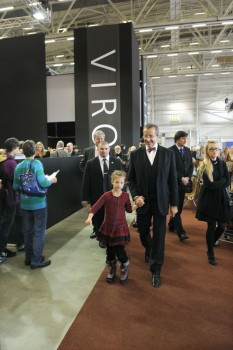
President Toomas Hendrik Ilves at the Book Fair: Viro is Estonia in Finnish. Photo: Kimmo Brandt/The Finnish Fair Corporation
The Helsinki Book Fair, held from 27 to 30 October, attracted more visitors than ever before: 81,000 people came to browse and buy books at the stands of nearly 300 exhibitors and to meet more than a thousand writers and performers at almost 700 events.
The Music Fair, the Wine, Food and Good Living event and the sales exhibition of contemporary art, ArtForum, held at the same time at Helsinki’s Exhibition and Convention Centre, expanded the selection of events and – a significant synergetic advantage, of course – shopping facilities. Twenty-eight per cent of the visitors thought this Book Fair was better than the previous one held in 2010.
According to a poll conducted among three hundred visitors, 21 per cent had read an electronic book while only 6 per cent had an e-book reader of their own. Twenty-five per cent did not believe that e-books will exceed the popularity of printed books, and only three per cent believed that e-books would win the competition.
Estonia was the theme country this time. President Toomas Hendrik Ilves of the Republic of Estonia noted in his speech at the opening ceremony: ‘As we know well from the fate of many of our kindred Finno-Ugric languages, not writing could truly mean a slow national demise. So publish or perish has special meaning here. Without a literary culture, we would simply not exist and we have known this for many generations, since the Finnish and Estonian national epics Kalevala and Kalevipoeg. – During the last decade, more original literature and translations have been published in Estonia than ever before. And we need only access the Internet to glimpse the volume of text that is not printed – it is even larger than the printed corpus. We live in an era of flood, not drought, and thus it is no wonder that as a discerning people, we do not want to keep our ideas and wisdom to ourselves but try to share and distribute them more widely. The idea is not to try to conquer the world but simply, with our own words, to be a full participant in global literary culture, and in the intellectual history and future of humankind.’
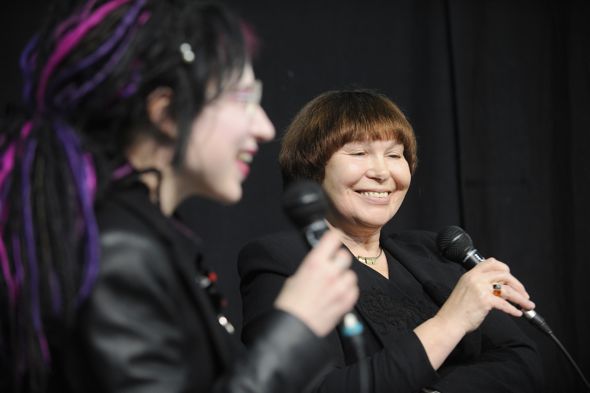
Finland meets Estonia: authors Sofi Oksanen and Viivi Luik in discussion. Photo: Kimmo Brandt/The Finnish Fair Corporation
Publisher: sold!
14 October 2011 | In the news
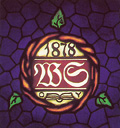
WSOY trademark: design by Akseli Gallen-Kallela
The Swedish media company Bonnier (est. 1804) has bought the Finnish WSOY (Werner Söderström Corporation, est. 1878) publishing company, formerly owned by the now multinational Sanoma Corporation. Bonniers’s learning materials in Finland and Sweden were simultaneously bought by Sanoma.
Leena Majander-Reenpää, former managing director of Otava Publishing Company (est. 1890; she resigned from her job last year), is the new vice CEO responsible for the publishing programme and foreign rights at WSOY.
Anne Valsta, CEO of the Tammi Publishers, (est. 1943, also owned by Bonnier since 1996) is also the CEO of the new WSOY.
The president of the Swedish Bonnierförlagen AB, Jacob Dalborg, will be the Chairman of the Boards of both Tammi and WSOY; he says both will continue as independent companies.
Bonnier operates in 17 countries and employs more than 10,000 people. WSOY last year shed 40 jobs and now employs some 100 people.