

Tag: short story
Genuine beauty
14 February 2013 | Fiction, Prose
Erään ihailijan päiväkirjasta (‘From the diary of an admirer’), a story published in the collection of short prose Taskunovellit (‘Pocket stories’, edited by Vilja-Tuulia Huotarinen; Karisto, 2013)
10.6.
Dear Diary, I have met a wonderful man. He is tender, handsome and clever. It is a real piece of luck that fate didn’t throw us together until now: I’m embarrassed at the very thought that he might have seen me a couple of years ago, as an immature and childish sixth-former. His name is Petri Tamminen and he’s a writer. Writers are gorgeous. Not all of them, of course, some of them think too much of themselves and appear e.g. on television, but Petri is gorgeous.
15.6.
Dear Diary, he has shown me the road to a new world: we went to the Åland islands. Petri doesn’t like Helsinki, he wants to get away from the beaten track of everyday life. The sun sank into the horizon at Eckerö, and my soul floated up into the summer night. This is love. In the morning, in the hotel bed, he recited a poem for me. I have read all his novels and I know that one day they will receive the recognition they deserve, but in his deepest self he is a poet.
16.6.
Dear Diary, we went fishing. Petri caught a sea-trout. It was enormous. He gathered herbs from a shoreline meadow, seasoned the fish and baked it over the embers. We ate with our fingers, fed each other. Delicious. Certain much weaker chefs try to make their names by preparing food e.g. on television. Losers. More…
Crème de la crème
31 January 2013 | Fiction, Prose
Such straining and pasteurising is going on in the city that Arabs and other Muslims, the unemployed, drunkards, poor people and lunatics have been eliminated. By chance I became a cultural figure, and I was invited to a cultural evening whose invitation had been personally written by the Anarchist. At the restaurant table sat the Anarchist, the Psychoanalyst and the Psychologist’s boyfriend, 20 years younger, the Journalist, the Gift-Shop Owner, a Librarian and the Deputy Rector of a community college. Accompanying me to the restaurant, too, were the Wolf and the Deer, who hadn’t been invited. Sparse white fur grew on the Wolf’s narrow muzzle and there were teeth missing from his mouth. The Deer was beautiful, with huge eyes. And of course both of them were drunk. I asked them to come along because I believed that intellectuals are warm-hearted and open-minded. A really dumb idea. More…
Moomins, and the meanings of our lives
21 December 2012 | This 'n' that
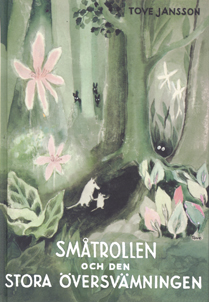
The first ever Moomin story, 1945
Tove Jansson’s Moomin books are widely cherished by children and adults alike. They are funny and charming yet haunting and profound. Lovable Moomintroll; practical and sensible Moominmama; spiky Little My; the terrifying yet complex monster, Groke – Jansson’s creations linger in the mind.
The first ever Moomin book – The Moomins and the Great Flood (Småtrollen och den stora översvämningen, 1945) – was published in the UK in October by Sort Of Books, but Jansson’s writing for adults is also achieving recognition in the English-speaking world.
A Winter Book, a selection of 20 stories by Jansson (Sort Of Books, 2006) was the trigger for a recent event on London’s South Bank. Along with journalist Suzi Feay and writer Philip Ardagh, I was invited to talk about Jansson’s work in general and about these stories in particular.
As Ali Smith notes in her fine introduction to the collection, the texts are ‘beautifully crafted and deceptively simple-seeming’. They are, as she puts it ‘like pieces of scattered light’. She also refers to the stories’ ‘suppleness’ and ‘childlike wilfulness’.
‘The Dark’, for example, offers an apparently random set of snapshots of childhood. Arresting images abound – swaying lamps over an ice rink, swirls in the pattern of a carpet that turn into terrible snakes – to create a tapestry of childhood. It’s like a dream: of ice and fire, fear and safety, a mixture that recalls the secure yet scary world of Moomin valley.
‘Snow’, too, conjures childhood fear. The house that features in this story is unhomely or uncanny, to refer to Freud, and seems haunted by the ghosts of other families. The story ends with the shared resolution between mother and child to return to a place of safety: ‘So we went home.’
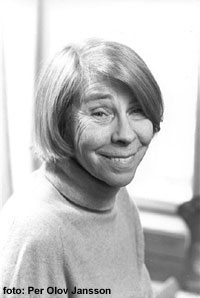
Tove Jansson (1914–2001)
The combination of scariness and safety, of comfort and unease, is one of the things that makes Jansson (1914–2001) such a powerful writer, not only for children – although questions of security and fear might have especial resonance in early life – but also for adults, who continue to be haunted by the unknown, but also tempted by it.
The South Bank event also gave participants and audience the chance to talk about other works by Jansson. The Summer Book (Sommarboken, 1972) notably, is a delicate and deft evocation of a summer spent on an island.
The narrative charts the relationship between a grandmother and granddaughter, and at the same time probes such profoundly human questions as love and loss, hope and change and continuity. As always in Jansson, the descriptions are sharp and crisp, and the writing is at once spare and suggestive.
Novels like Fair Play (Rent spel, 1989) and The True Deceiver (Den ärliga bedragaren, 1982) reveal Jansson’s subversive, sly, and subtle sides, which sit alongside her playfulness, warmth, and humour to create a unique aesthetic. Fair Play is a book about the relationship between two women; it’s tender, funny and thoughtful. Never sentimental, it is nonetheless moving. And it’s quietly subversive in its matter-of-fact depiction of a same-sex relationship.
The True Deceiver is set in a snowbound hamlet. A young woman fakes a break-in at the house of an elderly artist, a children’s book illustrator, and a strange dynamic develops between the two women. It’s a book about being outside, about not belonging. The relationship between the women, which is never fully resolved or explained, is especially fascinating.
Jansson excels at showing the human need for both company and privacy, intimacy and autonomy. And her work is profoundly philosophical. In very light, nimble narratives, Jansson explores the meanings of our lives.
In defence of small people
15 November 2012 | Non-fiction, Reviews
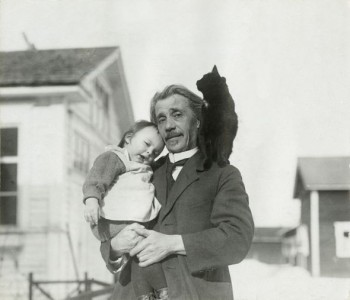
Teuvo Pakkala with grandson Teuvo-Pentti and Mirri the cat. Photo: F. Suomela / Otava, 1922
The best-known work of author Teuvo Pakkala (1862–1925) is Tukkijoella (‘On the log river’, 1899), Finland’s most-performed play. The song-studded comedy set in motion a phase of ‘logger romanticism’ in Finnish literature which later spread to film as well. Like the cowboy of the old west, the wandering lumberjack became the prototype for the Finnish masculine adventurer.
The entertaining musical play was a blockbuster. Pakkala’s works of more literary significance, however, encountered more difficulty. His short story collections on the lives of children – Lapsia (‘Children’, 1895) and Pikku ihmisiä (‘Little people’, 1913) – were greeted with flattering acclaim, but marked the author as hopelessly ‘effeminate’, as the critics put it. The stories were read as a kind of child-rearing guide, or even as tales for children. It wasn’t until much later, in the second half of the 20th century, that these psychological studies of children were re-examined as early gems of the short story form by a contemporary of Freud. More…
The mighty word
15 November 2012 | Fiction, Prose
‘Mahtisana’, a short story from the collection Lapsia (‘Children’, 1895). Introduction by Mervi Kantokorpi
Mother and Dad hadn’t said a single word to each other since lunchtime. The children, Maija and Iikka, were quiet, too. They sat apart, Iikka on the chair at the end of the sofa, where he could see the moon through the window, and Maija next to the window looking out on the street, where children moved about on skis and sleds. They didn’t dare make a sound, not even a whisper to ask for permission to go outside. It had been so quiet all that Sunday evening that when Mother spoke, encouraging them to go out and play, both of them nearly jumped.
They left without saying a word, Maija creeping quite silently. Even out in the courtyard she and Iikka still spoke in whispers as they decided which hill to go to. They didn’t really want to go anywhere, but when they came out to the street and could hear the happy shouts of children from every direction, it refreshed their spirits. Maija sat Iikka down on the sled and set off at a run, pulling him behind her. She felt as if her gloomy mood was falling away in pieces to be trampled underfoot.
A few streets down there was a large crowd of boys on the corner. They decided to go and see what was happening. More…
The Hunter King
9 August 2012 | Fiction, Prose
A story from the collection of fiction and non-fiction, Salattuja voimia (‘Hidden powers’, Teos, 2012)
And just as Gran Paradiso is the highest peak in unified Italy, the only mountain whose rugged, perpetually snow-capped summit reaches a height of over thirteen thousand feet (there are rumours that, on a clear day, you can see the peaks of both Mont Blanc and the Matterhorn from the top), so we know that the largest and most splendid mountain creature throughout Europe is the ibex, which grazes on the slopes of Gran Paradiso – the ibex, the alpine goat, the distant ancestor and modern-day cousin of our own homely goat, the French bouquetin and the German Steinbock.
The male ibex can be the size of a foal, about three feet tall, and its curved horns, like Oriental daggers decorated with rippling patterns, can grow to reach the same length as the creature’s own height. Local folklore tells us that, in the olden days when the mists of the distant Ice Age still hung heavy in the gullies of Valle d’Aosta and Valle d’Orso, herds of ibexes could still be seen further down the mountain slopes, but because the ibex loves the cooling mountain winds and values the cold, which keeps predators from the valleys at bay, they moved up to the most inhospitable terrain and made it their home.
But there was one beast that followed the ibex up these paths, sowing fear and causing death and destruction – and that beast was man. More…
Special effects
14 June 2012 | Authors, Reviews
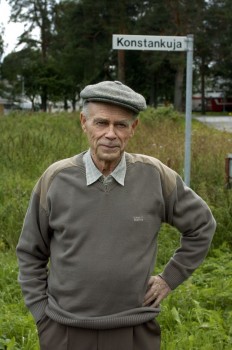
Veikko Huovinen. Photo: Harri Nurminen
Depictions of simple country folk who live close to nature, diabolical satire of the powers that be, playful rambling tales.
The humour of Veikko Huovinen has two dimensions: it is learned, intelligent, and insightful, but it is also exuberant and folksy. Critics have made comparisons to Nikolai Gogol and Mark Twain, and not without reason.
Huovinen (1927–2009) began writing stories in 1949 and published his final work in 2007, two years before his death. This half century saw the birth of a broad and multifaceted library, including a good number of works that do not fit any genre as such – Huovinen called his works that lay in the interstices between the short story, causerie and satire ‘short specials’. More…
Pop song lyrics
A ‘short special’: a previously unpublished text (written in the 1960s) from Luonnonkierto (‘Nature’s circle’, Siltala, 2012). Introduction by Jarmo Papinniemi
The pop song is a wide, mysterious world. It is like an ocean. Like a snow-covered desert. Like a rose garden. Like a perfume factory. The pop song is as mysterious as spring. The pop song is as whimsical as the restroom of the city hotel in Samarkand. The pop song is as coarse as your father’s eldest brother. Pop songs snag everyone, especially the young and the old. The best pop songs are foreign, because the words make no sense. Pop stars rise into the sky. Lovely young women step into the arena smelling of perfume and sing about love or tell playful stories about animals or nursery rooms. And then on the other end of life the stars go out and start to look for a place to be buried. But before dying they drone on in their gruff voices about the temptations of the big city, and love, which in a certain sense tortured and wore out those concerned…
Up here in Finland, we write and set pop songs to music as well. But I have to say that they aren’t any good. We also translate and water down a lot of foreign hits as well. Well, of course they’re all popular and people hum them in parishes in the city and in the country, but from a critical perspective they stink. Usually the weak point of a pop song is its execrable lyrics. More…
Movies and mores
16 April 2012 | Authors, Interviews
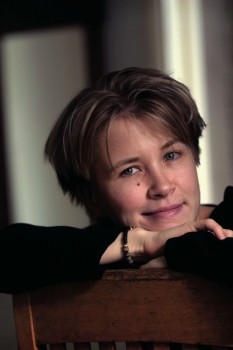
Tuuve Aro. Photo: Liisa Takala
Interview with Tuuve Aro, author of Himokone (‘Desire machine’): in these short stories she borrows titles and ambiance from the silver screen
A dark theatre, the smell of popcorn, expectation quivering in the air. Since childhood, the author and film critic Tuuve Aro (born 1973) has loved that magic moment when a new, exciting story is about to begin once again on the silver screen.
The stories in her fourth short story collection Himokone (‘Desire machine’, WSOY, 2012) have taken their names from films – Vertigo, Alien, and Invasion of the Body Snatchers, for example. The book’s title comes from a certain Dr Samuel L. Brimstone, member of the ‘Royal Film Academy of Suffolk’: according to him, a film projector is a desire machine: it doesn’t give anything, it only shows, and for that very reason it is hard to resist. More…
Fight Club
16 April 2012 | Fiction, Prose
A short story from Himokone (‘Lust machine’, WSOY, 2012). Interview by Anna-Leena Ekroos
Karoliina wondered whether her name was suitable for a famous poet.
Her first name was alright – four syllables, and a bit old-fashioned. But Järvi didn’t inspire any passion. Should she change her name before her first collection came out? Was there still time? She had four months until September.
Even if The flower of my secret was the name of some old movie, Karoliina clung to the title she’d chosen. It described the book’s multifaceted, erotically-tinged sensory world and the essential place of nature in the poems. Karoliina loved to take long walks in the woods. Sometimes she talked to the trees.
She had been meeting new people. At the writer’s evening organised by her publisher, she’d been seated next to Märta Fagerlund, in the flesh. Karoliina had read Fagerlund’s poems since her teens, and seen her charisma light up the stage on cultural television shows.
At first Karoliina couldn’t get a word out of her mouth. She just blushed and dripped gravy on her lap. But the longer the evening went on, the more ordinary Märta seemed. She was even calling her Märta, and telling her about a new friend on Facebook who said how ‘awfully funny’ Märta was. In fact, the squeaky-voiced Märta, with her enthusiasm for Greece, was a bit dry, and, after three glasses of white wine, tedious. But Karoliina never mentioned it to anyone, because she wasn’t a spiteful person. More…
Blog-jam
24 October 2011 | Authors, Reviews
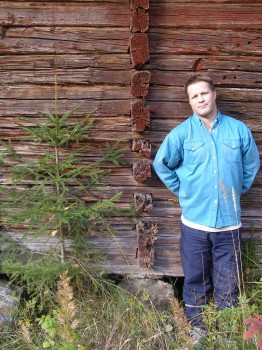
Jouni Tossavainen. Photo: Like
Poet and writer Jouni Tossavainen has directed his verbal curiosity towards blog writing in his eighth prose work, entitled Sivullisia (‘Outsiders’, Like, 2011); it consists of a collection of (fictional) blog posts, which seem to contain plenty of junk as well as treasures.
The book is a dizzying linguistic playground; it includes posts, around a page in length, from 157 ‘outsiders’. Escaping the familiar structures of language usage gives rise to snapshots of estrangement.
The narrator of the book claims to have assembled his material from a collection of blog posts received from the greater Helsinki region. Individual fragments of views and facts are like codes that have lost what they were meant to unlock. Mocking, satirical jibes emerge from the texts, accompanied by a sneaking suspicion of understanding and solace, as there ought to be in a true carnival. More…
The joy of work
24 October 2011 | Fiction, Prose
Short prose from Sivullisia (‘Outsiders’, Like, 2011). Introduction by Teppo Kulmala
Since I’ve been unemployed, I started a blog called Outsiders. It soon came to serve as work, and I became dependent on its benefits. Although describing being an outsider helped to anaesthetise me, and verbalising all of my afternoons didn’t even take up all my time, the feedback that came in was reward enough. I wouldn’t have taken any other reimbursement anyway because of the restrictions set on recipients of government benefits. Increasingly frequently I found myself longing for more. Even a short blog comment about being an outsider felt even truer than what I with my self-employed, jobless person’s competence was able to achieve in relation to being sidelined as an unemployed person, regardless of what kind of manager I had been in my previous life. When asking for more accounts of other people’s well-being, I wanted them to use their own names. I justified this because I did not want to read lies, which often come from and lead to chatter in cafés and on the web. Apart from the pure enjoyment of being present, using one’s own name – even in wrong-headed topics or notions – makes it easier to approach the harsh laws of the working world. When one knows that by using one’s own signature one is dragging one’s family into the mire, including those who have gone before and those yet to come, one is able to blaze trails along which one can outflank the passive to activate another, equally unemployed. I did not place any further requirements on the other commenters besides first name and surname, as the rules had been drawn up by professionals in their own field. The regulator’s work also requires skill, if not a tremendous craving, for damming up another flood of text so that one’s own advantages do not have a chance to dry up. To facilitate reading for myself and others, I introduced only a couple of restrictions, which I imagined that I, too, would be able to adhere to. Only one side of a sheet of A4 was to be used – that is, one page – and what people wrote had to be true. Truth, beauty and quality ensured that everyone would begin what they had to say by writing about their current work. More stories, anecdotes, even poems piled up than the law permits me to read – much less compile – during working hours. For this book I have selected only 157 stories from the Greater Helsinki area for the sake of efficiency. The faster you can read the work, the less time it will distract you from your main job. I chose to limit things to the capital area so that the stories about well-being from individuals linked to this place would seem to form a more integral work, or document at least, about what was happening in the Big H, the centre of the nation, at the start of the millennium. I will publish the tales of work from beyond the outer ring road at some later stage, if I manage to come to an agreement with the writers concerning intellectual property rights. More…
Truths to tell
1 June 2011 | Authors, Interviews
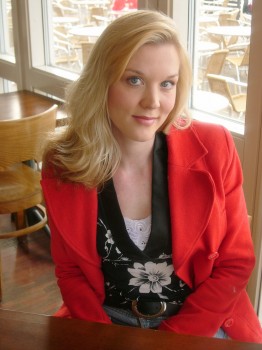
Johanna Holmström. Photo: Irmeli Jung
‘In my writing I try to give as many angles as possible, and my agenda is to show that there’s not just one truth, that there are always several ways of seeing what one perceives at first sight. So I often have more than one main narrator. I constantly aim to question accepted truths. My stories always begin with indignation about something I feel I must write about. Fiction is a way of distancing oneself. After all, books are literary, invented things. When you work on the subject of a literary text it becomes less personal.’
This is how Johanna Holmström (born 1981) describes her approach to writing. Since her first collection of short stories published in 2003 she has produced a book every two years: three short story collections and one novel. Her books have been variously described as imaginative, committed and uncomfortable. Her short story ‘Stormen’ (‘The storm’) is a precisely observed account of a day when everything changes for its young protagonist.
The storm
From the collection of short stories Tvåsamhet (‘Two alone’, Söderströms, 2005). Introduction by Tiia Strandén
A storm blows up during the night. As he lies in bed, not yet asleep, just lingering on the brink of falling, in that soft yet sensitive state where sounds seem to grow and get bigger, he can hear the clattering, hissing sound of the wind coming up out there and sweeping up everything not fastened down, capable of being put in motion. It scrapes against the roof and window, loosens leaves and pine needles which scud across the ground, and it whistles and whines round the chimney and the windows, and it even beats against the shed door, which Dad must have forgotten to shut properly before he came in. Before he stamped the mud off his boots in the front hall. Before he had a chance to pull the front door shut firmly as well, because Joakim can hear how he brings the storm into the hall with him, and it sweeps through the kitchen faster than he ever could have imagined. Joakim shuts his eyes tighter, even though he is no longer really awake, and he hears the powerful gust flap past Dad, who is still standing with his hand on the door handle, and then Mum starts shouting because the wind is slamming into the furniture and making dishes crash to the floor and making pots and pans do the same. When Dad starts shouting as well, Joakim lets go of the last little bit of wakefulness and lets himself sink down into the cradle of dreams to be carried along until the morning. It is the sun that wakes him, or maybe the sound of the telephone, because he wakes up just as it rings, but in any case it has stopped blowing, and the branches of the big lilac bush outside the window are completely still. More…
Winning stories of alternative realities
10 February 2011 | In the news
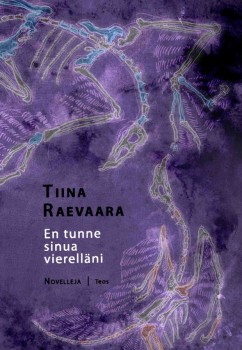 The Runeberg Prize for fiction, awarded this year for the twenty-fifth time, went to a collection of short stories by Tiina Raevaara.
Her En tunne sinua vierelläni (‘I don’t feel you beside me’, Teos, 2010) mixes fantasy and realism, dealing with, for example, animal kingdom, human mind and artificial intelligence. See the introduction and translation of a story which we ran here on the Books from Finland website.
Raevaara (born 1979) holds a doctorate in genetics; the prizewinner is her second work of fiction. The prize, worth €10,000, was awarded on 5 February – the birthday of the poet J.L Runeberg (1804–1877) – in the southern Finnish city of Porvoo.
The jury – representing the prize’s founders, the Uusimaa newspaper, the city of Porvoo, both the Finnish and Finland-Swedish writers’ associations and the Finnish Critics’ Association – chose the winner from a shortlist of eight books: a collection of poetry, Vagga liten vagabond (‘Swing, little wanderer’, Söderströms) by Eva-Stina Byggmästar, the novel Poikakirja (‘Boys’ Own Book’, Otava) by Olli Jalonen, the novel Kiimakangas (WSOY) by Pekka Manninen, two collections of essays, Kuka nauttii eniten (‘Who enjoys most’) by Tommi Melender and Halun ja epäluulon esseet (‘The essays of desire and suspicion’) by Antti Nylén (both publlished by Savukeidas), a collection of poetry, Texas, sakset (‘Texas, scissors’, Otava) by Harry Salmenniemi and another collection of short stories, Apatosauruksen maa (‘The land of the apatosaurus’, WSOY) by Miina Supinen.