

Archive for 1987
Higher goals
Issue 4/1987 | Archives online, Fiction, Prose
An extract from the novel Tammerkosken sillalla (‘On Tammerkoski bridge’, 1982). Introduction by Panu Rajala
I had thought there were a lot of books in the libraries in Oulu. But both those libraries were totally overshadowed when, having climbed up to the top of the Messukylä Workers’ House, I began to cast my eyes along the bookshelves in the attic. A tallish and refined-looking librarian responded when I exclaimed aloud.
‘Just under seven thousand volumes altogether. Some of them are out on loan. We’d like to have a lot more books, but getting the money to buy them is like getting water from a stone.’
‘But you’ve already got an incredible amount compared to what we have in the rural library at home… In Taivalkoski during the war all we had was two cupboardsful.’
‘You didn’t have a lot of choice there,’ agreed the librarian. More…
In my memory
Issue 4/1987 | Archives online, Fiction, poetry
Poems and aphorisms from four collections. Introduction by Erkka Lehtola
Let the healing epidemics out! There must be some.
The many-headed monster, the market ideology, it can simultaneously read, count and even write at least 666 works. And without the sign of the beast no one can buy or sell.
Those who can read know you only realise you’ve forgotten how
when you can do it again.
What a handsome winter we have here! If it weren’t so dark, we’d see it. We could orientate ourselves on the stars with the beam from a pocket torch. Somewhere in mid-sky, I’d say, they come flying along on long lights.
As a child I said I’ll do what I want. Now I want what I do.
Who’s in the middle when the two sides of your face are side by side, as they are, in the mirror.
The trees that hide the sun are bright inside.
A frosty night when you feel the stars on your skin and discuss what you’re wearing.
Somebody’s walking over there, with an umbrella over his head, taking the rain for a walk.
I’m so delighted to find so much that’s useless.
What a relief there’s no longer enough time to get acquainted.
From Tuoreessa muistissa kevät (‘Springtime fresh in the memory’), 1987 More…
Mickeys
Issue 4/1987 | Archives online, Fiction, Prose
Maskuja (‘Mickeys’, WSOY, 1987). Introduction by Erkka Lehtola
When I was on a trip with my friend and there was a wide enough bed in the southern night for the two of us to sleep easily side by side, it was a big shock when, even so, I sprang up suddenly at midnight, and my friend did too, and there was a thud as our heads banged together and we saw stars, and in the morning no one could understand why we were so stupefied.
Micky ran to the barber’s. ‘Are you free? Could you do something with my hair?’ He took his cap off. ‘Look, all the hairs are loose at the other end.’
Once, out of sheer absent-mindedness, he was officiously helping someone onto a tram from behind; he grabbed their bottom, got a furious look, and spluttered,’ Sorry, but I thought it was your bag.’ More…
The tower
Issue 4/1987 | Archives online, Fiction, Prose
A short story from the collection Torni (‘The tower’, 1987). Introduction by Erkka Lehtola
The dog came through the door first, a big, long-haired brute. He hadn’t said anything about it on the phone, but from the look on his face you could tell it was his and that he meant to take it with him into the forest.
He shuffled across the yard with his rubber boots on and a rucksack on his back. In one hand he held a camera tripod.
I rolled down the window.
‘Wait a minute,’ he said.
He walked behind the cars standing in the parking lot, over to his own car and opened the trunk. The dog twisted around his legs whining softly. He took something out and slammed the trunk shut. More…
Short and sharp
Issue 4/1987 | Archives online, Authors

Juha Seppälä. Photo: WSOY
The latest development in Finnish literature has taken a couple of decades to emerge. Instead of the long, epic prose that was so popular for so long, we now have short fiction that often takes the form of the short story. Descriptions of country surroundings and vanished ways of life have been supplanted by prose that pulsates to the rhythm of the city.
At the same time the image of the writer has changed. Today’s young Finnish author is not an amateur or someone who is forced to make his living by other means; he is often a highly educated professional writer with a grasp of many new and diverse fields of knowledge.
Juha Seppälä (born 1956) is a good example of this changed author type. He is a graduate of Turku University in Finnish literature and cultural history. He has never worked in, for example, a school or, indeed, had any other steady job. His job is writing, and he works to a strict regime, for there is much to be done: Seppälä has written many radio plays, television scripts and two collections of short stories which have had a very positive critical reception. He also writes literary criticism for a number of newspapers, including a weekly column for Aamulehti, one of Finland’s biggest daily papers. More…
Paris 2
Issue 3/1987 | Archives online, Fiction, Prose
An extract from the novel Paholaispoika (‘The devil boy’, 1987). Introduction by Austin Flint
You must sit down, sayes Love, and taste my meat:
So I did sit and eat.
(George Herbert)
The city was the sum of the whole century, the capital of the eighteen hundreds, of no particular country. Like millions of others, I passed time reading the newspapers and keeping up with what was happening in Europe. Acorns would get crushed. There were many omens of how everything would turn out.
There were still a few remnants of the World’s Fair over by the Palais Royal. Not very many. The latest and most shocking incident was that the Lipschitz sculpture, ‘Prometheus Strangling the Vulture’, had been chopped to bits. Then it was put into storage, in some secret place. Crumbling rough grey stone that gave no idea of its shape. Rumour had it that the statue had offended official policy, and all sorts of things were certainly in the air. There was no longer any sign of the sculpture near the Palais Royal. More…
Encounters with the real
Issue 3/1987 | Archives online, Authors
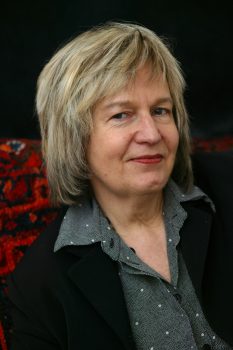
Kirsti Simonsuuri. Photo: Pertti Nisonen / Tammi
When one mentions Kirsti Simonsuuri to literary people in Finland, one is likely to get the response, ‘Ah, yes, very interesting, of course, but you know she’s not really a Finnish writer. Her themes are more international, more intellectual, more European.’
Looking at her career, one can see why she has acquired such a reputation. While she took her MA degree in English and Classical Studies from the University of Helsinki in 1971, since then she has spent most of her productive literary years outside Finland, studying for the PhD which she received from the University of Cambridge, England in 1977 and doing additional research in Paris, London, Strasbourg, and Bonn. More recently, in addition to teaching at the Universities of Oulu and Turku in Finland, she has held positions as Visiting Scholar at Harvard University, at the University of California, Los Angeles, and at Columbia University in New York, where she has taught a course on Finnish literature in the European context. More…
Three short stories
Issue 2/1987 | Archives online, Fiction, Prose
from Väärinkäsityksiä (‘Misconceptions’). Interview by Markku Huotari
Love
Kaija couldn’t understand why she felt like laughing all the time.
‘As for me, what I stand for is good old-fashioned courtesy,’ he pointed out.
He’d got a soft, low, caressing voice. He rested his hand on Kaija’s shoulder. They’d got that far already. Kaija had decided to say yes, even though he hadn’t suggested anything yet. She was beginning to picture luxurious rooms, gourmet dishes, expensive drinks, and tender, passionate lovemaking.
‘Socially I’m a radical,’ he said. ‘Culturally a liberal, but in personal things an unshakeable conservative. A woman, in my view, is to be respected – I don’t consider that damaging to her independence. Too often, in today’s world, equality’s used to justify what are quite simply bad manners.’ More…
Beyond good and evil?
Issue 2/1987 | Archives online, Authors, Interviews
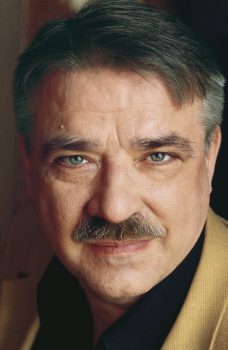
Esa Sariola. Kuva Irmeli Jung
Markku Huotari interviews Esa Sariola
A stylish restaurant in the Stock Exchange building in Helsinki. Esa Sariola and I order a businessmen’s lunch. We talk about hard-nosed success stories. About technocracy, casino economics.
About profit.
A steely-eyed businessman enters the room from the stock exchange and sees us two soft-talkers, even if we look like men, wasting time. The ruthless gambler bolts down his lunch and disappears to the upper floor again, where he is making money.
We remain.
We’re just talking.
And there’s no money accruing in our wallets.
All the same we have a grip on that investor. Esa Sariola has already laid siege to people like him in three books: Väärinkäsityksiä (‘Misconceptions’, 1983), a collection of short stories, and two novels: Rakas ystävä (‘Dear friend’, 1985) and Kuolemaani saakka (‘Until my dying day’, 1986). More…
A small lie
Issue 2/1987 | Archives online, Fiction, Prose
A short story from Pieni valhe (‘A small lie’). Introduction by Marianne Bargum
The white cat had started to hate her.
Only half a year ago, Marja remembered, it had been playing with the hems of her robe, while she had passed the morning reading and drinking coffee. Right now it was staring relentlessly at her from the bookcase where it was ensconced: out of reach, she thought. Its stare was green and mean. At night it attacked her ankles; it lurked in the crevices of the apartment and when it heard her approaching steps it leapt past her, screaming, and crossed the room to the curtains or the table. The curtains fell, books crashed to the floor, the cat stared with its eyes opened wide, the pupils like narrow slits. She would lock the cat into the other room for the night, hear it mew and feel the door with its paws; she fell asleep only after the cat had calmed down. When she approached it during the day, stroked it and called its name, it looked at her, motionless, as if it had seen and known everything, and then she withdrew her hand, backed off, started behaving as if there wasn’t even a cat in the apartment. More…
Soulscapes
Issue 2/1987 | Archives online, Authors, Reviews
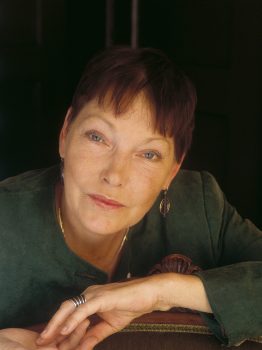
Raija Siekkinen. Photo: Irmeli Jung
When the first collection of short stories by Raija Siekkinen (born 1953), entitled Talven tulo (‘The coming of winter’, 1978) appeared, the critics were unanimous on one point: here was a mature writer with an original, individual voice. For her second collection, Tuomitut (‘The condemned’, 1982), Raija Siekkinen received the coveted Kalevi Jäntti Prize. Since then she has remained faithful to the short story. And since the publication of her fourth collection, Pieni valhe (‘A small lie’), the reader has been able to trace a development in which she has polished and tightened her narrative and brought to it more and more poetic and symbolic elements.
The main character in Raija Siekkinen’s short stories is generally a woman, not old but not very young either, often alone, sometimes broken by illness. Death is a recurring theme with Siekkinen; illness withers her women, her men die sometimes by their own hand. Siekkinen writes seldom about children; when she does so, it is from a child’s point of view. This perspective results in a critique of the narrow and restricted world view of adults. But always sensitively, never pointing the finger. More…
Poems, poèmes
Issue 2/1987 | Archives online, Fiction, poetry
Poems from Mies joka rakasti vaimoaan liikaa (‘The man who loved his wife too much’, 1979 and Vaikka on kesä (‘Although it’s summer’, 1983). Interview by Markku Huotari
Look at this epitaph with whiskers.
Threw herself so gladly into my troubles, sometimes she seemed to be bearing, properly, my burdens.
A dog called Julia. Combining
July and Yuletide.
Often thought of putting her down, so she wouldn’t need to die.
Smash her skull or break her neck
with my own hands, to stop her mourning her premature death.
Which still seems to be delaying.
She puts her four paws gently down, one at a time. So the Lord won’t hear her still about
and whisk her away.
Two years ago, she steps on some glass, her toe sticks out, a tendon’s cut.
She looks at me. Believe it or not,
I’m grieved by little Julia’s lot: for a second
I think the blood’s dripping from my own heart. More…
A poet of the fresh air
Issue 2/1987 | Archives online, Authors, Interviews
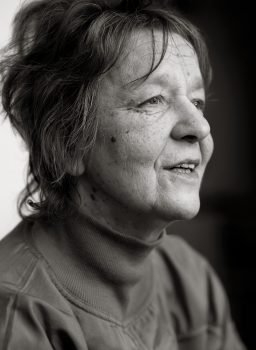
Sirkka Turkka. Photo: Pertti Nisonen
Sirkka Turkka is interviewed by Markku Huotari
Snowflakes are already covering the forest, and an angry wind is blowing off Lake Lohjanjärvi. It is autumn, and in the courtyard, at the roots of a stunted rowan, is a lounge chair, its paint already peeling.
‘I’ve left the chair there because my mother used to sit in it and knit.’
I start at Sirkka Turkka’s comment. In my mind is her last-but-one volume of poetry, Vaikka on kesä (‘Although it’s summer’, 1983); its poems sound a contemporary lament, occasioned by her mother’s death.
‘There’s nothing made-up in my poetry,’ says Sirkka Turkka.
Landscape, nature, the circular path of life – all of these have left their wounds in Sirkka Turkka’s poetry. But as she writes in Tule takaisin, pikku Sheba (‘Come back, little Sheba’, 1986), winner of the Finlandia Prize 1987, ‘from the wounds life grows’. More…