

Archive for 1982
Chronicles of crisis
Issue 4/1982 | Archives online, Fiction, Prose
Books from Finland presents here an extract from Dyre prins, a novel by the Finland-Swedish writer Christer Kihlman that is to be published in 1983 by Peter Owen of London under the title Sweet Prince, in a translation by Joan Tate.
Christer Kihlman (born 1930) first became known as a poet; but, after publishing two collections of poetry, he turned to novels. He has been branded a merciless scourge of the bourgeoisie. Equally important in his writing, however, are his masterly psychological analyses, his examination of the myriad aspects of the human personality, his sovereign disregard for taboos and his unflagging search for the truth. His books are about crises – the conflict between the generations, between the individual and society, between opposing political ideologies, between homosexual and heterosexual love. As Ingmar Svedberg remarked in an extensive appreciation of Kihlman’s work that appeared in Books from Finland 1-2/1976, ‘In his perceptive moral analyses, his exploration of the depths of human destructiveness and degradation, Kihlman is sometimes reminiscent of Faulkner.’ Since 1970, Kihlman has published three revealing autobiographical works, two of them dealing with his encounter with South America; Dyre prins, first published in 1975, represents a brief interlude of fiction.
The extract printed below is accompanied with a personal appreciation of the novel by its English translator, Joan Tate
Grandfather’s astonishing revelation gave me a new perspective on my life. I had suddenly been given a concrete, genuine foundation for both my hatred and my self-esteem. In a way I took the story of my origins as an extreme confirmation of the rightness of the Communist interpretation of reality, and at the same time it gave me a wonderful, dazzling sensation of being someone, despite everything, of having a place in a meaningful human perspective of time, despite everything, of being a link, however modest, in the historical family tradition. I did not need to found a dynasty; I already belonged to a dynasty, if only a minor branch. One was less important than the other, and even if the two experiences were irreconcilable and contradictory, they existed all the same in the same consciousness, contained within the same consciousness, my consciousness. I, Donald Blad! More…
A personal appreciation
Issue 4/1982 | Archives online, Authors
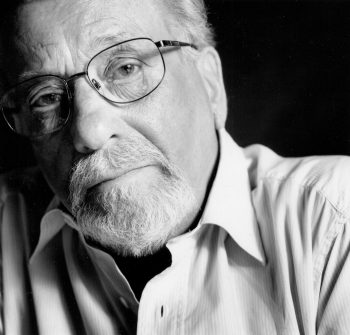
Christer Kihlman. Photo: Magnus Weckström
Almost twenty years ago, a book arrived on my table from a London publisher, a large book called Den blå modern, by someone called Christer Kihlman, of whom I had never heard. Although the book came from Stockholm, in fact it turned out to be the work of a Finland-Swedish writer, perhaps the second or third I had ever read.
The book was to me remarkable. I had never read anything quite like it before, and I have been reading adult fiction for over fifty years. Looking back now in my ancient tatty files, I see I typed three single-spaced pages of synopsis and two and a half of comment, and even translated several extracts, not something I can normally afford to do. This was partly because I was impressed with the book, partly because it was almost impossible to explain the style, or styles, in which it was written, and also it was very difficult to say succinctly just what kind of book it was. The blurb called it a ‘family chronicle’, which in a way it was, but in all other respects it was nothing like what we normally call a family chronicle, anyhow of the kind so familiar from the United States. Two sons trying to live up to their father’s image of a third son, who is dead; but in fact it seemed to me to be the story of one man’s struggle with himself and the agony of existing in a world in which pain and hatred and suffering and despair are constantly victorious over love. In the book was almost everything any thinking person struggles with in his or her mind during a whole lifetime, a search for some kind of meaning in a life that appears meaningless. More…
They believe in Father Christmas
Issue 4/1982 | Archives online, Authors, Interviews
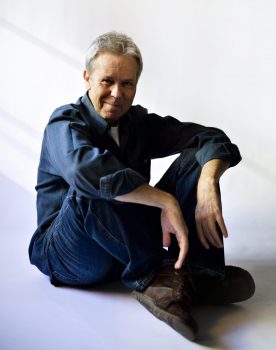
Mauri Kunnas. Photo: Otava / Katja Lösönen
Mauri Kunnas, 32, says he believes in Father Christmas more than ever before. His wife Tarja agrees; she and her husband work together in their studio in Turku on the illustrated children’s books that have won them fame in Finland and abroad. It is easy to believe the truth of the young artists’ protestations: the success of their book Joulupukki, or Santa Claus, must have seemed like a gift from Father Christmas. It appeared in the early autumn of 1981 and was taken to the Frankfurt Book Fair by its publishers, Otava, where it attracted more attention than any Finnish book had done previously. Rights immediately went to ten countries, from Japan to Canada, and four more contracts have since been concluded. Arto Seppälä intervews Mauri and Tarja Kunnas
Mauri Kunnas says he has drawn all his life. He intended to study law, but his sister persuaded him to go to art school instead. Towards the end of his course, short of money, Kunnas began to draw a strip cartoon for a Helsinki evening paper. He progressed to cartoons – but at present his plans for new books keep him too busy to contemplate anything else.
Mauri Kunnas’s first book was Suomalainen tonttukirja (‘The book of Finnish fairies’, 1979). ‘I never thought I would write children’s books until the fairy idea came into my head,’ he says. ‘At that time I was unhappily employed in an advertising agency, and life wasn’t living up to my expectations. I wanted to splash out, try something new. The fairy idea came to me as the result of a chance conversation about the Finnish world of faerie – elves, gnomes, guardian spirits and so on. More…
The Storm • September
Issue 3/1982 | Archives online, Fiction, Prose
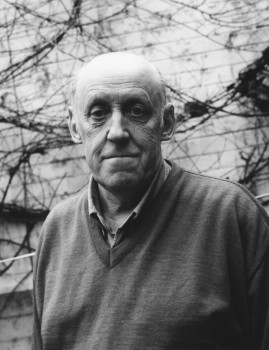
Bo Carpelan. Photo: Charlotta Boucht
Extracts from Jag minns att jag drömde (‘I remember dreaming’, 1979)
The Storm
I remember dreaming about the great storm which one October evening over forty years ago shook our old schoolhouse by the park. My dream is filled with racing clouds and plaintive cries, of roaring echoes and strange meetings, a witch’s brew still bubbling and hissing in the memory of those great yellow clouds.
Our maths teacher – a small sinewy woman who seemed to have swallowed a question mark and was always wondering where the dot had gone, so she directed us in a low voice and with downcast eyes as if we didn’t exist – and yet her little black eyes saw everything that happened in the class, and weasel-like, were there if anyone disobeyed her – was writing the seven times table on the blackboard, when a peculiar light filled our classroom. We looked across at the window; the whole schoolhouse seemed to have been suddenly transformed into a railway station, shaking and trembling, a whistling sound penetrating the cold thick stone walls, and at raging speed, streaky clouds of smoke were sliding past the window, hurtling our classroom forward as if we were in an aeroplane. Our teacher stopped writing and raised her narrow dark head. Without a word, she went over to the window and stood looking out at the racing clouds. More…
Writer in demand
Issue 3/1982 | Archives online, Fiction, poetry
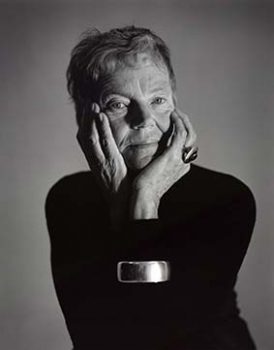
Märta Tikkanen. Photo: Stefan Bremer
Poems from Århundradets kärlekssaga (The Love Story of the Century)
Märta Tikkanen (born 1935), a Finland-Swedish journalist, teacher and mother of four children, made her literary debut with the novel Nu imorron (‘Now tomorrow’) in 1970. It is a story of the liberation of one woman who breaks free from her traditional role. Her next novels, Ingenmansland (‘No man’s land’, 1972) and Vem bryr sej om Doris Mihailov (‘Who cares about Doris Mihailov’, 1974) brought her fame in Scandinavia, but it was not until her fourth novel, Män kan inte våldtas (Manrape, translated by Alison Weir, Virago, 1978) appeared in 1975 that she made her international breakthrough. To date the book has been translated into eight languages and a film adaptation has been made by Jörn Donner.
Her next work, a cycle of poems called Århundradets kärlekssaga (The Love Story of the Century, 1978) became very popular: it has been translated into seven languages as well as adapted for radio, television and the stage . In 1979 she was awarded the Nordic Women’s Alternative Literature Prize. Die Liebesgeschichte des Jahrhunderts, a monologue play based on Verena Reichel’s translation (Rohwolt Taschenbuch Verlag, 1981) is presently being staged in some twenty theatres in West Germany, Austria and Switzerland. Recently Der Spiegel devoted a page to her career. The American première, directed by Margaret Booker, will take place in Intiman Theatre, Seattle. More…
Arska
Issue 3/1982 | Archives online, Fiction, Prose
A short story from Kaksin (‘Two together’). Introduction by Pekka Tarkka
A landlady is a landlady, and cannot be expected – particularly if she is a widow and by now a rather battered one – to possess an inexhaustible supply of human kindness. Thus when Irja’s landlady went to the little room behind the kitchen at nine o’clock on a warm September morning, and found her tenant still asleep under a mound of bedclothes, she uttered a groan of exasperation.
“What you do here this hour of day?” she asked, in a despairing tone. “You don’t going to work?”
Irja heaved and clawed at the blankets until at last her head emerged from under them.
“No,” she replied, after the landlady had repeated the question.
“You gone and left your job again?”
“Yep.” More…
Reality versus morality
Issue 3/1982 | Archives online, Authors
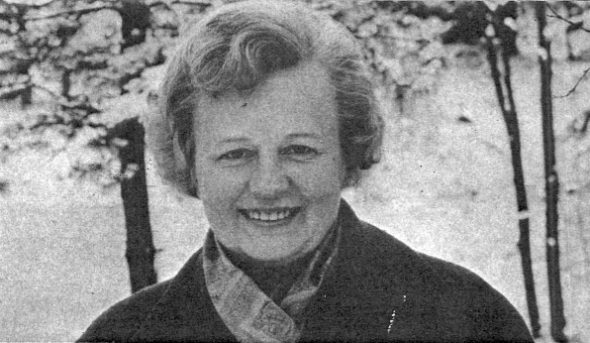
Eila Pennanen. Photo: Anonymous (Suomen Kuvalehti 1965) via Wikimedia Commons
Reviewing Eila Pennanen‘s second collection of essays, which appeared earlier this year under the delightfully ambiguous title of Kirjailijatar ja hänen miehensä (‘The authoress and her… man? … men? … husband?… husbands?’), a critic called attention to the heading she had chosen for her essay on Bernard Malamud: ‘Malamud’s ignoble hero’. His comment on this was that the moral judgment implicit in such a title would be both pointless and valueless if Pennanen had maintained it with logical consistency throughout the essay. If in fact she does no such thing, it is because she knows how to look at a character, however ignoble, with an eye for subtleties and a great deal of psychological insight. This is something one often notices about Eila Pennanen: she is apt to begin by labelling somebody or something ‘good’ or ‘bad’, and even to sound quite defiant about it, but she is never, in the end, content to leave it at that. I once heard her give a lecture on Joel Lehtonen. She startled her audience by the vehemence with which she avowed the feelings of loathing or sympathy aroused in her by characters or events in Lehtonen’s books. Her cheeks blazed as she talked. Then, just as unexpectedly, she chided herself for exaggerating, took back a lot of what she had said, laid bare the reasons for Lehtonen’s contradictoriness, and left her hearers in a condition of fruitful perplexity. Whatever they may have thought or felt about the ‘moral approach’ to criticism, they were left in no doubt as to the wit and intelligence of its leading Finnish exponent. More…
About calendars and other documents
Issue 2/1982 | Archives online, Fiction, Prose
An extract from Sudenkorento (‘The dragonfly’, 1970). Introduction by Aarne Kinnunen
I now have. Right here in front of me. To be interviewed. Insulin artist. Caleb Buttocks. I have heard. About his decision. To grasp his nearly. Nonexistent hair and. Lift. Himself and. At the same time. His horse. Out of the swamp into which. He. Claims. He has sunk so deep that. Only. His nose is showing. How is it now, toe dancer Caleb Buttocks. Are you. Perhaps. Or is It your intention. To explain. The self in the world or. The world. In the self. Or is It now that. Just when you. Finally have agreed to. Be interviewed by yourself. You have decided. To go. To the bar for a beer?
– Yes. Can you spare a ten?
– Yes.
– Thanks. See, what’s really happened is that. My hands have started shaking. But when I down two or three bottles of beer, that corpse-washing water as I’ve heard them call it, my hands stop shaking and I don’t make so many typing errors. If I put away six or seven they stop shaking even more and the typing mistakes turn really strange. They become like dreams: all of a sudden you notice you’ve struck it just right. Let’s say, ‘arty’ becomes ‘farty’. Or I mean to say, ‘it strikes me to the core’ I end up typing ‘score’. It’s like that. A friend of mine, an artist, once stuck a revolver in my hand. Imagine, a revolver! I’ve never shot anything with any kind of weapon except a puppy once with a miniature rifle. My God, how nicely it wagged its tail when I aimed at it, but what I’m talking about are handguns, those shiny black steelblue clumps people worship as heaven knows what symbols. It’s not as if I haven’t been hoping to all my life. And now, finally, after I’d waited over fifty years, it turned out that the revolver was a star Nagant, just the kind I’d always dreamed of. So if I ever got one of those, oh, then would sleep through the lulls between shots with that black steel clump ready under my pillow. Well, my friend the artist set out one vodka bottle with a white label and three brown beer bottles with gold labels on the edge of a potato pit – we had just emptied all of them together – stuck the fully loaded star Nagant into my hand, took me thirty yards away and said:
– Oh, Lord. More…
Juha Mannerkorpi (1915–1989) and the metamorphosis of the self
Issue 2/1982 | Archives online, Authors
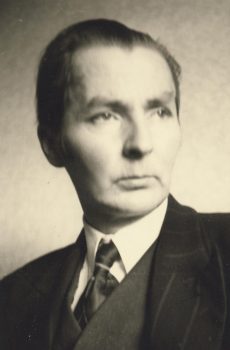
Juha Mannerkorpi. Photo: SKS Archives
The chapter, entitled ‘About calendars and other documents’, is a section of Juha Mannerkorpi’s book, Sudenkorento eli erään pakaraisen esittävät seikkailut (‘The dragonfly, or the representative adventures of a certain buttocks’, 1970). The main character is a writer, Caleb Buttocks, a long-term diabetic who can get around only on crutches and spends most of his days sitting in his room smoking and drinking beer. Pain and depression are his daily companions.
In the beginning, Caleb Buttocks attempts a real adventure: lifting himself out of the swamp like Baron von Münchhausen and going on an outing with his wife. The adventure comes to a bad end; he is not up to it. Thereafter, he has to be content with ‘representative adventures’: dreams, memories, and nightmares which are interwoven with the present time.
Sudenkorento is largely a first-person narrative which operates on many levels and the language of which is exceptionally rich. The narrator makes use of many different elements: fairy tales, poems, fantasies realistic narratives, and reminiscences. Sudekorento can be considered the most important book by Juha Mannerkorpi (1915-1980), and represents a synthesis of his earlier writing, which includes some twenty works since 1946: poems, plays, radio-plays, novels, and short stories. After the publication of Sudenkorento Mannerkorpi wrote a short diary-like work, Päivänsinet (‘Heavenly blue’, 1979), a study of the will to live in the shadow of a serious illness, diabetes, which is a subject he often dealt with in his work. Characteristic of Mannerkorpi’s writing are his analyses of the relationship of the self with the world and his explication of existential questions. In the European literary milieu, he is closest to Camus, Sartre and Beckett, all of whom he has translated into Finnish. More…
The Session
Issue 2/1982 | Archives online, Fiction, Prose
Pappas flicka (‘Daddy’s girl’, 1982), an extract of which appears below, is published in Finland by Söderstrom & C:o and in Sweden by Norstedt. The Finnish translation is published by Tammi. Introduction by Gustaf Widén
At first I say nothing, as usual.
Dr Berg also sits in silence. I can hear him moving in his chair and try to work out what he’s doing. Is he getting out pen and paper? Or perhaps he has a tiny soundless tape-recorder he is switching on.
Or is he just settling down, deep down into his armchair, one leg crossed over the other, like Dad used to sit? I used to climb up on to his foot. The he would hold my hands and bounce his foot up and down, and you had to say “whoopsie” and finally with a powerful kick, he would fling me in the air so that I landed in his arms.
I have worked it out that the little cushion under my head is to stop us lunatics from turning our heads round to look at Herr Doktor.
It would certainly be nice to sit bouncing up and down on Dr Berg’s foot. His ankle would rub me between my legs …
I soon start feeling ashamed and blush.
“Mm,” says Dr Berg, as if reading my thoughts. Or can he see my face from where he is sitting? I try rolling my eyes up to catch a glimpse of him, but all I can see is the ceiling with all its thick beams.
“I seem to have been here before,” I say. More…
Poems
Issue 2/1982 | Archives online, Fiction, poetry
Introduction by George C. Schoolfield
The Cranes
Today the springtime shot its arrow point
into the winter’s heart:
the cranes’ crooked plow.
Today on the ice
the water splashed
half-a-yard high beneath the horse’s hooves –
may the magpie laugh cunningly
beside the ice-hole’s edge –
beneath the snow the earth growls
the hidden bodies of the trees cry:
the cranes the cranes!
From Taggiga lågor (‘Barbed flames’, 1924)
Johan Bargum’s analyses
Issue 2/1982 | Archives online, Authors
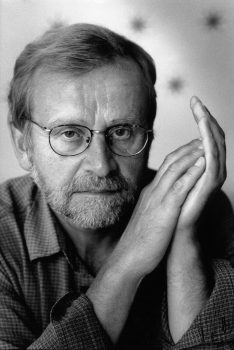
Johan Bargum. Photo: Irmeli Jung
Few Finland-Swedish authors can make a living by their writing. A readership of little more than 300,000 cannot support a large number of writers, and only the most successful books sell more than a thousand copies. Writers have thus no choice but to seek other markets, notably in Sweden or among the Finnish-speaking population.
Both alternatives present problems, but popular writers like Henrik Tikkanen and Christer Kihlman are tending more and more to publish simultaneously in all three markets. Since the publication of his novel Den privata detektiven (‘The private detective’) in 1980, which even became the Book of the Month in Sweden, Johan Bargum has joined this group. Enthusiastic reviewers have since speculated on the possibility of translations into other European languages.
Born in 1943, Bargum grew up in Helsinki and, like so many other writers with their roots in the Finnish capital, he comes from an upper-class family. Politically he belongs to the left, while artistically he has benefited from family tradition: both his grandmother, Margit von Willebrand-Hollmerus, and his mother, Viveca Hollmerus, are well-known authors. Writing as a family tradition is actually quite a common phenomenon in Finland-Swedish literature.
A social conscience
Thanks to his skill as a dramatist as well as a prose-writer, Johan Bargum has been able to live by his pen for the past ten years. Early in the 1970s he had a success with Som snort (‘A cinch’), Bygga bastu (‘Building a sauna’) and Virke och verkan (‘Material and the making’), all specially written for Lilla Teatern, the Swedish-language theatre in Helsinki. In this trilogy he was concerned with the difficulties encountered by small businessman in their struggle against large monopolies. His text is characterized by a strong ironic humour. More…
A portrait of Elmer Diktonius
Issue 2/1982 | Archives online, Authors
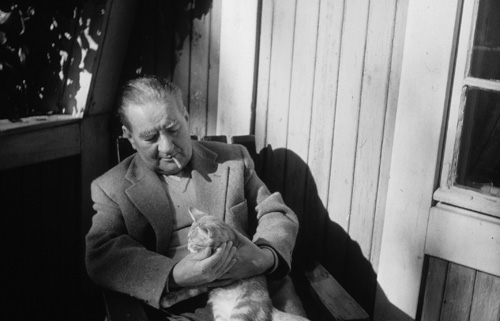
Elmer Diktonius at his home in Kauniainen (Grankulla). Photo: Wikimedia Commons / Public domain
Elmer Diktonius, one of the leading Finland-Swedish modernists of the 1920s, was a revolutionary poet, prose-writer and critic who also tried his hand at composing. Professor George Schoolfield, whose article on Diktonius appears below, appends his own translations of several of the lyrics: a filler selection is going to be published in the United States, Recently Professor Schoolfield has been working on a biography of Diktonius which he hopes to publish soon.
The literary fate of the Finland-Swedish modernist Elmer Diktonius (1896-1961) has not been an altogether happy one. Saluted early and late in his career as Finland’s Strindberg and as a possible rival to Mayakovsky in the contest for the greatest lyricist of the revolution, Diktonius would seem, surely, to deserve a place on the world’s literary stage. Yet the attention he has received outside the north has been mostly unwitting: the writers of program notes quote his description of the Silbelius Fourth, ‘the bark-bread symphony’ without knowing its source, the collected concert-reviews of Opus 12: Musik (1933). Surveys that might have introduced him to a larger public are silent. The chubby Pelican Guide to the European Literature of Modernism ignores him; the Penguin Book of Socialist Verse omits him from its 134 specimens of the lyric left; and Ulrich Weisstein’s volume of Expressionism as an International Literary Phenomenon does not have him in its chapter on ‘Expressionism in Scandinavia’, although he would qualify – as the Swedish scholar Bill Romefors has proved – as the major northern heir of German expressionism. More…
Poems
Issue 2/1982 | Archives online, Fiction, poetry
Sirkka Turkka is among the most important poets who started their work in the 1970s. So far she has published five collections of poetry and one work in prose. ‘I speak of death when I mean to speak of life,’ writes Sirkka Turkka in one of the poems in her collection Mies joka rakasti vaimoaan liikaa (‘The man who loved his wife too much’, 1979). The theme of death is close at hand, too, in the previously unpublished poems printed below. Introduction by Arto Kytöhonka
1
Before death itself comes
it paints the pine boles red
around this house
It erects a moon in the sky, a luminous moon,
set on edge like an old dish
with the light enamel peeling off.
Onto this house, over which
night is now pleating.
And the house, in the veering waters, in the clinging waters,
is slowly preparing itself, quite by itself, for death. More…
On Sirkka Turkka
Issue 2/1982 | Archives online, Authors
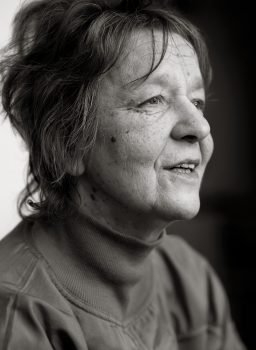
Sirkka Turkka. Photo: Pertti Nisonen
1.
I met Sirkka Turkka towards the end of the sixties; she was a friend of a girl-friend of mine.
We called her Hemuli. Not that she bore any resemblance to the Hemulen of the Moomin books, but she did view the world with the same charitable curiosity as some of Tove Jansson’s immortal characters.
In the evenings Hemuli would speak with wit and wisdom, as the sky darkened, then paled towards dawn. Her words were spontaneous: she talked of nature, of the city, always with a gentle understanding, a compelling magic which dissolved ideas into music, full of a sad beauty, echoes of loneliness, painful and happy memories. She looked life straight in the eye, without illusions.
What I’m saying, Sirkka Turkka was a master of the spoken word. She was a story-teller, a ballad-singer, a reciter of epic tales, creating literature of a kind no longer recognized as literature. More…