

Archive for 2011
Tchotchkes for the tsar
11 August 2011 | Reviews
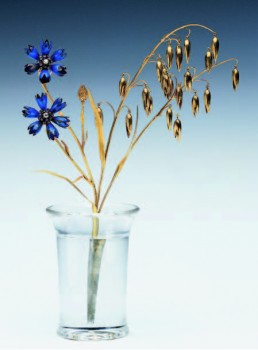
Cornflower and ear of oats: one of the several Fabergé gemstone ornaments now owned by Queen Elizabeth of England (gold, rock crystal, diamonds, enamel, ca 18 cm)
Ulla Tillander-Godenhielm
Fabergén suomalaiset mestarit
[Fabergé’s Finnish masters]
Design: Jukka Aalto/Armadillo Graphics
Helsinki: Tammi, 2011. 271 p., ill.
ISBN 978-951-31-5878-1
€57, hardback
In its online shop, the Hermitage Museum in St Petersburg sells a copy of a most delicate, enchanting little nephrite-and-opal lily of the valley that perfectly imitates nature, sitting in a vase made of rock crystal that looks like a glass of water.
These small flowers made of gold and gemstones were manufactured by the jeweller Fabergé a hundred years ago. The lily of the valley was the most frequently used floral motif in the Fabergé workshops – it was the favourite flower of Empress Alexandra (1872–1918), and the imperial family was the the foremost client of the world’s foremost jeweller.
The replica (13.5 centimetres high) is available at the Hermitage as a ‘luxury gift’ for the price of mere $3,300. (N.B. Since we published this review, the ‘luxury gift’ items seem to have disappeared from the Hermitage online shop selection, so we have removed the link. Several Fabergé egg replicas are available though, ranging in price from $200 upwards – link below.)
For those who feel the price is excessive, there is also a rather modestly-priced little bay tree (original: gold, Siberian nephrite, diamonds, amethysts, pearls, citrines, agates and rubies as well as natural feathers, about 30 centimetres tall, featuring a little bird that emerges flapping its wings and singing when a small key is turned) at just $ 219,95. Despite its form, it is classified as one of the famous imperial Easter eggs. (However, as I write, this item is unfortunately sold out…) More…
Sodan haavoittama lapsuus [A childhood scarred by war]
11 August 2011 | Mini reviews, Reviews
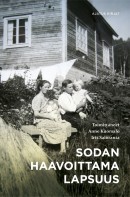 Sodan haavoittama lapsuus
[A childhood scarred by war]
Toimittaneet [Edited by]: Anne Kuorsalo & Iris Saloranta
Helsinki: Gummerus, 2010. 288 p., ill.
ISBN 978-951-20-8107-3
€ 34, hardback
Around 1.5 million Finns were children during the Winter and Continuation Wars of 1939–1944. Three hundred children are estimated to have been killed by bombs, and between 55,000 and 80,000 were orphaned by the war. Many more deaths were caused by diseases such as tuberculosis, polio and cerebral meningitis. Some children lived fairly secure lives on farms with their own families or with relatives; some were sent to live with foster families in Sweden; some were evacuated from Karelia and a small number were interned in camps because of their German heritage. Many under-18s served in the Finnish military and would now be considered child soldiers. Finns who were born in the 1930s and early 1940s have long been a neglected group: for several decades, discussions of the victims of war were avoided for foreign policy reasons as well. It is only in recent years that discussions have emerged concerning the fates of the children who were sent to Sweden during the war and those who were born to Finnish women, fathered by German soldiers. This book includes the stories of thirty people. The views of some refugees who have settled in Finland are included as well, such as the story of Mahmoud, who fled from Iraq via people smugglers.
Translated by Ruth Urbom
Summer in the bookshop
11 August 2011 | In the news
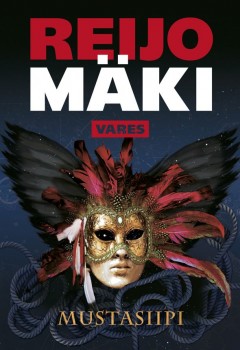 Not a surprise: in June and July Finns liked to read thrillers, both Finnish and foreign, as the Bookseller’s Association of Finland’s list of the best-selling Finnish fiction shows. Three out of top five on the Finnish fiction list were crime stories; number one was Mustasiipi (‘Blackwing‘, Otava), a thriller by Reijo Mäki.
Tuomas Kyrö’s book of short prose about a grumpy old man resisting all sorts of contemporary fads, Mielensäpahoittaja (‘Taking offence’, WSOY), was stubborn enough to stick to number four (as in May).
Sofi Oksanen’s hugely successful novel about women and Estonian history, Puhdistus (2008), English version: Purge, keeps going strong: it is still number six on the list.
On the non-fiction list there were books, among others, on cooking, gardening and birds – in summer Finns like to grill barbecues while listening to birdsong and reading about diets, trekking and handicrafts…
Sun and shade
3 August 2011 | Extracts, Non-fiction
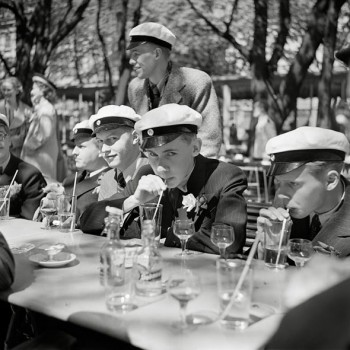
Springtime: the new graduates celebrate the beginning of summer. Photos: ©Jussi Brofeldt
Documentary film-making and photography arrived in Finland in the 1920s with pioneers like Heikki Aho and Björn Soldan, who founded a film company in 1925 in Helsinki. They also took thousands of photographs of their city; in a selection taken in the turbulent 1930s, people go on about their lives, rain or shine
Photographs from Aho & Soldan: Kaupunkilaiselämää – Stadsliv – City life. Näkymiä 1930-luvun Helsinkiin (‘Views of Helsinki of the 1930s’, WSOY, 2011)
Photos: Aho & Soldan@Jussi Brofeldt. Texts, by Jörn Donner and Ilkka Kippola, are published in Finnish, Swedish and English.
The exhibition ‘City life‘ is open at Virka Gallery of the Helsinki City Hall from 1 June to 4 September.
Aho and Soldan were half-brothers, Heikki the eldest son of the writer Juhani Aho (1861–1921; an extract from one of his novels is available here) and the artist Venny Soldan-Brofeldt. (Juhani Aho changed his original Swedish surname, Brofeldt, to Aho in 1907), Björn Soldan was Aho’s son from an extramarital relationship. More…
Aamu Nyström: I.K. Inha – Valokuvaaja, kirjailija, kulttuurin löytöretkeilijä [I.K. Inha – Photographer, writer, cultural explorer]
3 August 2011 | Mini reviews, Reviews
 I.K. Inha – Valokuvaaja, kirjailija, kulttuurin löytöretkeilijä
[I.K. Inha – Photographer, writer, cultural explorer]
Jyväskylä: Minerva, 2011. 271 p., ill.
ISBN 978-952-492-441-2
€ 31, hardback
I.K. Inha (1865–1930) was a photographer, a writer, a translator and a journalist. He is known particularly for his photographic journeys in Finland and Russian Karelia. Both the texts and the photographs in Inha’s landscape and nature works are of a high aesthetic standard. This book focuses on Inha’s lesser-known works and the various phases of his life. Inha’s travel diary documents the cycle journey he made as a student in 1886 to Germany and Switzerland. In 1897 Inha was appointed Finland’s first-ever foreign correspondent; from Athens he reported on events such as the Greco-Turkish War. In 1899 and 1901 Inha was posted to England, where he observed Queen Victoria’s funeral and the coronation of King Edward VII. Aamu Nyström, the niece of Inha’s brother, has had access to letters, photographs and written and oral recollections of family members.
Translated by Ruth Urbom
Timo Kalevi Forss & Martti Lintunen: Karjala edestakaisin [Karelia back and forth]
3 August 2011 | Mini reviews, Reviews
 Karjala edestakaisin
[Karelia back and forth]
Teksti [Text by]: Timo Kalevi Forss
Kuvat [Photographs by]: Martti Lintunen
Helsinki: Like Kustannus, 2010. 164 p., ill.
ISBN 978-952-01-0504-4
€ 29, paperback
At the end of the Continuation War (1941–44), some 400,000 Karelians were forced to abandon their homes. They were resettled in various parts of Finland, and nowadays around a fifth of Finns have some Karelian heritage. Through interviews with fifteen people living in the modern-day region of Karelia, this book documents the part of Karelia that was ceded to the Soviet Union. The researchers travelled to Vyborg, Sortavala, Priozersk, and the Valaam Monastery. The interviewees include a construction company owner building a house on an old Finnish stone foundation, a rock music club owner from Vyborg and a colonel who served in the counter-terrorism division of the Russian army. The photographs convey the range of buildings in Karelia, from Finnish houses to traditional Karelian homesteads, from mansions of the nouveaux riches to Soviet-era tower blocks. In the idyllic villages around Lake Ladoga, cows graze near small houses; time seems to have been frozen around the turn of the last century. The long sandy beaches of the spa towns on the shores of the Gulf of Finland are now filled with tourists from St Petersburg.
Translated by Ruth Urbom
A light shining
28 July 2011 | Essays, Non-fiction
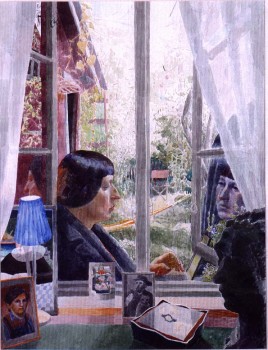
Portrait of the author: Leena Krohn, watercolour by Marjatta Hanhijoki (1998, WSOY)
In many of Leena Krohn’s books metamorphosis and paradox are central. In this article she takes a look at her own history of reading and writing, which to her are ‘the most human of metamorphoses’. Her first book, Vihreä vallankumous (‘The green revolution’, 1970), was for children; what, if anything, makes writing for children different from writing for adults?
Extracts from an essay published in Luovuuden lähteillä. Lasten- ja nuortenkirjailijat kertovat (‘At the sources of creativity. Writings by authors of books for children and young people’, edited by Päivi Heikkilä-Halttunen; The Finnish Institute for Children’s Literature & BTJ Kustannus, 2010)
What is writing? What is reading? I can still remember clearly the moment when, at the age of five, I saw signs become meanings. I had just woken up and taken down a book my mother had left on top of the chest of drawers, having read to us from it the previous day. It was Pilvihepo (‘The cloud-horse’) by Edith Unnerstad. I opened the book and as my eyes travelled along the lines, I understood what I saw. It was a second awakening, a moment of sudden realisation. I count that morning as one of the most significant of my life.
Learning to read lights up books. The dumb begin to speak. The dead come to life. The black letters look the same as they did before, and yet the change is thrilling. Reading and writing are among the most human of metamorphoses. More…
Tiia Aarnipuu: Jonkun on uskallettava katsoa. Animalian puoli vuosisataa [Someone’s got to dare to look. Half a century of Animalia]
28 July 2011 | Mini reviews, Reviews
 Jonkun on uskallettava katsoa. Animalian puoli vuosisataa
[Someone’s got to dare to look. Half a century of Animalia]
Helsinki: Like Kustannus, 2011. 209 p., ill.
ISBN 978-952-01-0582-2
€ 33, paperback
This book has been published to mark the 50th anniversary of Animalia, the Federation for the Protection of Animals. The public image of the organisation has varied between one of a conservative club of ladies and gentlemen and that of a radical terrorist group. Animalia was founded in 1961, inspired by Johan Börtz, a Swede who gave lectures on the plight of animals used in experiments. Animalia began making visits to inspect animal testing facilities, which were completely unregulated in the early 1960s. Gradually the animal rights movement became more radicalised, somewhat later than in places such as Britain. Animal rights became a subject of wider debate in Finland in the 1980s. In the 1990s, the organisation was falsely linked with attacks made on fur farms by direct-action youth groups. Animalia’s stance has been to renounce vandalism and violence. In February 2010 Animalia launched its largest-ever information campaign, aimed at ridding Finland of fur farms by 2025.
Translated by Ruth Urbom
Johanna Ilmakunnas: Kapiot, kartanot, rykmentit. Erään aatelissuvun elämäntapa 1700-luvun Ruotsissa [Trousseaus, manors, regiments. The lifestyle of one noble house in 18th-century Sweden]
28 July 2011 | Mini reviews, Reviews
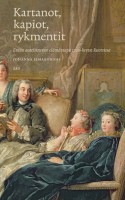 Kapiot, kartanot, rykmentit. Erään aatelissuvun elämäntapa 1700-luvun Ruotsissa
[Trousseaus, manors, regiments. The lifestyle of one noble house in 18th-century Sweden]
Helsinki: Suomalaisen Kirjallisuuden Seura, 2011. 524 p., ill.
ISBN 978-952-222-264-0
€ 38, hardback
This book deals with the lifestyles, finances and consumption habits of the high nobility of Sweden in the 18th century (which included Finland at that time). The central figure is Count Axel von Fersen (1719–1794), a very influential statesman and soldier, and his German-Baltic lineage. This portrait broadens into a lifestyle study, providing extensive information on the customs and the world of the nobility of that era, such as the institution of marriage, child-rearing, mistresses, clothing and interior decor – as indicators of one’s social status – artistic activities, games and gastronomy. The topic of consumption is linked to social, cultural, ideological and legal perspectives. In the lives of the high nobility, money – or lack thereof – was not a defining feature; rather, choices were governed by ideals, values and obligations such as honour, reputation, faith and origin. Johanna Ilmakunnas is a historical researcher and editor. This book is based on her award-winning doctoral thesis (2009).
Translated by Ruth Urbom
Päivi Jantunen: Kaj & Franck. Esineitä ja lähikuvia / Designs & Impressions
6 July 2011 | Mini reviews, Reviews
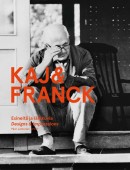 Kaj & Franck. Esineitä ja lähikuvia. / Designs & Impressions
English translations: Peter Herring and Esa Lehtinen
Helsinki: WSOY, 2011. 166 p., ill.
ISBN 978-951-0-36898-5
€ 42, hardback
This dual-language book showcases the work of one of Finland’s most widely known glass and ceramic designers in his centenary year. The unaffected designs and clean geometric shapes of the tableware designed by Kaj Franck (1911–1989) are well suited to a wide range of cultures. Franck’s guiding principle was to create anonymous, self-evident objects for everyday use. In the 1940s and 1950s, Franck updated tableware to match post-war changes in society; he wanted to get away from the sets of crockery that filled up smaller kitchen cupboards. His designs that emphasised environmental principles and equality were ahead of their time with their ideology of sustainable development. This book portrays Franck’s life and career, which centred on the oldest glassworks in Finland in the community of Nuutajärvi, where he worked from the early 1950s until his death. Interviews with local residents and Franck’s colleagues create a portrait of him as a colourful personality. Ample illustrations provide a cross-section of Franck’s design output. In addition to his mass-produced items, there are photos of Franck’s one-off artistic creations.
Translated by Ruth Urbom
Vesa Puuronen: Rasistinen Suomi [Racist Finland]
6 July 2011 | Mini reviews, Reviews
 Rasistinen Suomi
[Racist Finland]
Helsinki: Gaudeamus, 2011. 286 p., ill.
ISBN 978-952-495-196-8
€ 36, paperback
Multiculturalism, immigration and racism have become more frequent subjects of discussion in Finland, particularly as a result of the 2008 local elections and the subsequent speeches and writings by people critical of immigration. This book aims to move the discussion forward by describing and defining racism, presenting developments in research into racism, racism perpetrated by Finns against Sámi and Russians, and the history of Finnish enmity towards Russians from the early 20th century to the present day. The author considers the use of shaming and subjugation as tools of exterminating Sámi culture, as well as linguistic discrimination and denial of land ownership rights against the Sámi. The book also examines the development of hate crimes since the 1990s, racism in Finnish politics and the politics of multiculturalism as practised in Finland, which studies have shown treat different minority groups in different ways. Vesa Puuronen is a sociologist and a researcher into racism who works at the University of Eastern Finland.
Translated by Ruth Urbom
Best in show
30 June 2011 | This 'n' that
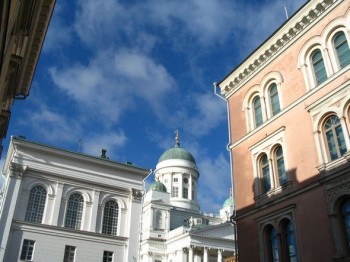
Cooler than we thought: Helsinki. Photo: Leena Lahti
So Helsinki has just come out top in Monocle magazine’s Quality of Life survey.
Monocle, which takes a determinedly internationalist and unfailingly style-conscious view of politics, business, culture and design, was founded by its editor Tyler Brûlé in 2007. As anyone who follows his weekly column in the Financial Times will know, Brûlé leads a peripatetic life that will have given him personal experience of most, if not all, of the 25 cities under Monocle’s lens in this survey.
Monocle’s preferences, as the top three cities on the list indicate – Helsinki is followed by Zurich and Copenhagen – is for small, well organised, forward-looking cities. Oh, and ones with good water pressure – his home town of London, which might otherwise have featured higher on the list, was debarred by its Victorian water system, which rules out the cheering experience of an energising shower before work in the morning.
So, on a list clearly based on the minutest of scrutiny, just what is it that makes life in Helsinki so different, so appealing?
According to the criteria used, ‘the world’s most liveable city’ boasts a low crime rate, good school system, excellent public transport and low unemployment – but where Helsinki really stands out, for Monocle, is in its continuous implementation of intelligent urban planning (large docklands in the city centre have been demolished, for example, and replaced by desirable new housing areas) and its dynamic, can-do, approach to doing business.
Oh, and the eating and food culture in the city is flourishing, as the ‘New Nordic Cuisine’ rules. And, Monocle being Monocle, the sheer physical beauty of the city will have played its part in earning it its accolade. More details are to be found in the current, July-August, issue of Monocle.
Much of this is certainly true. From a resident’s point of view, Helsinki’s street culture has been transformed in the past fifteen to twenty years. The transportation system is a delight, although one that Helsinki people tend to take for granted, with clean buses, trains and trams running, broadly speaking, on time, as is the education system, with the state providing excellent schools to the extent that private-sector education is practically non-existent.
As for what the ‘New Nordic Cuisine’ is exactly, this remains slightly elusive to your editors here at Books from Finland, although it clearly has to do with well-sourced, locally grown food and simple flavours. We do agree that the demise of the less-hip beer-drinking dens of yesteryear and the rise of well-lit cafés and restaurant with pleasant outdoor seating are indeed reality. Old greasy spoons are on the wane, definitely.
Oh yes: and there’s nothing wrong with Helsinki’s water pressure. Our morning showers are decidedly brisk and invigorating.
Paris match
30 June 2011 | Articles, Non-fiction
In 1889 the author and journalist Juhani Aho (1861–1921) went to Paris on a Finnish government writing bursary. In the cafés and in his apartment near Montmartre he began a novella, Yksin (‘Alone’), the showpiece for his study year. Jyrki Nummi introduces this classic text and takes a look at the international career of a writer from the far north
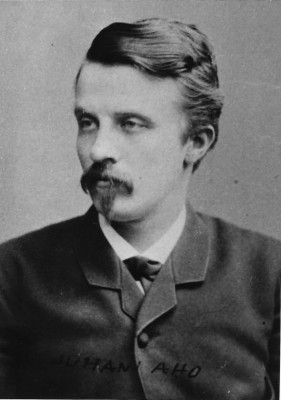
Juhani Aho. Photo: SKS/Literary archives
Yksin is the tale of a fashionable, no-longer-young ‘decadent’, alienated from his bourgeois circle, and with his aesthetic stances and social duties in crisis. He flees from his disappointments and heartbreaks to Paris, the foremost metropolis at the end of the 19th century, where solitude could be experienced in the modern manner – among crowds of people. Yksin is the first portrayal of modern city life in the newly emerging Finnish prose, unique in its time.
Aho’s story has parallels in the contemporary European literature: Karl-Joris Huysmans’s A Rebours (1884), Knut Hamsun’s Hunger (1890) and Oscar Wilde’s The Portrait of Dorian Gray (1890). More…
L’Amour à la Moulin Rouge
Extracts from the novella Yksin (‘Alone’, 1890). Introduction by Jyrki Nummi
After dining at the Duval on the Left Bank I take the same route back and drop in at the Café Régence to flick through the Finnish papers they have there.
I find my familiar café almost empty. The waiters are hanging about idly, and the billiard tables are quiet under their covers. The habitués are of course at home with their families. Anyone who has a friend or acquaintance is sharing their company this Christmas Eve. Only a few elderly gentlemen are seated there, reading papers and smoking pipes. Perhaps they’re foreigners, perhaps people for whom the café is their only home, as for me.
A little way off at the other end of the same table is a somewhat younger man. He was there when I came in. He’s finished his coffee and appears to be waiting. He’s restless and keeps consulting his watch. An agreed time has obviously passed. He calms himself and lights a cigarette. A moment later I can see a woman through the glass door. She’s hurrying across the street in front of a moving bus and running straight here. Now the man notices her too, and he cheers up and signals to the waiter for the bill. The woman slips through the door and goes straight across to him. They altercate for a moment, come to an understanding and depart hand in hand. More…
Saamentutkimus tänään [Sámi research today]
30 June 2011 | Mini reviews, Reviews
 Saamentutkimus tänään
[Sámi research today]
Toimittaneet [Edited by] Irja Seurujärvi-Kari, Petri Halinen & Risto Pulkkinen
Helsinki: Suomalaisen Kirjallisuuden Seura (SKS), 2011. 449 p., ill.
ISBN 978-952-222-220-6
€ 28, paperback
This volume examines the Sámi people, the only indigenous tribe living in the European Union, via writers representing fourteen different fields of research. It is an updated and expanded edition of Johdatus Saamentutkimukseen (‘An introduction to Sámi research’, 1995) and makes use of The Saami. A Cultural Encyclopaedia (SKS, 2005). This book defines what is meant by the terms ‘indigenous tribe’ and ‘Sámi’, as well as describing the Sámi people’s biological and geographical environment, their prehistory and history and a linguistic and genetic outline. It also deals with their spiritual and material culture, from folk beliefs to handicrafts and arts, as well as reindeer herding. The status of the Sámi people is examined with regard to human rights and land ownership rights and compared to the situation of other indigenous tribes. Currently between 70,000 and 82,000 Sámi live in Finland, Sweden, Norway and Russia, with around 10,000 of them in Finland. The Sámi population in Finland has remained constant for the past 15 years, but as many as 60 per cent of them now live outside the traditional Sámi homelands.
Translated by Ruth Urbom