

Tag: cultural history
Panu Rajala: Tulisoihtu pimeään. Olavi Paavolaisen elämä [A torch into the darkness. The life of Olavi Paavolainen]
13 November 2014 | Mini reviews, Reviews
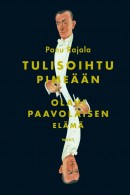 Tulisoihtu pimeään. Olavi Paavolaisen elämä
[A torch into the darkness. The life of Olavi Paavolainen]
Helsinki: WSOY, 2014. 624 pp., ill.
ISBN 978-951-040254-2
€32.90, hardback
In the 1920s Olavi Paavolainen (1903–1964) became the charismatic figurehead of the influential Tulenkantajat (‘Firebearers’) movement, which placed emphasis on internationalism and modernism. After the movement broke up Paavolainen worked as a prominent cultural leader and critic who knew how to provoke and to arouse admiration. The original travel book he wrote about Nazi Germany in peacetime is still read, as is his book Synkkä yksinpuhelu (‘A sombre monologue’, 1946), based on the diaries he kept during the Second World War. The criticism the book received (and doubts about its author’s ‘wisdom of hindsight’) contributed to Paavolainen’s silence as a writer. Although in the 1950s and 1960s as a director he brought about a flourishing of radio drama at the Finnish Broadcasting Company, he became an alcoholic. Much has been written about Paavolainen, but author and researcher Panu Rajala’s popular biography has managed to find new perspectives and gives a vivid portrayal of Paavolainen’s personality, the writers he knew, the colourful story of his complex relationships with women, and his travels. There is less analysis of his literary production, though the content and reception of his books are discussed.
Translated by David McDuff
Monikulttuurisen maamme kirja. Suomen kielen ja kulttuurin lukukirja [The book of our multicultural land. A reader of Finnish language and culture]
23 October 2014 | Mini reviews, Reviews
 Monikulttuurisen maamme kirja. Suomen kielen ja kulttuurin lukukirja
[The book of our multicultural land. A reader of Finnish language and culture]
Toim. [Ed. By] Marjukka Kenttälä, Lasse Koskela, Saija Pyhäniemi, Tuomas Seppä
Helsinki: Gaudeamus, 2013. 252 pp.
ISBN 978-952-495-253-8
€ 34, hardback
This book opens a fascinating, often entertaining and eminently readable perspective on Finnishness and Finnish culture. It contains short Finnish texts supplied with introductions, from the Kalevala and the writings of Finland’s national author Aleksis Kivi to the present day. There are also Finnish translations of the work of Finnish-Swedish authors. The older texts are drawn from the literary ‘canon’, in works by J.L. Runeberg, Z. Topelius, Juhani Aho, Maria Jotuni, Eino Leino, F.E. Sillanpää, Väinö Linna and Tove Jansson. Among the excerpts that date from more recent times there are even pop and rock lyrics. The writing often throws light on some aspect of Finnishness, sometimes with a critical or ironic note. There is also writing by immigrants. Interspersed with the literary examples are short essays giving the views of experts on subjects like Finnish history, language or sport. Some of the texts conclude with a glossary of unfamiliar words and terms. The explanations are arranged in order of their appearance in the text: for the casual reader seeking the meaning of a word, alphabetical order would have been more practical, though even then some phrases might have remained unnoticed.
Translated by David McDuff
Letters from Tove
6 October 2014 | Extracts, Non-fiction
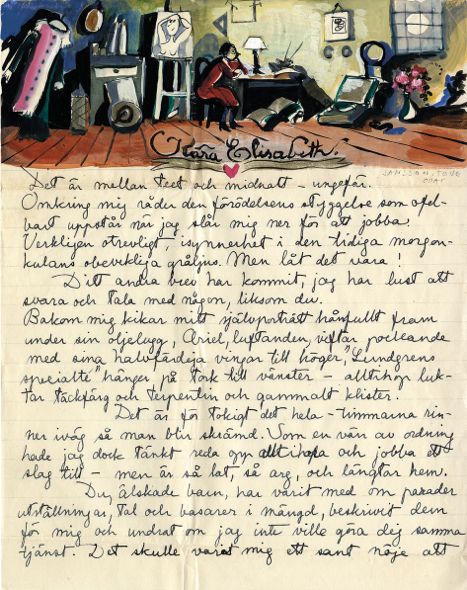
Early days: Tove Jansson went to Stockholm to study art when she was just 16. A letter to her friend Elisabeth Wolff, from November 1932
Artist and author Tove Jansson (1914–2001) is known abroad for her Moomin books for children and fiction for adults. A large selection of her letters – to family, friends and lovers – was published for the first time in September. In these extracts she writes to her best friend Eva Konikoff who moved to the US in 1941, to her lover, Atos Wirtanen, journalist and politician, and to her life companion of 45 years, artist Tuulikki Pietilä.
Brev från Tove Jansson (selected and commented by Boel Westin and Helen Svensson; Schildts & Söderströms, 2014; illustrations from the book) introduced by Pia Ingström
7.10.44. H:fors. [Helsinki]
exp. Tove Jansson. Ulrikaborgg. A Tornet. Helsingfors. Finland. Written in swedish.
to: Miss Eva Konikoff. Mr. Saletan. 70 Fifty Aveny. New York City. U.S.A.
Dearest Eva!
Now I can’t help writing to you again – the war [Finnish Continuation War, from 1941 to 19 September 1944] is over, and perhaps gradually it will be possible to send letters to America. Next year, maybe. But this letter will have to wait until then – even so, it will show that I was thinking of you. Curiously enough, Konikova, all these years you have been more alive for me than any of my other friends. I have talked to you, often. And your smiling Polyfoto has cheered me up and comforted me and has also taken part in the fortunate and wonderful things that have happened. I remembered your warmth, your vitality and your friendship and felt happy! At first I wrote frequently, every week – but after about a year most of it was returned to me. I wrote more after that, but the letters were often so gloomy that I didn’t feel like saving them. Now there are so absurdly many things I have to talk to you about that I don’t know where to begin. Koni, if only I’d had you here in my grand new studio and could have hugged you. After these recent years there is no human being I have longed for more than you. More…
The painter who wrote
6 October 2014 | Non-fiction, Reviews
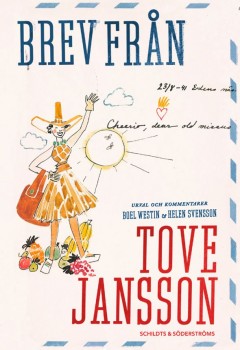 Brev från Tove Jansson
Urval och kommentarer Boel Westin & Helen Svensson
[Letters from Tove Jansson, selected and commented by Boel Westin & Helen Svensson]
Helsingfors: Schildts & Söderströms, 2014. 491 pp., ill.
ISBN 978-951-52-3408-7
€34.90
In Finnish (translated by Jaana Nikula):
Kirjeitä Tove Janssonilta
ISBN 978-951-52-3409-4
Nothing could be more mistaken than to describe Tove Jansson as ‘Moominmamma’. In her statements she was both cutting and complex – conflict-ridden and full of paradoxes. And she was nobody’s mamma.
Tove Jansson (1914–2001) became world famous (especially ‘big’ in Japan) with her Moomins – the characters of her illustrated books for children (1945–1970) – and her books for adults are a part of her work that is at least as interesting. Her training, ambition and artistic passion were, however, focused on painting.
Anyone who has read Boel Westin’s excellent biography – now available in English, Tove Jansson: Life, Art, Words – ‘knows’ all this, but to experience it through Jansson’s own letters, in an alternating process of reflection and recreation, brings the problems close to the reader in quite a different way: one that is shocking, but also deeply human. More…
Harri Kalha: Muodon vuoksi. Lasin ja keramiikan klassikot [For form’s sake. The classics of glass and ceramics]
24 June 2014 | Mini reviews, Reviews
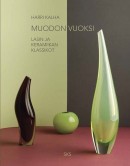 Muodon vuoksi. Lasin ja keramiikan klassikot
[For form’s sake. The classics of glass and ceramics]
Helsinki: The Finnish Literature Society, 2013. 335 pp., ill.
ISBN 978-952-222-402-6
€75, hardback
This handsome, massive work introduces objects of glass and ceramics from the Finnish ‘golden age’ of the 1940s, 1950s and 1960s. Artist-designers Kaj Franck, Tapio Wirkkala, Toini Muona, Timo Sarpaneva and Kyllikki Salmenhaara were awarded three prizes at the Milan Triennale, Rut Bryk and Birger Kaipiainen two, but the number of designers whose works have become classics without these prizes is naturally much larger. The art historian and author Harri Kalha records the exceptional development of industrial design. In postwar Finland, with scarce resources, art and mass production entwined, resulting in high-standard objects of glass and ceramics gaining international fame and becoming part of international modernism. The businessman Kyösti Kakkonen became interested in Finnish design in the 1990s, and now his private collection consists of thousands of objects, from which Kalha has made his choices for the book. More than two hundred photographs, by Niclas Warius, pay tribute to the materials, shapes and colours of the objects as light is reflected from the surfaces, making them appear three-dimensional, both real and dream-like. The printing, by Bookwell, matches the quality of the photography.
Liisa Suvikumpu: Suomalaiset kylpylät. Kotimaisen kylpyläkulttuurin historiaa [Finnish spas. The history of Finnish spa culture]
28 May 2014 | Mini reviews, Reviews
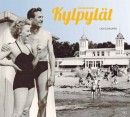 Suomalaiset kylpylät. Kotimaisen kylpyläkulttuurin historiaa
[Finnish spas. The history of Finnish spa culture]
Helsinki: Finnish Literature Society, 2013. 240 pp., ill.
ISBN 978-952-222-239-8
€45, hardback
The Finnish sauna fulfils some of the same functions as the spa, but the latter is more public. In Finland there have been various kinds of spas that employ the health-giving effects of water, and they have mostly been based on European models. The historian Liisa Suvikumpu presents the story of some twenty Finnish spas from a cultural-historical perspective. Their heyday lasted from the nineteenth century to World War II. At these establishments it was possible to enjoy the benefits of bathing and mineral water: they were accompanied by relaxation therapy, rest, exercise and a healthy diet , but also entertainment and socialising. The spas in various parts of Finland were keenly patronised by Russian visitors before the Russian Revolution of 1917. Some of Finland’s most renowned architects designed the buildings, and the premises often included pavilions, kiosks, a restaurant and a park. With its lively text and versatile illustrations this book would make also an excellent present.
Translated by David McDuff
Tellervo Krogerus: Sanottu. Tehty. Matti Kuusen elämä 1914–1998. [Said. Done. The life of Matti Kuusi, 1914–1998]
22 May 2014 | Mini reviews, Reviews
 Sanottu. Tehty. Matti Kuusen elämä 1914–1998
[Said. Done. The life of Matti Kuusi, 1914–1998]
Helsinki: Siltala , 2014. 856 pp., ill .
ISBN 978-952-234-194-5
€31.50, hardback
The folklorist Matti Kuusi vied for the status of the world’s leading researcher of proverbs with the Californian scholar Archer Taylor, his work extending from the shores of the Baltic Sea to Namibia’s Ovamboland. Proverbs revealed to him the deep structures of the human mind and showed that the nations of the world possessed a basis for mutual understanding. As a young man Kuusi read Spengler and predicted the destruction of the Western world. According to his ‘Kalevalan imperialism’, the Nordic region was to be the new world power. The war brought him to his senses: he understood that patriotism was mainly a matter of bland resilience. Professor Kuusi was a rigorous scholar, but also a provocative man of ideas who showed that pop music was today’s folk poetry. That idea received a mixed reception, but nowadays his department studies both rap music and ancient folk song. This biography by Tellervo Krogerus creates a rich portrait of a complex personality.
Translated by David McDuff
Kynällä kyntäjät. Kansan kirjallistuminen 1800-luvun Suomessa [Ploughers with a pen. The development of literacy in nineteenth-century Finland]
15 May 2014 | Mini reviews, Reviews
 Kynällä kyntäjät. Kansan kirjallistuminen 1800-luvun Suomessa
[Ploughers with a pen. The development of literacy in nineteenth-century Finland]
Toimittajat [Editors]: Lea Laitinen & Kati Mikkola
Helsinki: Finnish Literature Society, 2013. 558 pp., ill.
ISBN 978-952-222-453-8
€42, paperback
This multidisciplinary work by thirteen researchers discusses the writings of self-taught people in the 19th century. In their own communities these Finnish-language amateur authors were exceptions to the norm, but viewed in the context of the Finnish nation as a whole there were more of them than there were authors belonging to the educated classes. The principal aim is to examine how the common people saw the social and cultural phenomena which the educated classes saw from their own perspective. Kynällä kyntäjät provides a background to the research of the subject and the spread of writing ability, presenting diaries, biographies, letters, rural poetry published in newspapers, broadside ballads, plays, short stories, collections of folklore and handwritten journals, as well as focusing on the mental and linguistic changes related to the development of literacy. The book opens up a new and fascinating perspective on the 19th-century world of ideas.
Translated by David McDuff
Martin Panelius & Risto Santti & Jarkko S. Tuusvuori: Käsikirja [The hand book]
8 May 2014 | Mini reviews, Reviews
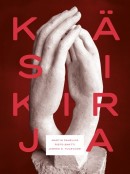 Käsikirja
[Handbook]
Helsinki: Teos, 2013. 761 pp., ill .
ISBN 978-951-851-523-7
€37, hardback
Human development and human life are in many ways linked to the hand – and yet we seldom think about its significance. In their accessibly written and comprehensive Käsikirja, Emeritus Professors Martin Panelius and Risto Santti are joined by researcher Jarkko S. Tuusvuori in considering the body’s upper extremity from various points of view. The authors’ expertise in their own fields – neurology, anatomy and philosophy – set the book’s tone, but it goes far beyond these. The structure and functions of the hand are examined, as are its phylogeny, its neural networks, its aging process, its use in skills, and the injuries and illnesses that threaten it. The book deals with the hand’s connection with language and communication, its social significance, and the importance of human touch. There are a great many details, terms and names, but the artwork, the beautiful layout, the examples and the literary selections enliven the narrative. A multi-faceted achievement, Käsikirja is a refreshingly original work of non-fiction.
Translated by David McDuff
Petri Pietiläinen: Koirien maailmanhistoria [A world history of dogs]
24 April 2014 | Mini reviews, Reviews
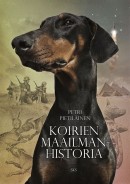 Koirien maailmanhistoria
[A world history of dogs]
Helsinki: Finnish Literature Society, 2013. 344 pp .
ISBN 978-952-222-351-7
€34, hardback
By partly fictional means this book tells the compelling story of the dog, particularly from a cultural and historical perspective. Recent archaeological finds suggest that man has tamed dogs for more than 30,000 years. Descended from wolves, during the Stone Age they became common as domestic animals. In Finland, too, there have been finds that indicate that this was so. The dog was used for hunting and as a sentinel, and later in a variety of service tasks. From early on they were mythical creatures, worshipped in some cultures, in others shunned, and in some bred to be eaten. While in 17th-century Europe dogs were sentenced to death at trials, in Japan it was nobles who faced the death penalty for ill-treating their dogs. The book also presents the fascinating stories of dogs both famous and nameless, beginning with Alexander the Great’s dog Peritas. In the Western world the dog was not treated as a member of the family until the modern era, though in prehistoric burial sites there are indications of its having been a close companion of man. Pietiläinen links the story of the dog to more general history in an insightful way.
Translated by David McDuff
At your service
19 March 2014 | Extracts, Non-fiction
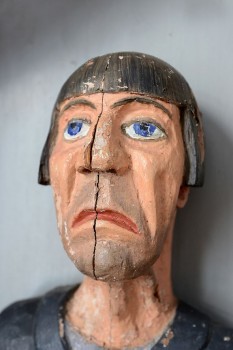
Melancholy man: detail of the almsman in Pomarkku, carved by Artturi Kaseva in the 1920s. Photo: Aki Paavola
Old men carved of wood have stood outside churches since the 17th century, begging for money to be given to the poor and the sick of the parish. These almsmen, or men-at-alms, mostly represented a disabled soldier; the tradition is not known elsewhere. Some 40 of the still surviving almsmen (there is one almswoman) were assembled for an exhibition in Kerimäki – in the world’s largest Christian wooden church – in summer 2013. The surviving specimens were hunted down and photographed by Aki Paavola for the book Vaivaisukkojen paluu (‘The return of the almsmen’). Otso Kantokorpi asks in the title of his introduction: are men-at-alms pioneers of ITE (from the words itse tehty elämä, ‘self-made life’; the English-language term is ‘outsider art’) or a disappearing folk tradition?
Many a church or belfry wall, particularly in Ostrobothnia, has been decorated – and is often still decorated – with a wooden human figure. Often they stand beneath a decorative canopy, sometimes accompanied by an encouraging phrase: He that hath pity upon the poor lendeth unto the LORD. They have been called men-at-alms or boys-at-alms. More…
In good company
18 October 2013 | This 'n' that
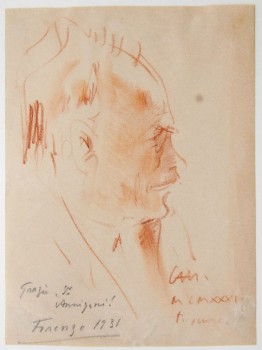
Portrait of an artist: Joel Lehtonen, sketched by Pietro Annigoni in Florence, 1931. Picture: literary archives of the Finnish Literature Society
Margaret, Countess of Snowdon (Princess Margaret, 1930–2002), Joel, Master of Putkinotko (1881–1934), and Philip, Duke of Edinburgh (born 1921) met in the same museum case in Florerence in October, when an exhibition of the work of the artist Pietro Annigoni (1910–1988) was opened.
The morganatic juxtaposition of the English royals and the Finnish writer is based on Annigoni’s reputation as one of the best-known portraitists of the 20th century, in whom the royal courts of England and Denmark, among others, placed their trust.
Joel Lehtonen, author of the novel Putkinotko (‘Hogweed Hollow’, the name also refers to a place) and classic of Finnish literature, is included on account of the fact that, in celebrating his fiftieth birthday in Florence in 1931, he partied throughout the night with students from the Accademia di Belle Arte ‘to the rhythm of an excellent Chianti’.
Also present was the young Piero Annigoni, who, in a cellar restaurant, took out his working tools. A red-chalk portrait of Lehtonen was the result, along with a series of dancing girls drawn in Indian ink. ‘It was five in the morning before I realised,’ Lehtonen wrote back to Finland.
Lehtonen had already spent a year in Italy in 1908 translating Boccaccio’s The Decameron, which, to his annoyance, was censored by the publisher. He published a volume of poetic prose based on his Italian experiences, Myrtti ja alppiruusu (‘The myrtle and the rhododendron’), of which one section is dedicated to Florence, that ‘glittering, passionate city of the spirit’.
Young Florentine artists were used to world-class artists. When the poet Dylan Thomas visited the city in the 1940s, the poet and author Luigi Berti – an acquaintance of Lehtonen’s – complained that ‘poets travelling in Italy no longer give themselves the airs of “milords” – behave like Lord Byron.’ Lehtonen, however, was able to party stylishly and thoroughly in a way that appears to have pleased the sons of Florence.
As he set off on the return journey to Finland, Lehtonen wrote to his wife: ‘An embarrassing day is over’, ‘I am in fine spirits! Heat the sauna.’ He brought with him Annigoni’s works, which are now in the archive of the Finnish Literature Society.
The curator of the Florence exhibition found more sketches of Lehtonen in the Museo Annigoni: in the current show, they are placed alongside sketches of Princess Margaret and Prince Philip.
The opening of the exhibition, in the premises of the Ente Cassa di Risparmio di Firenze, was attended by 300 of the city’s elite. It was as if the nobility of the portraits of the Uffizi art gallery had stepped out of their frames to honour Annigoni, whose paintings continued the traditions of the renaissance. The Corriere della Sera and La Repubblica gave prominent coverage to the event. The young politician and Florence mayor Matteo Renzi said in his speech that in northern Italy Annigoni’s significance to art is parallel to that of Olivetti to industry.
Annigoni’s early portraits of Lehtonen are shown in a section entitled Opere rare o inedited. The 240-page catalogue also includes brief description of Lehtonen as a writer and an account of that night in Florence in 1931.
Translated by Hildi Hawkins
A rare bird from Fancyland
20 August 2013 | Reviews
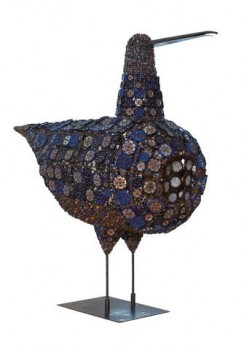
Bead-covered curlew, 1960. Height ca. 115 cm, Collection Kakkonen. Photo: Niclas Warius
Harri Kalha:
Birger Kaipiainen
Helsinki: Suomalaisen Kirjallisuuden Seura (The Finnish Literature Society), 2013. 249 p., ill.
(Summaries in Swedish and English)
ISBN 978-952-222-457-6
€46, hardback
Ceramics confectioner. Degenerate aristocrat. Ornamental criminal. These epithets can be found in Birger Kaipiainen, a new, full-length study of the ceramic artist by art historian Harri Kalha.
Throughout his artistic career Birger Kaipiainen (1915–1988) worked with forms, subjects and methods that were unfamiliar in the field of traditional ceramics, at least in mid-20th-century Finland, and made use of fantasy and ornament. As a ‘porcelain painter’ he showed little interest in the technical challenges of clay – although in his ceramic creations Kaipiainen explored three-dimensional form, montage, colour, texture and the tactile dimensions of the medium. More…
Books from Helsinki
30 June 2013 | This 'n' that
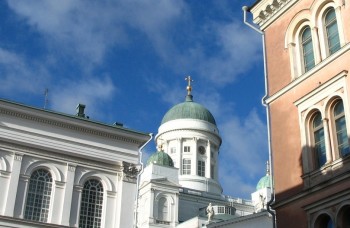
Helsinki: view it from different angles! Photo: Leena Lahti
Helsinki is relatively young city, Finnish literature even younger.
Flushed with a huge wave of migration at the beginning of the 20th century, the capital and its people went through the dramatic times of gaining independence and the Civil War (1917–18). The capital – since 1812 – and the life experiences of its inhabitants have been plentifully featured in Finnish fiction.
In his doctoral dissertation, Lieven Ameel has concentrated on a period of Finnish literary history. His Moved by the City: Experiences of Helsinki in Finnish Prose Fiction 1889–1941 (2013, Department of Finnish, Finno-Ugrian and Scandinavian Studies, University of Helsinki) examines more than sixty novels, collections of short stories and individual short stories portraying the city: how do the characters experience this urban public space? (Popular – crime fiction, for example – and children’s literature are excluded.) More…
Writes of passage
20 June 2013 | This 'n' that
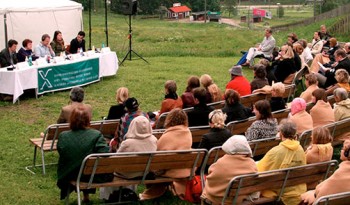
Debating the word: participants at the Lahti Reunion. Photo: LIWRE
The 26th Lahti International Writers’ Reunion took place at Messilä Manor (some 120 km from Helsinki, on Lake Vesijärvi) from 15 to 18 June.
Chaired by Virpi Hämeen-Anttila and Joni Pyysalo, writers from more than 20 countries held discussions in Finnish, English and French.
This summer the theme was ‘Breaking walls’. ‘Problems demand answers, answers demand questions. If attitudes harden, arms talk, and everyone erects a wall around himself, where is literature in the equation? Is the highest wall right there inside the writer? Or is literature itself a protecting wall? What happens when walls break down?’
The first Writers’ Reunion took place in Lahti – first at Mukkula Manor – fifty years ago; more than a thousand writers, translators, critics and other professionals both Finnish and foreign have come to Lahti to discuss writing. The Reunion has always been open to the public as well.
The biannual Reunion began life in 1963, during the Cold War. Writers from both sides of the Iron Curtain met under the oaks of Mukkula. In the Reunion’s blog some participants and organisers share their experiences of the past; here, the meeting’s one-time international secretary Marianne Bargum recalls the late 1970s and early 1980s:
‘…following in the footsteps of the legendary publisher Erkki Reenpää who knew everybody and all languages, I did my best to persuade big stars to come to Mukkula. Some writers had difficulties when they realised that they were not as well known in Finland as in their own countries. The French poet Michel Deguy left after one day, very offended when nobody knew how big a name he was. (I met him in Paris some years later and he apologised.)
A scandal with huge political consequences came close when the French philosopher Bernard-Henry Lévy said some derogatory things about the Soviet head of state Brezhnev. The Russian delegate, Michael Baryshev, threatened to leave the conference, and Valentina Morozova, interpreter and politruk, had to phone the Soviet Embassy in Helsinki and explain that this was not very serious. The famous British critic and writer Al Alvarez did his best to calm down the antagonists in a panel.’
My own first personal experiences of this international fête (which could mean either wading in the mud on the way to the huge tent sheltering the discussions or basking in hot sunshine followed by the most gentle nightless nights), from the sunny summer of 1983: interviewing Salman Rushdie and Jayne Anne Phillips, among others, for the Finnish Broadcasting Company. Another time the bag containing some hundred copies of the latest issue of Books from Finland, fresh from the printing press, sat on a bus heading for Lahti while I sat on the one behind – which then broke down in the middle of the road, and this was before mobile phones. The driver did have a radio phone though, and the participants got their copies in time.
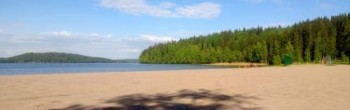
Soccer on the sand: Messilä beach. Photo: LIWRE
Among the traditions is a midnight football match between Finns and foreigners: the summer night is light and long. This time the result of the Finland against the rest of the world was convincing 6-3 to Finland.