
Fiction
Intelligent living
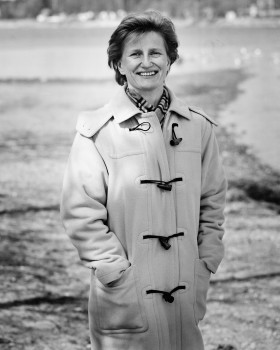
Minna Lindgren. Photo: Ville Palonen.
In Ehtoolehdon tuho [‘The decline of Twilight Grove’, Teos, 2015), the final novel in a trilogy about life in an assisted living home, employing human staff has become too expensive and the old folk are part of a pilot project in which they are cared for by electronic devices, monitors, cameras, ‘smartwalls’ and cleaning robots: ‘there was intelligence everywhere, masses of it, just a hiccup and something terribly intelligent would happen.’
The aged lady residents don’t like their new life, but they’re resilient; they’re not about to let the new technology defeat them…
Minna Lindgren’s mordantly satirical, often hilariously funny writing has earned her a wide readership. Translations of the trilogy are soon to appear in English, German and French.

An excerpt from Ehtoolehdon tuho [‘The decline of Twilight Grove’, Teos, 2015). Review by Soila Lehtonen
‘You’re 97 today! Your wakeup call service today congratulates!’
As if she wouldn’t have remembered. Ninety-seven was almost a hundred. She and Irma had decided that they would refuse to turn one hundred. It would only make trouble. One lady, in the bottom apartment of the A staircase, had received an invitation to the health centre on her birthday. Apparently all five-year-olds were called in for monitoring of their motor and psychological development, and when this lady turned 105, the computer system thought she was a toddler. The computer didn’t recognise numbers over one hundred. Siiri thought the lady should have kept the appointment; she would have done, for the tests were fun. You had to draw a triangle and walk along a straight line. Not that easy for someone of 105. But the lady didn’t go, she just made a terrible fuss about it and complained to everyone, until she died before her complaints reached the right official. More…
A perfect storm
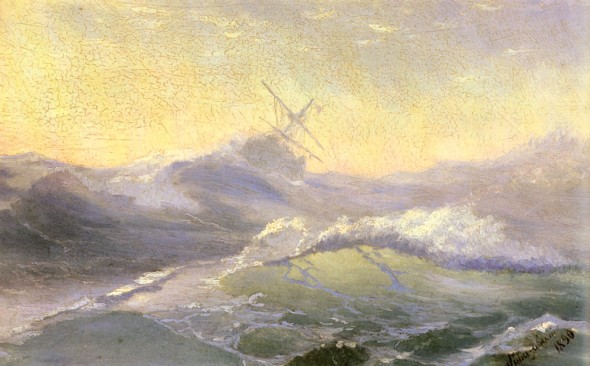
Bracing the waves. Ivan Aivazovsky, 1890.
According to Petri Tamminen, Finns are burdened by the need to succeed. Instead, he argues they should learn to fail better.
Part comedy, part tragedy, part picaresque novel, with a dash of Joseph Conrad – Tamminen’s new book, Meriromaani. Eräitä valoisia hetkiä merikapteeni Vilhelm Huurnan synkässä elämässä (‘A maritime novel. A few bright moments in Captain Vilhelm Huurna’s sombre life’, Otava, 2015) is set in an indeterminate seafaring past of the 18th or 19th century. It tells the story of the world’s most unsuccessful sea captain, Vilhelm Huurna who, one by one, sinks all the ships he commands.
Tamminen (born 1966) is a master of very short prose – this miniature novel is a a huge undertaking in the context of his work as a whole – and at Books from Finland we’re big fans. You can read more of his work here.
We join the story as Huurna, leaving behind him a failed romance in Viipuri, sets sail for Archangel, on the far north coast of Russia.
An excerpt from Meriromaani. Eräitä valoisia hetkiä merikapteeni Vilhelm Huurnan synkässä elämässä (‘A maritime novel. A few bright moments in Captain Vilhelm Huurna’s sombre life’, Otava, 2015)
The sun shone on the Arctic Ocean night and day, and the voyage went amazingly well, as did all the tasks and jobs that Huurna particularly feared beforehand.
Ships lay in Archangel harbour like objects on a collector’s shelf. They were waiting for timber cargo from the local sawmills where work was at a standstill because the mills lacked the machines and machine parts that they were now bringing them. When their cargo had been unloaded and the machines installed, timber began arriving from the sawmills. They found themselves at the end of the queue, and after the other ships had departed, one by one, they were still waiting in Archangel. That suited Huurna; in the first few days of his stay he had become acquainted with two English merchants and, through them, had received invitations to parties. He had stood in salons drinking toasts to the honour of this or that and made the acquaintance of some charming ladies into whose eyes he wished to gaze another time. He was quite moved by the whirl of this unexpected social life, and brightened at the thought that there was really nothing to complain about in his life apart from the fact that he happened still to be a bachelor. More…
The forest folk’s trip to Helsinki
26 March 2015 | Children's books, Fiction
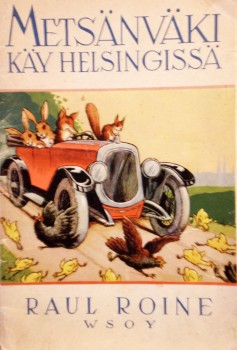 The country comes to town in this coyly modern fairy story of 1937 by the classic children’s writer Raul Roine (1907-1960). Reynard the Fox, the village taxi-driver, celebrates restoring his beat-up old Ford by taking his woodland friends – squirrels, chaffinches, bobtails… – on a day out to Helsinki. Trouble starts when a policeman tells them off for eating the plants in the Esplanade park, but the fun really begins when the hares find themselves participating in the marathon which is being run through the city streets that day…
The translation of this delectable tale is by Books from Finland’s long-time collaborator Herbert Lomas (1924-2011), who was often at his best when working on the whimsy of children’s literature.
Spring had come to the forest homeland. The wood anemones were raising their heads shyly from under the moss, large tears of joy were flowing down the spruce trees’ beards of lichen, and sky-ploughs of cranes were coming from the south. They bugled mightily on their trumpets and then landed in the Great Marsh to sample the cranberries More…
A walk on the West Side
16 March 2015 | Fiction, Prose
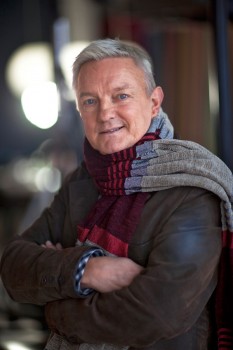
Hannu Väisänen. Photo: Jouni Harala
Just because you’re a Finnish author, you don’t have to write about Finland – do you?
Here’s a deliciously closely observed short story set in New York: Hannu Väisänen’s Eli Zebbahin voikeksit (‘Eli Zebbah’s shortbread biscuits’) from his new collection, Piisamiturkki (‘The musquash coat’, Otava, 2015).
Best known as a painter, Väisänen (born 1951) has also won large readerships and critical recognition for his series of autobiographical novels Vanikan palat (‘The pieces of crispbread’, 2004, Toiset kengät (‘The other shoes’, 2007, winner of that year’s Finlandia Prize) and Kuperat ja koverat (‘Convex and concave’, 2010). Here he launches into pure fiction with a tale that wouldn’t be out of place in Italo Calvino’s 1973 classic The Castle of Crossed Destinies…
Eli Zebbah’s shortbread biscuits
Eli Zebbah’s small but well-stocked grocery store is located on Amsterdam Avenue in New York, between two enormous florist’s shops. The shop is only a block and a half from the apartment that I had rented for the summer to write there.
The store is literally the breadth of its front door and it is not particularly easy to make out between the two-storey flower stands. The shop space is narrow but long, or maybe I should say deep. It recalls a tunnel or gullet whose walls are lined from floor to ceiling. In addition, hanging from the ceiling using a system of winches, is everything that hasn’t yet found a space on the shelves. In the shop movement is equally possible in a vertical and a horizontal direction. Rails run along both walls, two of them in fact, carrying ladders attached with rings up which the shop assistant scurries with astonishing agility, up and down. Before I have time to mention which particular kind of pasta I wanted, he climbs up, stuffs three packets in to his apron pocket, presents me with them and asks: ‘Will you take the eight-minute or the ten-minute penne?’ I never hear the brusque ‘we’re out of them’ response I’m used to at home. If I’m feeling nostalgic for home food, for example Balkan sausage, it is found for me, always of course under a couple of boxes. You can challenge the shop assistant with something you think is impossible, but I have never heard of anyone being successful. If I don’t fancy Ukrainian pickled cucumbers, I’m bound to find the Belorussian ones I prefer. More…
Elina Brotherus & Riikka Ala-harja
The passing of time
2 March 2015 | Extracts, Fiction, Prose
In 1999 the Musée Nicéphore Niépce invited the young Finnish photographer Elina Brotherus to Chalon-sur-Saône in Burgundy, France, as a visiting artist.
After initially qualifying as an analytical chemist, Brotherus was then at the beginning of her career as a photographer. Everything lay before her, and she charted her French experience in a series of characteristically melancholy, subjective images.
Twelve years on, she revisited the same places, photographing them, and herself, again. The images in the resulting book, 12 ans après / 12 vuotta myöhemmin / 12 years later (Sémiosquare, 2015) are accompanied by a short story by the writer Riikka Ala-Harja, who moved to France a little later than Brotherus.
In the event, neither woman’s life took root in France. The book represents a personal coming-to-terms with the evaporation of youthful dreams, a mourning for lost time and broken relationships, a level and unselfpitying gaze at the passage of time: ‘Life has not been what I hoped for. Soon it will be time to accept it and mourn for the dreams that will never come true. Mourn for the lost time, my young self, who no longer exists.’
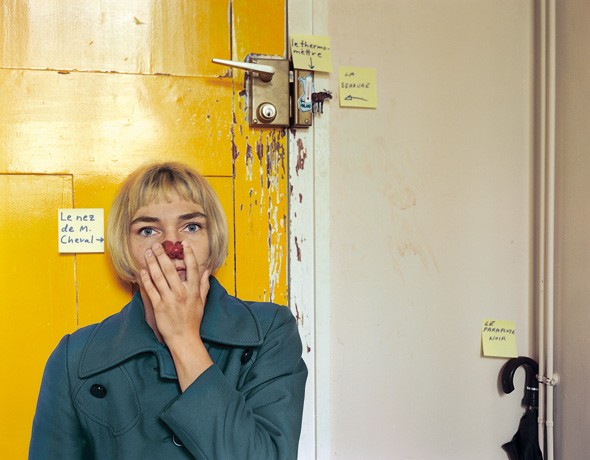
1999 Mr Cheval’s nose
You may say I’m a dreamer
25 November 2014 | Fiction, poetry
Prose poems from Tärnornas station – en drömbok (‘The Lucia Maids’ Station – a dream book’‚ Ellips, 2014). Introduction by Michel Ekman
I nurse a very small, perfectly formed child. It’s a girl. She smiles openly at me, even though she is so small. There is no doubt, neither about that nor anything else. The girl is the size of a nib pen, and just as exclusive. The nursing is going very well, it doesn’t hurt, and she can suckle without any problems. We are both at ease and yet awake, not introspective. The girl has intelligent eyes.
The milk keeps flowing.
Nothing runs dry.
Everything is obvious and neither of us is surprised. Just the fact that she is so small. Like a fountain pen. She is swathed in strips of bird cherry white bandages – like the ones mum had in her summer medicine cabinet – a cocoon, a chrysalis, but she’s not cramped, just secure. It smells good around us. I nurse my daughter who is perfect and the right size.
Year of the cat
13 November 2014 | Fiction, Prose
Extracts from the novel Kissani Jugoslavia (‘Yugoslavia, my cat’, Otava 2014). Introduction by Mervi Kantokorpi
I met the cat in a bar. And he wasn’t just any cat, the kind of cat that likes toy mice or climbing trees or feather dusters, not at all, but entirely different from any cat I’d ever met.
I noticed the cat across the dance floor, somewhere between two bar counters and behind a couple of turned backs. He loped contentedly from one place to the other, chatting to acquaintances in order to maintain a smooth, balanced social life. I had never seen anything so enchanting, so alluring. He was a perfect cat with black-and-white stripes. His soft fur gleamed in the dim lights of the bar as though it had just been greased, and he was standing, firm and upright, on his two muscular back paws.
Then the cat noticed me; he started smiling at me and I started smiling at him, and then he raised his front paw to the top button of his shirt, unbuttoned it and began walking towards me. More…
The day of mourning
6 November 2014 | Fiction, Prose
Extracts from the novel Katedraali (‘The cathedral’, Teos, 2014). Introduction by Mervi Kantokorpi
I am here now, at this funeral; I’m sitting on a puffy rococo chair which stands in the corner of this large living room – hall – on a Berber rug, one of a series of four pieces of furniture. The fourth is a curly-legged table, painted matt white. I wriggle like anything, trying to rid myself of my too-tight shoes. Fish thrash their tails in the same way. The lady in the dry cleaner’s told me she hates fish. She said that clothes that smell of fish and are brought into her shop make her shake with loathing but also bring her satisfaction because she can wash the awful stench away.
My shoes are impossibly small. They pinch my feet worse every moment. My back aches, too, despite the painkillers. You can’t swallow pills forever, so I just try to find a better position and put up with it. Finally my shoes leave my feet. I kick them underneath the table so that they can’t be seen. I can breathe again. In my shoes I felt as if I were sinking under the ground.
My father once showed me the Stephansdom catacombs. Thousands of people were buried here, before that, too, was forbidden by someone, he said. More…
Journey to the first palm tree
16 October 2014 | Fiction, Prose
Teemu is a fat, desperate middle-aged man who’s had it with life – he drives his old Lada to Spain, where he intends to commit suicide by letting himself be trampled to death by bulls in the Pamplona bullrun. (However, there is a chance of this tragedy being cancelled, thanks to a tenacious hitch-hiker, female.) An extract from the novel Särkyvää (‘Fragile’, Tammi, 2014)
When I was seventeen, I yearned to leave behind the small town where I grew up. I heard the owl hooting in the forest: go to Europe.
I heard the dirt-track gravel crunching beneath my shoes: run, lad, run.
The birch in the yard rustled and whispered: if you spend one more summer hanging around the garden of your childhood, you’ll stay here forever.
A frog in the ditch gave a stern croak: look at your father; if you don’t escape you’ll end up an old codger just like him.
Even the smoke twirling up from the sauna chimney spoke to me in billows: I’ll show you the right direction, head south, and don’t stop until you see the first camel. More…
Profiles
2 October 2014 | Fiction, Prose
Rosa Liksom’s first book, in 1985, was a collection of short prose; she has also written novels, children’s books, plays, comic and picture books. Her new book, Väliaikainen (‘Temporary’, Like, 2014) – a return to her signature very short prose – features beasts, machines and men
He’s there in the living room. We’ve gotta be very quiet. I left the computer on, and the reading lamp. I’ll go in and turn them off, quietly. Or the computer at least. I can watch Emmerdale on the little tv in the kitchen. You wait here. OK, I turned off the computer but I left the lamp on so I wouldn’t wake him up. I put his nap blanket over him. He’s laying on his left side now. That’s good. Whenever he wakes up on his right side he gets awfully grumpy. Let’s go in the kitchen so we don’t disturb him. The poor guy. It’s been hours since he’s had a good sleep. You know, I think it’s the depression again. It started on Monday when he was supposed to go to his guide’s job.He didn’t taste his breakfast, even though I brought it to him in bed. I had to go to the hospital, my shift was starting, and he just laid there in the bedroom with his eyes open… I don’t know how long it’s gonna last this time. Last month he was depressed for three days. I think it’ll pass more quickly this time because he’s napping a little bit, and licking his paw now and again.
Love is the only song
7 August 2014 | Fiction, poetry
Poems from Helise, taivas! Valitut runot (‘Ring out, sky! Selected poems’, Siltala, 2014). Introduction by Marja-Leena Mikkola
Who will tell me?
Who will tell me why white butterflies
strew the velvet skin of the night?
Who will tell me?
While people walk, mute and strange
and they have snowy, armoured faces,
such snowy faces!
and the eyes of a stuffed bird.
Who will tell me why in the morning, on the grass,
the thrushes begin their secret game?
Who will tell me?
While black soldiers stand at the gate
in their hands withered roses
such withered roses!
and broken tiger lilies.
Who will tell me, quietly in the sun’s shadow
how to bare my heart?
Who will tell me?
Come to me over the fields
Come close and softly
so softly!
Open the clothes of my heart. More…
Two men in a boat
The meaning of life, Bob Dylan, the broken thermostat of the Earth, the authors Ambrose Bierce and Aleksis Kivi…. Two severely culturally-inclined men set out to row a boat some 700 kilometres along the Finnish coastline, and there is no shortage of things to discuss. Extracts from the novel Nyljetyt ajatukset (‘Fleeced thoughts’, Teos, 2014)
The red sphere of the sun plopped into the sea.
At 23.09 official summertime Köpi announced the reading from his wind-up pocket-watch.
‘There she goes,’ commented Aimo, gazing at the sunken red of the horizon, ‘but don’t you think it’ll pop back up again in another quarter of an hour, unless something absolutely amazing and new happens in the universe and the solar system tonight!’
Aimo pulled long, accelerating sweeps with his oars, slurped the phlegm in his throat, spat a gob overboard, smacked his lips and adjusted his tongue on its marks behind his teeth. There’s a respectable amount of talk about to come out of there, thought Köpi about his old friend’s gestures, and he was right.
‘Sure thing,’ was Aimo’s opening move, ‘darkness. Darkness, that’s the thing. I want to talk about it and on its behalf just now, now in particular, while we’re rowing on the shimmering sea at the lightest point of the summer. More…
Another morning, another day
Poems from Unen kaivo (‘The well of dreams’, WSOY, 1936). Introduction by Satu Grünthal
IN THE MIRROR
Strange and truly wondrous
in the mirror you look at me.
All I really know is
that you I cannot be.
With my eyes you survey me,
with my lips you smile, too,
what I see in the mirror
is not me, but you, just you.
Whoever you are – astral morning,
eternal night – in the frame
like a wraith, a ghostly phantom,
invisible I remain. More…
The nursemaid
Lapsenpiika (‘The nursemaid’), a short story, first published in the newspaper Keski-Suomi in December, 1887. Minna Canth and a new biography introduced by Mervi Kantokorpi
‘Emmi, hey, get up, don’t you hear the bell, the lady wants you! Emmi! Bless the girl, will nothing wake her? Emmi, Emmi!’
At last, Silja got her to show some signs of life. Emmi sat up, mumbled something, and rubbed her eyes. She still felt dreadfully sleepy.
‘What time is it?’
‘Getting on for five.’
Five? She had had three hours in bed. It had been half-past one before she finished the washing-up: there had been visitors that evening, as usual, and for two nights before that she had had to stay up because of the child; the lady had gone off to a wedding, and baby Lilli had refused to content herself with her sugar-dummy. Was it any wonder that Emmi wanted to sleep? More…
Through thick and thin
10 April 2014 | Comics, Fiction