

Authors
Imagine
25 November 2014 | Authors, Reviews
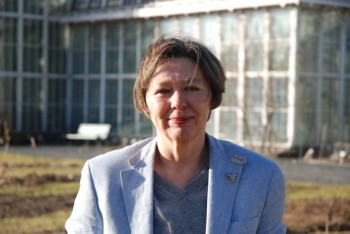
Susanne Ringell. Photo: Anders Larsson
Dreams about and in the Eternal City. Leonard Cohen who plays a shanty by the Swedish poet Dan Andersson on the lute. The narrator of these prose poems gives birth to a daughter who is as small as a fountain pen, but perfect and just the right size – and she brings up a litter of puppies too.
This and much more is included in the wonderful new collection of prose poetry, Tärnornas station – en drömbok (‘The Lucia Maids’ station – a book of dreams’, Ellips, 2014) by Susanne Ringell (born 1955), one of the most personal voices in Finland-Swedish literature today. After an early career as an actress, she made her debut with a short story collection in 1993, and since then she has written short prose of different varieties, poetry, and plays. In Ringell’s work there is nothing amiss in the style and language, in the audacious combinations, in the chronicled sadness and the unwaveringly discrete humour. With fantastic clarity she approaches the most elusive of motifs, the deepest content of the soul, making it vivid and recognisable. More…
Finding a voice
13 November 2014 | Authors, Reviews
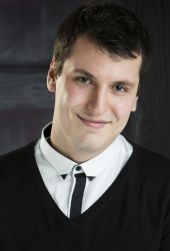
Pajtim Statovci. Photo: Tommi Tuomi
Here it is, finally: Pajtim Statovci’s debut novel is the first book of literary merit written in Finnish by an author who originally came to Finland from the former Yugoslavia, Kosovo. Kissani Jugoslavia (‘Yugoslavia, my cat’, Otava, 2014) is a wild depiction of identity, told simultaneously from the perspectives of the mother of an immigrant family and her son. Statovci builds a keen sense of tension between the narrative of the Albanian woman and that of her youngest son.
Born in Podujevë, Kosovo, in 1990, Statovci came to Finland at the age of two. He is studying comparative literature at the University of Helsinki and film and television scriptwriting at the Aalto University. The French and Norwegian translation rights to Kissani Jugoslavia were sold before the book had even been published. More…
In the shadow of the cathedral
6 November 2014 | Authors, Reviews
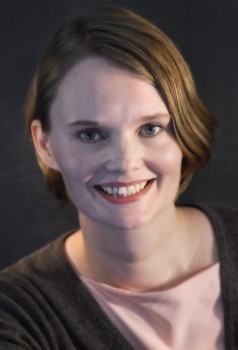
Satu Taskinen. Photo: Heini Lehväslaiho
In recent years the Finnish novel has been refreshed by central European tones in the work of authors including Kristina Carlson, Katri Lipson and Sofi Oksanen. Among these reforming powers is Satu Taskinen, whose first novel, Täydellinen paisti (‘The perfect roast’, 2011), won the Helsingin Sanomat prize for a debut work.
The novel, set over a day and describing a Viennese family’s All Saints’ Day lunch and, in particular, its demanding preparations, aroused admiration, but also wonderment at its slow, thoughtful monologue, in which absurdist humour and irony mixed with a melancholy atmosphere.
Satu Taskinen, who studied philosophy and German philology at Helsinki University, has lived and worked in Vienna for a long time. Her second novel, Katedraali (‘The cathedral’), is also a one-day novel describing a Viennese family. More…
Light songs and dark
4 August 2014 | Authors, Reviews
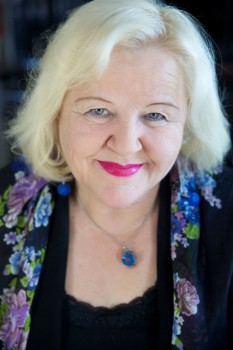
Aulikki Oksanen. Photo: Laura Malmivaara
On my wall at home are paintings given to me by the artist and poet Aulikki Oksanen. A watercolour from 1966 is a stylised depiction, a little in the manner of Modigliani, of a room with a girl by the window. In the background are a harbour and ships.
The work reminds me of the time when I got to know Aulilkki when we both moved in University Theatre circles and I visited her in the room shown in the painting. The flat was later the scene for Lapualaismorsian (‘Lapua bride’), a film which Aulikki (born 1944) took part in.
To me, with her blond, straight hair, she was like a beautiful, slender young filly, so I was not in the least surprised when her debut work included some enchanting horse symbolism. Her first book, an original, fresh collection of poems entitled Hevosen kuolema (‘Death of a horse’, 1966) gained immediate attention. More…
Debt to life
28 May 2014 | Authors, Non-fiction
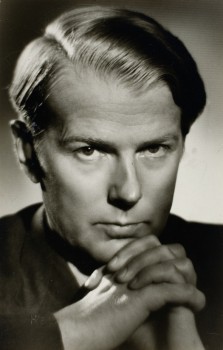
Kaarlo Sarkia (1902–1945). Photo: Ivar Helander (The Literary Archives/Finnish Literature Society)
Joie de vivre, dream, death, love: Kaarlo Sarkia’s rhymed poetry made him one of the Finnish classics, even if he only had time to publish four collections. Like several unfortunate poets of the first half of the 20th century – among them Edith Södergran, Saima Harmaja, Katri Vala, Uuno Kailas – he died of tuberculosis. Poems from Unen kaivo (‘The well of dreams’, WSOY, 1936)
From the point of view of both form and content, Kaarlo Sarkia’s poem ‘Älä elämää pelkää’ (‘Don’t be afraid of life’, 1936) is among the best examples of Finnish poetry. It crystallises several typical themes and features of his work: a declamatory absoluteness and existential courage, a faith in beauty, and the presence of death.
Don’t be afraid of life,
don’t shut out its beauty.
Invite it to sit by your fire,
or should your hearth expire,
to meet it outside is your duty.
– – –
More…
The stars above
6 March 2014 | Authors, Reviews
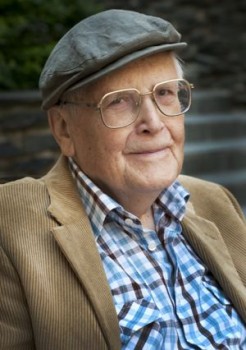
Lars Huldén. Photo: Charlotta Boucht
The state of poetry in Finland has been the subject of heated debate in recent years. The focus of much of this attention has been so-called ‘experimental poetry’. Some commentators have gone as far as to suggest that, in its ability to reshape and reinvent itself, contemporary poetry serves as a model for other forms of literature.
In such a literary climate, a writer like Lars Huldén might easily be overlooked, a writer whose poems give honest expression to thoughts and moods. This Huldén achieves in a manner that is at once recognisable and inventive. His poems are, perhaps, close to what many assume poems should be: concise speech expressing the wisdom of experience and often revealing a clear sense of resignation – which is hardly surprising when you have reached the age of 88. More…
The princess who quit
27 February 2014 | Authors, Interviews
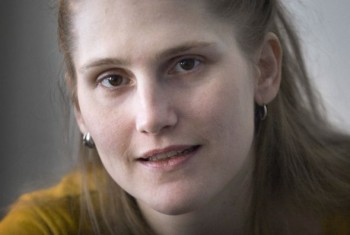
Alexandra Salmela. Photo: Heini Lehväslaiho
Interview with Alexandra Salmela, whose second book, Kirahviäiti ja muita hölmöjä aikuisia (‘The giraffe mummy and other silly adults’, Teos, 2013), is for children – and for those adults who admit their silliness
Once upon a time there was a boy called Sulo. Just a normal lad, more a middle-of-the-road character than winner material. And not even always brave, let alone cheerful. An ordinary sprog isn’t enough for Sulo’s parents, so they take the boy to a child repair shop. There, new parts are fitted to children: virtuoso fingers, football-feet and angel-faces.
In addition to Sulo, Alexandra Salmela’s Kirahviäiti ja muita hölmöjä aikuisia (‘The giraffe mummy and other silly adults’) introduces us to the misunderstood Flabby Monster, Adalmiina, who wings through trees like an ape, and a father who absentmindedly loses his head. The work is the second book by Alexandra Salmela, who was born in Bratislava, in what was then Czechoslovakia, and now lives in Tampere.
A-L E: How did the idea of a story-book come up? More…
In memoriam Mirkka Rekola 1931–2014
20 February 2014 | Authors, In the news
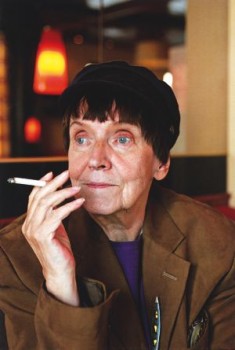
Mirkka Rekola. Photo: Elina Laukkarinen/WSOY
The poet and author Mirkka Rekola died on 5 February at the age of 82. From 1954 onwards she has written aphorisms, essays and 18 collections of poetry. Rekola was awarded many literary prizes, among them the Eino Leino prize (1979), the Finland prize (Suomi-palkinto, 1995) and the Dancing Bear poetry prize (1997). Her intellectual, linguistically brilliant poetry was not easy to translate – however, translations have appeared in Swedish, German, French, Hungarian, English and Macedonian.
The poet and translator Herbert Lomas wrote in his introduction to Rekola’s collection Valekuun reitti (‘The path of a false moon’) in 2004: ‘Mirkka Rekola was a minimalist before minimalism was invented.’ Her poems are, he said, ‘moments of crossing an edge towards an intenser awareness of the universe’s continuum, requiring us to wake up from sleep, as we do at times of heightened consciousness and love.’
At first light I put my hand
      in the hollow of a white willow –
once someone's cigarette box
had been left there –
      now a bird flew out
going seaward.
Touch of a wingquill on the back of my hand.
      It flew higher.
            In the evening
I felt its touch on my shoulder blade.
From Valekuun reitti, translated by Herbert Lomas
The party’s not yet over
14 November 2013 | Authors, Interviews
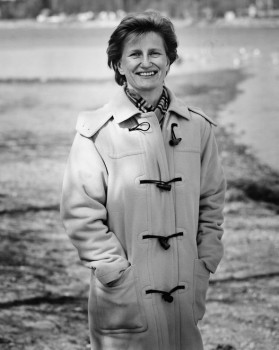
Minna Lindgren. Photo: Ville Palonen
Ordinary, boring, controlled life in an old folks’ home takes an interesting turn as crimes are committed. But daily tramrides in Helsinki, the virtues of friendship and general joie de vivre are enjoyed by 90-year-plus-old ladies who refuse to act as expected – as Bette Davis put it, old age is no place for sissies. Minna Lindgren is interviewed by Anna- Leena Ekroos
Welcome to Twilight Grove, a Helsinki home for the elderly – the bright, institutional lighting in its parlour creating an atmosphere like a dentist’s office, the odd resident dozing on the sofas, waiting for the next meal. The menu often includes mashed potatoes, easy for those with bad teeth. Residents seeking recreation are offered chair aerobics, accordion recitals, and crafts. A very ordinary assisted living centre, or is it? In Minna Lindgren’s novel, Kuolema Ehtoolehdossa (‘Death at Twilight Grove’, Teos), the everyday life of a home for the elderly is the setting for absurd and even criminal happenings, suspicious deaths and medical mix-ups.
Anna-Leena Ekroos: You’re a journalist and writer. Formerly you worked for the Finnish Broadcasting Company. In 2009 you won the Bonnier journalism prize for an article of yours about the last phases of your father’s life, and his death. Kuolema Ehtoolehdossa is your first novel. How did it come into being?
Minna Lindgren: I’ve always known I was a writer but the mere urge to write isn’t enough for a novel – you have to have a meaningful story. The more absorbed I became in the life of the old, the more important it felt to me to write this story. Writing a novel turned out to be carefree compared to working as a journalist. Many of the stories I heard would have become bad social porn in the media, dissolved into banality, but in a novel they become genuinely tragic, or tragicomic, as the case may be. More…
Love and marriage
31 October 2013 | Authors, Interviews
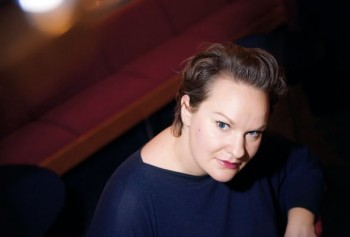
Sanna Tahvanainen. Photo: Cata Portin
Victoria, a lonely, restricted child, grows up to be a mother of nine; in the eyes of the world, she is enormously powerful. The love she feels for her husband is equally strong. In constant, troubled search of herself as a woman, Victoria lives a long life.
Sanna Tahvanainen’s character is a queen – but her novel, Bär den som en krona (‘Wear it like a crown’, 2013) a surprising, rich portrait of a woman, is almost completely lacking in descriptions of Victoria’s regal duties. This extract is set at the opening of the London International Exhibition of Industry and Art in 1851. Janina Orlov interviews the author.
JO: How did you decide on Queen Victoria? I remember you once commented that you only had a very general picture of her, but once you started rooting around you must have found a wealth of information.
ST: I didn’t make any sort of concrete decision to write a book about her; she fascinated me in a peculiar way. I would return to her every time I was working on a new collection of poetry; I’d already written so much poetry that there was almost a hint of routine about it all, this was something I could really get my teeth into. Because we know so little about Victoria’s childhood, I actually had quite a lot of freedom. Of course, there are reams of books about her! But I’ve never found a novel about her.
JO: How did you go about creating her voice? More…
On subterranean spaces
30 August 2013 | Authors, Reviews
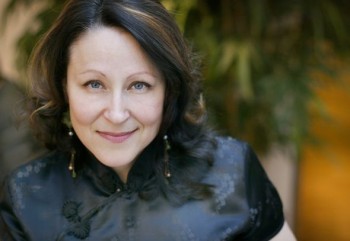
Zinaida Lindén. Photo: Janne Aaltonen
A melancholic diplomat’s wife in Turku recalls her childhood in 1970s Leningrad. This is how one might describe the new novel by Zinaida Lindén – then one might be surprised encountering nuance after nuance that challenge our expectations.
The melancholy in Lindén’s novel isn’t soft and misty; it is sharp and metallic. The life of the protagonist Galina, a diplomat’s wife, is far from glamorous, and consists mostly of standing over the ironing board in the family’s one-bedroom flat, ironing shirts for her conscientious and overworked husband at the consulate. The 1970s Leningrad of her memories is not an arena for ideology or culture, but serves as the backdrop for an intimate familial drama, in which the child always remained on the outside and was eventually left alone after the death of her parents. More…
Me by myself
20 June 2013 | Authors, Essays, Non-fiction, On writing and not writing

In this series, Finnish authors ponder their profession. Jyrki Kiiskinen casts light on the process of getting his books written: who is it that actually does the job?
People think I am a writer. But I am not. At literary events they sometimes come up and praise my most recent work, if they have happened to like it, not knowing that I have not written a single book. I try to ignore negative criticism, although it is not easy to put up with being blamed for other people’s work. I accept praise unhesitatingly, on those rare occasions when I receive it, although it feels strange.
It’s as if the person I’m talking to thinks I was someone else. He talks about the book’s style, its characters and its narrative voice, supposing that they are my invention.
At that moment I feel like a trickster. But I can’t be bothered to correct the misconception. I slurp my red wine happily and nod in false modesty, gazing deep into my interlocutor’s eyes. I keep chatting, to give him the impression that he’s met a living writer, myself – the person behind my words.
Journeys to nearby places
18 April 2013 | Authors, Interviews
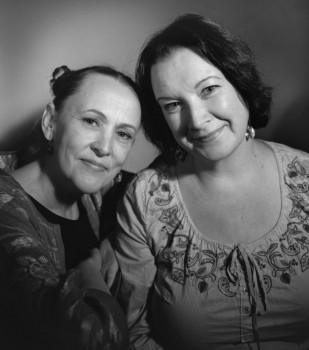
Workmates: Virpi Talvitie and Katri Tapola. Photo: Teos
Short texts and vibrant illustrations merge composing capricious situations in Katri Tapola and Virpi Talvitie’s adult picture book. Mahdollisuuksien rajoissa. Matkakirja (‘In the realm of impossibility. Travel book’, Teos, 2013) turns the ordinary pleasantly askew
It is a different kind of travel book: instead of faraway places, it explores things nearby, where our gaze and our thoughts don’t usually pause – the little things at the bottom of a pocket, in a dark closet full of outdoor gear, quiet moments in noontime traffic.
The travellers are perhaps Nobody in Particular, or somebody called Random. We keep on travelling, but we don’t get any farther than the corner store. What’s small becomes large, what’s supposedly large shrinks. Our self-image is off-kilter, there’s a hole in our CV, and the world is pleasantly tilted.
A-L E: The book is in the form of short prose – a page, half a page. What was it like to write these compact texts?
K T: I love having constraints; the short form is very rewarding. Focus and compactness make your whole life clear. And this has been good for me to learn because I’m naturally prone to long, extended forms of expression. More…
Winter journey
1 November 2012 | Authors, Reviews
Tua Forsström. Photo: Mao Lindholm
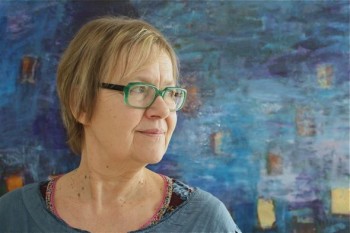
The Finland-Swedish poet Tua Forsström publishes rarely, and so when she does the expectations are always high. It is a pleasure to note that her new book, En kväll i oktober rodde jag ut på sjön (‘One evening in October I rowed out on the lake’), once again lives up to them.
Forsström’s poetry is simultaneously concrete and existential, rooted in attention to the everyday and open to symbolic readings. The highly-charged images in her poems mostly grow out of the sort of things that anyone can observe around them. More…
Dear diary
18 October 2012 | Authors, Extracts, Non-fiction, poetry
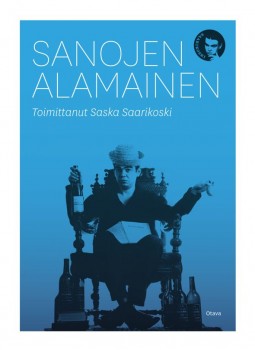 The poet and translator Pentti Saarikoski (1937–1983) was a legend in his own lifetime, a media darling, a public drinker who had five children with four women. His oeuvre nevertheless encompasses 30 works, and his translations include Homer and James Joyce. The journalist Saska Saarikoski (born 1963) has finally read all that work – in search of the father whom he seldom met. The following samples are from his annotated selection of Pentti Saarikoski’s thoughts over 30 years, Sanojen alamainen (‘Servant of words’, Otava, 2012; see Figuring out father)
I try to write books whose reading will bring enjoyment, in other words not entertaining ones.
Suomentajan päiväkirjat (‘Translator’s diaries’, 1970)
The term ‘world literature’ was invented by Goethe to describe the importance of Goethe.
Päiväkirjat (‘Diaries’, 1978)
A work of art is bad if it ‘makes you think’. About something other than itself. What is wrong with ‘art for art’s sake’ – or bread for bread’s sake? Art is art and bread is bread, and people need both in their diet.
Päiväkirjat (‘Diaries’, 1978) More…