

Non-fiction
Living with a genius
23 June 2015 | Extracts, Non-fiction
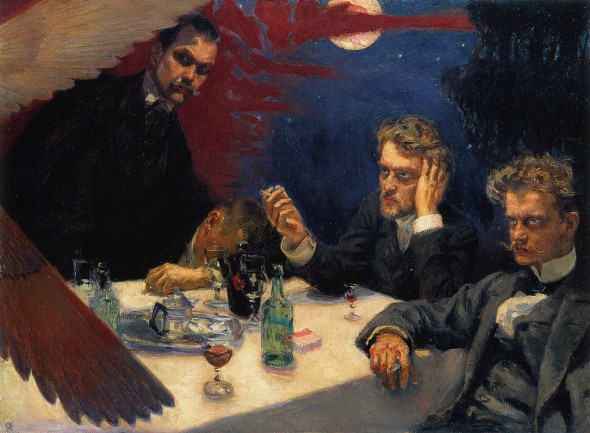
Akseli Gallen-Kallela’s painting Symposium (1894). From left: Akseli Gallen-Kallela, the composer Oskar Merikanto, the conductor Robert Kajanus and Jean Sibelius. Aino Sibelius was not pleased with this depiction of her husband depicted during a drinking session with his buddies
It is 150 years since the birth of Finland’s ‘national’ composer, Jean Sibelius. Much has been written about his life; Jenni Kirves’s new book casts light on his wife, Aino (1871–1969), and through her on the composer’s emotional and family life.
Aino, Kirves remarks in her introduction, has often been viewed as an almost saintly muse who sacrificed her life for her husband. But she was flesh and blood, and the book charts the difficulties of life with her brilliant husband from the very beginning – his unfaithfulness during their engagement, how to deal with a sexually transmitted infection he had contracted, his alcohol problem, the death of a child. It was Aino’s choice, time and again, to stand by her man; she felt it was her privilege to support her husband in his work in every possible way. ‘For me it is as if we two are not alone in our union,’ she wrote, far-sightedly, as a young bride. ‘There is also an equally rightful third: music.’
Aino’s own family, the Järnefelts, were a considerable cultural force in Finland, supporters of Finnish-language education and the growing independence movement. Her brothers included the writer Arvid Järnefelt, the artist Erik Järnefelt and the composer Armas Järnefelt. It was Armas who introduced her to his friend Jean Sibelius.
Aino bore Sibelius – known in family circles as Janne – six daughters, and offered her husband her unfailing support through 65 years of married life. ‘I must have you,’ Sibelius wrote, ‘in order for my innermost being to be complete; without you I am nothing… For this reason you are as much an artist as I am – if not more.’
As an old lady, Aino remarked of her own life that it had been ‘like a long, sunny day.’

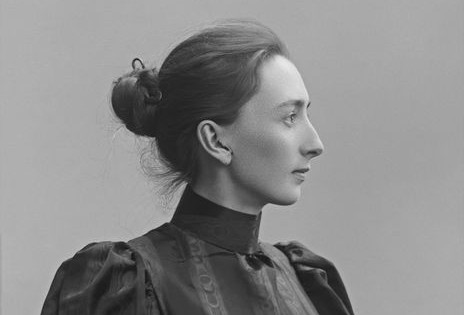
Aino Sibelius, 1891. Photo: National Board of Antiquities – Musketti.
An excerpt from Aino Sibelius: Ihmeellinen olento (‘Aino Sibelius: wondrous creature’, Johnny Kniga, 2015). We join the young couple in 1892 as they prepare for their long-awaited wedding.
At last, the wedding!
In the spring of 1892 the wedding really began to seem possible, as Janne’s symphonic poem Kullervo was very favourably received and Janne finally began to believe that he could support Aino. His financial situation was still, however, far from brilliant, and there were only two weeks to the wedding, as Janne wrote on 27 May 1892: ‘All the same, we must really be very careful about money. You will keep the cashbox and we will decide on everything together.’ The wedding grew closer and three days later Janne wrote triumphantly:
Do you understand, Aino, that we shall be man and wife in 1 ½ weeks – that we shall be able to kiss each other however we like and wherever we like (!) – and live together and have a household together – eat and make coffee together – it’s just so lovely.
A couple of weeks before the wedding, however, Janne wrote to Aino about some wishes for Aino in the future:
A skill with which a married artist can be protected from regressing is that the ‘wife’ understands to make him as little as possible into a model citizen. The man must not be allowed to be a paterfamilias with a pipe in his mouth, drowsy and docile; he must continually seek as many impressions as before, that’s clear, isn’t it? The kind of marriage whose main goal is the bringing of children into the world is repugnant to me – there are most certainly other things to do for those who work in the arts. More…
When the viewer vanishes
26 May 2015 | Essays, Non-fiction
 For the author Leena Krohn, there is no philosophy of art without moral philosophy
I lightheartedly promised to explain the foundations of my aesthetics without thinking at any great length about what is my very own that could be called aesthetics. Now I am forced to think about it. The foundations of my possible aesthetics – like those of all aesthetics – lie of course somewhere quite different from aesthetics itself. They lie in human consciousnesses and language, with all the associated indefiniteness.
It is my belief that we do not live in reality, but in metareality. The first virtual world, the simulated Pretend-land is inherent in us.
It is the human consciousness, spun by our own brains, which is shared by everyone belonging to this species. Thus it can be called a shared dream, as indeed I have done. More…
Picture this
9 April 2015 | Articles
It’s impossible to put Finnish graphic novels into one bottle and glue a clear label on to the outside, writes Heikki Jokinen. Finnish graphic novels are too varied in both graphics and narrative – what unites them is their individuality. Here is a selection of the Finnish graphic novels published in 2014
Graphic novels are a combination of image and word in which both carry the story. Their importance can vary very freely. Sometimes the narrative may progress through the force of words alone, sometimes through pictures. The image can be used in very different ways, and that is exactly what Finnish artists do.
In many countries graphic novels share some common style or mainstream in which artists aim to place themselves. In recent years an autobiographical approach has been popular all over the worlds in graphic novels as well as many other art forms. This may sometimes have led to a narrowing of content as the perspective concentrates on one person’s experience. Often the visual form has been felt to be less important, and clearly subservient to the text. This, in turn, has sometimes even led to deliberately clumsy graphic expression.
This is not the case in Finland: graphic diversity lies at the heart of Finnish graphic novels. Appreciation of a fluent line and competent drawing is high. The content of the work embraces everything possible between earth and sky.
Finnish graphic novels are indeed surprisingly well-known and respected internationally precisely for the diversity of their content and their visual mastery.
Life on the block
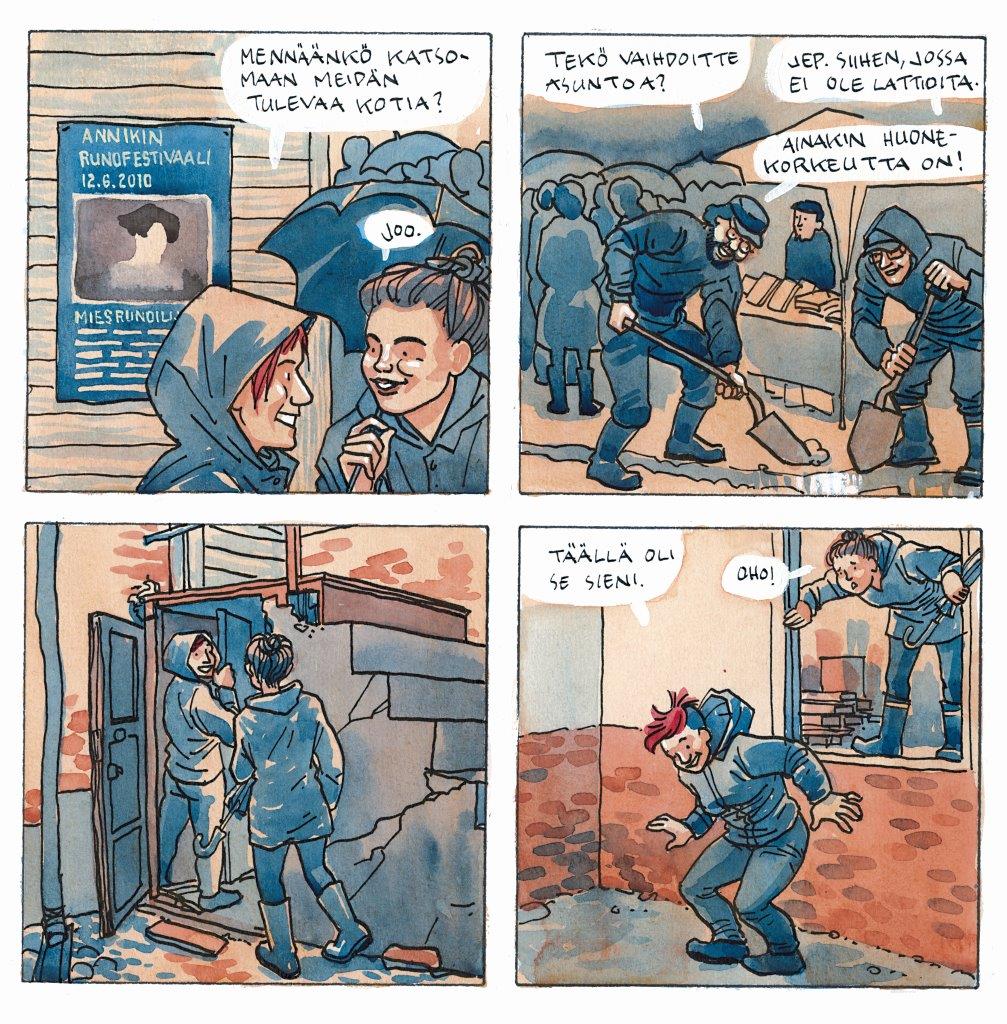
‘Shall we go and look at our new house? / Yeah. / Did you move house? / Yeah, to one without a floor. / At least you have head-space! / This is where the mould was. / Oh dear!’. Tiitu Takalo, Minä, Mikko ja Annikki (‘Me, Mikko and Annikki’, Suuri kurpitsa).
Elina Brotherus & Riikka Ala-harja
The passing of time
2 March 2015 | Extracts, Fiction, Prose
In 1999 the Musée Nicéphore Niépce invited the young Finnish photographer Elina Brotherus to Chalon-sur-Saône in Burgundy, France, as a visiting artist.
After initially qualifying as an analytical chemist, Brotherus was then at the beginning of her career as a photographer. Everything lay before her, and she charted her French experience in a series of characteristically melancholy, subjective images.
Twelve years on, she revisited the same places, photographing them, and herself, again. The images in the resulting book, 12 ans après / 12 vuotta myöhemmin / 12 years later (Sémiosquare, 2015) are accompanied by a short story by the writer Riikka Ala-Harja, who moved to France a little later than Brotherus.
In the event, neither woman’s life took root in France. The book represents a personal coming-to-terms with the evaporation of youthful dreams, a mourning for lost time and broken relationships, a level and unselfpitying gaze at the passage of time: ‘Life has not been what I hoped for. Soon it will be time to accept it and mourn for the dreams that will never come true. Mourn for the lost time, my young self, who no longer exists.’
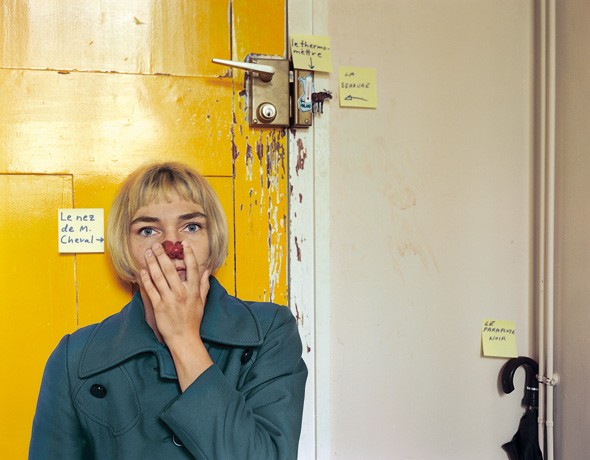
1999 Mr Cheval’s nose
Why translate?
28 January 2015 | Essays, Non-fiction
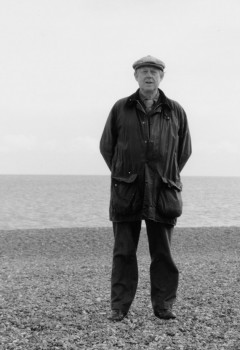
Down by the sea: Herbert Lomas in Aldeburgh. – Photo: Soila Lehtonen
‘People do not read translations to encourage minor literatures but to rediscover themselves in new imaginative adventures‚’ says the poet and translator Herbert Lomas in this essay on translation (first published in Books from Finland 1/1982). ‘Translation is a thankless activity,’ he concludes – and yet ‘you have the pleasure of writing without the agony of primary invention. It’s like reading, only more so. It’s like writing, only less so.’ And how do Finnish and English differ from each other, actually?
Any writer’s likely to feel – unless he’s a star, a celebrity, a very popular and different beast – that the writer is a necessary evil in the publisher’s world, but not very necessary. How much more, then, the translator from a ‘small’ country’s language.
Why do it? The pay’s absurd, you need the time for your own writing, it’s very hard to please people, and translation is, after all, the complacent argument goes, impossible. I’m convinced by all these arguments, and really I can’t afford to go on; but I don’t regret what I’ve done and, looking back, I can find two reasons for translating Finnish writing, one personal, the other cultural. More…
Not a world language, and yet….
16 January 2015 | Articles, Non-fiction
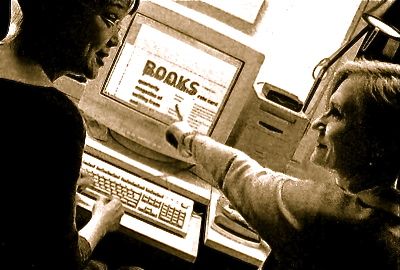
The editors (Hildi Hawkins and Soila Lehtonen) at the screen: we begun publishing material on our website in 1998. Photo: Jorma Hinkka, 2001
Longevity may not generally be a virtue of literary magazines – they tend to come and go – but Books from Finland, which began publication in 1967, has stuck around for a rather impressively long time. Literary life, as well as the means of production, has changed dramatically in the almost half-century we have been in existence. So where do we stand now? And what does the future look like?
This is the farewell letter from the current Editor-in-Chief, Soila Lehtonen – who began working for the journal in 1983
‘The literature of Finland suffers the handicap of being written in a so-called “minor” language, not a “world” language…. Finland has not entirely been omitted from the world-map of culture, but a more complete and detailed picture of our literature should be made available to those interested in it.’
Thus spake the Finnish Minister of Education, R.H. Oittinen, in early 1967, in the very first little issue of Books from Finland, then published by the Publishers’ Association of Finland, financed by the Education Ministry.
Forty-seven years, almost 10,000 printed pages (1967–2008) and (from 2009) 1,400 website posts later, we might claim that the modest publication entitled Books from Finland, has accomplished the task of creating ‘a more complete and detailed picture’ of Finnish literature for anyone interested in it. More…
The magic box: childhood revisited
25 December 2014 | Essays, Non-fiction
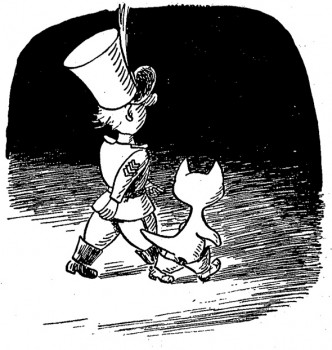
The tin soldier and the Blue Cat. Illustration: Usko Laukkanen
A tribute to Oiva Paloheimo’s children’s novel Tinaseppä ja seitsemän (‘The Tinsmith and the Seven’, illustrated by Usko Laukkanen, WSOY, 1956)
I’ve happened upon this (Christmassy) text of mine – first published in Books from Finland back in 1995 – when sorting through my papers as I begin to contemplate my retirement. With it I would like to offer my goodbyes, and many thanks, to you – to our readers, for whom I have been commissioning, editing and writing texts for the past thirty-one years – it’s time to do other things; time to read the books that still remain unread…
A dusky winter’s afternoon. Outside, soft and grey, a little snow is falling. I am sitting in our living-room, in an armchair covered in a pale yellow boucle fabric, my legs curled up, eating a carrot. In my lap is a book which I have fetched from the library after school. Conversation, the faint clattering of crockery, a singing kettle, the smell of food: grandmother and mother are cooking supper in the kitchen. My little sister is asleep.
But these sounds and the room around me do not really exist: there is only the world of make-believe in which Tiina sets off on her adventures with the Blue Cat, the Tinsmith, the St Bernard dog, the star and the spider: that world is a magic box which is able to contain all of childhood. More…
Is less really more? On new books for young readers
18 December 2014 | Articles, Non-fiction
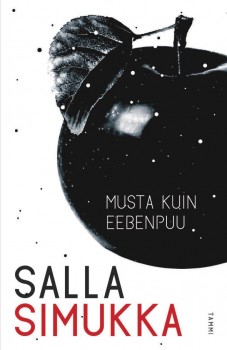
Black as ebony: volume three of the ‘Snow White’ trilogy for young adults by Salla Simukka
This year has been an eventful for Finnish literature in many ways, not least in terms of young adults’ and children’s books. The full ramifications of Finland’s turn as the theme country at this year’s Frankfurt Book Fair will only be known with the passage of time, but more mega-success stories to stand alongside Salla Simukka’s Lumikki (Snow White, Tammi) trilogy for young adults – now sold to almost 50 countries – are eagerly awaited. Visitors to the Frankfurt Book Fair also got a look at Finland-Swedish illustration at the By/Kylä (‘Village’) stand, which presented varied works by nine illustrators and animators in a memorable exhibit.
Book sales continue to fall in Finland. The major general-interest publishers – WSOY, Tammi, and Otava – have cut back on Finnish titles and are concentrating on high-sellers and proven authors.
Books in series are now a dominant phenomenon in literature for children and young adults, aiming to win readers’ loyalty with their continuing stories and characters. Many longtime authors and illustrators of books for children and young adults have had to look for new contacts, and publishers are increasingly hesitant to launch debut artists. More…
Encounters with a language
12 December 2014 | Articles, Non-fiction
Mistranslation: illustration by Sminthopsis84/Wikimedia
Mother tongue: not Finnish. How do people become interested enough in the Finnish language in order to become translators? In the olden days some might have been greatly inspired by the music Sibelius (as were the eminent British translators of Finnish, David Barrett or Herbert Lomas, for example, back in the 1950s and 1960s). We asked contemporary translators to reminisce on how they in turn have become infatuated enough with Finnish to start studying and translating this small, somewhat eccentric northern language. Three translators into English, one into French, German and Latvian tell us why
Oh misery me
3 December 2014 | Non-fiction, Tales of a journalist
Illustration: Joonas Väänänen
The Finnish media never pass up an opportunity to post articles on our favourite miseries, says columnist Jyrki Lehtola: Finns are great at wallowing in self-denigration, so it sells well. And life is always better somewhere else, isn’t it? At least in ‘Europe’ it is
They should never have let us Finns into Europe. Or North America, South America, Australia, Africa, Asia.
Another Nordic country might perhaps suit us, or Albania or Russia. We could visit them.
Europe doesn’t suit us. Europe makes us even more stupid than we already are. Europe makes us think less of ourselves and more of other people. More…
The coder’s Latin
30 October 2014 | Articles, Non-fiction
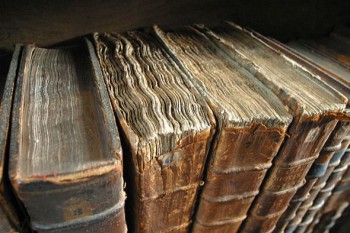
Pleasant interface still? Old book bindings (Merton College library, Oxford, UK). Photo: Wikipedia
Writing is arguably brain-control technology, notes our columnist Teemu Manninen. Writing might not be on its way out, at least not quite yet, he thinks, but the printed book might not stay with us for ever. And would that be a happier world?
When the future of literature is discussed, either here in Finland and elsewhere, topics usually revolve around changes in the economics and practicalities of reading, writing, and publishing: how will writers and publishers get paid, and how can readers find more books to read.
What is taken for granted in these instances is that literature itself will continue to be something that exists in a recognisable way – which itself of course implies that writing itself will remain a viable mass medium for the transmission of information over the transcendent, enormous, unfathomable gulfs of space and time, as it has been for thousands of years. More…
Back to the sources
23 October 2014 | Essays, Non-fiction, On writing and not writing
In this series, authors discuss the difficulties of their trade. Jari Järvelä finds it difficult to stop gathering source material which then gets piled in towers on his desk and in sacks around it. He knows that it’s got to stop though – for when it does, the stories will finally emerge, and life is a bliss… for a moment
When I was younger I thought that writing a novel began with the moment when I sat down at my desk and pressed a key for the first time. A. Hmmm…no, H. No, let’s make that S. No no no, I need a more original beginning…Z!
That’s not the case. The writing of a novel begins between two and twenty years before the choice of the first letter and the first word. Sometimes longer.
In the case of my novel Särkyvää (‘Fragile’, 2014), I know the exact moment of its birth.
Before I began to make a career as an author, I spent a year as a teacher at Hamari school in Porvoo. It was the beginning of the 1990s. Hamari was an old sawmill community on the sea, full of wooden houses more than a century old and motor boats put-putting toward the horizon. The headmaster looked more like a sea dog than a teacher; one morning he announced that it was his fortieth birthday. After that he sat down on the staff-room sofa, fell into deep thought and suddenly ejaculated, ‘Why the hell does a person have to gather so much junk in their life?!’ More…
Letters from Tove
6 October 2014 | Extracts, Non-fiction
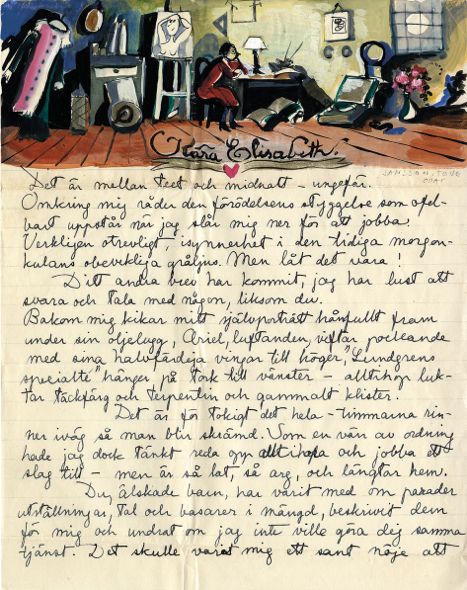
Early days: Tove Jansson went to Stockholm to study art when she was just 16. A letter to her friend Elisabeth Wolff, from November 1932
Artist and author Tove Jansson (1914–2001) is known abroad for her Moomin books for children and fiction for adults. A large selection of her letters – to family, friends and lovers – was published for the first time in September. In these extracts she writes to her best friend Eva Konikoff who moved to the US in 1941, to her lover, Atos Wirtanen, journalist and politician, and to her life companion of 45 years, artist Tuulikki Pietilä.
Brev från Tove Jansson (selected and commented by Boel Westin and Helen Svensson; Schildts & Söderströms, 2014; illustrations from the book) introduced by Pia Ingström
7.10.44. H:fors. [Helsinki]
exp. Tove Jansson. Ulrikaborgg. A Tornet. Helsingfors. Finland. Written in swedish.
to: Miss Eva Konikoff. Mr. Saletan. 70 Fifty Aveny. New York City. U.S.A.
Dearest Eva!
Now I can’t help writing to you again – the war [Finnish Continuation War, from 1941 to 19 September 1944] is over, and perhaps gradually it will be possible to send letters to America. Next year, maybe. But this letter will have to wait until then – even so, it will show that I was thinking of you. Curiously enough, Konikova, all these years you have been more alive for me than any of my other friends. I have talked to you, often. And your smiling Polyfoto has cheered me up and comforted me and has also taken part in the fortunate and wonderful things that have happened. I remembered your warmth, your vitality and your friendship and felt happy! At first I wrote frequently, every week – but after about a year most of it was returned to me. I wrote more after that, but the letters were often so gloomy that I didn’t feel like saving them. Now there are so absurdly many things I have to talk to you about that I don’t know where to begin. Koni, if only I’d had you here in my grand new studio and could have hugged you. After these recent years there is no human being I have longed for more than you. More…
The painter who wrote
6 October 2014 | Non-fiction, Reviews
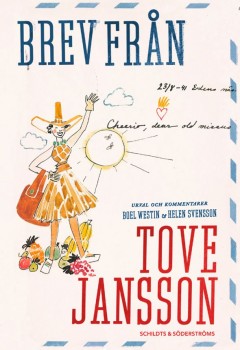 Brev från Tove Jansson
Urval och kommentarer Boel Westin & Helen Svensson
[Letters from Tove Jansson, selected and commented by Boel Westin & Helen Svensson]
Helsingfors: Schildts & Söderströms, 2014. 491 pp., ill.
ISBN 978-951-52-3408-7
€34.90
In Finnish (translated by Jaana Nikula):
Kirjeitä Tove Janssonilta
ISBN 978-951-52-3409-4
Nothing could be more mistaken than to describe Tove Jansson as ‘Moominmamma’. In her statements she was both cutting and complex – conflict-ridden and full of paradoxes. And she was nobody’s mamma.
Tove Jansson (1914–2001) became world famous (especially ‘big’ in Japan) with her Moomins – the characters of her illustrated books for children (1945–1970) – and her books for adults are a part of her work that is at least as interesting. Her training, ambition and artistic passion were, however, focused on painting.
Anyone who has read Boel Westin’s excellent biography – now available in English, Tove Jansson: Life, Art, Words – ‘knows’ all this, but to experience it through Jansson’s own letters, in an alternating process of reflection and recreation, brings the problems close to the reader in quite a different way: one that is shocking, but also deeply human. More…
Finland, cool! The Frankfurt Book Fair 8–12 October
30 September 2014 | Articles, Non-fiction

Finnland. Cool. pavilion in Frankfurt, designed by Natalia Baczynska Kimberley, Nina Kosonen and Matti Mikkilä from Aalto University
It starts next week: Finland is Guest of Honour at the Book Fair in the German and global city of Frankfurt. This link will take you to it all.
Approximately 170,000 professionals from the literary world are expected to visit the exhibition halls from Wednesday to Friday; the weekend is reserved for the general public, c.100,000 visitors. Since 1980s different countries have been in focus each year. More…