

Extracts
Living with a genius
23 June 2015 | Extracts, Non-fiction
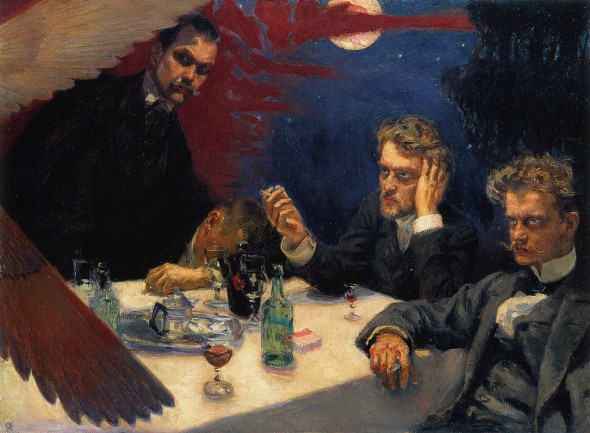
Akseli Gallen-Kallela’s painting Symposium (1894). From left: Akseli Gallen-Kallela, the composer Oskar Merikanto, the conductor Robert Kajanus and Jean Sibelius. Aino Sibelius was not pleased with this depiction of her husband depicted during a drinking session with his buddies
It is 150 years since the birth of Finland’s ‘national’ composer, Jean Sibelius. Much has been written about his life; Jenni Kirves’s new book casts light on his wife, Aino (1871–1969), and through her on the composer’s emotional and family life.
Aino, Kirves remarks in her introduction, has often been viewed as an almost saintly muse who sacrificed her life for her husband. But she was flesh and blood, and the book charts the difficulties of life with her brilliant husband from the very beginning – his unfaithfulness during their engagement, how to deal with a sexually transmitted infection he had contracted, his alcohol problem, the death of a child. It was Aino’s choice, time and again, to stand by her man; she felt it was her privilege to support her husband in his work in every possible way. ‘For me it is as if we two are not alone in our union,’ she wrote, far-sightedly, as a young bride. ‘There is also an equally rightful third: music.’
Aino’s own family, the Järnefelts, were a considerable cultural force in Finland, supporters of Finnish-language education and the growing independence movement. Her brothers included the writer Arvid Järnefelt, the artist Erik Järnefelt and the composer Armas Järnefelt. It was Armas who introduced her to his friend Jean Sibelius.
Aino bore Sibelius – known in family circles as Janne – six daughters, and offered her husband her unfailing support through 65 years of married life. ‘I must have you,’ Sibelius wrote, ‘in order for my innermost being to be complete; without you I am nothing… For this reason you are as much an artist as I am – if not more.’
As an old lady, Aino remarked of her own life that it had been ‘like a long, sunny day.’

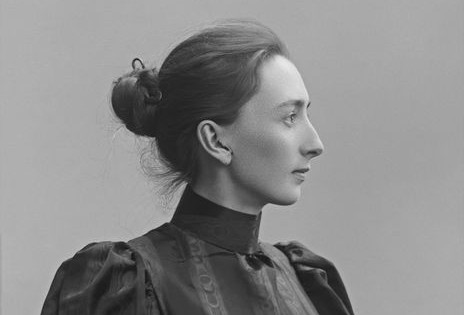
Aino Sibelius, 1891. Photo: National Board of Antiquities – Musketti.
An excerpt from Aino Sibelius: Ihmeellinen olento (‘Aino Sibelius: wondrous creature’, Johnny Kniga, 2015). We join the young couple in 1892 as they prepare for their long-awaited wedding.
At last, the wedding!
In the spring of 1892 the wedding really began to seem possible, as Janne’s symphonic poem Kullervo was very favourably received and Janne finally began to believe that he could support Aino. His financial situation was still, however, far from brilliant, and there were only two weeks to the wedding, as Janne wrote on 27 May 1892: ‘All the same, we must really be very careful about money. You will keep the cashbox and we will decide on everything together.’ The wedding grew closer and three days later Janne wrote triumphantly:
Do you understand, Aino, that we shall be man and wife in 1 ½ weeks – that we shall be able to kiss each other however we like and wherever we like (!) – and live together and have a household together – eat and make coffee together – it’s just so lovely.
A couple of weeks before the wedding, however, Janne wrote to Aino about some wishes for Aino in the future:
A skill with which a married artist can be protected from regressing is that the ‘wife’ understands to make him as little as possible into a model citizen. The man must not be allowed to be a paterfamilias with a pipe in his mouth, drowsy and docile; he must continually seek as many impressions as before, that’s clear, isn’t it? The kind of marriage whose main goal is the bringing of children into the world is repugnant to me – there are most certainly other things to do for those who work in the arts. More…
Elina Brotherus & Riikka Ala-harja
The passing of time
2 March 2015 | Extracts, Fiction, Prose
In 1999 the Musée Nicéphore Niépce invited the young Finnish photographer Elina Brotherus to Chalon-sur-Saône in Burgundy, France, as a visiting artist.
After initially qualifying as an analytical chemist, Brotherus was then at the beginning of her career as a photographer. Everything lay before her, and she charted her French experience in a series of characteristically melancholy, subjective images.
Twelve years on, she revisited the same places, photographing them, and herself, again. The images in the resulting book, 12 ans après / 12 vuotta myöhemmin / 12 years later (Sémiosquare, 2015) are accompanied by a short story by the writer Riikka Ala-Harja, who moved to France a little later than Brotherus.
In the event, neither woman’s life took root in France. The book represents a personal coming-to-terms with the evaporation of youthful dreams, a mourning for lost time and broken relationships, a level and unselfpitying gaze at the passage of time: ‘Life has not been what I hoped for. Soon it will be time to accept it and mourn for the dreams that will never come true. Mourn for the lost time, my young self, who no longer exists.’
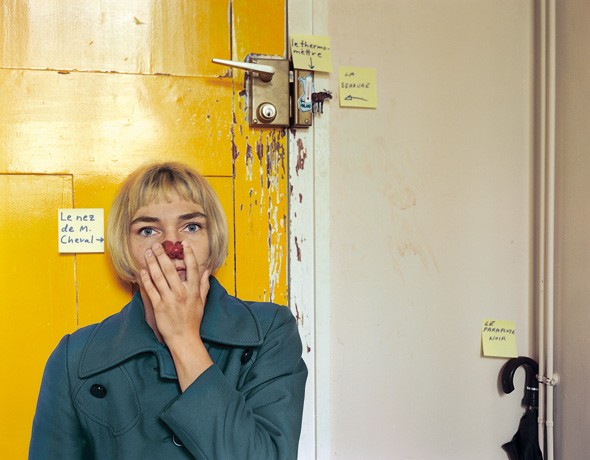
1999 Mr Cheval’s nose
Letters from Tove
6 October 2014 | Extracts, Non-fiction
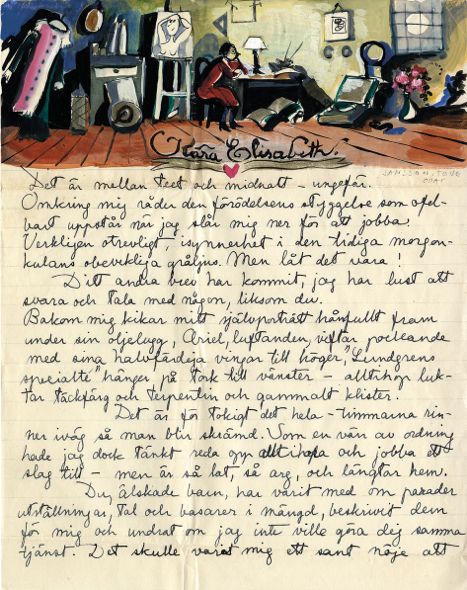
Early days: Tove Jansson went to Stockholm to study art when she was just 16. A letter to her friend Elisabeth Wolff, from November 1932
Artist and author Tove Jansson (1914–2001) is known abroad for her Moomin books for children and fiction for adults. A large selection of her letters – to family, friends and lovers – was published for the first time in September. In these extracts she writes to her best friend Eva Konikoff who moved to the US in 1941, to her lover, Atos Wirtanen, journalist and politician, and to her life companion of 45 years, artist Tuulikki Pietilä.
Brev från Tove Jansson (selected and commented by Boel Westin and Helen Svensson; Schildts & Söderströms, 2014; illustrations from the book) introduced by Pia Ingström
7.10.44. H:fors. [Helsinki]
exp. Tove Jansson. Ulrikaborgg. A Tornet. Helsingfors. Finland. Written in swedish.
to: Miss Eva Konikoff. Mr. Saletan. 70 Fifty Aveny. New York City. U.S.A.
Dearest Eva!
Now I can’t help writing to you again – the war [Finnish Continuation War, from 1941 to 19 September 1944] is over, and perhaps gradually it will be possible to send letters to America. Next year, maybe. But this letter will have to wait until then – even so, it will show that I was thinking of you. Curiously enough, Konikova, all these years you have been more alive for me than any of my other friends. I have talked to you, often. And your smiling Polyfoto has cheered me up and comforted me and has also taken part in the fortunate and wonderful things that have happened. I remembered your warmth, your vitality and your friendship and felt happy! At first I wrote frequently, every week – but after about a year most of it was returned to me. I wrote more after that, but the letters were often so gloomy that I didn’t feel like saving them. Now there are so absurdly many things I have to talk to you about that I don’t know where to begin. Koni, if only I’d had you here in my grand new studio and could have hugged you. After these recent years there is no human being I have longed for more than you. More…
Reflections on light
24 September 2014 | Extracts, Non-fiction
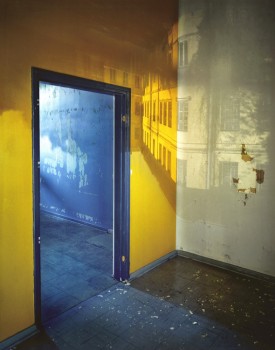
Speaking House #12, 2006. Photo: Marja PIrilä
A camera obscura (‘darkened room’) is the optical device that made photography possible; it is a box – or a room – with a hole in one side. Photographer Marja Pirilä has been using this method as a tool for almost 20 years. The book Carried by Light spans more than 30 years of her photography.
In the book artist and researcher Jyrki Siukonen notes in his essay ‘Eyes and Cameras’ that ‘in photographing spaces Pirilä also depicts people. The dreams continue on the walls of the empty building, as if after the people the house had become like them and were dreaming the dreams itself.’
Photographs and text extracts from Carried by Light by Marja Pirilä (Musta Taide, 2014)
Life: facts and fiction
10 September 2014 | Extracts, Non-fiction
 In his latest book, the architect and author Arne Nevanlinna (born 1925) recalls, among other things, his Helsinki childhood and family, the wartime period, his fellow architect Alvar Aalto, various aspects of the spirit of the times, his own work and writings. His first novel Marie was published in 2008. Extracts from Arne. Oman elämän kintereillä (‘Arne. On the trail of one’s life’, Siltala, 2014)
My attitude to my own identity has developed from the unconsciousness of childhood, the uncertainty of early adulthood, the artificial arrogance of middle age and the self-analysis of approaching retirement, to my present situation.
Despite the fact that my first book had some degree of success, it took many books before I felt I was a real writer. The process continued for well over ten years, by which time I was already over eighty. Before that, I thought of writing as a way to pass the time and combat loneliness. I imagined that I was writing for a living, and that I lived in order to write. I was in the fortunate position of not to think about my income.
Even then, I knew that this was just a catchphrase for the event that it occurred to someone in the audience to ask me why I wrote. That never actually happened. No wonder, as both question and answer would have been unnecessary, to put it mildly, and stupid, to put it harshly. More…
Rooms with views
21 August 2014 | Extracts, Non-fiction
Most of us live in box-shaped houses; the long-prevailing laws of modernist architecture relate to cubes, geometry and masses. Together with an architect, artist Jan-Erik Andersson designed a leaf-shaped house for himself. Could it be both art and architecture? In his new book he takes a look at non-cubical buildings in Finland and beyond, attempting to define what makes ‘wow factor architecture’: good architecture requires freedom from strict aesthetic rules.
Extracts from the chapter entitled ‘Det inre rummet’ (‘The inner room’) in Wow. Åsikter om finländsk arkitektur (‘Wow. Thoughts on Finnish architecture’, Schildts & Söderströms, 2014)
I remember from my childhood in the 1960s how my brother and I each lay in our beds in a little room late in the evening and stared up at the ceiling, onto which the lights from cars outside cast patterns. The patterns were constantly changing, they were like the doors of imagination onto eternity. Along with the hum of the engines they lulled me into a kind of half-stupor.
During the days the floor of the room grew to a town as we threw ourselves into a world of adventures and sped around with Formula 1 cars. Or the waste-paper bin was squeezed into a corner between the bookshelf and the wall, and the room took on the dimensions of a basketball court.
When defining a room it is difficult to distinguish between the outer, physical room, and the inner room formed by your consciousness. More…
The many arms of Krishna
14 August 2014 | Extracts, Non-fiction
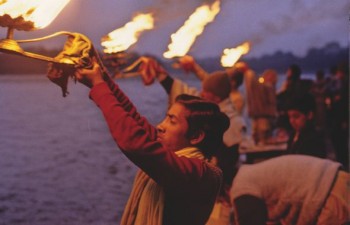
A feast by the Ganges. Photo from Pirjo Honkasalo’s film Atman
Cinematographer, camerawoman and director Pirjo Honkasalo has travelled and filmed widely – Japan, Estonia, India, Chechnya, Ingushetia, Russia – and her documentary films in particular have gained fame. American film critic John Anderson interviews Honkasalo; they talk about her documentary film Atman (1996) about a pilgrimage in India.
Edited extracts from Armoton kauneus. Pirjo Honkasalon elokuvataide (‘Merciless beauty. The film art of Pirjo Honkasalo’, Siltala, 2014; translated from English into Finnish by Leena Tamminen)
You can almost catch a whiff of the Ganges watching Atman [Hindu term, ‘self’], a documentary film in which religious pilgrimage, devotion, exhilaration and hysteria compete with tormented bodies, physical mortification, corpses, pollution and the acrid smoke of ritual cremation for domination of the viewer’s senses. The fact that it won the top prize at the International Documentary Film Festival Amsterdam in 1996 proves there is, if not justice, then good taste in the world. With all due respect to her previous work, Atman signified the full manifestation of Honkasalo’s genius.
What is it about? Eternity. Also, Jamana Lal: a member of the low-caste of Baila, a wifeless, crippled devotee of Lord Shiva whose mother has died, and who must – according to Hindu tradition – take her ashes from the ostensible mouth of the Ganges to the foothills of the Himalayas. More…
Animal magic
3 June 2014 | Extracts, Non-fiction
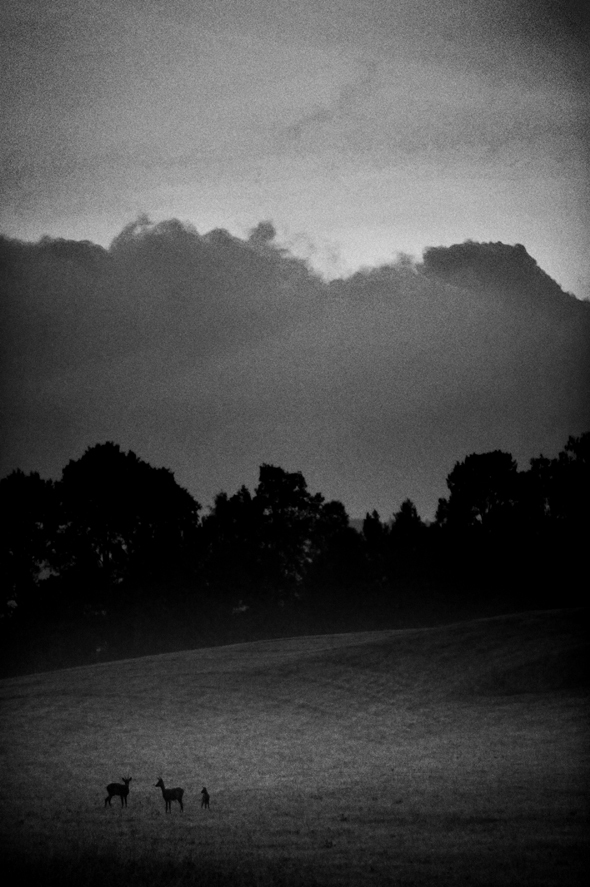
Roe deer, Sweden. Photo: Mats Andersson
A day in the life of an elk, of a lynx? Nature photographers venture into the depths of forests, in pursuit of the inhabitants – predator and prey, mythical and real. Photographs from Kohtaamisia (‘Encounters’), by Mats Andersson and Heikki Willamo, text by Willamo (Maahenki & Musta Taide [Black Art], 2014)
The feelings in our dreams. They well from depths – from those layers of awareness that the mind does not shackle. In sleep we handle and organise the events of our lives in a way which is impossible when awake, when we are conscious of ourselves and our limitations. That is why animals can come into my dreams as friends, equal partners, like me, and therefore I so often dream of having their abilities and skills.
When awake we think all the time. We think about past events and worry about the future or dream of something better. Very seldom do we live in the moment. Photographs are passing moments, often only a thousandth of a second long, but sometimes lasting minutes or even hours. In finished photographs the beholder can see much more – he adds his memories or dreams of the future. The picture-taking moment vanishes, something else comes in its stead. More…
Rock or baroque?
30 April 2014 | Extracts, Non-fiction
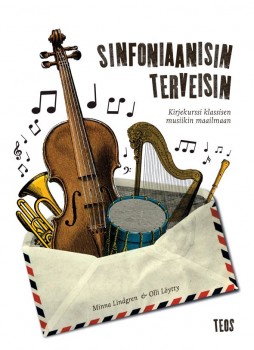 What if your old favourites lose their flavour? Could there be a way of broadening one’s views? Scholar Olli Löytty began thinking that there might be more to music than 1980s rock, so he turned to the music writer Minna Lindgren who was delighted by the chance of introducing him the enormous garden of classical music. In their correspondence they discussed – and argued about – the creativity of orchestra musicians, the significance of rhythm and whether the emotional approach to music might not be the only one. Their letters, from 2009 to 2013, an entertaining musical conversation, became a book. Extracts from Sinfoniaanisin terveisin. Kirjekurssi klassisen musiikin maailmaan (‘With symphonical greetings. A correspondence course in classical music’)
Olli, 19 March, 2009
Dear expert,
I never imagined that the day would come when I would say that rock had begun to sound rather boring. There are seldom, any more, the moments when some piece sweeps you away and makes you want to listen to more of the same. I derive my greatest enjoyment from the favourites of my youth, and that is, I think, rather alarming, as I consider people to be naturally curious beings whom new experiences, extending their range of experiences and sensations, brings nothing but good.
Singing along, with practised wistfulness, to Eppu Normaali’s ‘Murheellisten laulujen maa’ (‘The land of sad songs’) alone in the car doesn’t provide much in the way of inspiration. It really is time to find something new to listen to! My situation is already so desperate that I am prepared to seek musical stimulation from as distant a world as classical music. I know more about the African roots of rock than about the birth of western music, the music that is known as classical. But it looks and sounds like such an unapproachable culture that I badly need help on my voyage of exploration. Where should I start, when I don’t really know anything? More…
At your service
19 March 2014 | Extracts, Non-fiction
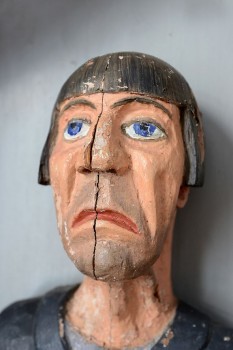
Melancholy man: detail of the almsman in Pomarkku, carved by Artturi Kaseva in the 1920s. Photo: Aki Paavola
Old men carved of wood have stood outside churches since the 17th century, begging for money to be given to the poor and the sick of the parish. These almsmen, or men-at-alms, mostly represented a disabled soldier; the tradition is not known elsewhere. Some 40 of the still surviving almsmen (there is one almswoman) were assembled for an exhibition in Kerimäki – in the world’s largest Christian wooden church – in summer 2013. The surviving specimens were hunted down and photographed by Aki Paavola for the book Vaivaisukkojen paluu (‘The return of the almsmen’). Otso Kantokorpi asks in the title of his introduction: are men-at-alms pioneers of ITE (from the words itse tehty elämä, ‘self-made life’; the English-language term is ‘outsider art’) or a disappearing folk tradition?
Many a church or belfry wall, particularly in Ostrobothnia, has been decorated – and is often still decorated – with a wooden human figure. Often they stand beneath a decorative canopy, sometimes accompanied by an encouraging phrase: He that hath pity upon the poor lendeth unto the LORD. They have been called men-at-alms or boys-at-alms. More…
Below and above the surface
13 March 2014 | Extracts, Non-fiction
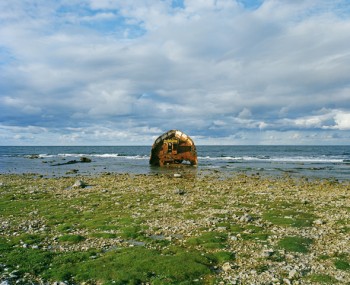
Fårö, Gotland, Sweden. Photo: Lauri Rotko
The Baltic Sea, surrounded by nine countries, is small, shallow – and polluted. The condition of the sea should concern every citizen on its shores. The photographers Jukka Rapo and Lauri Rotko set out in 2010 to record their views of the sea, resulting in the book See the Baltic Sea / Katso Itämerta (Musta Taide / Aalto ARTS Books, 2013). What is endangered can and must be protected, is their message; the photos have innumerable stories to tell
We packed our van for the first photo shooting trip in early May, 2010. The plan was to make a photography book about the Baltic Sea. We wanted to present the Baltic Sea free of old clichés.
No unspoiled scenic landscapes, cute marine animals, or praise for the bracing archipelago. We were looking for compelling pictures of a sea fallen ill from the actions of man. We were looking for honesty. More…
Is this all?
10 October 2013 | Extracts, Non-fiction
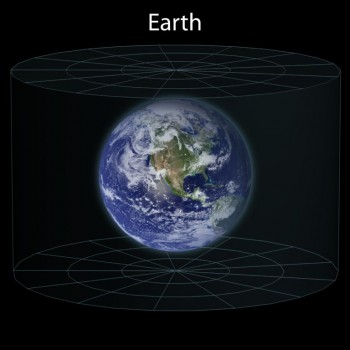
Earth. Andrew Z. Colvin/Wikimedia
In today’s world, many people find that it is not the lack of something that is problematic, but excess: the same goes for knowledge. According to professor of space astronomy, Esko Valtaoja, knowledge should contribute to the creation of a better world. His latest book is a contribution to the sum of all knowledge; over the course of two hundred pages Valtaoja delves deep into the inner space of man by taking his reader on a brief tour of the universe. Extracts from Kaiken käsikirja. Mitä jokaisen tulisi tietää (‘A handbook to everything. What everybody should know’, Ursa, 2012)
Whatever god you bow down to, you’re probably worshipping the wrong god.
The above is almost the only completely certain thing that can be said about religion, and even it does not encompass any deep truth; it’s just a simple mathematical statement. The world’s biggest religion is Roman Catholicism, which is confessed, at least nominally, by 1.1 billion people. If the Roman Catholic god were the true god, the majority of people in the world are therefore worshipping a false god. (According to the official stance of the Catholic church, the other Christian denominations are heresies, and their believers will be condemned to perdition: extra ecclesiam nulla salus. This inconvenient truth is, understandably, politely bypassed in ecumenical debate. But even if all those who call themselves Christians were counted as worshipping the same god, two thirds of the world’s population are still knocking at the wrong door.)
If you’re a religious person, don’t worry; I’m not blaspheming. And if you’re a campaigning atheist, hang on a minute: all I want to do is to find a clear and undisputed starting point to consider what it is we’re talking about when we speak of religion. More…
Findians, Finglish, Finntowns
16 May 2013 | Extracts, Non-fiction
Workers, miners, loggers, idealists, communists, utopians: early last century numerous Finns left for North America to find their fortune, settling down in Michigan, Minnesota, Wisconsin and Ontario. Some 800,000 of their descendants now live around the continent, but the old Finntowns have disappeared, and Finglish is fading away – that amusing language cocktail: äpylipai, apple pie.
The 375th anniversary of the arrival of the first Finnish and Swedish settlers, in Delaware, was celebrated on 11 May. Photographer Vesa Oja has met hundreds of American Finns over eight years; the photos and stories are from his new book, Finglish. Finns in North America

Drinking with the workmen: The Työmies Bar. Superior, Wisconsin, USA (2007)
The Työmies Bar is located in the former printing house of the Finnish leftist newspaper, Työmies (‘The workman’). The owners, however, don’t know what this Finnish word means, or how to pronounce it.
The Työmies Society, which published the newspaper of the same name, Työmies, was founded in Worcester, Massachusetts in 1903 as a socialist organ. It moved to Hancock, Michigan the following year. More…
Gypsy life
21 March 2013 | Extracts, Non-fiction
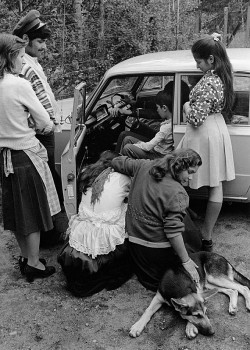
Romani teenagers, Kouvola, 1976. Photo: Mikko Savolainen
Photographer Mikko Savolainen began taking photos of Finnish Romani life in the 1960s, in the time of transition from nomadism to life in housing estates. New trends in the 1960s and 1970s also brought Romani culture to the fore – singers, musicians, festivals; an act baning racial discrimination had been passed. Savolainen became interested in Gypsy life
The text and the photographs are from Suomen romanit. Romanielämää 1960–1970-luvuilla / The Roma of Finland. Roma life in the 1960s and 1970s (Musta Taide, 2008. English translation: Jüri Kokkonen)
I have visited over a hundred Roma homes. Respect for parents, care of the elderly and hospitality are the first things that come to mind.
I have come across similar consideration for visitors only in cottages in Karelia, where the first question was whether I wanted a cup of coffee or to eat first.
I took my first photographs of Roma people in the Market Square of Hamina as an amateur photographer who only wanted to take good portraits. More…
In one hundred springtimes
23 November 2012 | Extracts, Non-fiction
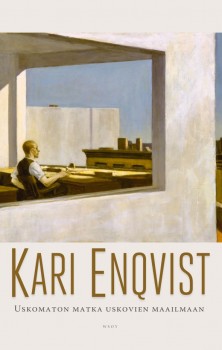 Extracts from Uskomaton matka uskovien maailmaan (‘An unbelievable journey into the world of the believers’, WSOY, 2012)
In his new book the writer, professor of cosmology, a scientist without a religion Kari Enqvist explores religiosity, how it manifests itself in present-day Finland, in various churches and parishes. How will the expanding scope of science and secularisation change the world and the forms of spirituality in the course of the next century?
When, in July 1969, Neil Armstrong climbed down the ladder on to the surface of the Moon, it was a huge propaganda coup for both the United States and the scientific world view. Manned space flights as a way of gaining knowledge are both ineffective and brain-numbingly expensive, but it is hard to imagine a stronger individual and universally understandable demonstration of the superiority of the scientific world view than an astronaut on the surface of a foreign celestial body. Everyone can recognise it as a triumph of both engineering technology and the hard sciences.
But the astronaut solution has been tested already, and I do not believe that space travel will expand our consciousnesses in the next century. It is possible that we will not even have visited Mars. Fantasies about manned flights to other stars are, in my opinion, utopian in the extreme and I do not really believe that humans as physical beings will ever leave the solar system. Journeys to the stars are inconceivably long and so expensive that they cannot be embarked on merely in order to fulfil the Buck Rogers fantasies of teenage boys. Carrying humans to the closest one, alpha Centauri, a mere four light years away, would take, at best, hundreds of years (we can dismiss rockets that travel at the speed of light as mere scientific fantasy). Even if deep-freezing to slow vital functions were possible, it would make as much sense to pay hundreds of billions to freight pig carcasses to the planets. For everything that human beings can do can be done better – and, more importantly, more cheaply – by machines. Even if the spirit were willing, the flesh is so weak that silicone beats it hollow.
So it is my guess that in place of the macrocosmos the scientific world view will seek consolidation in the microcosmos. As a cosmologist, I am not happy to admit this, but admit it I must. More…