

Author: Päivi Heikkilä-Halttunen
Maria Turtschaninoff: Maresi. Krönikor från röda klostret [Maresi. Chronicles of the red convent]
6 March 2015 | Mini reviews, Reviews
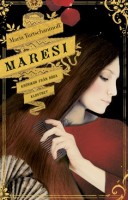 Maresi. Krönikor från röda klostret
[Maresi. Chronicles of the red convent]
Helsinki: Schildts & Söderströms, 2014. 213 pp.
ISBN 978-951-52-3471-1
€18.90, hardback
Maresi. Punaisen luostarin kronikoita
Suom. [Translated from Swedish into Finnish by]: Marja Kyrö
Helsinki: Tammi, 2014. 213 pp.
ISBN 978-951-31-8000-3
€25.90, hardback
Maria Turtschaninoff (born 1971) has quickly established a place as a leading author of Finland-Swedish young adults’ literature. Her fantasy novel Maresi is set in an old convent run entirely by women. The narrator Maresi is a conscientious girl loved by the congregation of sisters; she is gradually learning of her own special talents and what is expected from her. The peace of the convent is threatened with the arrival of the mute, uncommunicative Jai. Her experience of trauma gradually come to light and the girls work up their collective courage, together with the other women, to challenge the despotism of men. Turtschaninoff is a visual storyteller; her descriptions of nature, convent life, and animal care are indelible. The setting is vividly drawn and the sheltered environment feels well depicted. The novel unflinchingly takes on women’s experiences of physical and psychological violence, and its points of identification transcend all cultural boundaries. This provocative, feminist novel won the 2014 Finlandia Junior prize.
Translated by Lola Rogers
Iiro Küttner & Ville Tietäväinen: Puiden tarinoita: Puuseppä [Tales by trees: the carpenter]
26 February 2015 | Mini reviews, Reviews
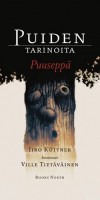 Puiden tarinoita: Puuseppä
[Tales by trees: The carpenter]
Kuvitus [Ill. by] Ville Tietäväinen
Helsinki: Books North, 2014. 30 pp., ill.
ISBN 978-952-67980-5-9
€28.90, hardback
The picture book surprise of the year is Puuseppä, the first book in the Tales by trees trilogy, launched with fanfare by Books North, a new small press, and extremely polished in appearance. The story pays homage to the classic tales of Zacharias Topelius and H.C. Andersen. The carpenter of the story is under the special protection of the emperor, and has the time and money to make anything he wants. His chosen project is stupendous – to isolate himself for 30 years and build an enormous tree, using various types of wood and complicated construction techniques. He forgets his family and finally wears himself out in the process. The story closes with a sly moral reflective of Finnish contemporary society, about forced labour, the pressures of working life, and the value of work. Comics artist Ville Tietäväinen’s illustrations are tactile – the picture of tree rings makes you want to touch it and feel the rough texture of the cut wood. Books North is an offshoot of Agency North Oy, which specialises in promoting Finnish drama and film abroad.
Translated by Lola Rogers
Timo Parvela: Paten aikakirjat [Pate’s chronicles]
26 February 2015 | Mini reviews, Reviews
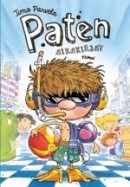 Paten aikakirjat
[Pate’s chronicles]
Kuvitus [Ill. by]: Pasi Pitkänen
Helsinki: Tammi, 2014. 96 pp., ill.
ISBN 978-951-31-7800-0
€25.90, hardback
Timo Parvela has achieved acclaim and won readers both in Finland and abroad – in Germany in particular. His Maukka ja Väykkä (Purdy and Barker) series of children’s novels will also soon be published in Great Britain. The Ella series for beginning readers now includes no less than 17 books, and now Pate, one of Ella’s supporting characters, has got his own series. The international counterpart of Paten aikakirjat – abundantly illustrated by Pasi Pitkänen – might be someone like Jeff Kinney, illustrator for Diaries of a Wimpy Kid. After living aborad for many years, Pate’s Uncle Pentti makes a bustling entrance into Pate’s life. Timo Parvela delights as usual with his trademark contrasts between children and slightly weird adults. In between comic mishaps are tons of easy-to-read dialogue, comics and lists of silly things.
Translated by Lola Rogers
Hiroko Motai & Marika Maijala: Miljoner biljoner julgubbar [A million trillion Santas]
19 February 2015 | Mini reviews, Reviews
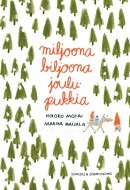 Miljoner biljoner julgubbar
[A million trillion Santas]
Translated from English into Swedish by Mirjam Ilvas
Kuvitus [Ill. by]: Marika Maijala
Helsinki: Schildts & Södersröms, 2014. 40 pp., ill.
ISBN 978-951-52-3422-3
€19.90, hardback
Miljoona biljoona joulupukkia
Suom. [Translated from English into Finnish by] Hannele Mikaela Taivassalo
Kuvitus [Ill. by]: Marika Maijala
Helsinki: Schildts & Södersröms, 2014. 40 pp., ill.
ISBN 978-951-52-3473-5
€18.90, hardback
Christmas-themed children’s books have a long tradition in Finland. Many new Christmas books appear every year to quench both children’s and adults’ Christmas fever. Japanese Tove Jansson fan Hiroko Motai (born 1972) approached Jansson’s Finnish publisher with her anarchic Santa Claus story with the hope that they would be interested in her idea. Motai’s story explains the miracle that happens every Christmas Eve: there are multiple Santas these days, because there’s no possible way that Santa could make it to the home of every child in the world in just one night. Versatile illustrator Marika Maijala has updated her image register by tightening up her earlier style. The rough chalk drawings brought to this reader’s mind drawings from her own school days. The sparse, naïve style is a excellent proof that a retro style can inspire an illustrator to create her own unique expressions.
Translated by Lola Rogers
Marja-Leena Mikkola: Helmenkantaja [The pearl bearer]
19 February 2015 | Mini reviews, Reviews
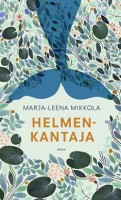 Helmenkantaja
[The pearl bearer]
Helsinki: Otava, 2014.125 pp.
ISBN 978-951-1-28182-5
€23.90, hardback
Marja-Leena Mikkola (born 193x) has had a long career as a poet and translator. She has also written books for children and young adults, and Helmenkantaja shows her thorough familiarity with Anglo-Saxon fantasy fiction. Charles Kingsley’s Water Babies as well as H.C. Andersen’s little mermaid seem to glimmer in the background of this story. True to Mikkola’s ethos, the novel has a dose of ecocriticism in its theme of protection of a threatened pearl oyster. Reetta is fed up with looking out for her younger siblings at the family’s summer cabin; it feels as if the summer is slipping away. This everyday tale gradually breaks off into an exciting adventure in an underwater kingdom. The water boy, heir to the queen of the water, has to be rescued from the clutches of the water wizard. This difficult task requires a daredevil like Reetta, who, in additon to many other important qualities, has the gift of storytelling.
Translated by Lola Rogers
Suvi-Tuuli Junttila: Minne matka, lapanen? [Where are you going, little mitten?]
11 February 2015 | Mini reviews, Reviews
 Minne matka, lapanen?
[Where are you going, little mitten?]
Kuvitus [Ill. by]: Suvi-Tuuli Junttila
Helsinki: Schildts & Söderströms, 2014. 57 pp., ill
ISBN 978-951-52-3420-9
€19.90, hardback
Lilla vanten
[Little mitten]
Kuvitus [Ill. by]: Suvi-Tuuli Junttila
Ruotsinnos [Translated into Swedish]: by Jonna Brander
Helsingfors: Schildts & Söderströms, 2014. 57 pp., ill.
ISBN 978-951-52-3460-5
€19.90, hardback
Suvi-Tuuli Junttila’s book combines assemblages and miniatures with winning originality. The exciting journey of the mitten, acorn and bottlecap from autumn to a new spring will inspire creative play and allows young readers to see everyday wonders from a new point of view. Illustration has always been more important than writing for designer and graphic artist Junttila (born 1979) – it is the pictures’ job to create their own story for the viewer. She always places her illustrations in the starring role and gives the text the task of suggestion. Junttila’s previous picture book, Missä, tässä, jossakin (‘Where, here, somewhere’, 2011) won first prize in the Mikkeli illustration triennial.
Translated by Lola Rogers
Réka Király: Yksi vielä [One more]
11 February 2015 | Mini reviews, Reviews
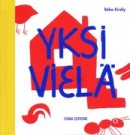 Yksi vielä
[One more]
Kuvitus [Ill. by]: Réka Király
Helsinki: Etana Editions 2014. 32 pp., ill.
ISBN 978-952-7105-01-6
€17.90, hardback
Réka Király, born in Hungary in 1977, has previously collaborated with fellow illustrator Marika Maijala. Her bright, harmonious fields of primary-colours are well suited to a story influenced by simple folk narratives that tells of animals coming one by one to stay in an uninhabited small cabin. As expected, the cabin creaks and cracks and finally breaks into a million pieces that fly into the air. Kiréaly’s simplified animal characters are very sympathetic. Yksi vielä is a good example of a picture book that develops a child’s sense of image and shape through clever visual inventiveness.
Translated by Lola Rogers
Maija & Anssi Hurme: Lepakkopoika [Batboy]
5 February 2015 | Mini reviews, Reviews
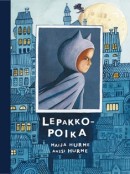 Lepakkopoika
[Batboy]
Kuvitus [Ill. by]: Maija Hurme
Helsinki: Schildts & Söderströms, 2014. 27 pp., ill.
ISBN 978-951-52-3361-5
€22.90, hardback
Fladdermuspojken
Kuvitus [Ill. by]: Maija Hurme
Helsinki: Schildts & Söderströms, 2014.
ISBN 978-951-52-3326-4
€28.90, hardback
Bat boy is a compact picture book with sparse text and abundant pictures that are well-balanced – there is never too much or too little of either. A six-year-old named Ilmari changes into a bat boy who stalks people in the dim of evening. The book describes the feelings of a boy approaching school age with sensitivity – the story deals with defiance of adult authority, rules and restrictions. Ilmari can also be thought of as a special child who experiences the world differently than other kids his age. The day care he attends is presented in both text and pictures as a prison and the adult day care workers as guards. Maija Hurme’s watercolour illustrations have an anarchic energy. The comic strip narrative supports Ilmari’s feelings of aggression. His fantasies are presented as blue-toned photographs with white borders, but the colours of the home and park settings glow with a message of safety, caring and trust.
Translated by Lola Rogers
Vilja-Tuulia Huotarinen: Kimmel
5 February 2015 | Mini reviews, Reviews
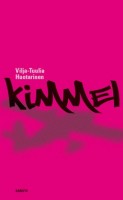 Kimmel
Hämeenlinna: Karisto, 2014. 120 pp.
978-951-23-5840-3
€22.90, hardback
In Kimmel, Vilja-Tuulia Huotarinen, known also for her poetry, presents no fewer than 12 teenage girls whose fates are left to be pondered long after the story is completed. Kimmel is a girl hero whose parents place the rescue of the entire planet on her shoulders. She has no doubt she will succeed in her task. She acquires a small pink airplane decorated with glitter – even though ‘there’s really nothing soft and pretty and hello-kitty about sixteen year olds’. For her companion on this epic trip Kimmel gets an interactive night book that empathises with her feelings and sometimes gives her concrete advice. Kimmel can be seen as a modern version of classic girl’s books – the author plays with girl’s book clichés but challenges the reader to think about myths of womanhood and the limits set by society. Huotarinen writes about the explosions of joy and the depths of sadness in girlhood with magical poignance and poetry.
Translated by Lola Rogers
Saku Heinänen: Zaida ja lumienkeli [Zaida and the snow angel]
29 January 2015 | Mini reviews, Reviews
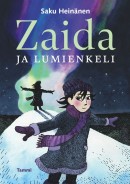 Zaida ja lumienkeli
[Zaida and the snow angel]
Kuvitus [Ill. by]: Saku Heinänen
Helsinki: Tammi, 2014. 207 pp., ill.
ISBN 978-951-31-7631-0
€25.90, hardback
The adopted child’s story is already a familiar one from old classics of girl’s literature. This debut novel by Saku Heinänen, the story of Zaida, a girl adopted from India, draws on this tradition, yet Heinänen (born 1968), a professor in graphic design at Aalto University, succeeds in creating a fresh and original setting and sympathetic central characters. Zaida is used to talking openly with her parents, but bullying at school makes her withdraw into her shell. She gets her strength from a soul sister who understands her bad moods. This tension is what gives this novel its extraordinary suspense. Heinänen’s book doesn’t paint a child’s everyday life as idyllic – there are many kinds of secrets in one little family. Zaida’s uncle is prone to drink and melancholy, but the two are still close. Heinänen also illustrated the book and designed his own font – Freya – just for the book. His wife is children’s book author and illustrator Christel Rönns.
Translated by Lola Rogers
Jenni Erkintalo: Värejä meressä [Colours in the sea]
29 January 2015 | Mini reviews, Reviews
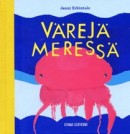 Värejä meressä
[Colours in the sea]
Kuvitus [Ill. by]: Jenni Erkintalo
Helsinki: Etana Editions, 2014. 32 pp., ill.
ISBN 978-952-7105-00-9
€17.90, hardback
In recent years a large number of board books have appeared in Finland: many of the graphic artists and designers of the younger generation have taken an interest in them. The style is generally modern, but unfussy and easy for a child to make sense of. Graphic artist Jenni Erkintalo’s (born 1978) picture book debut is ebullient, in all its simplicity. With supple rhyming text and minimal drawings, little readers are guided through the beginnings of learning colours. The three primary colours give birth to new colours and the illustrations demonstrate the mixture of colours in a fun way. The book has thick cardboard pages that can stand up to even a two-year-old’s rough handling.
Translated by Lola Rogers
Is less really more? On new books for young readers
18 December 2014 | Articles, Non-fiction
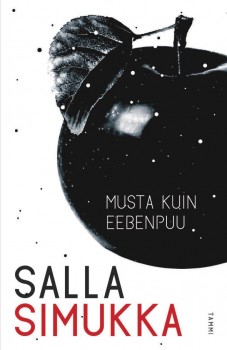
Black as ebony: volume three of the ‘Snow White’ trilogy for young adults by Salla Simukka
This year has been an eventful for Finnish literature in many ways, not least in terms of young adults’ and children’s books. The full ramifications of Finland’s turn as the theme country at this year’s Frankfurt Book Fair will only be known with the passage of time, but more mega-success stories to stand alongside Salla Simukka’s Lumikki (Snow White, Tammi) trilogy for young adults – now sold to almost 50 countries – are eagerly awaited. Visitors to the Frankfurt Book Fair also got a look at Finland-Swedish illustration at the By/Kylä (‘Village’) stand, which presented varied works by nine illustrators and animators in a memorable exhibit.
Book sales continue to fall in Finland. The major general-interest publishers – WSOY, Tammi, and Otava – have cut back on Finnish titles and are concentrating on high-sellers and proven authors.
Books in series are now a dominant phenomenon in literature for children and young adults, aiming to win readers’ loyalty with their continuing stories and characters. Many longtime authors and illustrators of books for children and young adults have had to look for new contacts, and publishers are increasingly hesitant to launch debut artists. More…
Reading matters? On new books for young readers
9 January 2014 | Articles, Children's books, Non-fiction
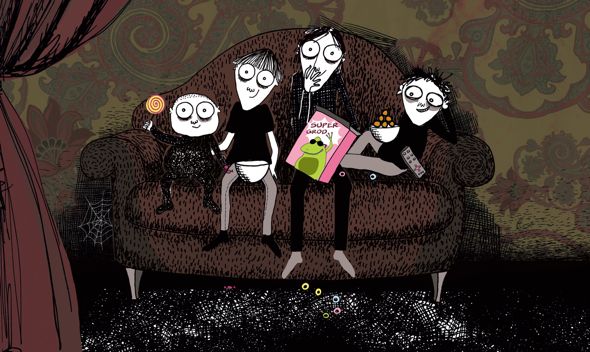
The Pixon brothers don’t read books, they love the telly: story by Malin Kivelä, illustrations by Linda Bondestam (Bröderna Pixon och TV:ns hemtrevliga sken, ‘The Pixon brothers and the homely shimmer of the telly’)
Finnish picture books for children have long been reliable export goods around the world. In the last few years, a number of novels for children have come along in their wake: works by authors such as Timo Parvela and Siri Kolu have been translated into a good many languages.
Now young adult literature has also blazed a trail on to the international market – in what also seems to be almost a matter of precision timing with regard to the Frankfurt Book Fair 2014. Finnish publishers have been investing in their home-grown lists of children’s and young adult books ever since the turn of the millennium, and now the time has come to harvest the fruits of their long-term efforts.
Kreetta Onkeli: Poika joka menetti muistinsa [The boy who lost his memory]
9 January 2014 | Mini reviews, Reviews
 Poika joka menetti muistinsa
[The boy who lost his memory]
Helsinki: Otava, 2013. 111 pp.
ISBN 978-951-1-27022-5
€22.90, hardback
Kreetta Onkeli, better known for her books for adults, was awarded the 2013 Finlandia Junior award for this book. Arto is a schoolboy who loses his memory, but goes off in search of himself with an open mind. He meets a number of people who are outsiders in various ways and learns important lessons from each of them. Onkeli portrays a child of around 11 to 13 who is confused by many things. Researchers consider this age group to fall into an in-between area: there aren’t enough appealing activities on offer for kids of this age, who are treated as an awkward bunch both at home and at school. This book contains some rule-breakers: the boys eat at a restaurant buffet without paying and ride the subway without a ticket while other characters hint at forging official documents. Adult readers with their eyes closed to reality might consider Arto’s odyssey an anxiety-inducing vision of the future, in which grown-ups are not shown in a flattering light. Children, however, will get wrapped up in this absurd adventure.
Translated by Ruth Urbom
Alexandra Salmela: Kirahviäiti ja muita hölmöjä aikuisia [The giraffe mummy and other silly adults]
9 January 2014 | Mini reviews, Reviews
 Kirahviäiti ja muita hölmöjä aikuisia
[The giraffe mummy and other silly adults]
Kuvitus [Ill. by]: Martina Matlovicová
Helsinki: Teos, 2013. 96 pp., ill.
ISBN 978-951-851-466-7
€27.90, hardback
The first children’s book by Alexandra Salmela, who has previously published a novel for adults, brings some sorely needed anarchy to Finnish storybooks. The 21 brief stories encourage children to add to them, whether by drawing, writing or out loud. Salmela’s tales are populated by trolls, dragons, knights and princesses, as well as ordinary children with silly parents. A boy called Ossi has two mums: Little Mum and Big Mum. One night, Little Mum collapses under the Tree of Exhaustion, but Ossi and his little sister hug their mum better. Allu’s absent-minded dad manages to mislay his head, and two perfect parents trade in their defective son Sulo at the child repair shop. The collage images by Slovakian illustrator Martina Matlovičová will work their way straight into your subconscious and start to bubble away.