

Author: Soila Lehtonen
Colour me beautiful?
29 June 2015 | This 'n' that
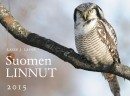 The May list of the ten best-selling non-fiction books compiled by Suomen Kirjakauppaliitto (the Finnish Booksellers’ Association; the list is in Finnish only) included five books on food (smoothies in particular); number one was Suomen linnut (‘The birds of Finland’) by Lasse J. Laine (Otava). Every summer people occasionally seem to remember to look up from their electronic gadgets to spot birds in the sky, wondering what they are.
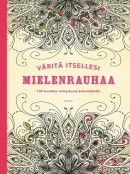 Number three was a book called ‘Find mindfulness by colouring’ (Väritä itsellesi mielenrauhaa, Atena).
Colouring books like this one have now become enormously popular; Johanna Basford’s books, for example, have sold millions of copies in various countries.
Has the oh-so-trendy ‘mindfulness’ has now become so frantically pursued that colouring patterns represent a kind of instant, fast-food-type mandala substitute?
Number six on the best-seller list was The 1000 Dot-to-Dot Book by Thomas Pavitte. Haven’t we all done these as little kids: after connecting, tongue in cheek, the dots with a erroneous pencil, a picture of a doggy or a flower, miraculously, appeared on the page? Yes: for adults it’s doggies, too, but also Elvis Presley, Muhammad Ali, Madonna or John F. Kennedy, or the Eiffel Tower (coming up soon, masterpieces of the world art).
Also available is a Kama Sutra dot-to-dot book (first published by Random House: ‘…this wickedly witty book only exposes its 30 exotic positions to the most persistent hands. Put a little lead in your pencil and get stuck in’).
‘It lets me feel like a “real” artist even though it is a simple dot to dot’, said one customer on Amazon’s pages, where the books are sold with the following sales patter: ‘…much more sophisticated than the one-dimensional images created in childhood connect-the-dot activity books…. Dot-to-dot puzzles have also been proven to increase short-term cognitive acuity, hand-eye coordination, and concentration skills.’
Readers say they feel that they ‘realise their creativity’. Uh-huh? (A scary prospect: some say they might even give their finished pictures to friends as gifts.) It isn’t creative though – rather, contemplative. Or was that navel-gazing…
These trends were interpreted in a recent article in the Swedish newspaper Dagbladet as demonstrating the infantilisation of contemporary society. People want to flee from their stressful grown-up duties (life, reality…) – by retreating (or regressing) to their own simple childhood pastimes?
How about, instead of doting on connecting dots to make time pass, people made live contacts with childhood, i.e. real children, or friends, or read a real book? Their brains would benefit more – and so would their mindfulness.
Leena Krohn: Erehdys [‘The mistake’]
8 June 2015 | Mini reviews, Reviews
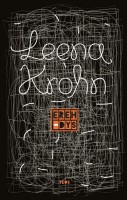 Leena Krohn
Erehdys [‘The mistake’]
Helsinki: Teos, 2015. 154 pp.
ISBN 978-951-851-575-6
€24.00, hardback
The protagonist of this new novel by Leena Krohn (born 1947) is an elderly author, E., who one dark and cold winter night arrives by car in a small town to perform in a literary event at a local library. The atmosphere does not seem very welcoming, and as the author begins reading extracts from his works, the comments and questions from the audience are mostly negative and impolite, even hostile. Gradually the sinisterness of the whole event becomes tragicomic; on leaving, the author has to fight his feelings of self-pity and anger. This novel frames E’s life in a portrait of a serious soul in constant pursuit of comprehending life – which he finally seems to acquire in death (in a car accident). The larger part of the novel consists of the stories the author reads; they will be familiar in style to fans of Krohn’s work. Unexpected, strange and unexplicable events and moments of everyday life take the characters by surprise; dreams, memories, remembering and forgetting what has taken place in the history – imagined or real – may perhaps change the way they have lived their lives.
Minna Lindgren: Ehtoolehdon tuho [The downfall of Twilight Grove]
1 June 2015 | Mini reviews, Reviews
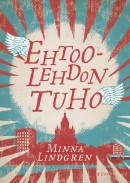 Minna Lindgren
Ehtoolehdon tuho [The downfall of Twilight Grove]
Helsinki: Teos, 2015. 288pp.
ISBN 978-951-851-646-3
€29.90, paperback
This is the final novel in a trilogy by the writer and music editor Minna Lindgren (born 1963). The protagonists in Kuolema Ehtoolehdossa (‘Death in Twilight Grove’, 2013) were lively ninety-something ladies in an assisted living facility in Helsinki. Now their life is turning more and more satirically and grotesquely absurd: as employing human workforce is becoming too expensive for the owners of the facility, the old folks are being cared for by electronic devices, monitors, cameras, ’smartwalls’ and cleaning robots, and their food – tasteless but colourful paste – is dispensed from 3D vending machines. In addition to all this, the members of a devious religious group, in pursuit of any money that the inhabitants may still have, begin to manipulate them. Things are not looking good, but the resourceful ladies are not about to give in, even though one of them will peacefully – and considering her age, naturally – pass away (in her bed, holding her favourite book, Thomas Mann’s The Magic Mountain). Lindgren defends the human rights of her characters with gusto. No wonder, then, that the trilogy will shortly appear in several languages, including English, German and French.
Riitta Nikula: Suomalainen rivitalo. Työväen asunnosta keskiluokan unelmaksi. [The Finnish terraced house. From worker housing to middle-class dream.]
18 May 2015 | Mini reviews, Reviews
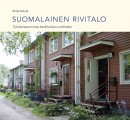 Riitta Nikula
Suomalainen rivitalo. Työväen asunnosta keskiluokan unelmaksi.
[The Finnish terraced house. From worker housing to middle-class dream.]
Helsinki: Suomalaisen Kirjallisuuden Seura (The Finnish Literature Society), 2014. 252 pp., ill.
ISBN 978-952-222-568-9
€ 37, hardback
In her extensive, well-researched book on the semi-detached house, Professor Emerita of Art History Riitta Nikula describes the housing history of a typical well-to-do Finn as setting off from a flat in an apartment building, continuing to a terraced house and ending up in a house of his or her own. In Finland rivitalo (simply, ‘row house’) became increasingly popular in the 1960s and the majority of houses of this type were built during the two decades that followed. However, in her book Nikula concentrates on the years 1900–1960, the decades of rapid industrialisation and urbanisation. In the 1930s Finland was eager to follow the renewal of town planning and architecture that was taking place elsewhere in Europe, and the rivitalo houses were part of the project of modernism. After the war the government funding system helped people to become owners of the properties they lived in, and the rivitalo became popular in growing towns. Prominent architects such as Eliel Saarinen, Alvar Aalto, Hilding Ekelund, Viljo Revell, and Kaija and Heikki Siren have all contributed to the development of this form of architecture. Nikula has travelled widely, in Europe and in Finland, researching this mode of living (the index of literature referred to alone fills seven large pages). The plentiful photographs and illustrations complement the text well.
Pekka Lassila: Maininki [Surge]
5 May 2015 | Mini reviews, Reviews
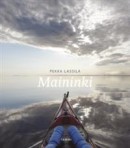 Pekka Lassila
Maininki [Surge]
Helsinki: Tammi, 2014. 278 pp., ill.
ISBN 978-951-31-8126-0
€36, hardback
This book is a journal of a ‘survival project’: a continuous kayak voyage of 1,300 kilometres along the Finnish coast, from the eastern border (Russia) to the northwestern one (Sweden). Pekka Lassila (born 1959) is a photojournalist who, in an attempt to find a way out of the crisis of losing a job he had heald for thirty years, set off on his voyage in May, when the ice had only just melted. Nights were spent mostly in a tent; all washing up had to be done with sea water. Lassila blogged daily for newspapers by the power of his solar-charged phone and tablet. This solitary endeavour seems slightly obsessive at first – but the stories about the geography and history of the places passed by and the descriptions of the personal daily marine routines turn out to be interesting, never repetitive. The shallow west coast, the Gulf of Finland, even proves to be dangerous: the waves, growing rough, threaten to crush the kayak on the rocks, but Lassila’s paddling skills and luck save him. The photographs, taken each day, illustrate the voyage well (even though it is irritating that there are no captions!). Reaching his goal, after 31 days, Lassila manages to complete his ‘project’ – but confesses that he may only later fully understand the reasons why he set out.
Peter von Bagh: Muisteja [Memories]
17 April 2015 | Mini reviews, Reviews
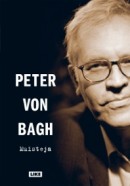 Peter von Bagh
Muisteja [Memories]
Helsinki: Like, 2014. 426 pp., ill.
ISBN 978-952-01-1093-2
€29.95, hardback
Peter von Bagh (1943–2014) became a cinephile legend in his lifetime. He was the son of a German emigrée, a psychiatrist from St Petersburg; his mother died when he was six, and his stepmother, ‘mean and stupid’, destroyed in his absence all his personal belongings, books and photographs. In this memoir von Bagh contends that his own films were to a large extent a means of reconstructing the past that his stepmother destroyed. Von Bagh was editor-in-chief of Filmihullu (‘Film fan’) magazine for 43 years, published more than 30 books on cinema and its history, worked in radio and for the National Film Archive, and directed dozens of films, mainly for television. He promoted the Midnight Sun Film Festival in Sodankylä, Lapland, for twenty-eight years, and held the post of artistic director of Bologna’s Il cinema Ritrovato festival for thirteen. This book presents the reader with a huge number of people, films, books, encounters and travels; although, typically of von Bagh, who, despite his doctorate, never cared for ‘formalities’, and rather annoyingly, there is no index. (Surely the publisher could have provided them!) But both self-criticism and the acidic, boldly blunt comments on anything – or anybody – that the writer considers ridiculous or stupid, the knowledge and the experience as well as the sardonic humour make the book a very worthwhile experience. The reader is very thankful for the fact that the author was able to finish writing this book of memoirs.
Minna Lindgren: Ehtoolehdon pakolaiset [The refugees of Twilight Grove]
26 March 2015 | Mini reviews, Reviews
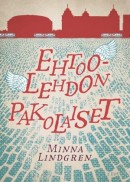 Ehtoolehdon pakolaiset
[The refugees of Twilight Grove]
Helsinki: Teos, 2014. 334 pp.
ISBN 978-951-851-584-8
€29.90, paperback
This is the second volume of a novel trilogy by the writer and music editor Minna Lindgren (born 1963). The protagonists in Kuolema Ehtoolehdossa (‘Death in Twilight Grove’, 2013) were ladies in their nineties in an assisted living facility in Helsinki – administered by a foundation entitled (ironically enough), ‘Care and Love of the Elderly‘. Lindgren’s ‘adventure satire’ continues to focus on the lack of common sense, respect and empathy (as well as presence or interest of relatives) in the – often patronising – care of the elderly. The story revolves round the evacuation of the inhabitants from the facility to temporary housing as a tragicomically huge renovation project sets off, not without some seriously fishy business. This volume might be described as a slightly more sombre in its themes than the previous one, as illnesses and death occur – however, the point is that dying, not an unexpected turn in a person’s life after the age of 90, should be regarded as something natural. As what Lindgren writes about is by no means a phenomenon foreign to contemporary western societies, it is not surprising that so far the translation rights of the trilogy into eight languages have been sold.
Kaisa Koivisto & Uta Laurén: Suomalaisen taidelasin kultakausi [The golden era of the Finnish glass]
19 March 2015 | Mini reviews, Reviews
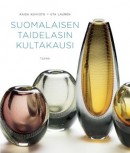 Suomalaisen taidelasin kultakausi
[The golden era of the Finnish glass]
Helsinki: Tammi, 2014. 326 pp., ill.
ISBN 978-951-31-7320-3
€49.90, hardback
The authors of this book specialise in Finnish glass and its history, working at the Finnish Glass Museum. The 1950s and the early 1960s formed the golden age of Finnish glass: young artists such as Timo Sarpaneva, Tapio Wirkkala, Gunnel Nyman, Nanny Still and Kaj Franck all began gaining fame as the number of prizes won at the 1950s Milan triennales made way for their international success. Finnish glass factories worked closely with artists, as serial production had to provide the commercial success. In the 1970s, however, the glass industry began to diminish due to heavy competition in the form of imported glassware. Unique objects of glass are still made and glass artists trained in Finland, but of six major factories only Iittala (est. 1881) is still working; for example, the 220-year old Nuutajärvi Glass Factory closed its doors in 2013. The majority of the excellent photographs in this comprehensive, beautiful book are from the Finnish Glass Museum or the Finnish Design Museum. The book includes short biographies of 27 Finnish glass artists and histories of glassworks as well as a glossary of glass-making terms.
Marjatta Levanto & Julia Vuori: Leonardo. Oikealta vasemmalle [Leonardo. From right to left]
6 March 2015 | Mini reviews, Reviews
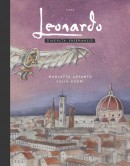 Leonardo. Oikealta vasemmalle
[Leonardo. From right to left]
Teksti [Text by]: Marjatta Levanto
Kuvitus [Ill. by]: Julia Vuori
Design: Dog Design
Helsinki: Teos, 2014. 113 pp., ill.
ISBN 978-951851-467-4
€34.90, hardback
This handsome non-fiction book is a lavishly illustrated biography of the 15th-century Italian artist genius Leonardo da Vinci. The title refers to the fact that he employed ‘mirror’ writing in his diaries and notebooks. Art historian Marjatta Levanto has published several works on art for children and young people, and many of them have been illustrated by Julia Vuori. Leonardo introduces to the reader the world of the Italian renaissance, the artist’s astonishing and unique inventions – such as various human flying devices – his philosophical writings, his anatomical studies and his magnificent paintings and drawings. Julia Vuori’s amusing little vignettes and larger, colourful illustrations comment on the narrative and mingle with the text and the reproductions of Leonardo’s artwork. Some pictures are printed on transparent pages. This beautiful book is a treasure trove to a reader of any age.
Not a world language, and yet….
16 January 2015 | Articles, Non-fiction
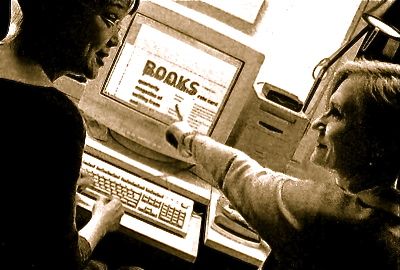
The editors (Hildi Hawkins and Soila Lehtonen) at the screen: we begun publishing material on our website in 1998. Photo: Jorma Hinkka, 2001
Longevity may not generally be a virtue of literary magazines – they tend to come and go – but Books from Finland, which began publication in 1967, has stuck around for a rather impressively long time. Literary life, as well as the means of production, has changed dramatically in the almost half-century we have been in existence. So where do we stand now? And what does the future look like?
This is the farewell letter from the current Editor-in-Chief, Soila Lehtonen – who began working for the journal in 1983
‘The literature of Finland suffers the handicap of being written in a so-called “minor” language, not a “world” language…. Finland has not entirely been omitted from the world-map of culture, but a more complete and detailed picture of our literature should be made available to those interested in it.’
Thus spake the Finnish Minister of Education, R.H. Oittinen, in early 1967, in the very first little issue of Books from Finland, then published by the Publishers’ Association of Finland, financed by the Education Ministry.
Forty-seven years, almost 10,000 printed pages (1967–2008) and (from 2009) 1,400 website posts later, we might claim that the modest publication entitled Books from Finland, has accomplished the task of creating ‘a more complete and detailed picture’ of Finnish literature for anyone interested in it. More…
Aho & Soldan: Helsinki 1950-luvun väreissä / Helsingfors in 1950-talets färger / Helsinki in 1950’s colours
11 January 2015 | Mini reviews, Reviews
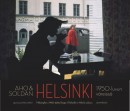 Aho & Soldan: Helsinki 1950-luvun väreissä / Helsingfors in 1950-talets färger / Helsinki in 1950’s colours
Teksti / text: Eino Leino
Translation into Swedish by Marjut Hökfelt, into English by Elina Adams
Helsinki: Gummerus, 2014. 168 pp., ill.
ISBN 978-951-20-9527-8
€36.90, hardback
The photographer Claire Aho (born 1925) is the granddaughter of the author and journalist Juhani Aho (1861–1921) and his artist wife Venny Soldan-Brofeldt. Two of Aho’s sons, Heikki and Björn, became photographers and documentary film producers, founding the company Aho & Soldan. In the 1940s Heikki’s daughter Claire began to work for Aho & Soldan and becme a well-known fashion photographer. She also began photographing her native Helsinki; in 1952 she was assigned to film the Helsinki Summer Olympics. She continued her collaboration with Pathé News until the early 1960s. Colour came, literally, into the picture after the war; the photographs in this book feature life in the 1950s Helsinki. The photographs in their gently faded colours of the still small city, its inhabitants, parks, buildings and monuments are taken by either the two brothers or Claire Aho – in their time they were all signed just by Aho & Soldan. In his essay journalist Eino Leino portrays life in the city that he remembers from his own childhood in the post-war era, which to today’s reader appears sweetly idyllic, somehow optimistic and peaceful; the city has changed greatly – and yet stayed the same.
The magic box: childhood revisited
25 December 2014 | Essays, Non-fiction
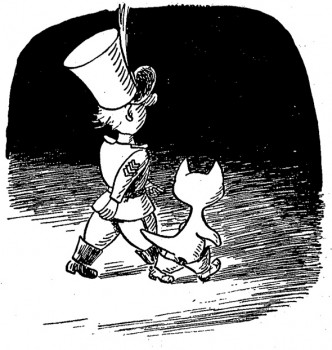
The tin soldier and the Blue Cat. Illustration: Usko Laukkanen
A tribute to Oiva Paloheimo’s children’s novel Tinaseppä ja seitsemän (‘The Tinsmith and the Seven’, illustrated by Usko Laukkanen, WSOY, 1956)
I’ve happened upon this (Christmassy) text of mine – first published in Books from Finland back in 1995 – when sorting through my papers as I begin to contemplate my retirement. With it I would like to offer my goodbyes, and many thanks, to you – to our readers, for whom I have been commissioning, editing and writing texts for the past thirty-one years – it’s time to do other things; time to read the books that still remain unread…
A dusky winter’s afternoon. Outside, soft and grey, a little snow is falling. I am sitting in our living-room, in an armchair covered in a pale yellow boucle fabric, my legs curled up, eating a carrot. In my lap is a book which I have fetched from the library after school. Conversation, the faint clattering of crockery, a singing kettle, the smell of food: grandmother and mother are cooking supper in the kitchen. My little sister is asleep.
But these sounds and the room around me do not really exist: there is only the world of make-believe in which Tiina sets off on her adventures with the Blue Cat, the Tinsmith, the St Bernard dog, the star and the spider: that world is a magic box which is able to contain all of childhood. More…
Instant erudition, or, who are you kidding?
2 September 2014 | Articles, Letter from the Editors, Non-fiction
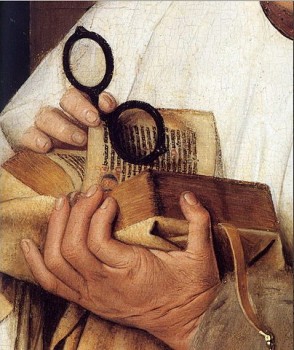
Time to read? Detail from Madonna with Canon van der Paele by Jan van Eyck (1439. The Groeninge Museum, Brugge). Wikipedia
In a recent ‘Saturday essay’ in the Helsingin Sanomat newspaper (9 August) journalist Oskari Onninen ponders the moral dilemma of pretending to be erudite. For example, who has the time to read books these days? ‘The Woolfs remain unread, Bergmans unwatched’, Onninen writes.
Our consumerist lifestyle forces us to follow the trends of ever-expanding, multiplying forms of entertainment. However, it is apparent that the need to know about culture in order to pass as a cultured, well-informed citizen still exists, to some extent at least.
According to Onninen, there is less and less time for unproductivity. ‘If one looks for measurable cost-benefit results from the reading of heavyweight fiction, the act of reading will certainly not always be worthwhile.’ Consuming art (reading books, going to art exhibitions, watching plays) requires time and effort, and how productive is that? More…
Harri Kalha: Muodon vuoksi. Lasin ja keramiikan klassikot [For form’s sake. The classics of glass and ceramics]
24 June 2014 | Mini reviews, Reviews
 Muodon vuoksi. Lasin ja keramiikan klassikot
[For form’s sake. The classics of glass and ceramics]
Helsinki: The Finnish Literature Society, 2013. 335 pp., ill.
ISBN 978-952-222-402-6
€75, hardback
This handsome, massive work introduces objects of glass and ceramics from the Finnish ‘golden age’ of the 1940s, 1950s and 1960s. Artist-designers Kaj Franck, Tapio Wirkkala, Toini Muona, Timo Sarpaneva and Kyllikki Salmenhaara were awarded three prizes at the Milan Triennale, Rut Bryk and Birger Kaipiainen two, but the number of designers whose works have become classics without these prizes is naturally much larger. The art historian and author Harri Kalha records the exceptional development of industrial design. In postwar Finland, with scarce resources, art and mass production entwined, resulting in high-standard objects of glass and ceramics gaining international fame and becoming part of international modernism. The businessman Kyösti Kakkonen became interested in Finnish design in the 1990s, and now his private collection consists of thousands of objects, from which Kalha has made his choices for the book. More than two hundred photographs, by Niclas Warius, pay tribute to the materials, shapes and colours of the objects as light is reflected from the surfaces, making them appear three-dimensional, both real and dream-like. The printing, by Bookwell, matches the quality of the photography.
The private I? Me and my home
17 June 2014 | Reviews
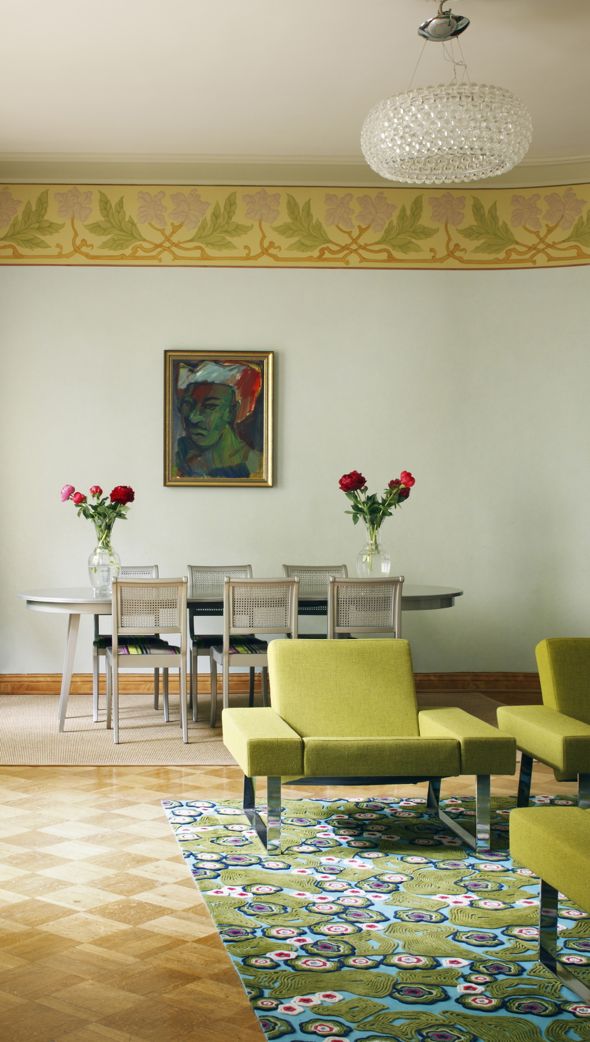
Art Nouveau with a modern twist. Photo: Avaimia ajattomiin suomalaisiin sisustuksiin / Jaanis Kerkis
Avaimia ajattomiin suomalaisiin sisustuksiin
[Keys to timeless Finnish interiors]
Design: Hanni Koroma, text: Sami Sykkö, photographs: Jaanis Kerkis
Helsinki: Gummerus, 2014. 123 pp., ill.
ISBN 978-951-20-9507-0
€32.90, hardback
Katja Lindroos
MOMO. Koti elementissään
[MOMO. The home in its element]
Photography: Riikka Kantinkoski, Niclas Warius
Helsinki: Siltala, 2013. 154 pp., ill.
ISBN 978-952-234-164-8
€32.90, hardback
www.momokoti.fi (in Finnish only)
‘Interior decoration’ has become an extremely popular pastime in Finland – as elsewhere where the standard of living allows it.
Innumerable magazines and blogs keep churning out photos of rooms with large white, cushioned sofas, glossy white kitchen cabinets and white floors on which furniture seems to float forlornly. Walls are decorated with wooden or metallic letters forming words: love; home, sweet home. In the kitchen the bread bin bears the word BREAD. (Bookcases, with actual books, are rare.)
Why is it that in our age which worships ‘individuality’, trends rule? More…