

Tag: politics
Osmo Soininvaara: Jäähyväiset eduskunnalle [Farewell to Parliament]
23 June 2015 | Mini reviews, Reviews
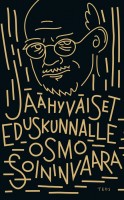 Osmo Soininvaara
Jäähyväiset eduskunnalle [Farewell to Parliament]
Helsinki: Teos, 2015. 247pp.
ISBN 978-951-851-649-4
€33, hardback
Long-time member of the Finnish Parliament Osmo Soininvaara, who has also worked as a minister, decided not to participate in the 2015 parliamentary elections. In this timely book, this expert in social politics and influential figure in the Green Alliance examines the reasons for political alienation, analyses politics more broadly and presents his own medicines for improving the situation. According to Soininvaara, the Finnish parliament has become superficial and publicity-seeking and there is much room for improvement in its work. The six-party ‘rainbow coalition’ of the outgoing parliament was incapable of action and the two largest, leftist, parties were continually at loggerheads, with the Social Democrats, in particular, demanding reforms. The divided opposition was toothless. Finland’s economy weakened still further, and it proved impossible to implement the administration’s central projects, reform of the social and health systems and of municipal administration, let alone others, among them the structural administrative changes essential for economic recovery. Writing fluently, Soininvaara examines politics and Parliament from many different perspectives, arguing eloquently for his views.
Risto Uimonen: Juha Sipilä. Keskustajohtajan henkilökuva. [Juha Sipilä. Portrait of a centrist leader.]
23 June 2015 | Mini reviews, Reviews
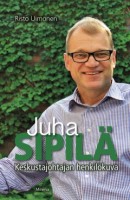 Risto Uimonen
Juha Sipilä. Keskustajohtajan henkilökuva. [Juha Sipilä. Portrait of a centrist leader.]
Helsinki: Minerva, 2015. 431pp., ill.
ISBN 978-952-312-125-6
€33,90, hardback
Juha Sipilä was an information technology millionaire and business entrepreneur when, in 2011, he became, at his first attempt, a member of parliament for the Finnish Centre Party, which represents principally country people, is considered conservative in its values and had lost support. The very next year this engineer from northern Finland was elected chairman of the party. Through, among other things, numerous interviews, the experienced non-fiction writer and journalist Risto Uimonen builds a nuanced portrait of a party leader with a strongly ethical value-system that lies on his Christian faith. Characteristic of Sipilä are informality, consideration of others, practicality and the ability to present issues clearly and pithily. In his party, he has focused on issues that are important to him, such as the promotion of biotechnology. Uimonen offers a fluent portrait of the background to Sipilä’s life and surprising career development, to which, as the book was being completed, a family tragedy brought darker tones. After the publication of the book, Sipilä led the Centre Party to victory in the parliamentary elections of April 2015. As chairman of the biggest party, he began to form a government and has already been praised for his efficiency.
Alpo Rusi: Etupiirin ote [The grip of the sphere of influence]
4 May 2015 | Mini reviews, Reviews
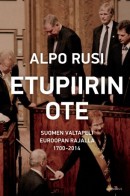 Alpo Rusi
Etupiirin ote [The grip of the sphere of influence]
Helsinki: Gummerus, 2014. 411p.
ISBN 978-951-20-9715-9
€34.90, hardback
In his work Etupiirin ote, the scholar, writer and former ambassador Alpo Rusi provides an interesting and polemical analysis of Finland’s foreign and security policies, particularly with regard to its neighbour, Russia / the Soviet Union. His premise is that from the 18th century onward Finland has, sometimes more broadly, sometimes more narrowly, formed part of the Russian sphere of influence. He gives a brief account of the end of the period of Swedish rule (until 1809) and that of Russian rule (1809-1917), as well as of the early decades of Finnish independence. The main emphasis of the book is on the period beginning with the Second World War. Rusi has a personal perspective on much recent history. He bases his evaluations on many diverse, sometimes controversial, sources and expresses strong opinions in his account, for example, of ‘Finlandisation’, Soviet influence on Finnish politics with its negative side effects. Rusi strongly criticises decision-makers who, as late as the 1980s and 1990s, believed in the desirability of trade with the east and the permanence of the Soviet Union, despite signals to the contrary. Following the collapse of the Soviet Union, Finland joined the European Union, but even as a member its attitudes towards, for example, Nato and Russia, have been problematic in many ways. Rusi ends his book on the theme of the Ukraine crisis, presenting his own proposal for the development of foreign and security policies.
Hannu Rautkallio: Mannerheim vai Stalin. Yhdysvallat ja Suomen selviytyminen 1939–1944 [Mannerheim or Stalin. The United States and Finland’s survival 1939–1944]
2 April 2015 | Mini reviews, Reviews
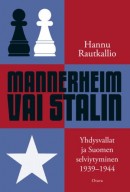 Mannerheim vai Stalin. Yhdysvallat ja Suomen selviytyminen 1939–1944
[Mannerheim or Stalin. The United States and Finland’s survival 1939–1944]
Helsinki: Otava, 2014. 463 pp., ill.
ISBN 978-951-1-27394-3
€39.70, hardback
In his book political historian Hannu Rautkallio explores American attitudes towards Finland during the Second World War, when the country fought a Winter War and Continuation War against the Soviet Union. He makes use both of older materials and of American documents that have only become accessible to researchers in the 2010s. During the war years two trends were dominant; one was sympathetic to the aims of the Soviet Union, while the other took a hostile view of them. The US political leadership had refused to support Finland in the Winter War, but as the World War progressed the United States tended to understand the small country’s objectives and also the special nature of its alliance with Germany. The two states shared intelligence and there were a large number of secret contacts with Finland’s top government leadership. At the end of World War II, the United States communicated to the Soviet Union, which was dictating peace terms to Finland, that it was important Finland should remain an independent state. Rautkallio’s account keeps branching out along interesting side-tracks, but the book’s central theme captures the reader’s interest.
Translated by David McDuff
Marjo Vilkko: Suomi on ruotsalainen [Finland is Swedish]
16 January 2015 | Mini reviews, Reviews
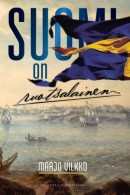 Suomi on ruotsalainen
[Finland is Swedish]
Helsinki: Schildts & Söderströms, 2014. 321 pp.
ISBN 978-951-52-3419-3
€36, hardback
Finland was a part of the Swedish kingdom from the deep Middle Ages until 1809, when for a hundred years it was incorporated into Russia. The Swedish period left profound traces in Finnish society, and these were examined – with lively discussion – in the television series Finland is Swedish. Now the series scriptwriter and editor Marjo Vilkko has provided a more thoroughgoing treatment of the topic in her book. Although Finland is a country that shares Western and Nordic values, it differs from Sweden in several respects. For historical reasons and due to the presence of a significant Swedish-speaking minority, Swedish is still an official language; many things have moved from Europe to Finland via Sweden. However, at times the differences in Finland’s development have been emphasised by those wishing to propagate ‘original Finnish’ characteristics. With the use of fascinating examples and reflections drawn from history, Vilkko shows, for example, how Finland’s local government, legal system and Lutheran religion are to a large extent an inheritance from the Swedish period, with a continuous mutual interaction. The book moderately propagates the recognition of a common heritage and support for mutual understanding.
Translated by David McDuff
Erkki Tuomioja: Siinä syntyy vielä rumihia. Poliittiset päiväkirjat 1991–1994 [Heads will roll. Political diaries 1991–1994]
20 November 2014 | Mini reviews, Reviews
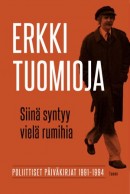 Siinä syntyy vielä rumihia. Poliittiset päiväkirjat 1991–1994
[Heads will roll. Political diaries 1991–1994]
Editor: Veli-Pekka Leppänen
Helsinki: Tammi, 2014. 680 pp., ill.
ISBN 978-951-31-7555-9
€39, hardback
Erkki Tuomioja (born 1945) has for a long time served as a member of parliament and as Finland’s foreign minister. A left-wing Social Democrat, Tuomioja has since his youth been known as a sharp-minded social debater as well as a writer and researcher. His publications include a biography of his grandmother, the Estonian-born eminent writer and dramatist Hella Wuolijoki. These fascinating political diaries from the early 1990s cover such topics as the break-up of the Soviet Union, Finland’s increasingly close integration with western Europe, and with the disputes about the Social Democrat leadership and the remarkable rise of Martti Ahtisaari, who came in from outside to become the party’s presidential candidate, and ultimately the country’s president. Tuomioja’s characterisations of Finnish politicians and political life are apt and plain-spoken, with particular criticism reserved, for example, for President Ahtisaari. Tuomioja does not conceal his own doubts and disappointments, and accepts that some of his views of the time do not correspond to those that he holds today. The editor provides the reader with a summary of the important events at the beginning of each month.
Translated by David McDuff
Luvattu maa. Suur-Suomen unelma ja unohdus [The promised land. The dream of Greater Finland, and how it was forgotten]
26 September 2014 | Mini reviews, Reviews
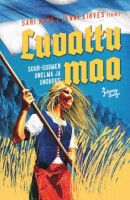 Luvattu maa. Suur-Suomen unelma ja unohdus
[The promised land. The dream of Greater Finland, and how it was forgotten]
Toim. [Ed. by] Sari Näre & Jenni Kirves
Helsinki: Johnny Kniga, 2014. 407 p.
ISBN 978-951-0-40295-5
€36.90, hardback
In the 1920s and 1930s Finland was powerfully influenced by the idea of a Greater Finland which was also to include the Finno-Ugric peoples living on the Soviet side of the border – at least East Karelia, if not more. Right-wing nationalists in particular nourished a vision that had its roots in the idealistic ‘Karelianism’ of the nineteenth century. When during the Second World War in 1941 Finland ended up fighting the Soviet Union as an ally of Nazi Germany, and the Finnish army advanced far beyond the eastern border, for a short time many Finns even viewed a Greater Finland as a possibility. After Finland suffered defeat in the war there was a desire to forget both the embarrassing alliance with Nazi Germany and the frenzied nationalistic dreams of Greater Finland with their population resettlements and other plans. Not until the 1970s did anyone begin to study the subject in more depth. Five historians from a younger generation present a fascinating study of the Greater Finland idea and the attempts at its realisation, discussing, for example, the attitude to the war taken by women and the clergy, life at the front line, and propaganda, including its expression in literature.
Translated by David McDuff
Juho Kotakallio: Hänen majesteettinsa agentit. Brittitiedustelu Suomessa 1918–1941 [His Majesty’s agents. British Intelligence in Finland 1918–1941]
14 August 2014 | Mini reviews, Reviews
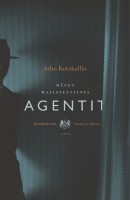 Hänen majesteettinsa agentit. Brittitiedustelu Suomessa 1918–1941
[His Majesty’s agents. British Intelligence in Finland 1918–1941]
Jyväskylä: Atena, 2014. 297 pp., ill.
ISBN 978-952-300-025-4
€34, hardback
Historian Juho Kotakallio’s book deals with the work of the British Intelligence Service (SIS) in Finland from the Declaration of Independence (1917) to the early phase of the Continuation War (1941–1944). The Bolshevik Soviet state was also seen as a threat to Europe in its western neighbour Finland, which offered a key observation post for the gathering of secret intelligence about the Soviet Union. Undercover British agents took up residence in the country, and were moved to and fro across the eastern border. Russian émigrés and some Finns also worked for the British. One victim of the spy world was Sidney Reilly (considered to be a prototype of James Bond), who was lured through Finland to the Soviet Union, where he met his death by execution. In the 1930s the agents’ interest also increasingly focused on economics and on the growing power of Germany. During Finland’s Winter War with the Soviet Union in 1939–40 British intelligence was based more on openness and trust. After the outbreak of the so-called Continuation War, in December 1941, Britain declared war on Finland, and the possibilities for intelligence gathering there became fewer. The book, which gives a fascinating and objective view of the intelligence world, unfortunately lacks an index of names.
Translated by David McDuff
Juhani Suomi: Mannerheim – viimeinen kortti? Ylipäällikkö-presidentti [Finland plays its last card – Mannerheim, Commander-in-chief and President]
30 April 2014 | Mini reviews, Reviews
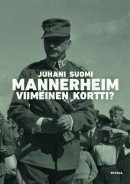 Mannerheim – viimeinen kortti? Ylipäällikkö-presidentti
[Finland plays its last card – Mannerheim, Commander-in-chief and President]
Helsinki: Siltala, 2013. 836 pp., ill.
ISBN 978-952-234-172-3
€32, hardback
In his book Professor Juhani Suomi – well-known as the biographer of President Urho Kekkonen – focuses on the life and actions of Marshal Gustaf Mannerheim (1867–1951) during the final phase of the Continuation War between Finland and the Soviet Union beginning in1943 and, in particular, during his term as Finnish President from 1944 to 1946. Mannerheim was elected President by exceptional procedure, and his difficult task was to lead Finland from war to peace, which he succeeded in doing. Suomi seeks to reply specifically to the question of whether Mannerheim lived up to the myth that was created about him, and of whether he was Finland’s last chance as the guarantor of the country’s independence during those fateful years, as he is often presented. On the basis of a number of sources, the author draws a critical portrait of an aristocrat: this was a man who was cold and vain, who at every turn thought mainly of his own posthumous reputation and who as an elderly leader was slow and fickle in his decisions – though the reader will not necessarily agree with all of Suomi’s conclusions. Well-written, occasionally a bit too detailed, his book vividly describes a dramatic period in Finland’s recent history.
Translated by David McDuff
Antti Kujala: Neukkujen taskussa? Kekkonen, suomalaiset puolueet ja Neuvostoliitto 1956–71 [In the Soviets’ pocket? Kekkonen, the Finnish political parties and the Soviet Union 1956–71]
17 April 2014 | Mini reviews, Reviews
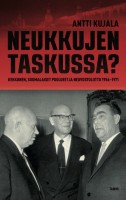 Neukkujen taskussa? Kekkonen, suomalaiset puolueet ja Neuvostoliitto 1956–71
[In the Soviets’ pocket? Kekkonen, the Finnish political parties and the Soviet Union 1956–71]
Helsinki: Tammi, 2013. 392 pp., ill .
ISBN 978-951-31-7347-0
€39, hardback
In this book, which partly cites new sources in Russia, associate history professor Antti Kujala describes the nature of the policy pursued by President Urho Kekkonen during his term of office from 1956 to 19971 (he resigned in 1981). The parties were divided among themselves, and also to some extent internally. In political plotting secret support was sought after from both the Soviet Union and the West. Kekkonen was able to achieve a strong position, which he made use of. He sought to safeguard Finland’s interests with regard to the Soviet Union and created a good relationship with its leaders. At home, however, he used his position as a weapon against his opponents and tried to restrain criticism that could easily be interpreted as anti-Soviet. The Soviet Union viewed Finland as lying within its sphere of power and was able to influence many Finnish politicians and union leaders, as well as the composition of the government. The section of the book in question contains an account of the central phenomena of Finland’s political history: the influence of the Soviet Union, as manifested by the ‘night frosts’ and the so-called ‘Note Crisis’, and Finland’s reactions to the occupation of Czechoslovakia by Soviet troops in 1968.
Translated by David McDuff
Timo Vihavainen: Ryssäviha. Venäjän-pelon historia [Ryssäviha. A history of Russophobia in Finland]
10 April 2014 | Mini reviews, Reviews
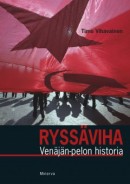 Ryssäviha. Venäjän-pelon historia
[Ryssäviha. A history of Russophobia in Finland]
Helsinki: Minerva Kustannus Oy, 2013. 322 pp.
ISBN 978-952-492-778-9
€31.90, hardback
In this well-written polemical study Professor Timo Vihavainen examines Russophobia mainly from a Finnish point of view, but also in a European context. He also writes about the reverse phenomenon, the emergence in Russia of xenophobia and accusations of ‘Russophobia’ among neighbouring countries. In 20th-century Europe it was more a question of opposition to the Soviet Union and its ideological system than of Russophobia as such. During the late 19th century Finland, which had been part of Russia from 1809 to 1917, saw the rise of so-called ryssäviha, ‘Russia-hate’, which began in the period of Russification and increased during the Civil War of 1917–1918. Between the World Wars it persisted especially in Akateeminen Karjala-Seura (‘The Academic Karelia Society’), a right-wing student organisation, and was fuelled by reports of political terror from across the eastern border, though even then a significant part of Finland’s working class saw the Soviet Union in a favourable light. During the Second World War ryssäviha came to a head in response to a conflict perceived as unjust, and to territorial concessions. In the 1960s, partly for political reasons, anti-Soviet sentiment became replaced by pro-Soviet attitude. Since the break-up of the Soviet Union in the 1990s relations with Russia have largely been free of problems.
Translated by David McDuff
Rauhan ytimessä. Sadankomitea 50 vuotta [In the core of peace. Sadankomitea at 50]
3 April 2014 | Mini reviews, Reviews
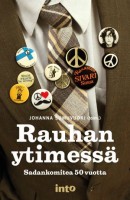 Rauhan ytimessä. Sadankomitea 50 vuotta
[In the core of peace. Sadankomitea at 50]
Toim. [Ed. by] Johanna Sumuvuori
Helsinki: Into, 2013. 170 pp., ill .
ISBN 978-952-264-264-6
€23, paperback
The nonpartisan Sadankomitea (‘Committee of 100’) peace organisation was founded in Finland in 1963 by the young radicals of their time. The movement was inspired by certain British non-governmental organisations. Its policies were established by research, discussion and writing rather than by direct action and marching. An important feature of the movement, especially during the Cold War, was its distinction from Rauhanpuolustajat (The Finnish Peace Committee), which was considered to be a mouthpiece of the Soviet Union. The movement’s discussion forum was the journal Ydin (‘The core’), founded in 1967, whose articles had more weight than its circulation might have suggested, a fact that also indicates Sadankomitea’s influence. This commemorative book contains a dozen or so articles in which peace movement veterans – including Finland’s foreign minister Erkki Tuomioja, who is a founding member – and younger activists discuss the movement’s work for peace. The fascinating articles range from personal recollections to analytical overviews.
Translated by David McDuff
Tarmo Kunnas: Fasismin lumous. Eurooppalainen älymystö Mussolinin ja Hitlerin politiikan tukijana [The allure of fascism. European intellectuals as backers of the policies of Mussolini and Hitler]
13 March 2014 | Mini reviews, Reviews
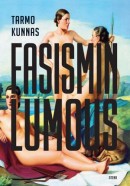 Fasismin lumous. Eurooppalainen älymystö Mussolinin ja Hitlerin politiikan tukijana
[The allure of fascism. European intellectuals as backers of the policies of Mussolini and Hitler]
Jyväskylä: Atena , 2013. 686 pp .
ISBN 978-951-796-933-8
€40, hardback
The most prominent fascist states in the period between the world wars were Nazi Germany and Mussolini’s Italy, but the ideology was reflected in the extremist movements of a number of European countries. The fascist movements could differ greatly, but their key feature was a strong nationalism that was both anti-democratic and anti-parliamentary. In his book, which at times is rather heavy going, Emeritus Professor Tarmo Kunnas examines the attraction of Fascist ideology for the European intelligentsia of the 1920s, 30s and 40s. He presents a nuanced view of the opinions of the period’s major intellectuals and detects the sources of their world outlook in factors like their philosophy of life. Their fascism rarely fitted in with party political programmes. Kunnas also sheds light on the fascist views of some of Finland’s cultural figures; according to him, in Finland genuine fascist groups did not really have much significance.
Translated by David McDuff
Markku Jokisipilä & Janne Könönen: Kolmannen valtakunnan vieraat. Suomi Hitlerin Saksan vaikutuspiirissä 1933–1944 [Guests from the Third Reich. Finland in the sphere of influence of Hitler’s Germany 1933–1944]
20 February 2014 | Mini reviews, Reviews
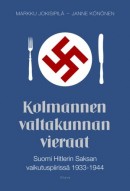 Kolmannen valtakunnan vieraat. Suomi Hitlerin Saksan vaikutuspiirissä 1933–1944
[Guests from the Third Reich. Finland in the sphere of influence of Hitler’s Germany 1933–1944]
Helsinki: Otava, 2013. 602 pp., ill .
ISBN 978-951-1-26881-9
€37, hardback
Germany had long been a great power with close historical ties to Finland, and when Hitler took over in 1933 the bond was still largely intact. Some Finnish cultural and scientific figures admired the new Germany and accepted its ideology, whereas the views of many Finland’s soldiers were influenced by the help received from Germany during the Civil War of 1918 and by the threat from the neighbouring Soviet Union. During the Winter War of 1939–40, when the Soviet Union attacked Finland and Germany was formally a Soviet ally, relations cooled. After the Winter War politicians sought support from Germany for reasons of Realpolitik, in preparation for another conflict. When the Germans invaded the Soviet Union during the Continuation War of 1941–1944, they sent military supplies to Finland and troops to the country’s north. Cultural relations with the Baltic superpower flourished. Hitler’s attendance in 1942 at the birthday party of Marshal Mannerheim (well known to be an Anglophile) was a spectacular display of Finnish-German friendship. However, no persecution of Jews took place in Finland. When it became obvious that Germany would be defeated, even the Nazis’ enthusiastic friends distanced themselves from them, and in the Lapland War of 1944–45 the German soldiers were driven out of Finland. The book provides a vivid and comprehensive reminder of a time when many Finns put their trust in Hitler’s Germany and were flattered to receive its attention.
Translated by David McDuff
Anna-Lena Laurén: Frihetens pris är okänt. Om demokratiska revolutioner i Georgien, Ukraina och Kirgizistan [The price of freedom is unknown: On democratic revolutions in Georgia, Ukraine and Kyrgyzstan]
22 November 2013 | Mini reviews, Reviews
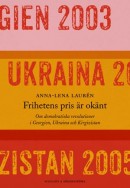 Frihetens pris är okänt. Om demokratiska revolutioner i Georgien, Ukraina och Kirgizistan
[The price of freedom is unknown: On democratic revolutions in Georgia, Ukraine and Kyrgyzstan]
Helsinki: Schildts & Söderströms, 2013. 212 pp., ill.
ISBN 978-951-523-227-4
€25, paperback
Finnish edition:
Kuinka kallis vapaus – värivallankumouksista Georgiassa, Ukrainassa ja Kirgisiassa
Suomentanut [Translated into Finnish by] Liisa Ryömä
Helsinki: Teos, 2013. 219 pp., ill.
ISBN 978-951-851-473-5
€28.40, paperback
Anna-Lena Laurén (born 1976) is an award-winning Finland-Swedish journalist, author and Moscow-based foreign correspondent. In this volume of reportage, she investigates three post-Soviet states after their ‘democratic revolutions’, which took place between 2003 and 2005. Georgia, Ukraine and Kyrgyzstan differ from one another in many respects. Georgia has made the most progress along the road to democracy, but even it remains an authoritarian state. Ukraine is plagued by corruption; impoverished Kyrgyzstan – culturally and linguistically divided, like Ukraine – is relatively free, but corruption is rife. For good or ill, these countries are overshadowed by their former ruling power, the present-day nation of Russia. Anna-Lena Laurén has listened with a keen ear to politicians, intellectuals, farmers and workers, as well as members of minority groups. She is well-versed in the history and current situation of these countries and portrays people’s everyday lives with empathy while spotting the green shoots of democracy in among the difficulties.
Translated by Ruth Urbom