

Tag: drama
Archives open!
12 December 2014 | This 'n' that
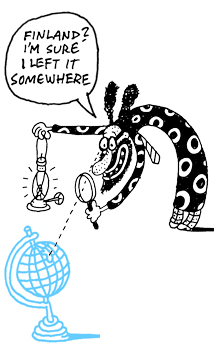
Illustration: Hannu Konttinen
For 41 years, from 1967 to 2008, Books from Finland was a printed journal. In 1976, after a decade of existence as not much more than a pamphlet, it began to expand: with more editorial staff and more pages, hundreds of Finnish books and authors were featured in the following decades.
Those texts remain archive treasures.
In 1998 Books from Finland went online, partially: we set up a website of our own, offering a few samples of text from each printed issue. In January 2009 Books from Finland became an online journal in its entirety, now accessible to everyone.
We then decided that we would digitise material from the printed volumes of 1976 to 2008: samples of fiction and related interviews, reviews, and articles should become part of the new website.
The process took a couple of years – thank you, diligent Finnish Literature Exchange (FILI) interns (and Johanna Sillanpää) : Claire Saint-Germain, Bruna di Pastena, Merethe Kristiansen, Franziska Fiebig, Saara Wille and Claire Dickenson! – and now it’s time to start publishing the results. We’re going to do so volume by volume, going backwards.
The first to go online was the fiction published in 2008: among the authors are the poets Tomi Kontio and Rakel Liehu and prose writers Helvi Hämäläinen (1907–1998), Sirpa Kähkönen, Maritta Lintunen, Arne Nevanlinna, Hagar Olsson (1893–1979), Juhani Peltonen (1941–1998) and Mika Waltari (1908–1979).
To introduce these new texts, we will feature a box on our website, entitled New from the archives, where links will take you to the new material. The digitised texts work in the same way as the rest of the posts, using the website’s search engine (although for technical reasons we have been unable to include all the original pictures).

By the time we reach the year 1976, there will be texts by more than 400 fiction authors on our website. We are proud and delighted that the printed treasures of past decades – the best of the Finnish literature published over the period – will be available to all readers of Books from Finland.
The small world of Finnish fiction will be even more accessible to the great English-speaking universe. Read on!
Updated, alive
8 May 2014 | Non-fiction, Reviews
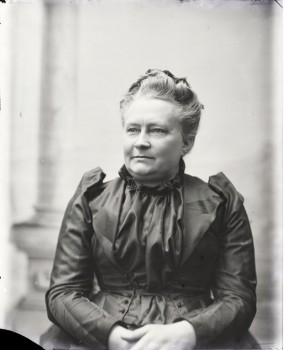
Minna at 50. The Finnish flag is flown on her birthday: 19 March has been named the Day of Equality. Canth also flies on the tail of one of the aircrafts of the Nordic airline Norwegian: the fleet carries portraits of ‘heroes’ and ‘heroines’ of four Nordic countries (the other Finn is the 19th-century poet J.L. Runeberg). Original photo: Viktor Barsokevich / Kuopio Museum of Cultural History
Herkkä, hellä, hehkuvainen – Minna Canth
[Sensitive, gentle, radiant – Minna Canth]
Helsinki: Otava, 2014. 429 pp., ill.
ISBN 978-951-1-23656-6
€40.20, hardback
There are two sure methods of preserving the freshness of the works of a classical author in a reading culture that is increasingly losing its vigour.
The first is to give a high profile to new interpretations of them, either in the form of scholarly lectures or of artistic re-workings, such as dramatisations, librettos or film scripts. Another unbeatable way to keep them alive as a subject of discussion is an updated biography, through which the author is seen with new eyes.
Minna Canth (1844–1897) is now celebrating her 170th anniversary, and she is fortunate in both respects. Having begun her literary career in the late nineteenth century, she still continues to be Finland’s most significant female writer.
Her influence on the role of women in society and, in particular, her promotion of girls’ education, is the cornerstone of Finland’s social equality. In the twenty-first century Canth’s plays are still receiving new interpretations, and they have also been made into operas and musicals. (Read her short story, ‘The nursemaid’, here.) More…
A gay fantasy on national themes
19 March 2012 | Authors, Reviews
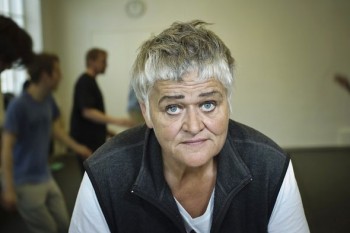
Pirkko Saisio. Photo: Laura Malmivaara
Why does the private become political? Who makes it happen? Why should religious doctrines define private matters such as sexuality? Why should those who wield power in the political system define personal sexuality?
Pirkko Saisio (born 1949), a theatremaker as well as a prolific and versatile author of plays, novels, film and television scripts, has written a play for the Finnish National Theatre entitled HOMO! and subtitled, ‘An anarchist musical farce’.
Answers to the above questions – and they are complicated – are to be found in, for example, historical, psychological and sociological research.
In the last century, Stalin and Hitler condemned gays. Thirty years ago homosexuality was considered an sickness in Finland; forty years ago it was a crime. Today, it is still illegal in more than 75 countries: punishments vary from flogging to life imprisonment or death. In democratic societies, the ‘gay problem’ is a question of human rights, and hence a subject for public debate – for example, in a musical play, for of course the issue also involves that eternally fascinating and entertaining feature of human life, love. More…
In pursuit of a conscience
19 March 2012 | Drama, Fiction
‘An unflinching opera and a hot-blooded cantata about a time when the church was torn apart, Finland was divided and gays stopped being biddable’: this is how Pirkko Saisio’s new play HOMO! (music composed by Jussi Tuurna) is described by the Finnish National Theatre, where it is currently playing to full houses. This tragicomical-farcical satire takes up serious issues with gusto. In this extract we meet Veijo Teräs, troubled by his dreams of Snow White, who resembles his steely MP wife Hellevi – and seven dwarves. Introduction by Soila Lehtonen
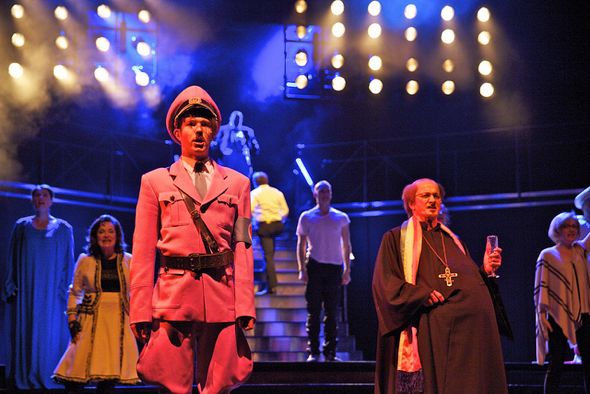
Dictators and bishops: Scene 15, ‘A small international gay opera’. Photographs: The Finnish National Theatre / Laura Malmivaara, 2011
CAST OF CHARACTERS
Veijo Teräs
Hellevi, Veijo’s wife and a Member of Parliament
Hellevi’s Conscience
Rebekka, Hellevi and Veijo’s daughter
Moritz, Hellevi and Veijo’s godson
Agnes af Starck-Hare, Doctor of Psychiatry
Seven Dwarves
Tom of Finland
Atik
The Bishop of Mikkeli
Adolf Hitler
Albert Speer
Josef Stalin
Old gays: Kale, Jorma, Rekku, Risto
Olli, Uffe,Tiina, Jorma: people from SETA [the Finnish LGBT association]
Second Lieutenant, Private Teräs, the men in the company
A Policeman
Big Gay, Little Gay, Middle Gay
William Shakespeare
Hermann Göring
Hans-Christian Andersen
Teemu & Oskari, a gay couple
The Apostle Paul
Father Nitro
Winston Churchill
SCENE ONE
On the stage, a narrow closet.
Veijo Teräs appears, struggling to get out of the closet.
Veijo Teräs is dressed as a prince. He is surprised and embarrassed to see that the audience is already there. He seems to be waiting for something.
He speaks, but continues to look out over the audience expectantly.
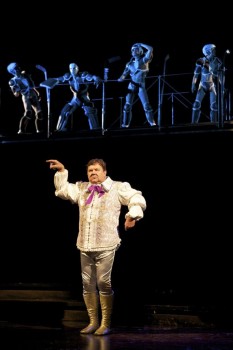
Snow White's spouse, Veijo (Juha Muje), and the dwarves. Photo: Laura Malmivaara, 2011
VEIJO
This outfit isn’t specifically for me, because… I mean, it’s part of this whole thing. This Snow White thing. I’m waiting for the play to start. Just like you are. My name is Veijo Teräs and I’m playing the point of view role in this story. Writers put point of view roles like this in their plays nowadays. They didn’t use to.
Just to be clear – this isn’t a ballet costume. I’m not going to do any ballet dancing, but I won’t mind if someone dances, even if it’s a man. Particularly if it’s a man. But I don’t watch. Ballet, I mean. Not at the opera house, or on television, or anywhere, and I have no idea why we had to bring up ballet – or I had to bring it up – because this is a historical costume, so it’s appropriate. This is what men used to wear, real men like Romeo and Hamlet, or Cyrano de Bergerac. But we in the theatre these days have a hell of a job getting an audience to listen to what a man has to say when he’s standing there saying what he has to say in an outfit like this. People get the idea that it’s a humorous thing, but this isn’t, this Snow White thing, where I play the prince. Snow White is waiting in her glass casket, she died from an apple, which seems to have become the Apple logo, Lord knows why, the one on the laptops you see on the tables of every café in town. More…
Best theatre, best play
16 March 2012 | In the news
On 11 March Finland’s theatre organisations gave their awards to last year’s best theatres and theatre-makers. Theatre of the Year was the Finnish National Theatre: according to the jury, it has both ‘opened all its doors, from cellar to attic’ and also left the building to make theatre and offered space for initiative. Audience figures have risen by more than 50,000, and the theatre’s repertoire has ‘cut keenly into the life and reality of contemporary audiences and the key national questions behind them without becoming bogged down in familiar stereotypes.’
The Finnish Dramatists’ Union awarded its Lea Prize for the Playtext of the Year, worth €5,000, to Pirkko Saisio’s HOMO! (This is Saisio’s fourth Lea Prize since 1986.) HOMO! is currently running, in a musical, or rather, operatic form in the National Theatre, in a production directed by the playwright herself; the composer is Jussi Tuurna.
In art as elsewhere, it is worth thinking about things from new angles – a few years back, for example, the National hardly did any musical theatre at all. (However, the company of actors in no way hinder the staging of musical theatre: under Tuurna’s direction, the entire cast burst into spectacular flower, alone and in chorus.) Besides, musical theatre was thought to be the province of the Helsinki City Theatre, where imported commercial musicals (Cats, Les Miserables, Mary Poppins etc) have lately represented a considerable part of the theatre’s income. On this production line, however, there are few chances for writers, composers and other theatremakers to develop a specifically Finnish musical theatre.
The Finnish National Theatre’s most recent success, Kristian Smeds’s Mr Vertigo also used original music, produced by young jazz musicians, which was on exactly the same wavelength as the text and its interpretation.
Success after success
9 March 2012 | This 'n' that
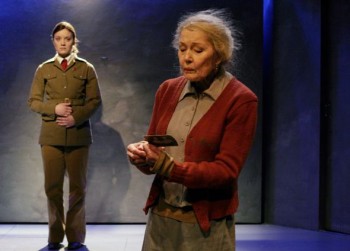
The women of Purge: Elena Leeve and Tea Ista in Sofi Oksanen's Puhdistus at the Finnish National Theatre, directed by Mika Myllyaho. Photo: Leena Klemelä, 2007
Sofi Oksanen’s Purge, an unparalleled Finnish literary sensation, is running in a production by Arcola Theatre in London, from 22 February to 24 March.
First premiered at the Finnish National Theatre in Helsinki in 2007, Puhdistus, to give it its Finnish title, was subsequently reworked by Oksanen (born 1977) into a novel – her third.
Puhdistus retells the story of her play about two Estonian women, moving through the past in flashbacks between 1939 and 1992. Aliide has experienced the horrors of the Stalin era and the deportation of Estonians to Siberia, but has to cope with the guilt of opportunism and even manslaughter. One night in 1992 she finds a young woman in the courtyard of her house; Zara has just escaped from the claws of members of the Russian mafia who held her as a sex slave. (Maya Jaggi reviewed the novel in London’s Guardian newspaper.) More…
Is it a play, is it a book?
25 February 2011 | This 'n' that
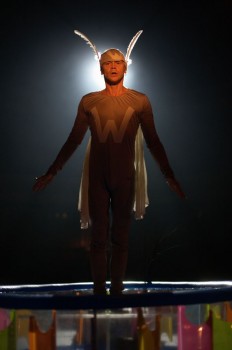
On the way to fame: Walt the Wonder Boy in Kristian Smeds's stage adaptation of Paul Auster's novel Mr. Vertigo at the Finnish National Theatre (2010). Photo: Antti Ahonen
Dramatisations of novels are tricky. Finnish theatremakers like adapting novels for the stage, which often results in a lot of talking instead of action – and action here doesn’t refer to just physical movement but to the subtext, to what happens under and behind the words.
Currently an adaptation of an American novel is running on the main stage of the Finnish National Theatre in Helsinki. Mr Vertigo (1994), Paul Auster’s seventh book, tells the story of an orphan boy in the 1930s St Louis. After harsh years as the long-suffering apprentice of the mysterious Master Yehudi, Walt becomes the sensational Wonder Boy by learning how to levitate.
In theatremaker Kristian Smeds’s adaptation, Auster’s whimsical, rambling novel becomes a capricious, illusory journey about illusions, freedom, and the unattainability of love. Walt (the highly expressive, athletic Tero Jartti) interprets, with hilarious comedy as well as with touching desperation, both the dizzyingly powerful experience of creativity and the ridiculous hubris of the artist. More…
Drama queen: on writing, and not writing, plays
14 June 2010 | Articles, Authors
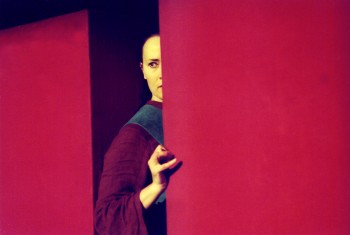
The queen who chose not to rule: Christina of Sweden in the play Queen C (first produced at the Finnish National Theatre in 2003, directed by the author, Laura Ruohonen, with Wanda Dubiel in the role of the Queen). Photo: Leena Klemelä
Extracts from ‘Postscript’, published in Kuningatar K ja muita näytelmiä (‘Queen C and other plays’, Otava, 2004)
It’s hard to read plays. I was bitterly disappointed at the age of eight, when I hid in my grandmother’s attic and opened up Romeo and Juliet, a book that seemed to promise lust and appalling acts. But it wasn’t even a real book; it was just talking from beginning to end! Where was the plot, the action, the much talked-about love story?
It’s also hard to write plays. Novels and works of poetry are closed miniature worlds that invite the reader in. A play always serves two masters. It has to be open and porous to allow the actor and the performance to penetrate into it. More…
The gender of the soul
Scenes from the play Kuningatar K / Queen C
Characters:
Christina, the Queen
Friend
The Queen Mother
Karl Gustav, the Count [Christina’s suitor, the King-to-be]
Descartes, philosopher
Official
Man
The King
Oxenstierna, Per Brahe
A choir of midwives
The play can be performed with six actors (3 female, 3 male). Other ways of dividing the roles are possible. All stage directions may be altered.
1. Prologue
The eels’ court
CHRISTINA
If eels had a court then a great female eel would sit in the centre and the little males would writhe about like seaweed around the throne. However they would not be envious of the queen, because they would know that if they swam up into rivers and lakes, into fresh waters, they themselves would gradually become females, great and heavy, and would be able to rule and close into their great embrace all the small little gentlemen. They just have to wait.
KARL GUSTAV
I don’t know. What I do know is that a great black eel, as thick as a rope, was pulled out of the well last night and the Queen looked at its silver stomach and its thrashing tail, but the eel looked the Queen in the eyes and in the heart and since then she has never been the same. More…
On stage in New York
28 May 2010 | In the news

Sofi Oksanen. Photo:
Puhdistus (2007), a play by Sofi Oksanen that also became a award-winning novel (2008), will be produced at the prestigious La MaMa theatre in New York in February 2011 under the title Purge. The director is Zishan Ugurlu, La MaMa’s Artistic Director.
Next month, Purge will be read in Chicago where the conference of the Theatre Communication Group of American professional theatres takes place. In September the play – which is set in 20th-century Estonia – will also be prèmiered in Tartu, Estonia. The novel was published in Estonian translation last year. Purge was published in English this April by Grove/Atlantic, translated by Lola Rogers. So far translation rights have been sold to 28 countries.
The play has been translated into English by Eva Buchwald, dramaturge at the Finnish National Theatre, where Purge was first produced in 2007. No Finnish play has ever before been produced on a professional stage in the US.
Drama news
20 May 2010 | In the news
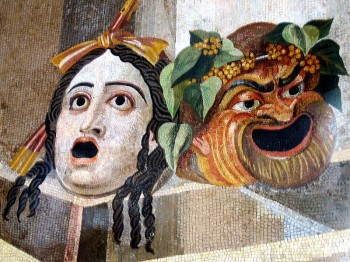
Tragedy and comedy: mosaic masks from Hadrian's villa (Capitoline Museum, Rome, 2nd century CE)
A new internet service aims to provide information about Finnish drama and its writers.
Finnishplays.com is operated by the Finnish Dramatists’ Union, which has entered into partnerships with international drama agents in order to promote Finnish plays.
This year, Finnish plays that are to be performed abroad include Sofi Oksanen’s Purge (Puhdistus; Oksanen’s multi-prize-winning novel (you’ll find a sample from the English translation, by Lola Rogers, through the link) began life as a play at the Finnish National Theatre, appearing in print a year later), Reko Lundán’s Unnecessary people (Tarpeettomia ihmisiä), to be performed in Estonia and in Hong Kong, and Sirkku Peltola’s The Finnhorse (Suomenhevonen), in Iceland.
The website also features a catalogue of plays in translation, plus a search service for Finnish plays in various languages.
Finnish theatre doesn’t travel easily, never has – it’s a long way from here down to European theatre festivals, for example, taking place mostly in the south. But Finnish drama has began to travel more than ever, as new translations of plays into various languages have been made – and they, in turn, have made their way into theatres, in Europe and in the United States.
Nordic Drama Award for Heini Junkkaala
14 May 2010 | In the news
On May 7 playwright Heini Junkkaala (born 1975) received the bi-annual Nordic Drama Award (worth €5,000), presented by the Nordic Theatre Union.
Her play Kymmenen tikkua laudalla (‘Ten sticks on a board’, 2008) is a drama for children spanning three generations that contains both realistic and fantastic elements. Junkkaala’s latest play, Kristuksen morsian (‘Bride of Christ’), about religion and homosexuality, was premièred at the Finnish National Theatre in March.
The last two winners of the award were also Finns: Juha Jokela received it for his play Fundamentalisti (The Fundamentalist) in 2008, and Kari Hotakainen won the prize for his play Punahukka (Border Crossing) in 2006 (both have been translated into English; introductions in English are available here; click Translations of Finnish drama).
The dog-man’s daughter
30 December 2001 | Fiction


 Extracts from the radio play Porkkalansaari (‘The island of Porkkala’, the Finnish Broadcasting Company, 1993)
The surface of the earth is the first to freeze; then the still waters. The sea freezes at the shore often at the same time, on the same night, as the slow-flowing brooks. I have watched them for many years. When you live in the same place for a long time, you notice this much: that almost everything just repeats and repeats.
It flows into a plastic tube. I suppose water flows inside it. You could drop matchsticks in on the other side of the road and wait on this side for them to swim through the drum. You’d only have to find one; that would be enough to prove it. More…
Burnt orange
Issue 3/1992 | Archives online, Drama, Fiction
Extracts from the play Poltettu oranssi (‘Burnt orange‘): ‘a ballad in three acts concerning the snares of the world and the blood’. Introduction by Tuula Hökkä
The scene is a small town in the decade before the First World War
Cast:
DR FROMM
an imperial,bearded middle-aged gentleman
ERNEST KLEIN
a moustached, ageing, slightly shabby leather-manufacturer
AMANDA KLEIN
his wife, well-preserved, forceful, angular
MARINA KLEIN
their daughter, shapely, withdrawn, wary
NURSE-RECEPTIONIST
open, direct, not too ‘common’
ACT ONE
Scene two
After a short interval the receptionist opens the door and ushers Marina Klein into the surgery. Exit the receptionist. Marina immediately goes to the end of the room and presses herself against the white wall. The white surface makes her look very isolated in her ascetic black dress. The Doctor, who now appears to be headless – an impression produced by the lighting and the yellowish background – half-turns towards her. More…