

Author: Jarmo Papinniemi
Jouni K. Kemppainen: Onnellinen mies. Arto Paasilinnan elämä [A happy man. The life of Arto Paasilinna]
21 June 2012 | Mini reviews, Reviews
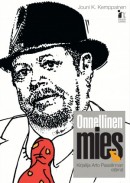 Onnellinen mies. Arto Paasilinnan elämä
[A happy man. The life of Arto Paasilinna]
Espoo: Paasilinna, 2012. 307 p.
ISBN 978-952-5856-37-8
€ 28, hardback
Arto Paasilinna (born 1942) is an uncanny phenomenon. For Finns he is a popular, prolific author of picaresque novels – which in the 1970s, 80s and 90s were praised by the critics, while the books he produced later received less acclaim, though most of them have sold tens of thousands of copies. Paasilinna’s best-known novel is Jäniksen vuosi (The Year of the Hare, 1975). In Europe – particularly in France and Italy – he is considered to be a major natural philosopher. However, the charming social man of the world was capable of turning into a violent ruffian; journalist Jouni K. Kemppainen’s fluent biography highlights every aspect of the author’s character. The book describes the development of a boy from a poor northern Finnish family to an international best-selling author (his works have been translated into more than 40 languages) and introduces interesting correspondence between the author and his publisher. Kemppainen emphasises some recurring themes in Paasilinna’s work: relations between humans and animals, travelling. In 2009 the author suffered a head injury while drinking, and lost his memory almost completely. The title of his latest, thirty-fifth novel is Elävänä omissa hautajaisissa (‘Alive at his own funeral’, 2009). The impression that this biography leaves on the reader’s mind is a picture of a now gentle man who delights in the fact that he has accomplished all that he is reported to have accomplished – and in that he managed to survive.
Translated by David McDuff
Special effects
14 June 2012 | Authors, Reviews
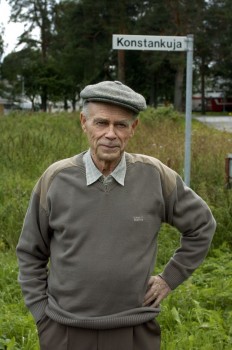
Veikko Huovinen. Photo: Harri Nurminen
Depictions of simple country folk who live close to nature, diabolical satire of the powers that be, playful rambling tales.
The humour of Veikko Huovinen has two dimensions: it is learned, intelligent, and insightful, but it is also exuberant and folksy. Critics have made comparisons to Nikolai Gogol and Mark Twain, and not without reason.
Huovinen (1927–2009) began writing stories in 1949 and published his final work in 2007, two years before his death. This half century saw the birth of a broad and multifaceted library, including a good number of works that do not fit any genre as such – Huovinen called his works that lay in the interstices between the short story, causerie and satire ‘short specials’. More…
Jari Tervo: Layla
28 October 2011 | Mini reviews, Reviews
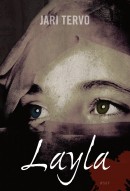 Layla
Layla
Helsinki: WSOY, 2011. 361 p.
ISBN 978-951-0-38277-6
31 €, hardback
Social reality has stepped firmly into contemporary Finnish literature. Many of the new novels deal with economic inequality, immigration, prostitution or human trafficking. In his 13th novel Jari Tervo (born 1959) deals with them all. Layla is a young Kurdish girl whose cruel fate is about to be decided by the men of her family in Turkey. When she flees, Layla ends up in faraway Finland as a prostitute. Another storyline portrays a Finnish woman, Helena, who sells herself in part voluntarily. Tervo shows himself to be a feminist; the men he describes are cold tyrants who see a woman’s body as an object of lust and as merchandise. The novel is tragic and defiant, but also amusing and lively. Tervo’s style involves surprises and ingenious tricks, of which towards the end of the book there are slightly too many. Layla contains a good deal of information about Turkey, Kurdish culture and the people smuggling that takes place on the outer borders of the European Union. Some of the details have already been shown to be inaccurate, but this does not reduce the distressing quality of this story of a human fate.
Translated by David McDuff
Juha Seppälä: Takla Makan
22 April 2010 | Mini reviews, Reviews
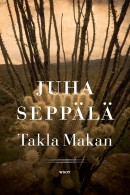 Takla Makan
Helsinki: WSOY, 2010. 149 p.
ISBN 978-951-0-36322-5
€ 27, hardback
Author Juha Seppälä’s manner of portraying the world is often characterised as harsh and desolate, and this certainly applies to this, his twentieth work. ‘Jesus’ mother was a woman,’ declares the first-person narrator in ‘Ristin tie’ (‘The path of Christ’) in the second novella in Takla Makan. This true but erotically charged statement sums up the themes of the two texts that make up the work. As the narrator of that story bears the cross in an Easter procession, issues of life and death, faith and worldliness, spirit and flesh, masculinity and femininity, are all present. The man carrying the cross, who has recently lost his job, has taken on a greater burden to bear. The other novella in this book, which takes its title from the name of a desert in China, tells of a terminally ill man who has withdrawn to a small rural community and lets his life slowly slip away. In Seppälä’s narratives anguished men are thrown into the world to ponder the big issues of life and death, expressing themselves with admirably precise sentences stripped of everything inessential.
Antti Hyry: Uuni [The stove]
22 January 2010 | Mini reviews, Reviews
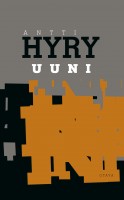 Uuni
Uuni
[The stove]
Helsinki: Otava, 2009. 400 p.
ISBN 978-951-1-23845-4
28 €, hardback
Many authors have inspired imitators, at least for a brief period, but few prove to be so original that they lend their name to an entire stylistic movement. Antti Hyry (born 1931), whose debut work was published in 1958, is a member of this most influential class of writers. His pared-down ‘Hyryesque’ sentences, which convey in a stark, crystal-clear manner only that which his characters think or observe, have been at the core of Finnish modernism for over half a century now. His latest novel, a tranquil, even meditative work, describes in minute detail – virtually brick by brick – how a man constructs a great wood-burning hearth in his house. Alongside the building work, Hyry provides minutely observed details of the natural surroundings and nearby people. Rich in content and brilliant in its simplicity, this novel was awarded the 2009 Finlandia Prize for fiction.
Tuomas Kyrö: 700 grammaa [700 grams]
12 November 2009 | Mini reviews, Reviews
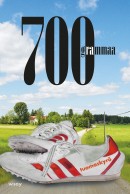 700 grammaa
[700 grams]
Helsinki: WSOY, 2009. 379 p.
ISBN 978-951-0-35601-2
€ 30, hardback
The genre of the picaresque novel is doing well, and one of its foremost exponents in Finland is Tuomas Kyrö (born 1974). The plot of his ingenious first novel, Nahkatakki (‘Leather jacket’, 2001), revolved around a jacket that moves from one owner to another. His later novels maintain this comical tension, but with a deepening of themes and a more sober outlook. Liitto (‘Union’, 2005) portrayed people scarred by war, while Benjamin Kivi (2007, featured in Books from Finland 4/2007) retold Finland’s history in a light-hearted and anachronistic manner. 700 grammaa is a book about sports fever and family relationships, the exploration of love and the pursuit of dreams. The main character is a boy who at birth weighs only 700 grams, and whose father vows to perform a seven metre long-jump if his son survives. He does, and the father has to devote his life to this almost impossible sporting achievement This novel, with its fast-developing plot and varied narrative techniques, is a paean to the heroism latent in mediocrity.
Teemu Kaskinen: Sinulle, yö [To you, the night]
29 October 2009 | Mini reviews, Reviews
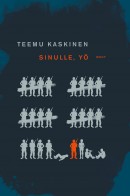 Sinulle, yö
[To you, the night]
Helsinki: WSOY, 2009. 268 p.
ISBN 978-951-0-35599-2
€ 29, hardback
In Teemu Kaskinen’s debut novel, Finland is at war with Norway and its NATO ally the United States. Fierce battles rage in the winter darkness in Lapland, and Helsinki has become the stage for a contemporary war, which seems rather ridiculous – except for the fact that there are neighbouring countries currently at war with each other after having previously coexisted peacefully for ages, and it would be easy to name several thriving cities whose streets have suddenly been filled with soldiers, bomb blasts and terror. In this novel by Kaskinen (born in 1976; he has previously written four plays) the streets and interiors are also filled with lust and the satisfaction of basic needs. In cool, modernistic episodes, the author shows how people’s instincts begin to drag them along in a crisis situation. Sinulle, yö is a grotesque, brutal novel – but then again, what would happen if you, I and the neighbour’s lad ended up in similar circumstances, like those that engulfed Sarajevo not all that long ago?
Jari Tervo: Koljatti [Goliath]
23 October 2009 | Mini reviews, Reviews
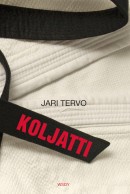 Koljatti
[Goliath]
Helsinki: WSOY, 2009. 317 p.
ISBN 978-951-0-35610-4
25 €, hardback
Jari Tervo (born 1959) writes comic, swiftly paced, linguistically accomplished prose with touches of historicism, philosophy and social commentary. Koljatti is a contemporary satire that prompted a great deal of fuss in the Finnish press for its perceived nastiness: the similarities between its character Pekka Lahnanen, an isolated and beleaguered prime minister, and Matti Vanhanen, the current Finnish Prime Minister, are clear. This novel outlines some crude caricatures, but its critical barbs are aimed not at politics, but rather at the relationship between the media and politics. This book, which describes the events of a single fast-paced weekend, portrays politics as theatre, in which the only thing that matters is how things appear; the media will drop any substantive questions in their relentless pursuit of new sensationalist headlines of politicians’ private lives. The news may not look the same after reading this novel. Tervo is one of Finland’s most popular authors; three of his novels have appeared in translation, in four languages. [Read a short story here.]
Kjell Westö: Gå inte ensam ut i natten [Don’t go out into the night alone]
23 October 2009 | Mini reviews, Reviews
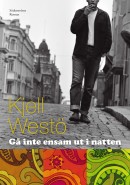 Gå inte ensam ut i natten
[Don’t go out into the night alone]
Helsinki: Söderströms, 2009. 604 p.
ISBN 978-951-52-2609-9
25 €, hardback
Finnish translation (by Katriina Savolainen): Älä käy yöhön yksin
Helsinki: Otava, 2009. 604 p.
ISBN 978-951-1-23833-1
25 €, hardback
This novel completes Kjell Westö’s Helsinki series and is his tenth book. As is the case with the three earlier books in this series (Drakarna över Helsingfors [‘The kites over Helsinki’], 1994, Vådan av att vara Skrake [‘The perils of being a Skrake’], 2000, and Där vi en gång gått [‘Where we once walked’], 2006, all also translated into Finnish) this is a character-driven, nostalgia-laden story that spans several decades. The central factor is music: in the 1960s three young people from different backgrounds become friends and record a single that ought to have been a huge hit, but because the song fades into obscurity, the circle of friends breaks up. In the latter part of the novel, a young man begins to investigate what became of the members of the trio and realises that his own life is linked to theirs. Westö (born 1961) writes remarkable experiential prose that brings the reader close to the characters. The retro setting may be a bit much for some: the avalanche of details feels rather excessive in places. Där vi en gång gått was awarded the Finlandia Prize in 2006. Another of Westö’s novels, Lang (2002), was published in England under the same title in 2005.
Juha Seppälä: Paholaisen haarukka [The Devil’s fork]
30 December 2008 | Mini reviews
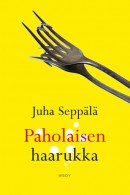 Paholaisen haarukka
[The Devil’s fork]
Helsinki: WSOY, 2008. 267 p.
ISBN 978-951-0-34534-4
€ 32, hardback
Seldom does a novel manage to be as topical as Juha Seppälä’s latest – his tenth – which portrays a great economic crisis and the people who are dragged along with it. Seppälä has written lines for his characters where they claim that a novel is only able to depict a reality that existed years ago – but Paholaisen haarukka proves this is not true. More…
The Turku Decameron
30 March 2004 | Authors, Reviews

Photo: Ari Kasanen
It was in the 1960s that Finns began to move en masse from the countryside to the town, but literature has not urbanised itself at quite the same pace. The majority of new literature is set in the countryside, amid nature, and even urban stories tend to shy away from city centres. After the countryside, the suburb has become one of the most fundamental backdrops in new Finnish literature.
Kahden ja yhden yön tarinoita (‘Tales from two and one nights’, Sammakko, 2003) by Riku Korhonen (born 1972) is typical of suburban novels in that it demonstrates how the sense of community found in small villages continues in the lives of children living in the suburbs. Children play together, form tribes and know everybody else’s business. However, Korhonen is not content simply to describe what goes on inside the Turku suburbs, but through the various stories in the novel he takes us from flat to flat, introducing us to the many adult tenants, whose lonely, oppressive existence is a far cry from village life. People in the suburbs live physically very close together, but the spiritual distance between neighbours can be enormous. More…