

Author: Leena Krohn
When the viewer vanishes
26 May 2015 | Essays, Non-fiction
 For the author Leena Krohn, there is no philosophy of art without moral philosophy
I lightheartedly promised to explain the foundations of my aesthetics without thinking at any great length about what is my very own that could be called aesthetics. Now I am forced to think about it. The foundations of my possible aesthetics – like those of all aesthetics – lie of course somewhere quite different from aesthetics itself. They lie in human consciousnesses and language, with all the associated indefiniteness.
It is my belief that we do not live in reality, but in metareality. The first virtual world, the simulated Pretend-land is inherent in us.
It is the human consciousness, spun by our own brains, which is shared by everyone belonging to this species. Thus it can be called a shared dream, as indeed I have done. More…
Me and my shadow
Hotel Sapiens is a place where people are made to take refuge from the world that no longer is habitable to them; the world economy has fallen – like the House of Usher, in Edgar Allan Poe’s story – and with it, most of what is called a civilised society. A rapid synthetic evolution has taken humankind by surprise, and the world is now governed by inhuman entities called the Guardians. ‘Kuin astuisitte aurinkoon’ (‘As if stepping into the sun’) is a chapter from the novel Hotel Sapiens ja muita irrationaalisia kertomuksia (‘Hotel Sapiens and other irrational tales’, Teos, 2012), where several narrators tell their stories
The fog banks have dissipated; the sky is empty. I cannot see the sails or swells in its heights, nor the golden cathedrals or teetering towers. I would not have believed I could miss a fog bank, but that’s exactly what it’s like: its disappearance is making me uneasy. For all its flimsiness and perforations it was our protection, our shield against the sun’s fire and the stars’ stings. Now the relentlessly blazing sun has awakened colours and extracted shadows from their hiding places. The moist warmth has dried into heat and the Flower Seller’s herb spirals have dried up into skeletons. The leaves on the trees are full of bronze, sickly red and black spots. Though there is no wind and autumn is not yet here, they come loose as if of their own volition, as if they wanted to die.
This morning, as I was strolling up and down the park path as usual, I saw another shadow alongside my own.
– Ah, you’re back! I said. – I wondered what had happened to you after you lost your shadow; how did you manage to change into your own shadow yourself? More…
Indifference under the axe
9 March 2012 | Essays, Non-fiction
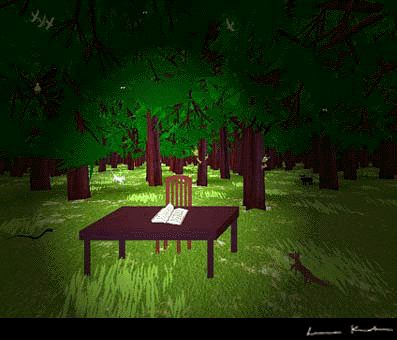
In the forest: an illustration by Leena Krohn for her book, Sfinksi vai robotti (Sphinx or robot, 1999)
The original virtual reality resides within ourselves, in our brains; the virtual reality of the Internet is but a simulation. In this essay, Leena Krohn takes a look at the ‘shared dreams’ of literature – a virtual, open cosmos, accessible to anyone, without a password
How can we see what does not yet exist? Literature – specifically the genre termed science fiction or fantasy literature, or sometimes magic realism – is a tool we can use to disperse or make holes in the mists that obscure our vision of the future.
A book is a harbinger of things to come. Sometimes it predicts future events; even more often it serves as a warning. Many of the direst visions of science fiction have already come true. Big Brother and the Ministry of Truth are watching over even greater territories than in Orwell’s Oceania of 1984. More…
A light shining
28 July 2011 | Essays, Non-fiction
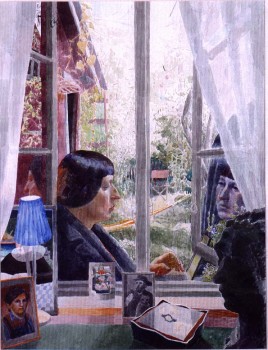
Portrait of the author: Leena Krohn, watercolour by Marjatta Hanhijoki (1998, WSOY)
In many of Leena Krohn’s books metamorphosis and paradox are central. In this article she takes a look at her own history of reading and writing, which to her are ‘the most human of metamorphoses’. Her first book, Vihreä vallankumous (‘The green revolution’, 1970), was for children; what, if anything, makes writing for children different from writing for adults?
Extracts from an essay published in Luovuuden lähteillä. Lasten- ja nuortenkirjailijat kertovat (‘At the sources of creativity. Writings by authors of books for children and young people’, edited by Päivi Heikkilä-Halttunen; The Finnish Institute for Children’s Literature & BTJ Kustannus, 2010)
What is writing? What is reading? I can still remember clearly the moment when, at the age of five, I saw signs become meanings. I had just woken up and taken down a book my mother had left on top of the chest of drawers, having read to us from it the previous day. It was Pilvihepo (‘The cloud-horse’) by Edith Unnerstad. I opened the book and as my eyes travelled along the lines, I understood what I saw. It was a second awakening, a moment of sudden realisation. I count that morning as one of the most significant of my life.
Learning to read lights up books. The dumb begin to speak. The dead come to life. The black letters look the same as they did before, and yet the change is thrilling. Reading and writing are among the most human of metamorphoses. More…
Digital dreams
4 February 2009 | Essays, Non-fiction
In this specially commissioned article, the first for the new Books from Finland website, Leena Krohn contemplates the internet and the invisible limits of literature.
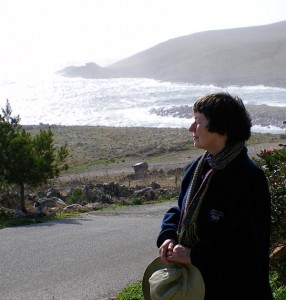
Leena Krohn on the way to Cape Tainaron, Southern Peloponnese, Greece; this is where Europe ends. Her novel entitled Tainaron appeared in 1985. – Photo: Mikael Böök (2008)
The world wide web, whose services most of us now use for work or entertainment, is a greater invention than we have, perhaps, realised up till now: according to the writer Leena Krohn, it is nothing less than an evolutionary leap
Technology combats the limitations of our senses, geography, and time. The human eye can’t compete with the visual acuity of an eagle, or even a cat, but with the best telescopes it can see into the early history of the universe, with new electron microscopes it can distinguish individual atoms.
The human senses nevertheless have an unbelievably broad bandwidth. About a million times more data flows to our brains by means of our senses than we could ever grasp consciously. More…
Really existing?
30 March 2007 | Fiction, Prose
Extracts from the novel Mehiläispaviljonki. Kertomus parvista (‘The Bee Pavilion. A story about swarms’, Teos, 2006)
There are few old buildings in this town. Most are demolished to make way for new ones long before they reach the end of their first century.
Nevertheless, one brick building in our part of town, built at the beginning of the last century, was spared demolition for a long time. The two-storey building functioned as a Support Centre for the Psychically Ill and later on, for a couple of winters, as a shelter for alcoholics. The board fence that had surrounded the building for decades was taken down long before the building itself, but the maples on the sidewalk cast their shadows on its windows to the very end. When the lilacs and dogwoods in the back garden were in bloom, their heavy racemes shed purple and white on the sand. More…
To sleep, to die
30 September 2004 | Fiction, Prose
Extracts from the novel Unelmakuolema (‘Dreamdeath’, Teos, 2004)
Dreamdeath
Who would not like to cheat the grim reaper? Ways are known, of course, both scientific and non-scientific, but all of them are uncertain and temporary. Except for the simplest: to get there first oneself.
The refinement of this idea was Dreamdeath’s business idea. ‘Dreamdeath – because you deserve it!’ went Dreamdeath’s slogan.
The Dreamdeath home offered those who wished it the means to the most pleasant, even luxurious realisation of an autonomic death in an atmosphere of moral approval, against a suitable fee. At Dreamdeath the client himself decided when and in what conditions he would leave his mortal clay. More…
The son of the chimera
30 September 1999 | Fiction, Prose
A short story from Pereat mundus. Romaani, eräänlainen (‘Pereat mundus. A novel, sort of’, WSOY, 1998)
I was born, but not because anyone wanted it to happen. No one even knew it was possible, for my mother was a human being, my father a chimera. He was one of the first multi-species hybrids.
Only one picture of my father survives. It is not a photograph, but a water-colour, painted by my mother. My father is sitting in an armchair, book in hand, one cloven hoof placed delicately on top of the other. According to my mother, he liked to leaf through illustrated books, although he never learned to read. He is wearing an elegant, muted blue suit jacket, but no trousers at all. Thick grey fur covers his strong legs, right down to his hoofs. Small horns curve gracefully over his convex forehead. Striking in his face are his round, yellow eyes, his extraordinarily wide mouth, his tiny chin and his surprisingly large but flat nose. More…
Gorgonoids
Issue 1/1993 | Archives online, Fiction, Prose
From Matemaattisia olioita tai jaettuja unia (‘Mathematical creatures, or shared dreams’, WSOY, 1992). Introduction by Soila Lehtonen
The egg of the gorgonoid is, of course, not smooth. Unlike a hen’s egg, its surface texture is noticeably uneven. Under its reddish, leather skin bulge what look like thick cords, distantly reminiscent of fingers. Flexible, multiply jointed fingers, entwined – or, rather, squeezed into a fist.
But what can those ‘fingers’ be?
None other than embryo of the gorgonoid itself.
For the gorgonoid is made up of two ‘cables’. One forms itself into a ring; the other wraps round it in a spiral, as if combining with itself. Young gorgonoids that have just broken out of their shells are pale and striped with red. Their colouring is like the peppermint candies you can buy at any city kiosk. More…
Invisible cities
Issue 4/1992 | Archives online, Essays
Extracts from Leena Krohn’s collection of essays, Rapina ja muita papereita (‘Rustle, and other papers’, WSOY, 1989).
Past me hurries a man in a rustling anorak. He pushes a card into a crack in the wall. There is a whirring noise, a door opens and, shoulder first, he pushes his way into a cramped room. At eye-level is a black screen, and under it a group of buttons. On the buttons is printed: Cash. Statement. Balance. On an empty button someone has written: Holdup. A question appears on the screen, and deserves our undivided attention: Do you wish to continue with another transaction?
We do! We certainly do. The mild warmth that suffuses the automatic bank pleases me, too. Why shouldn’t it? The warmth of the machine, the heat of money, is itself one of the forms of human energy secreted by the city, however stunted and primitive it may seem as it oozes from the depths of the metal cabinet. More…
The Paradox Archive
Issue 3/1991 | Archives online, Fiction, Prose
Extracts from the novel Umbra (WSOY, 1990). Introduction by Soila Lehtonen
The Paradox Archive
Umbra was a man of order. His profession alone made him that, for sickness was a disorder, and death chaos.
But life demands disorder, since it calls for energy, for warmth – which is disorder. Abnormal effort did perhaps enhance order within a small and carefully defined area, but it squandered considerable energy, and ultimately the disorder in the environment was only intensified.
Umbra saw that apparent order concealed latent chaos and collapse, but he knew too that apparent chaos contained its own order. More…
Six letters
Issue 1/1986 | Archives online, Fiction, Prose
From Tainaron (1985). Introduction by Soila Lehtonen
The whirr of the wheel
Letter II
I awoke in the night to sounds of rattling and tinkling from my kitchen alcove. Tainaron, as you probably know, lies within a volcanic zone. The experts say that we have now entered a period in which a great upheaval can be expected, one so devastating that it may destroy the city entirely.
But what of that? You need not imagine that it makes any difference to the Tainaronians’ way of living. The tremors during the night are forgotten, and in the dazzle of the morning, as I take my customary short cut across the market square, the open fruit-baskets glow with their honeyed haze, and the pavement underfoot is eternal again.
And in the evening I gaze at the huge Wheel of Earth, set on its hill and backed by thundercloud, with circumference, poles and axis pricked out in thousands of starry lights. The Wheel of Earth, the Wheel of Fortune… Sometimes its turning holds me fascinated, and even in my sleep I seem to hear the wheel’s unceasing hum, the voice of Tainaron itself. More…