

Tag: animals
Petri Pietiläinen: Koirien Suomi. Kansanperinnettä ja historiaa [Dogs in Finland. Folk tradition and history]
12 March 2015 | Mini reviews, Reviews
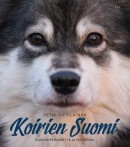 Koirien Suomi. Kansanperinnettä ja historiaa
[Dogs in Finland. Folk tradition and history]
Helsinki: Finnish Literature Society, 2014. 239 pp., ill.
ISBN 978-952-222-540-5
€32, hardback
Non-fiction writer Petri Pietilä is the author of the award-winning book Koirien maailmanhistoria (‘Dogs in world history’), which deals with the general cultural history of the dog. In the first half of this lively and fascinating new book he discusses the dog in Finnish folk tradition, while in the second half he gives an account of the history of the dog in Finland to the present day. Dogs have been domesticated in the North European region for thousands of years. In folk poetry, such as the national epic, the Kalevala, the dog is first and foremost a house guard and a partner in hunting. In Finnish folk tradition, the dog is viewed more leniently than in other countries, and stories about hellhounds are rare. Yet the attitude towards dogs in Finnish proverbs is not an exclusively positive one. Pietilä also says that the dog’s change of status has been linked to its becoming a helper and beloved pet, and today there are more than half a million of them in Finland. In addition, they are increasingly being used in various work and service roles. The book also presents the six Finnish dog breeds, and includes a dog name day calendar.
Translated by David McDuff
Animal magic
3 June 2014 | Extracts, Non-fiction
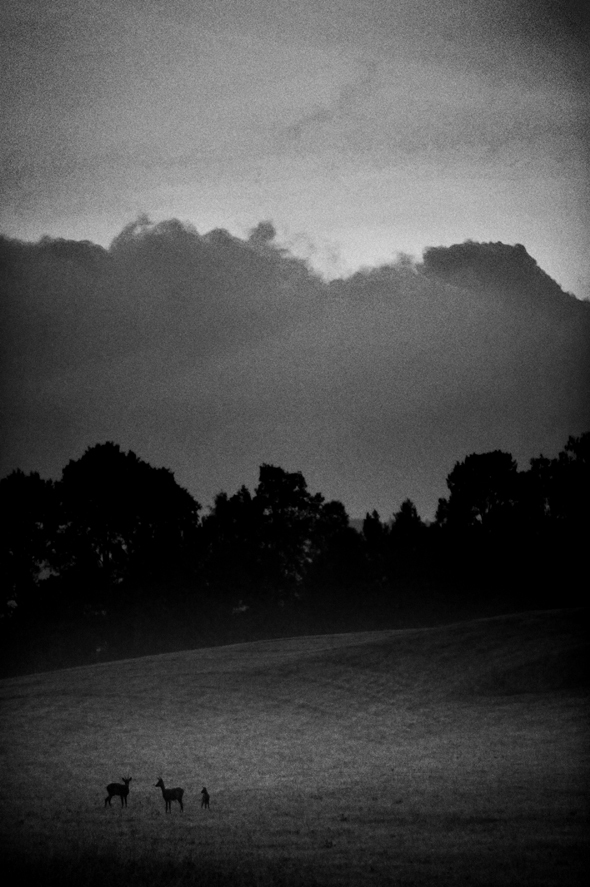
Roe deer, Sweden. Photo: Mats Andersson
A day in the life of an elk, of a lynx? Nature photographers venture into the depths of forests, in pursuit of the inhabitants – predator and prey, mythical and real. Photographs from Kohtaamisia (‘Encounters’), by Mats Andersson and Heikki Willamo, text by Willamo (Maahenki & Musta Taide [Black Art], 2014)
The feelings in our dreams. They well from depths – from those layers of awareness that the mind does not shackle. In sleep we handle and organise the events of our lives in a way which is impossible when awake, when we are conscious of ourselves and our limitations. That is why animals can come into my dreams as friends, equal partners, like me, and therefore I so often dream of having their abilities and skills.
When awake we think all the time. We think about past events and worry about the future or dream of something better. Very seldom do we live in the moment. Photographs are passing moments, often only a thousandth of a second long, but sometimes lasting minutes or even hours. In finished photographs the beholder can see much more – he adds his memories or dreams of the future. The picture-taking moment vanishes, something else comes in its stead. More…
Petri Pietiläinen: Koirien maailmanhistoria [A world history of dogs]
24 April 2014 | Mini reviews, Reviews
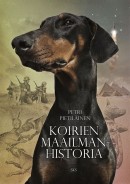 Koirien maailmanhistoria
[A world history of dogs]
Helsinki: Finnish Literature Society, 2013. 344 pp .
ISBN 978-952-222-351-7
€34, hardback
By partly fictional means this book tells the compelling story of the dog, particularly from a cultural and historical perspective. Recent archaeological finds suggest that man has tamed dogs for more than 30,000 years. Descended from wolves, during the Stone Age they became common as domestic animals. In Finland, too, there have been finds that indicate that this was so. The dog was used for hunting and as a sentinel, and later in a variety of service tasks. From early on they were mythical creatures, worshipped in some cultures, in others shunned, and in some bred to be eaten. While in 17th-century Europe dogs were sentenced to death at trials, in Japan it was nobles who faced the death penalty for ill-treating their dogs. The book also presents the fascinating stories of dogs both famous and nameless, beginning with Alexander the Great’s dog Peritas. In the Western world the dog was not treated as a member of the family until the modern era, though in prehistoric burial sites there are indications of its having been a close companion of man. Pietiläinen links the story of the dog to more general history in an insightful way.
Translated by David McDuff
Homeward bound!
29 March 2014 | This 'n' that
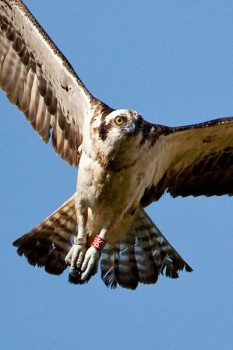
Jukka the osprey: sadly, his fate remains unknown. Photo: Hannu Vainiopekka
Snow is now, unusually for so early in the year, long gone from more than half of Finland. Bears are waking up and emerging from their winter lairs: spring is definitely in the air!
So are birds: the latest news from Cameroon is that on 26 March Ilmari caught his last African fishes and started winging his way to southern Finland.
Ilmari is an osprey: you may remember him – we reported his endeavour to cross continents on his way to Africa in 2012, asking you to watch this space. Well, the raptor is still doing fine, and his journey can be followed on the Finnish Museum of Natural History’s Luomus website. More than six thousand kilometres and a month later he will hopefully be spotted fishing on his home lakes in Hattula.
Let’s keep our fingers crossed for Ilmari. The fates of his compadres Pete, Eikka and Jukka are unfortunate: these great travellers perished on their particularly long and dangerous migration routes. Their stories are reported here.
Cute or what!
28 November 2013 | This 'n' that
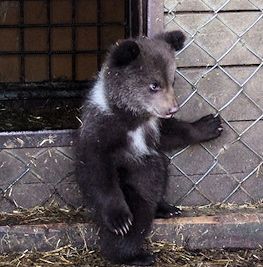
A bear pose: a small bear at the Kuusamo Predator Centre. Photo: Pasi Jäntti
Beardom is a weird, fascinating universe. We admit we have a soft spot for this furry predator, living in Finnish forests, which hibernates during the coldest months and does not eat humans (if it can possibly avoid it).
Take a look at these cuties: the New York Daily News published bear photos by a Finnish photographer on 21 November. This smash hit in bear photography is the series in which Valtteri Mulkahainen, an amateur photographer and teacher living in Sotkamo, north-eastern Finland, managed to capture a bear family in Suomussalmi last summer. Adorable creatures!
These lively triplets seem to be playing a round game while their mummy keeps on eating nearby. We hope they will live happily ever after, and that they found a good home for their winter sleep.
The estimate of the number of brown bears in the country is around 1,300. One hundred and thirty two shooting licences were issued this year. Bears in winter hibernation are strictly protected from hunting.
More bears, from the Kuusamo Predator Centre, also north-eastern Finland, on our page (and more of Valtteri Mulkahainen’s photos can be viewed on 500px.com)!
Winging it
6 June 2013 | This 'n' that
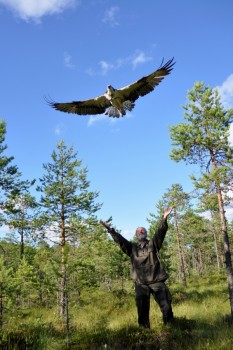
From Finland to Africa: Ilmari takes off in 2012. Photo: Juhani Koivu
Ilmari is back!
Last October we brought you the story of a winged traveller who left his home in southern Finland for Africa. Ilmari is a nine-year old osprey who spent his winter in Cameroon; as he and his family are fish-eaters, they have to foresake their frozen homeland for about five months of the year.
It’s a long way to Cameroon, around 6,500 kilometres, and the return trip is a dangerous one. But Ilmari made it: his satellite transmitter reported that he returned to his native landscape on 21 April, after flying 7,351 kilometres, which took him 23 days – an average of 320 kilometres per day. He took a couple of days off on Crete and in Serbia.
Now satellite transmitters and live cameras reveal all the intimate secrets of birds of prey (and bears, hibernating in their lairs). On this British site osprey Lizzie babysits as her chicks flap their tiny wings in early June.
Now it’s time for Ilmari to concentrate on fishing, hopefully in order to feed his offspring – until October, when he will take to the skies again.
Elina Lappalainen: Syötäväksi kasvatetut. Miten ruokasi eli elämänsä [Bred for the table. How your food lived its life]
8 February 2013 | Mini reviews, Reviews
 Syötäväksi kasvatetut. Miten ruokasi eli elämänsä
[Bred for the table. How your food lived its life]
Jyväskylä: Atena, 2012. 355 p, ill.
ISBN 978-951-796-843-0
€ 29, paperback
The development of animal welfare depends not only on producers, legislation and control, but also on the preferences of central trading and consumers. In her first book, young journalist Elina Lappalainen describes the conditions in which pigs, cattle and chickens live in Finland before they end up on the table. The living conditions for these are on average better than in many other countries, but they are still often poor. For example, it is difficult to build poultry farms of thousands of chickens, and it matters whether the birds live in cages, are organically grown or a deep litter system is used. Large-scale production does not necessarily mean that pigs, for example, are worse off than they would have been formerly on a small pig farm. On average, the best conditions are provided for cattle, though even most of those spend the long winter in a stanchion barn. Lappalainen has written a thoroughly researched, interesting and balanced review of this internationally important and even emotionally sensitive issue. The book was awarded the prestigious Finlandia Prize for Non-Fiction 2012.
Translated by David McDuff
Bear necessities
10 January 2013 | This 'n' that
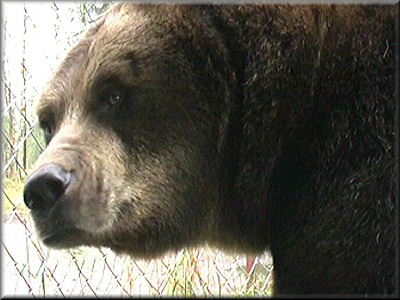
Ursus arctos: Juuso the bear. Photo: The Predator Centre, Kuusamo
In our odd quiet moments we occasionally amuse ourselves by checking out what’s happening in the bear village of Kuusamo, in the north-east of Finland, by watching ‘bear TV’ (the bears speak Finnish only with the staff, but the link offers plenty of expressive action without words).
The brown bear (Ursus arctos) – feared, respected and even mythical animal of the ancient Finns – can weigh more than 400kg. It can run fast (60km/h) and scare the pants off people in the woods, although it always avoids humans if possible. There are approximately 900–1300 wild bears in Finland. This large, intelligent beast hibernates from October to April. Omnivorous, it eats meat as well as plants and berries – carrots, too, if it can lay its paws on them.
Kuusamon suurpetokeskus (The Predator Centre) in Kuusamo has given home to several bears who have lost their mother when cubs or injured in accidents. The bears regard Sulo Karjalainen, their carer – beartaker? – their dear pal, or even mum.
It is really heart-warming to watch him and Pasi Jäntti socialising with their furry friends, who politely – or occasionally slightly rudely – devour the healthy treats that they are given in exchange for posing in several little home movies on their ‘bear TV’ website. In them, the endearing giants – Juuso, Niisku, Vyöti and others – lick Sulo’s cheek, have a bath, and Juuso tests a specially made bear weighing machine and, getting sleepy, a man-made lair with Sulo, his dear pal.
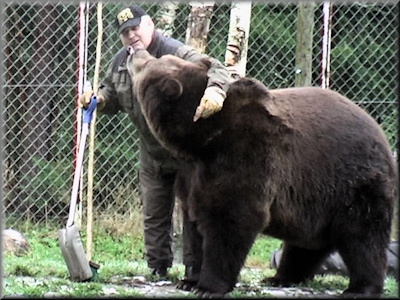
Beartaker at work: Sulo and his 400+-kilo friend. Photo: The Predator Centre, Kuusamo
Dangerous? Texts on the videos point out that only the staff can enter the bears’ home.
Sulo bears a scar on his cheek, yet he is perfectly fearless. With the largest mammal in Europe, there is a risk involved…
It’s a long way to Cameroon
18 October 2012 | This 'n' that
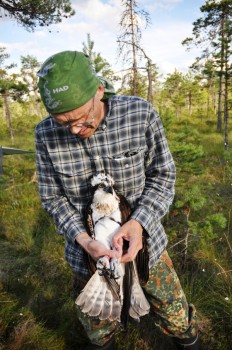
Before takeoff: Ilmari looks slightly annoyed here, as his ankle rings are checked by Harri Koskinen before his release. Photo: Juhani Koivu
An eight-year-old Finnish male, named Ilmari, has emigrated to Africa; on 13 October he was spotted in Cameroon. He set off for the journey on 16 September.
At the beginning of his journey, in Hattula, southern Finland, in August, he weighed 1,370g.
Ilmari is an osprey. The Osprey Foundation (more photos here too) fitted him with a Microwave GPS-Argos satellite transmitter (weighing just 30g and running on solar power). This allows osprey researchers to follow his journeys.
Actually Ilmari hasn’t emigrated – he will return to where he was born, in March 2013. As this is Ilmari’s first recorded migration, his final destination is not known. But one of his countrymen (-birds), carrying a transmitter, Jukka, liked it so much in Cameroon that he spent the winter there. Will Ilmari do the same? Watch this space!
The journeys of Finnish migrating birds are long (in this case, more than 6000 kilometres) and dangerous, so we wish Ilmari safe travel back home as well.
Horse sense
2 February 2012 | Essays, Non-fiction
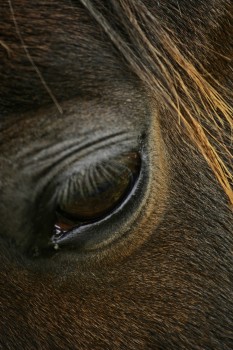
The eye that sees. Photo: Rauno Koitermaa
In this essay Katri Mehto ponders the enigma of the horse: it is an animal that will consent to serve humans, but is there something else about it that we should know?
A person should meet at least one horse a week to understand something. Dogs help, too, but they have a tendency to lose their essence through constant fussing. People who work with horses often also have a dog or two in tow. They patter around the edge of the riding track sniffing at the manure while their master or mistress on the horse draws loops and arcs in the sand. That is a person surrounded by loyalty.
But a horse has more characteristics that remind one of a cat. A dog wants to serve people, play with humans – demands it, in fact. With a dog, a person is in a co-dependent relationship, where the dog is constantly asking ‘Are we still US?’ More…
Warmer climes
10 November 2011 | This 'n' that
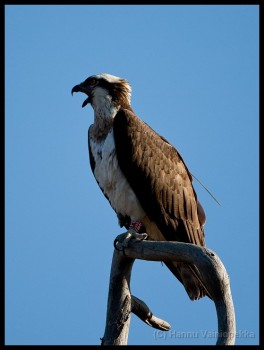
Up and away: Jukka is about to leave for the south. Photo: Hannu Vainiopekka /Finnish Museum of Natural History
Jukka spent the night of 9 October by the river Sana in Bosnia-Herzegovina. He then crossed the Croatian border, at times reaching a speed of 96 kilometres per hour.
By 15 October Jukka had crossed the border between Libya and Niger; 350 kilometres later he settled in the desert for the night. After entering Cameroon on the 21st, Jukka completed his journey of 34 days and 6,600 kilometres by landing on the bank of River Benoue and taking a well-earned break. In March it will be time to head homewards again, to Lake Pälkäne in Finland.
Jukka is a Finnish osprey.
Earlier, another osprey, Lasse, surprised the zoologists by spending his winter in Israel, instead of Africa. But Harri decided to wing his way as far as to South Africa, almost 12,000 kilometres from home, a distance he covered in some 57 days!
The Finnish Museum of Natural History / University of Helsinki and the Finnish Osprey Foundation track ospreys with the help of satellite tracking.
Long-distance travelling is dangerous, though: Eikka perished on his way to the south in Ukraine this autumn, and in 2008 Pete was probably eaten by a local eagle in Morocco: some of his feathers, as well as the transmitter were found beside a river by two officials of the Emirates Center for Wildlife Propagation, Eric Le Nuz and Rachid Khain.
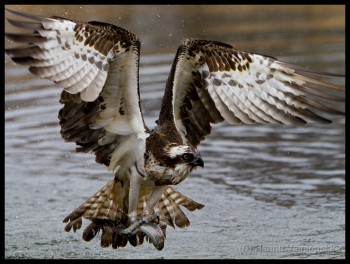
Gone fishing: Jukka the satellite osprey having lunch. Photo: Hannu Vainiopekka/Finnish Museum of Natural History
And why this interest in wildlife, you might wonder? Oh, as we sit here and edit Books from Finland in the semi-darkness of a November afternoon, creatures that migrate just seem to come to mind. Not to mention hibernation, but that’s another matter….
Snowbirds
2 November 2011 | Extracts, Non-fiction
The short winter days of the northerly latitudes are made brighter by snow cover, which almost doubles the amount of available light. Reflection from the snow is an aid for photographers working outdoors in winter conditions. A new book, entitled Linnut lumen valossa (‘Birds in the light of snow’), presents the best shots by four professionals, Arto Juvonen, Tomi Muukkonen, Jari Peltomäki and Markus Varesvuo, who specialise in patiently stalking the feathered survivors in the cold
The photographs and texts are from the book Linnut lumen valossa (‘Birds in the light of snow’, edited by Arno Rautavaara. Design and layout by Jukka Aalto/Armadillo Graphics. Tammi, 2011)
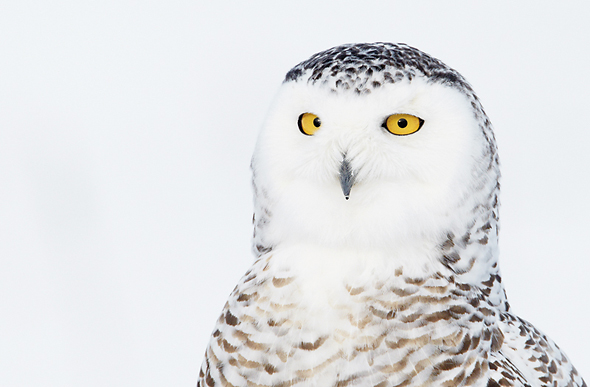
Snowy owl. Photo: Markus Varesvuo, 2010
Tiia Aarnipuu: Jonkun on uskallettava katsoa. Animalian puoli vuosisataa [Someone’s got to dare to look. Half a century of Animalia]
28 July 2011 | Mini reviews, Reviews
 Jonkun on uskallettava katsoa. Animalian puoli vuosisataa
[Someone’s got to dare to look. Half a century of Animalia]
Helsinki: Like Kustannus, 2011. 209 p., ill.
ISBN 978-952-01-0582-2
€ 33, paperback
This book has been published to mark the 50th anniversary of Animalia, the Federation for the Protection of Animals. The public image of the organisation has varied between one of a conservative club of ladies and gentlemen and that of a radical terrorist group. Animalia was founded in 1961, inspired by Johan Börtz, a Swede who gave lectures on the plight of animals used in experiments. Animalia began making visits to inspect animal testing facilities, which were completely unregulated in the early 1960s. Gradually the animal rights movement became more radicalised, somewhat later than in places such as Britain. Animal rights became a subject of wider debate in Finland in the 1980s. In the 1990s, the organisation was falsely linked with attacks made on fur farms by direct-action youth groups. Animalia’s stance has been to renounce vandalism and violence. In February 2010 Animalia launched its largest-ever information campaign, aimed at ridding Finland of fur farms by 2025.
Translated by Ruth Urbom
Johan Leche & Johan Grysselius
The birds and the bees
2 May 2011 | Non-fiction
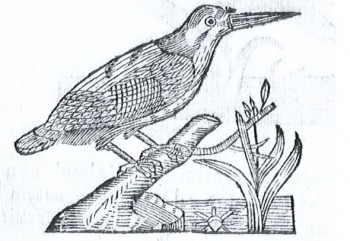
Halcyon or Ispida (kingfisher)? A picture of this mythical bird from a 17th-century thesis, published in Suomen lintutieteen synty
Halcyon or Ispida (kingfisher)? A picture of this mythical bird from a 17th-century thesis, published in Suomen lintutieteen synty
The famous Swedish scientist Carl von Linné claimed in his doctoral thesis in 1757 that swallows spend their winters underwater.
Two of Linné’s countrymen, working at Åbo Academy in Finland, proved him wrong seven years later by giving evidence of migration, but to no avail: the silly theory prevailed until the 19th century.
In these extracts doctors Leche and Grysselius eloquently present a ‘Well-Intended Reader’ with errors of humanity that become epidemic
Extracts from ‘An Academic Treatise on The Wintering and Migration of Swallows’ by Johan Leche & Johan Grysselius (1764), published in Finnish (translated from Latin by Sari Kivistö) in Suomen lintutieteen synty. Turun Akatemian aika (‘The birth of the Finnish ornithology. The era of the Åbo Akademi’, Faros, 2009), edited by Esa Lehikoinen, Risto Lemmetyinen, Timo Vuorisalo & Sari Kivistö
Preface
As we know, humanity is no less inclined to err in matters pertaining to nature than in matters of morals. With regards to errors concerning the natural world, even the most experienced scholars are not always immune. The common people, for their part, have not learned to avoid such pitfalls and are thus constantly bumping into them. This is no wonder, since they are not accustomed to using the help of natural science or mathematics, and are thus unable to perform appropriate tests, to correctly assess future eventualities, or to observe phenomena closely unless they concern something already familiar to them. More…
Nature’s own
22 April 2010 | Extracts, Non-fiction
As night falls, the silence is broken by pattering of small feet on the greying windowsill of an old, abandoned house: entire families may live under the rotten floorboards. Houses now inhabited not by humans but by wild animals are observed by Kai Fagerström and Heikki Willamo
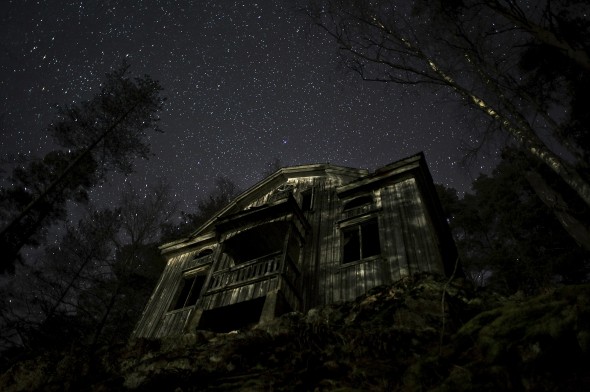
The wolf's hour? An abandoned house is alive...
Extracts from Viimeiset vieraat. Elämää autiotaloissa [The last visitors. Life in abandoned houses, Maahenki, 2010] by Kai Fagerström, Risto Rasa & Heikki Willamo. Text by Willamo, poems by Rasa, photographs by Fagerström and Willamo
Some thirty years later I found the badgers’ cottage again – it wasn’t the same one, but the mood of my childhood still floated there. Grey walls and a shingle roof, bare gaping windows, the door creaking on its single hinge. Oak tree in the yard, lilacs flourishing wild. The forest was rapidly reclaiming its own behind the cottage. The mounds of sand beside the wall bases showed prints of strong-clawed paws and a number of paths, hardened from use, led into the woods. More…