

Tag: Finnish nature
Pig cheeks and chanterelle dust
21 August 2014 | This 'n' that
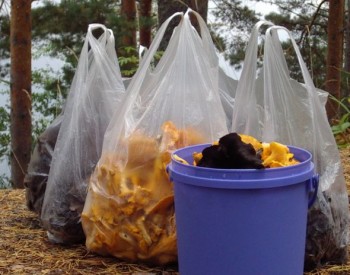
Wild and plentiful: chanterelles, black horns of plenty. Photo: Soila Lehtonen
Pop-up restaurants came into being in Helsinki in 2011: a few times every year any eager amateur cook is able to set up a ‘restaurant’ for one day on a street corner or in a park: citizens are welcome to take their pick, at a modest price.
In a northern city, not exactly suitable for street food trade all year round, in a country where rules of food hygiene are strict, the innovation of the Restaurant Day has been welcomed by the public. The latest event took place on 17 August.
The idea has now spread to at least 60 countries. Foodie culture thrives.
We find an article in The New Yorker by Adam Gopnik, No rules! Is Le Fooding, the French culinary movement, more than a feeling? interesting – according to comments quoted in it, ‘food must belong to its time’, and the traditional French cuisine ‘was caught in a museum culture: the dictatorship of a fossilized idea of gastronomy’.
In the 1960s, ‘nouvelle cuisine’, as opposed to cuisine classique, began to promote lighter, simpler, inventive, technically more advanced cooking. Well – some of us may remember that, at worst, this could also manifest itself in, say, three morsels of some edible substance placed decoratively on a plate topped with three chives: expensive, insubstantially elegant and pretty useless.
Today, Finland, the traditional stronghold of liver casserole, brown sauce and ham-mincemeat-pineapple pizzas (yes), seems to have moved onto a higher level of the culinary art – at least in selected restaurants. In a recent article, Helsinki’s food scene, coming on strong, published in The Washington Post, Tom Sietsema enjoys the pleasure of discovering things Finnish.
He is treated to parsnip leaves turned into ice cream imparting a coconut flavour, crackers made from leek ash and risotto in which ‘tiny green hops and their purple flowers interrupt the beige surface of the bowl, whose rim is dusted with golden chanterelle powder.’
The Executive Chef of Helsinki’s esteemed Savoy restaurant (est. 1937) cooks braised pig cheeks served with rhubarb and spring greens. A hunter-gatherer chef collects wild things: wood sorrel, spruce shoots and orpine and serves them in an omelette, with a drink made of chaga mushrooms (used for making tea; a sort of ‘sterile conk trunk rot of birch’, currently very much in vogue among the most eager of foodies for its medicinal [antioxidant, anti-inflammatory] properties).
It is true that Copenhagen and Stockholm have advanced further on their way to international fame of cuisine, but perhaps Helsinki will follow suit. And people who go out for a meal are no longer expected to settle for morsels with chives on top – food belongs to its time, and time changes food(ies).
A comment on Sietsema’s article claims though that his ‘verbiage’ has ‘nothing to do with what 99.999% of Finns eat! and what 99.99% of Finnish restaurants offer!’
But the truth (we know) is now closer to Sietsema than the commentator: ambitious restaurants may play with golden chanterelle powder, and even if it is not exactly what Finns often have for tea, we believe Finns today are losing interest in cheap chicken slivers in industrial marinade for dinner, and even beginning to accept that greens may not be only for bunnies.
Chanterelles have always been considered as a treat: fresh from the woods, quickly cooked in butter and cream, served with new potatoes and rye bread, or in an omelette: bon appetit (even without orpine)!
Animal magic
3 June 2014 | Extracts, Non-fiction
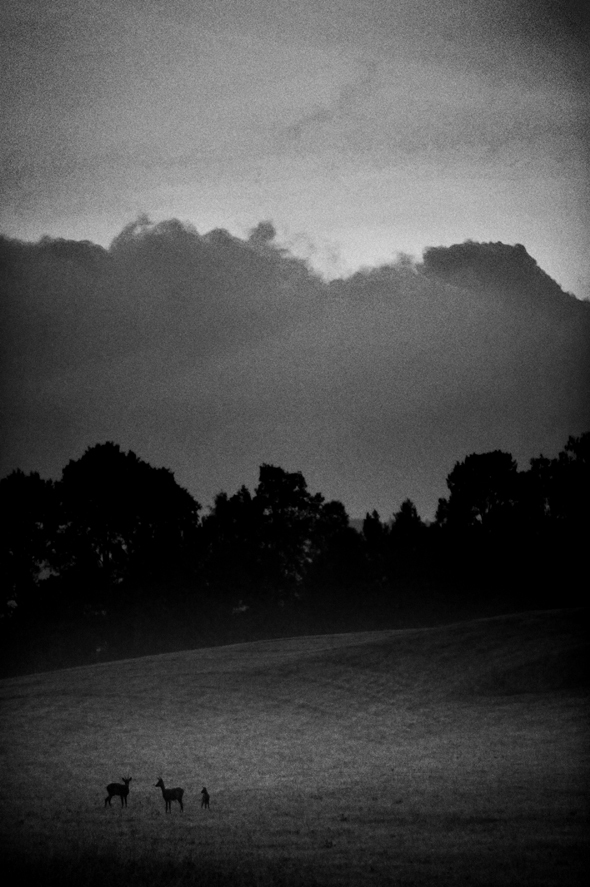
Roe deer, Sweden. Photo: Mats Andersson
A day in the life of an elk, of a lynx? Nature photographers venture into the depths of forests, in pursuit of the inhabitants – predator and prey, mythical and real. Photographs from Kohtaamisia (‘Encounters’), by Mats Andersson and Heikki Willamo, text by Willamo (Maahenki & Musta Taide [Black Art], 2014)
The feelings in our dreams. They well from depths – from those layers of awareness that the mind does not shackle. In sleep we handle and organise the events of our lives in a way which is impossible when awake, when we are conscious of ourselves and our limitations. That is why animals can come into my dreams as friends, equal partners, like me, and therefore I so often dream of having their abilities and skills.
When awake we think all the time. We think about past events and worry about the future or dream of something better. Very seldom do we live in the moment. Photographs are passing moments, often only a thousandth of a second long, but sometimes lasting minutes or even hours. In finished photographs the beholder can see much more – he adds his memories or dreams of the future. The picture-taking moment vanishes, something else comes in its stead. More…
Homeward bound!
29 March 2014 | This 'n' that
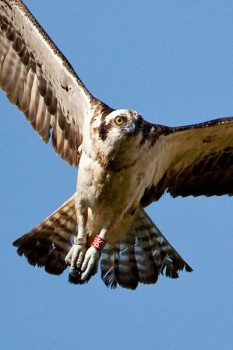
Jukka the osprey: sadly, his fate remains unknown. Photo: Hannu Vainiopekka
Snow is now, unusually for so early in the year, long gone from more than half of Finland. Bears are waking up and emerging from their winter lairs: spring is definitely in the air!
So are birds: the latest news from Cameroon is that on 26 March Ilmari caught his last African fishes and started winging his way to southern Finland.
Ilmari is an osprey: you may remember him – we reported his endeavour to cross continents on his way to Africa in 2012, asking you to watch this space. Well, the raptor is still doing fine, and his journey can be followed on the Finnish Museum of Natural History’s Luomus website. More than six thousand kilometres and a month later he will hopefully be spotted fishing on his home lakes in Hattula.
Let’s keep our fingers crossed for Ilmari. The fates of his compadres Pete, Eikka and Jukka are unfortunate: these great travellers perished on their particularly long and dangerous migration routes. Their stories are reported here.
Cute or what!
28 November 2013 | This 'n' that
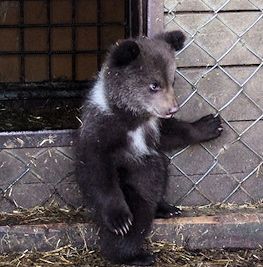
A bear pose: a small bear at the Kuusamo Predator Centre. Photo: Pasi Jäntti
Beardom is a weird, fascinating universe. We admit we have a soft spot for this furry predator, living in Finnish forests, which hibernates during the coldest months and does not eat humans (if it can possibly avoid it).
Take a look at these cuties: the New York Daily News published bear photos by a Finnish photographer on 21 November. This smash hit in bear photography is the series in which Valtteri Mulkahainen, an amateur photographer and teacher living in Sotkamo, north-eastern Finland, managed to capture a bear family in Suomussalmi last summer. Adorable creatures!
These lively triplets seem to be playing a round game while their mummy keeps on eating nearby. We hope they will live happily ever after, and that they found a good home for their winter sleep.
The estimate of the number of brown bears in the country is around 1,300. One hundred and thirty two shooting licences were issued this year. Bears in winter hibernation are strictly protected from hunting.
More bears, from the Kuusamo Predator Centre, also north-eastern Finland, on our page (and more of Valtteri Mulkahainen’s photos can be viewed on 500px.com)!
Winging it
6 June 2013 | This 'n' that
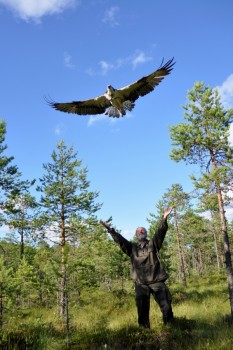
From Finland to Africa: Ilmari takes off in 2012. Photo: Juhani Koivu
Ilmari is back!
Last October we brought you the story of a winged traveller who left his home in southern Finland for Africa. Ilmari is a nine-year old osprey who spent his winter in Cameroon; as he and his family are fish-eaters, they have to foresake their frozen homeland for about five months of the year.
It’s a long way to Cameroon, around 6,500 kilometres, and the return trip is a dangerous one. But Ilmari made it: his satellite transmitter reported that he returned to his native landscape on 21 April, after flying 7,351 kilometres, which took him 23 days – an average of 320 kilometres per day. He took a couple of days off on Crete and in Serbia.
Now satellite transmitters and live cameras reveal all the intimate secrets of birds of prey (and bears, hibernating in their lairs). On this British site osprey Lizzie babysits as her chicks flap their tiny wings in early June.
Now it’s time for Ilmari to concentrate on fishing, hopefully in order to feed his offspring – until October, when he will take to the skies again.
Forest and fell
8 May 2013 | Reviews
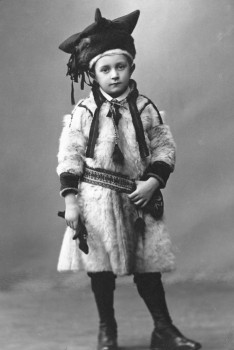
From North to South: young Heikki Soriola on his way to represent Utsjoki in Helsinki, in 1912. Photo from Saamelaiset suomalaiset
Veli-Pekka Lehtola
Saamelaiset suomalaiset: Kohtaamisia 1896–1953
[Sámi, Finns: encounters 1896–1953]
Helsinki: Suomalaisen Kirjallisuuden Seura, 2012. 528 p., ill.
ISBN 978-952-222-331-9
€53, hardback
Leena Valkeapää
Luonnossa: Vuoropuhelua Nils-Aslak Valkeapään tuotannon kanssa
[In nature, a dialogue with the works of Nils-Aslak Valkeapää]
Helsinki: Maahenki, 2011. 288 p., ill.
ISBN 978-952-5870-54-1
€40, hardback
The study of the Sámi people, like that of other indigenous peoples, has become considerably more diverse and deeper over recent decades. Where non-Sámi scholars, officials and clergymen once examined the Sámi according to the needs and values of the holders of power, contemporary scholarship starts out from dialogue, from an attempt to understand the interactions between different groups. More…
Inspired by winter
13 March 2013 | This 'n' that
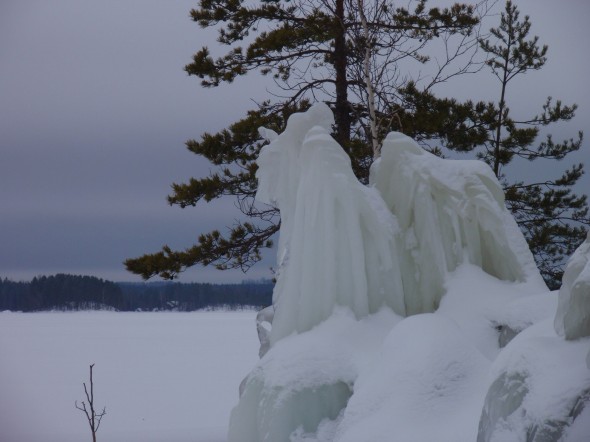
Made by nature: ice sculptures on Lake Saimaa. Photo: Soila Lehtonen
Jo kirkkahana aaltoo avaruus,
jo päivyt paistavi, jo hohtaa hanki,
vaan kaikkialla viel’ on hiljaisuus
ja taivas valju on ja maa on vanki.
Now bright swells in the heavens abound,
the days are sunny, snowdrifts gleam,
and yet silence still dwells all around,
the sky is pallid, a prisoner yet the soil.
We were so impressed by this astonishing ice sculpture, created by the artist Winter, that we wanted to share it with you – before, as the spring equinox has just been reached, it disappears for ever.
These hooded characters were created by the storm that sent waves up the trees growing on the waterfront of an islet, just before the lake Saimaa froze up late last year. They have been standing there for months, observed – and photographed – by hundreds of surprised skaters who pass them by on the 22-kilometre skating route.
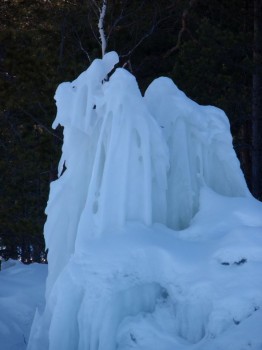
Bye-bye now…. Photo: Soila Lehtonen
Earlier these almost Biblical-looking figures seemed to be heading for south (the big photo), but as the changing temperatures and the March sun has now made their own adaptations in the marble-looking ice, the group now seems to be waving goodbye – until next winter, then?
The stanza is from the poem Maaliskuulla (‘In March‘, from the collection Maaliskuun lauluja, ‘Songs of March’, 1896) by Eino Leino (translation by yours truly).
Bear necessities
10 January 2013 | This 'n' that
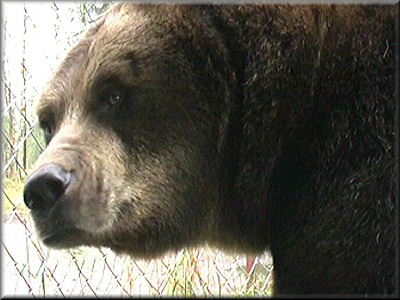
Ursus arctos: Juuso the bear. Photo: The Predator Centre, Kuusamo
In our odd quiet moments we occasionally amuse ourselves by checking out what’s happening in the bear village of Kuusamo, in the north-east of Finland, by watching ‘bear TV’ (the bears speak Finnish only with the staff, but the link offers plenty of expressive action without words).
The brown bear (Ursus arctos) – feared, respected and even mythical animal of the ancient Finns – can weigh more than 400kg. It can run fast (60km/h) and scare the pants off people in the woods, although it always avoids humans if possible. There are approximately 900–1300 wild bears in Finland. This large, intelligent beast hibernates from October to April. Omnivorous, it eats meat as well as plants and berries – carrots, too, if it can lay its paws on them.
Kuusamon suurpetokeskus (The Predator Centre) in Kuusamo has given home to several bears who have lost their mother when cubs or injured in accidents. The bears regard Sulo Karjalainen, their carer – beartaker? – their dear pal, or even mum.
It is really heart-warming to watch him and Pasi Jäntti socialising with their furry friends, who politely – or occasionally slightly rudely – devour the healthy treats that they are given in exchange for posing in several little home movies on their ‘bear TV’ website. In them, the endearing giants – Juuso, Niisku, Vyöti and others – lick Sulo’s cheek, have a bath, and Juuso tests a specially made bear weighing machine and, getting sleepy, a man-made lair with Sulo, his dear pal.
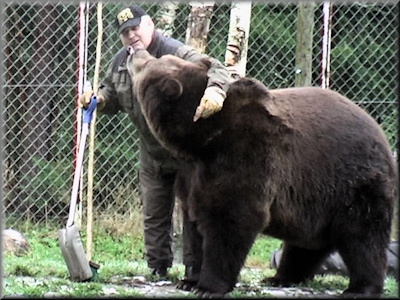
Beartaker at work: Sulo and his 400+-kilo friend. Photo: The Predator Centre, Kuusamo
Dangerous? Texts on the videos point out that only the staff can enter the bears’ home.
Sulo bears a scar on his cheek, yet he is perfectly fearless. With the largest mammal in Europe, there is a risk involved…
Pertti Lassila: Metsän autuus. Luonto suomalaisessa kirjallisuudessa 1700–1950 [Bliss of the forest. Nature in Finnish literature 1700–1950]
21 December 2012 | Mini reviews, Reviews
 Metsän autuus. Luonto suomalaisessa kirjallisuudessa 1700–1950
[Bliss of the forest. Nature in Finnish literature 1700–1950]
Helsinki: Suomalaisen Kirjallisuuden Seura (The Finnish Literature Society), 2011, 260 p.
ISBN 978-952-222-322-7
€35, paperback
Culture and art are relatively recent phenomena in Finland, but the forests, lakes and swamps have been here forever: national introspection has therefore always revolved around different ways of interpreting nature. National poet J.L. Runeberg (died 1877) romanticised the wilderness of the north and its starving inhabitants; pragmatic national philosopher J.V. Snellman (died 1881) rejoiced in the advances of continental culture in the farming regions of southwest Finland. Attempts to combine these two stances characterised the building of political and cultural ideas. Literary researcher Pertti Lassila follows the theme of nature through Finnish- and Swedish-language literature, including almost all major works up until the 20th century and some of the most important ones from the last century. His book is, at the same time, a description of the flow of ideas from the centre to the periphery, from the French classicist Carl Philip Creutz, author of hedonistic pastoral poetry, to Joel Lehtonen, writer of modern epics, whose endless pessimism was a largely constructed attempt to shape the split between nature and the alienated citizen of the 20th century; how successful he was is debatable. Nature remains a major theme in Finnish literature.
Translated by Claire Dickenson
Form follows fun
4 December 2012 | Non-fiction, Reviews
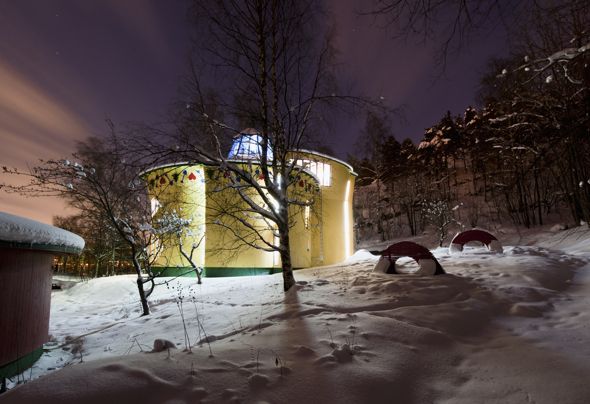
The house that the artist built: ‘Life on a leaf’ (2005–2009, Turku). Photo: Vesa Aaltonen
Jan-Erik Andersson: Elämää lehdellä [Life on a leaf]
Helsinki: Maahenki, 2012. 248 p., ill.
ISBN 978-952-5872-82-4
€42, hardback
‘I am Leaf House –
root house, sky house.
Enter me, be safe
And wander, dream.
The artist’s I is all our eyes….’
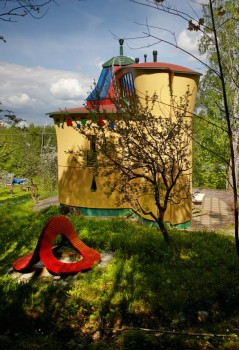
In the garden: red ‘apple’ benches designed by the English artist Trudy Entwistle. Photo: Matti A. Kallio
We all live – exceptions are really rare – in cubes. Not in cylinders or spheres, let alone in buildings of organic shapes like flowers or leaves; and houses in the shape of a shoe, for example, belong to the fairy-tale world, or perhaps to surrealism.
Artist Jan-Erik Andersson wanted to build a fairy-tale house in the shape of a leaf, and that is what he did (2005–2009), together with his architect partner Erkki Pitkäranta. Instead of the geometry of modernist architecture, he is inspired by the organic forms of nature.
Andersson’s house project, entitled ‘Life on a leaf’, also became an academic project, resulting in a dissertation at Finnish Academy of Fine Arts and now a book, including a detailed journal of the building process itself. The artist was at first advised, by a professor of architecture, not to proceed with his building project – he wouldn’t ‘like living in the house’, he was told. More…
A door to the other side
7 September 2012 | Extracts, Non-fiction
Building bird-houses is author Jyrki Vainonen’s hobby: he has crafted dozens of nesting boxes and hung them on trees for winged tenants. Roaming in the woods may be bring surprises, though: the bird-house man suddenly finds the world underfoot opening up or a moment… An extract from the collection of stories Linnunpöntön rakentaja (‘Builder of bird-houses’, Atena, 2012)
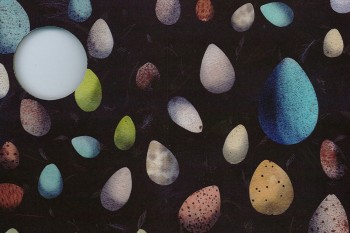
Birds coming up… Inside front cover of Linnunpöntön rakentaja by Elina Warsta/Solmu
The hinge was rusty, but after a cleaning and oiling it seemed to work, and didn’t even squeak. I had found it in a piece of board that was lying beside the road on the way to the dump. The board may have once served as part of a door frame.
The next day I rode my bike there again and unscrewed the hinge from the board, and now it looked quite handsome attached to the side wall of the birdhouse. I set the still floorless, roofless box upright and tried the door, opening the clasp and lifting the side wall on its hinges. It worked well, didn’t jam or make any sound. Next I attached the pieces of wood I’d already cut to form the roof and floor of the birdhouse. I inserted the floor and nailed through the three walls of the box – all except the wall that formed the door. Then I nailed the roof in place with several nails.
Now I had a box that would make it easy to watch the life inside. It would doubtless be wonderful to be able to see the nest from so close, and from the side rather than the top, as I usually had before. I could take photos, too. More…
Under cover
29 March 2012 | Extracts, Non-fiction
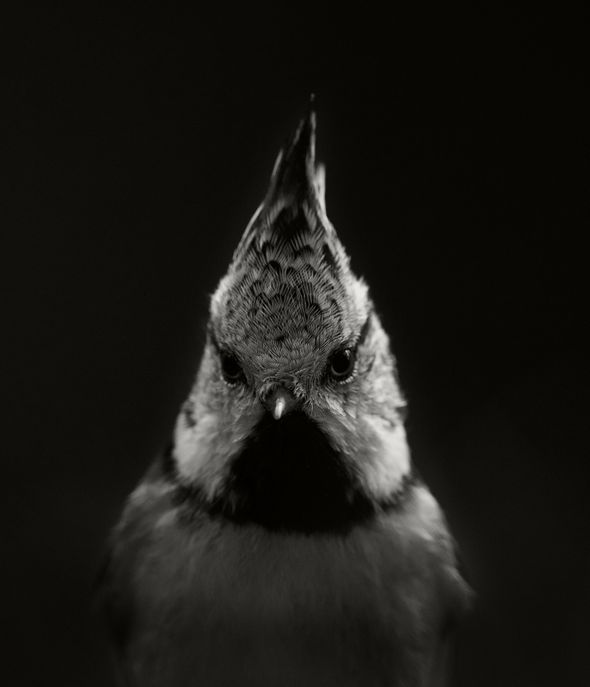
Soul-bird: crested tit. Photo: Heikki Willamo
The photographer and writer Heikki Willamo lived for a year in the forest – not full-time, but for long periods in all seasons, sleeping in his lean-to. This two-hundred, preserved hectare fragment lies in the midst of felled clearings, farmed forest and habitation in southern Finland.
Many Finns still say that being in a forest is a peaceful and empowering experience; Willamo recorded his thoughts on this as well as his black-and-white photographs in his book, Vuosi metsässä (‘A year in the forest’, Maahenki, 2012. See also extracts from Viimeiset vieraat [‘The last visitors’] here) More…
Snowbirds
2 November 2011 | Extracts, Non-fiction
The short winter days of the northerly latitudes are made brighter by snow cover, which almost doubles the amount of available light. Reflection from the snow is an aid for photographers working outdoors in winter conditions. A new book, entitled Linnut lumen valossa (‘Birds in the light of snow’), presents the best shots by four professionals, Arto Juvonen, Tomi Muukkonen, Jari Peltomäki and Markus Varesvuo, who specialise in patiently stalking the feathered survivors in the cold
The photographs and texts are from the book Linnut lumen valossa (‘Birds in the light of snow’, edited by Arno Rautavaara. Design and layout by Jukka Aalto/Armadillo Graphics. Tammi, 2011)
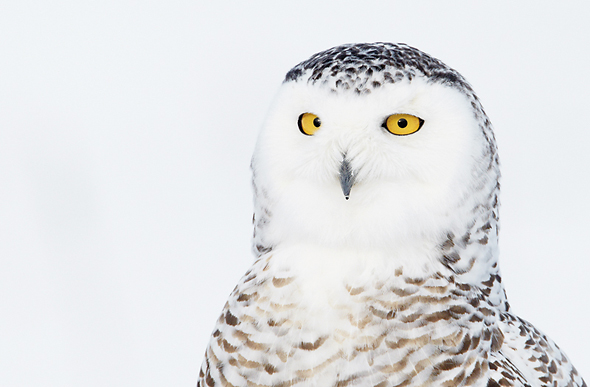
Snowy owl. Photo: Markus Varesvuo, 2010
Nature boy
15 September 2011 | In the news
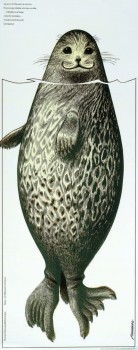
Seal signed: Saimaa ringed seal by Erik Bruun
The graphic artist Professor Erik Bruun has been awarded the Luonnotar / National Spirit of Nature Award for 2011.
The prize, established by the Puu kulttuurissa / Wood in Culture Association in 2001 and now worth € 12,000, is awarded bi-annually to Finnish professionals of any field of culture whose work has helped to make the public in Finland and abroad more aware of Finnish culture, heritage and environment.
Erik Bruun (born 1926) – who was the Art Editor of Books from Finland from 1976 to 1989 – is perhaps best known to the public for his numerous posters and advertisements, in particular his nature posters for the Finnish Association for Nature Conservation: the Saimaa ringed seal, the bear, eagles, owls, seagulls and other birds.
Bruun’s interest in nature photography, drawing, etching and lithography have long combined in his work for the Finnish wood processing industry as well as in his illustrative work for magazines and books and in designing postage stamps and banknotes.
A book on his life’s work, Sulka ja kynä. Erik Bruunin julisteita ja käyttögrafiikkaa (‘The quill and the pen. Posters and graphics by Erik Bruun’) by Ulla Aartomaa was published in 2007 (and reviewed in Books from Finland 3/2007). Take a look at his work on his home page.
Itämeren tulevaisuus [The future of the Baltic Sea]
17 February 2011 | Mini reviews, Reviews
 Itämeren tulevaisuus
[The future of the Baltic Sea]
Contributors: Saara Bäck, Markku Ollikainen, Erik Bonsdorff, Annukka Eriksson, Eeva-Liisa Hallanaro, Sakari Kuikka, Markku Viitasalo, Mari Walls
Helsinki: Gaudeamus, 2010. 350 p., ill.
ISBN 978-952-459-132-6
€ 39, paperback
This publication covers the key environmental issues affecting the Baltic Sea and provides new perspectives on those issues. The Baltic, with its relatively small, shallow dimensions and low salinity, is one of only a few seas in the world that is home to both freshwater and saltwater fish species and inland and marine birds. The Kvarken Archipelago in the Gulf of Bothnia was granted UNESCO World Heritage Site status in 2006. There are some 85 million people living within range of the environmentally sensitive, heavily trafficked Baltic Sea in nine countries around its coastline and its drainage basin. Serious environmental alarm bells began to ring in the 1960s with the realisation that the white-tailed eagle was on the brink of extinction. The socio-political history of the Baltic has had an effect on its protection, since the border between two competing economic systems – communism and capitalism – ran right through it. The articles in this book make it clear that science has identified ways to protect the Baltic Sea, but these research findings are not being put into practice in official decision-making.
Translated by Ruth Urbom