

Tag: children’s books
Once upon a time
27 February 2014 | Children's books, Fiction
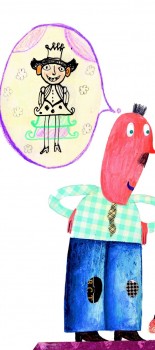 Stories from Kirahviäiti ja muita hölmöjä aikuisia (‘The giraffe mummy and other silly adults’, Teos, 2013), illustrated by Martina Matlovičová. Interview of Alexandra Salmela by Anna-Leena Ekroos
The monkey princess
Adalmiina’s life was not an easy one. Her parents decided to prepare her for her career as a princess when she was a little girl: when Adalmiina was three she was sent to ballet school, at four she started taking lute lessons and at five she went on a course in magic-mirror gazing.
When Adalmiina turned six, she received a giant suitcase full of princess clothes and shoes.
‘Put them on, darling, we want to see you in all your lovely beauty!’ her mother sparkled, waving a muslin veil.
‘I want to go to the jungle!’ Adalmiina demanded. ‘Without any clothes!’
‘Will we have to force you to dress in all your glory?’ her parents snapped.
‘You’ll have to catch me first!’ Adalmiina announced, running into the garden. More…
Reading matters? On new books for young readers
9 January 2014 | Articles, Children's books, Non-fiction
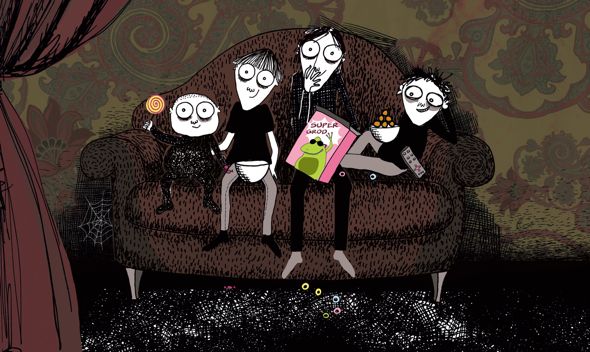
The Pixon brothers don’t read books, they love the telly: story by Malin Kivelä, illustrations by Linda Bondestam (Bröderna Pixon och TV:ns hemtrevliga sken, ‘The Pixon brothers and the homely shimmer of the telly’)
Finnish picture books for children have long been reliable export goods around the world. In the last few years, a number of novels for children have come along in their wake: works by authors such as Timo Parvela and Siri Kolu have been translated into a good many languages.
Now young adult literature has also blazed a trail on to the international market – in what also seems to be almost a matter of precision timing with regard to the Frankfurt Book Fair 2014. Finnish publishers have been investing in their home-grown lists of children’s and young adult books ever since the turn of the millennium, and now the time has come to harvest the fruits of their long-term efforts.
Malin Kivelä & Linda Bondestam: Bröderna Pixon och TV:ns hemtrevliga sken [The Pixon brothers and the homely shimmer of the telly]
9 January 2014 | Mini reviews, Reviews
 Bröderna Pixon och TV:ns hemtrevliga sken
[The Pixon brothers and the homely shimmer of the telly]
Helsingfors: Schildts & Söderströms, 2013. 38 pp.
Illustrerad av [Illustrated by] Linda Bondestam
ISBN 978-951-523-124-6
€22, hardback
Finnish translation:
Pixonin pojat ja TV:n kotoisa kajo
Suomentanut [translated by] Maarit Halmesarka
Helsinki: Teos, 2013. 38 pp.
ISBN 978-951-851-524-4
€27.90, hardback
The four Pixon brothers spend their time watching the telly and eating cereals and sweets. Their mother, in desperation, constantly demands that they go out and play, but they just don’t. The thin brothers’ teeth are bad as they have no vitamins in their blood: indeed they are as fit as 90-year-olds. One day the telly goes bust and the brothers end up in their neighbours’ home, where the two ladies cook them a good meal. They finally do go out and play – until the point of exhaustion: the story presents the reader with sinister turns à la Grimm brothers or Hoffmann, which the gloomy, dark pictures, suddenly devoid of colours, comically illustrate. But colours return to the pictures as well as to the brothers, who are now as fit as any 64-year old! This is the authors’ second book for children. Kivelä’s lesson takes the mickey out of didacticism but does not lose the point, so fun is had by all. Bondestam’s detailed, graphic pictures spice the story with amusing horror.
Kreetta Onkeli: Poika joka menetti muistinsa [The boy who lost his memory]
9 January 2014 | Mini reviews, Reviews
 Poika joka menetti muistinsa
[The boy who lost his memory]
Helsinki: Otava, 2013. 111 pp.
ISBN 978-951-1-27022-5
€22.90, hardback
Kreetta Onkeli, better known for her books for adults, was awarded the 2013 Finlandia Junior award for this book. Arto is a schoolboy who loses his memory, but goes off in search of himself with an open mind. He meets a number of people who are outsiders in various ways and learns important lessons from each of them. Onkeli portrays a child of around 11 to 13 who is confused by many things. Researchers consider this age group to fall into an in-between area: there aren’t enough appealing activities on offer for kids of this age, who are treated as an awkward bunch both at home and at school. This book contains some rule-breakers: the boys eat at a restaurant buffet without paying and ride the subway without a ticket while other characters hint at forging official documents. Adult readers with their eyes closed to reality might consider Arto’s odyssey an anxiety-inducing vision of the future, in which grown-ups are not shown in a flattering light. Children, however, will get wrapped up in this absurd adventure.
Translated by Ruth Urbom
Alexandra Salmela: Kirahviäiti ja muita hölmöjä aikuisia [The giraffe mummy and other silly adults]
9 January 2014 | Mini reviews, Reviews
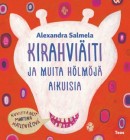 Kirahviäiti ja muita hölmöjä aikuisia
[The giraffe mummy and other silly adults]
Kuvitus [Ill. by]: Martina Matlovicová
Helsinki: Teos, 2013. 96 pp., ill.
ISBN 978-951-851-466-7
€27.90, hardback
The first children’s book by Alexandra Salmela, who has previously published a novel for adults, brings some sorely needed anarchy to Finnish storybooks. The 21 brief stories encourage children to add to them, whether by drawing, writing or out loud. Salmela’s tales are populated by trolls, dragons, knights and princesses, as well as ordinary children with silly parents. A boy called Ossi has two mums: Little Mum and Big Mum. One night, Little Mum collapses under the Tree of Exhaustion, but Ossi and his little sister hug their mum better. Allu’s absent-minded dad manages to mislay his head, and two perfect parents trade in their defective son Sulo at the child repair shop. The collage images by Slovakian illustrator Martina Matlovičová will work their way straight into your subconscious and start to bubble away.
Translated by Ruth Urbom
Jukka Laajarinne & Timo Mänttäri: Isä vaihtaa vapaalle [Dad takes time off]
9 January 2014 | Mini reviews, Reviews
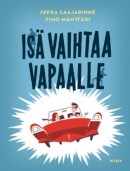 Isä vaihtaa vapaalle
[Dad takes time off]
Kuvitus [Ill. by]: Timo Mänttäri
Helsinki: WSOY, 2013. 31 pp., ill.
ISBN 978-951-0-39780-0
€26.90, hardback
Isä vaihtaa vapaalle is a picture book infused with wry humour which lends itself to both realistic and fanciful readings. In the story, a girl’s father is a secret agent. He’d like to reduce his working hours to spend more time with his daughter, but his employer has other ideas. This book provides an amusing reflection of its time: parents’ job titles often do not mean much to children, so their strange roles and the heavy briefcases parents lug home start to take on a life of their own in children’s minds. The story is free from clichés about gender roles and will entertain boys and girls alike. Timo Mänttäri, making his debut as a children’s book illustrator here, depicts fast-paced, dangerous situations and amusing details. The comic book-style narrative and large, double-page illustrations create suspense in this zippy story. The words and pictures are seamlessly integrated, and the not-overlong text is balanced by the exceptionally strong, expressive visuals.
Translated by Ruth Urbom
Riitta Jalonen & Kristiina Louhi: Aatos ja Sofian meri [Aatos and Sofia’s sea]
9 January 2014 | Mini reviews, Reviews
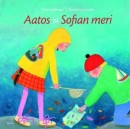 Aatos ja Sofian meri
[Aatos and Sofia’s sea]
Kuvitus [Ill. by]: Kristiina Louhi
Helsinki: Tammi, 2013. 36 pp., ill.
ISBN 978-951-31-7048-6
€21.90, hardback
The duo of Riitta Jalonen and Kristiina Louhi has come up with yet another well-rounded picture book trilogy. Aatos and Sofia are sensitive, independent preschoolers, each with a good imagination and the ability to savour fleeting moments. It is rare for children’s books to contain such a nuanced yet natural portrayal of companionship and devoted friendship between children. Sofia has her feet more firmly planted on the ground that Aatos, who is more prone to let his emotions run free. Sofia’s mum’s aerobics sessions are a fun contrast with the children’s slower-paced lifestyle, in which they hold on to individual moments. This book champions children’s free, creative play and their right to a long childhood. Kristiina Louhi’s illustration style is both traditional and extremely modern.
Translated by Ruth Urbom
Juba: Minerva. Alajuoksun kelluva pullukka [Minerva. The floating dumpling of the Lower Reaches]
9 January 2014 | Mini reviews, Reviews
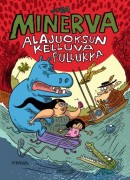 Minerva. Alajuoksun kelluva pullukka
[The floating dumpling of the Lower Reaches]
Helsinki: Otava, 2013. 48 pp., ill.
ISBN 978-951-1-25731-8
€17.80, hardback
Minerva is a cartoon character who has appeared in two previous volumes (2006, 2009) by Juba, a.k.a. Jussi Tuomola. Juba is the creator of an extremely popular comics series for adults about the woman and the pig (both male chauvinist and porcine), Viivi and Wagner. Minerva is a brave and extremely resourceful little heroine who is never daunted by even the wildest adventures she experiences after leaving home to fly around in weird lands. Petra, the floating dumpling of the Lower Reaches, is a woman with magical powers who likes to travel in a flying gondola. In this volume Minerva also meets other old friends on her journey under water, underground, on a river and in the air above a jungle, in pursuit of a rare ingredient for a perfume that Petra has determined to acquire no matter what. The comedy in the uninhibitedly fantastic adventures, illustrated effectively in cartoon squares of different sizes, will amuse readers of many ages.
Riina Katajavuori & Salla Savolainen: Pentti ja kitara [Pentti and the guitar]
9 January 2014 | Mini reviews, Reviews
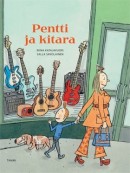 Pentti ja kitara
[Pentti and the guitar]
Kuvitus [Ill. by]: Salla Savolainen
Helsinki: Tammi, 2013. 32 pp., ill.
ISBN 978-951-31-6646-5
€22.90, hardback
Even early-years education is packed with activities these days. Pentti has a large extended family who really know how to have fun. He wants to learn how to play the guitar as well as his uncle Jaska. His mum tries to suggest an instrument she thinks would be more appropriate, but Pentti will not be put off. The Pentti picture book series is attractive for its nostalgic style; you can never be quite sure whether the era depicted is in the past or the present day. In this story, Riina Katajavuori focuses on what’s essential, yet still manages to convey the basics of playing the guitar – including dissonance and Jimi Hendrix. Salla Savolainen’s illustrations effectively capture the excitement of a child’s new hobby.
Translated by Ruth Urbom
Katri Tapola & Karoliina Pertamo: Toivon talvi [Toivo’s winter]
9 January 2014 | Mini reviews, Reviews
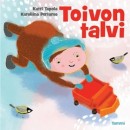 Toivon talvi
[Toivo’s winter]
Kuvitus [Ill. by]: Karoliina Pertamo
Helsinki: Tammi, 2013. 23 pp., ill.
ISBN 978-951-31-7047-9
€14.90, hardback
Most Finnish board books have been following the contemporary trend for strong colour palettes with pared-down character designs. Toivon talvi is a refreshing exception to the rule, dealing with everyday things children experience in their lives. One-year-old Toivo loves being outdoors. What’s most fun is when his mum comes out and plays with him. The first snowfall of the year causes him some confusion, but gradually Toivo learns to get the best out of the joys of winter. Katri Tapola’s story, with its child-friendly pacing which genuinely empathises with little ones’ fickle emotions, focuses on the boy’s everyday routines, thus conveying a sense of security. Karoliina Pertamo’s characters are simple sketches yet expressive enough to suit small children.
Translated by Ruth Urbom
Ville Hytönen & Matti Pikkujämsä: Hipinäaasi, apinahiisi [Donkeymonkey]
9 January 2014 | Mini reviews, Reviews
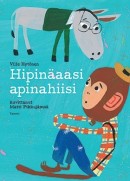 Hipinäaasi, apinahiisi
[Donkeymonkey]
Kuvitus [Ill. by]: Matti Pikkujämsä
Helsinki: Tammi, 2013. 32 pp., ill.
ISBN 978-951-31-7043-1
€24.90, hardback
In Ville Hytönen’s gently educational tale, some woodland creatures poke fun at a wheezy donkey and an oddball monkey. In the end, the animals who were the target of derision turn their unusual characteristics into strengths. Then they all make up, all the residents of the forest launch into an exuberant dance, and the earlier teasing is forgotten. Matti Pikkujämsä has been an extraordinarily productive in recent years: his illustrations have appeared in numerous newspapers and magazines as well as children’s books. Hipinäaasi, apinahiisi, which is his first solo picture book, features rhythm and movement; sometimes he creates extremely elaborate ornamentation, while other images calm the eye with spare yet colourful scraffito techniques.
Translated by Ruth Urbom
The books that sold in December
9 January 2014 | In the news
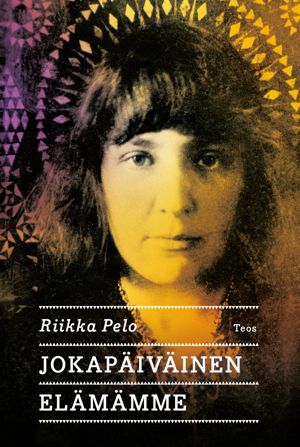 It seems that the Finlandia Prize does, as intended, have a strong influence in book sales. In December, a novel about the Russian poet Marina Tsvetaeva by Riikka Pelo, Jokapäiväinen elämämme (’Our everyday life’), which won the fiction prize in December, reached number one on the list of best-selling Finnish fiction.
The next four books on the list – compiled by the Finnish Booksellers’ Association – were the latest thriller by Ilkka Remes, Omertan liitto (‘The Omerta union’), a novel Me, keisarinna (‘We, the tsarina’), about the Russian empress Catherine the Great by Laila Hirvisaari, a novel, Hägring 38 (‘Mirage 38’), by Kjell Westö, and a novel, Kunkku (‘The king’), by Tuomas Kyrö.
The winner of the Finlandia Prize for Non-Fiction, Murtuneet mielet (‘Broken minds’), about the mentally crippled Finnish soldiers in the Second World War, also did well: it was number two on the non-fiction list. (Number one was a book about a Finnish actor and television presenter, Ville Haapasalo, who trained at the theatre academy in St Petersburg and became a film star in Russia.)
The ten best-selling books for children and young people were all Finnish (and written in Finnish): it seems that this time the buyers of Christmas presents favoured books written by Finnish authors.
Future, fantasy and everyday life: books for young readers
24 January 2013 | Articles, Children's books, Non-fiction
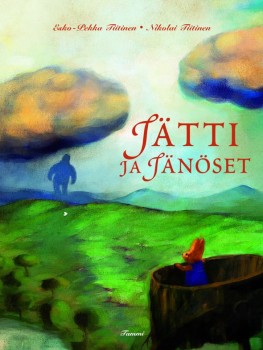
A giant meets the bunnies: a new story by Esko-Pekka Tiitinen, illustrated by Nikolai Tiitinen
Fantasy novels and dystopias feature in the new Finnish fiction for young readers; popular children’s books are recycled – stories and illustrations are adapted to new media and for new age groups. Päivi Heikkilä-Halttunen takes a look at new books for young readers published in 2012
All new mothers in Finland receive a ‘maternity package’ from the state containing items for the baby (including bedding, clothing and various childcare products) intended to give each baby a good start in life. This tradition, which started in 1938, is believed to be the only such programme in the world.
Each package also contains the baby’s first book, traditionally a sturdy board book by a Finnish author. The past few years have seen more original board books published in Finland than ever before: they are doing well in competition alongside books translated from other languages. Board books for babies have become a focus for Finnish illustrators and graphic artists. These books, with their simple visual language, have taken on a retro look.
History was made with the Finlandia Junior award, when for the first time the prestigious prize was given to a picture book originally written in Finland-Swedish: Det vindunderliga ägget (‘A most extraordinary egg’, Schildts & Söderströms) by Christel Rönns. The award can also be seen as an acknowledgement of the brave, experimental Finland-Swedish children’s picture books that are being published these days. Finnish-language picture books, on the other hand, are still crying out for more figures to shake up traditional practices. More…
Mila Teräs & Karoliina Pertamo: Elli ja tuttisuu [Elli and the dummy]
24 January 2013 | Mini reviews, Reviews
 Elli ja tuttisuu
[Elli and the dummy]
Kuvitus [Ill. by]: Karoliina Pertamo
Helsinki: Otava, 2012. 31 pp.
ISBN 978-951-1-26045-5
€16.90, hardback
The new Elli series of picture books continues the tradition in Finnish children’s literature of giving an idyllic portrayal of the natural world: even a small child and her parents have time to marvel at nature together. In reality, more and more children are becoming estranged from their natural surroundings. Elli is an energetic little two-year-old whose mother encourages her to give away her beloved dummy (pacifier) to a young squirrel in the garden. This book tells a typical story about everyday life that will reinforce children’s self-esteem and sense of identity, but fortunately Elli is also allowed to be a little girl who needs looking after by her parents. Our performance-obsessed society expects nearly superhuman effort and skills even from children, so it is important that kids are allowed to be kids – in children’s literature, at least. Karoliina Pertamo’s illustrations glow with warm, invigorating colours. Pertamo (b. 1971) has quickly established a highly individual illustration style for herself.
Translated by Ruth Urbom
Esko-Pekka Tiitinen & Nikolai Tiitinen: Jätti ja jänöset [The giant and the bunnies]
24 January 2013 | Mini reviews, Reviews
 Jätti ja jänöset
[The giant and the bunnies]
Kuvitus [Ill. by]: Nikolai Tiitinen.
Helsinki: Tammi, 2012. 25 pp., ill.
ISBN 978-951-31-6573-4
€19.90, hardback
This powerful allegory set in the animal kingdom is a tale of global inequality – with a lovely, take-it-easy, imaginative approach that emphasises tolerance and respect for nature. The rabbit community is shaken up when an arrogant giant barges into their territory. At first, the rabbits try to take an understanding view of the interloper, but he ends up in grave danger as a result of his own actions. Only the actions of the kind-hearted rabbits can save him. The calm tone and engaging pace of Esko-Pekka Tiitinen’s story make it ideal for reading out loud. It has the timeless enchantment of traditional animal fairy tales. The mixed-media illustrations by Esko-Pekka Tiitinen’s son Nikolai radiate warmth and a sense of togetherness, but also power, hatred and estrangement where necessary. The seamlessly integrated text and illustrations create an enjoyable reading and visual experience for children and adults in much the same vein as Herra Kuningas (‘Mister King’, Otava, 1986) by Raija Siekkinen and Hannu Taina, which has already joined the ranks of classic Finnish children’s titles.’
Translated by Ruth Urbom