

Author: Bo Carpelan
Solid, intangible
26 September 2013 | Fiction, poetry
Poems from Mot natten. Dikter 2010 (‘Towards the night. Poems 2010’, Schildts & Söderströms, 2013). Introduction by Michel Ekman
Memory
If you give me time
I don’t weigh it in my hand:
it’s so light, so transparent
and heavy as the thick
shining darkness
in the backyard gateway
to memory
Autumn’s child
17 November 2011 | Fiction, Prose
Extracts from Bo Carpelan’s novel Blad ur höstens arkiv. Tomas Skarfelts anteckningar (‘Leaves from autumn’s archive. The notes of Tomas Skarfelt’). Introduction by Clas Zilliacus
When I took my first walk here in Udda, along the road down to the end of the bay, my legs wanted to go left up to the forest, while I strove to walk straight ahead. It was an unsteadiness reminiscent of being slightly drunk. A slight vertigo I have already noticed before. Trees soughed through me and the water of the bay tasted almost like salt on my lips. All sorts of things try to pass straight through me nowadays. I am becoming a general store. The few people I know go there and choose, and I try to sell. Most of it is old memories with attendant dust. They are in no chronological order at all, and make involuntary, rapid leaps, like kangaroos. Even when I went to school they hopped around. They forced me to learn my lessons by heart. They continued to skip over me at university and added an extra complexity to my studies in general history: concentrate of reign lengths.
And if I followed my legs and gave not a damn about my dead straight road? Digressions from what was planned provided me later on with my best experiences, and coincidences were grains of gold. Improvisations were lucky throws, or disasters. Afterwards came the restrictions, the constructions, the architecture. Now only that squared-paper notebook remains with its pitfalls. The uncertainty is sometimes imperceptible, but is there: Am I not superfluous? Are not my legs somewhat irrational? More…
Scent of greenness
21 April 2011 | Fiction, poetry
‘Time the unstoppable’ features in the last collection of poems, Gramina, by Bo Carpelan (1926–2011), who reads timeless poetry while writing his own verses. In his introduction, Michel Ekman quotes the American poet and philosopher Ralph Waldo Emerson, who thought books should stimulate the reader’s thoughts instead of merely being devoured
Poems from the collection Gramina. Marginalia till Horatius, Vergilius och Dante (‘Gramina. Marginalia to Horace, Virgil and Dante’, Schildts, 2011)
Surf on the net –
in the net you are
with mouse and waiting spider

Fills life’s piggy bank
until it is emptied
The paved road of envy
where you stumble
Be sufficient unto oneself?
And who is this ‘self’
who doesn’t introduce himself? More…
A smell of the sea
Issue 1/2000 | Archives online, Fiction, poetry
Poems from Namnet på tavlan Klee målade (The name of the picture Klee painted’, Schildts,1999; Kleen taulun nimi, Otava, 1999; Finnish translation by Jaakko Anhava). Introduction by Hannu Väisänen
Old harmony
You see an old street and stop outside a gate to a shadowy inner courtyard. An oak tree grows there, its crown stretches towards the light. How big it is! On a bench underneath it an old couple sit looking at you. They are trying to discover what you once were. Beside them lies an old lute, like a large, gleaming fruit. You go over to it, pick it up, play a chord. The old woman and the old man look at you without surprise. It has all happened once before, after all. Not much more is needed, only a deep silence. The oak tree murmurs, the old couple have gone, you sit there with your wife and see someone entering the courtyard. Do we know him, you say. But scarcely have you finished your question than the courtyard is empty again, a moment in eternity. More…
Fruits of reading
30 December 1998 | Authors, Interviews

Photo: Promedia
This is an edited version of an interview published in Leva skrivande. Finlandssvenska författare samtalar (‘Living by writing. Finland-Swedish writers in conversation’), edited by Monika Fagerholm (Söderströms, 1998)
Bo Carpelan is one of the most translated of Finnish writers; his novel Axel (1986) attracted international attention when it was published in English translation. Here, in our occasional series of interviews with writers, he is in conversation with fellow poet Mårten Westö
Mårten Westö: The American writer Paul Auster has said: ‘A young person who wants to be an artist or a writer is above all influenced by art. But a young writer has nothing to say. One has a love of literature, but one can only imitate other writers to begin with. It takes a long time before one finds one’s own way.’ What do you think of that statement?
Bo Carpelan: Of course there’s a lot in what he says. At the same time I am convinced that one must have at least the shadow of one’s own voice from the very outset, otherwise what one writes turns out to be merely plagiarism. But to start with one does probably tend to work in close association with tradition. That was also true of me, but in my own view I didn’t continue – as has often been asserted – in the wake of Finland-Swedish modernism. It is of course quite possible that later on I returned to it, but the basis of my activity was probably the American New Criticism: the large anthologies on criticism and poetry that I read in the 1950s. Those influences have left their clearest traces in the very comprehensive bibliography of my academic work on the Finland-Swedish poet Gunnar Björling. In the last chapter of the dissertation I also tried to draw my own guidelines as to what I mean by poetry: that it is concrete and synthetic. More…
Stars above
30 December 1998 | Fiction, Prose
Extracts from the novel Benjamins bok (‘Benjamin’s book’, Schildts, 1997)
There are people who feel they are in contact with the stars. Among those who carry their secret knowledge around with them are both the healthy and the ‘sick’. Now I remember Olli stretching his arm out towards the evening star and seeming to greet it. For others, for me, the starry heavens are a form of distant vertigo. All those milky ways and galaxies, how could they not be inhabited, have developed a culture far older than our own. Perhaps they have watched the development of our planet with distaste, and are waiting for its ruin, which according to their calculation of time will take place in a few years or days from now. If I listen closely I seem to be faintly approached by a celestial choir, composed of indistinct sounds; if I stand on a lonely road in the country, and look up at the sky, the light and faint murmur from a nearby town emerge, and can be separated from the faint voices of the starry heavens. It is probably just my imagination. Perhaps it is an extension of that voice – anonymous, quiet – that I hear when I read a book. A good book is audio-visual. And no harm is done if it gives the reader a mild sense of vertigo. More…
Poems
30 December 1998 | Fiction, poetry
From Gården (‘The courtyard’, 1969)
The brown tablecloth hung over the edge.
I sat below there unseen in the odour of cabbage and warmth.
The sky hung on rusty hooks, the women of the courtyard shrank.
They were the only flowers the summer had.
They carried pails to the back yard where there was no sun.
Father read the newspaper, in the middle drawer of the writing table were
bills, promissory notes, pawn tickets, the rent book, everything in order. More…
Between shadow and sunlight
Issue 4/1996 | Archives online, Fiction, poetry
Poems from Homecoming (translated by David McDuff, published by Carcanet Press, 1993)
It was hopeless trying to keep the window on the yard side clean
Perhaps it was an advantage not to see clearly,
roofs and chimneys, indeed, even the sky became friendly
seen from this renunciation. When it rained
the water formed streets of narrow drops, almost silver-coloured.
I considered them closely.
What use I should have for them I did not know.
*
Presence and absence
Issue 4/1993 | Archives online, Fiction, Prose
Extracts from the novel Urwind (Schildts, 1993). Introduction by David McDuff
Snow letter
I have written you a snow letter. The day was clear, with clouds like drifting mist, woolly and small. In January the wind’s paintbrush is allusive and creates distance. But the darkness rises from the forests around the city; a pregnant bank of cloud, blue violet, is suddenly there, and it gets dark in the middle of the day. Then it reaches my room, too, and the silence thickens. The first snow falls, gleams like dust and down in the light from the setting sun. Then the snowstorm is there, whirls through gateways and along streets, stops, rises, turns, rushes onwards again under the courtyard’s swaying lamps. How long did I sit there, on the staircase, after Mrs Rosendal slammed her door shut, watching the darkness rising, stair by stair? Each year is a snowflake that blows around between now and the past. A door crashes shut, a door crashes open, out flies a grey soldier’s uniform and is followed, mumbling and swaying, by a man in long johns while a woman screams: ‘Swine!’ And again the staircase booms with the sound of a door being slammed shut. People stride through one another and leave traces of blood. More…
The life of a lonely friend
Issue 3/1986 | Archives online, Fiction, Prose
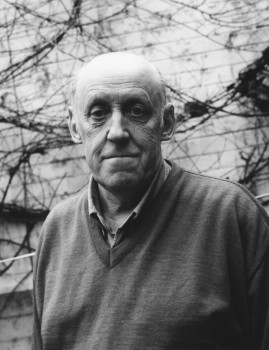
Bo Carpelan. Photo: Charlotta Boucht
Extracts from Bo Carpelan‘s novel Axel, ‘a fictional memoir’ (1986). In his preface to the novel Bo explains how he ‘found’ Axel.
Preface
In the 1930s I came across the name of Axel Carpelan (1858-1919), my paternal grandfather’s brother, in Karl Ekman’s Jean Sibelius and His Work (1935). In the bibliography, the author briefly mentions quotes from letters in the book addressed to Axel Carpelan, ‘who belonged to the Master’s most intimate circle of friends, and in musical matters was his constant confidant. Sibelius commemorated their friendship by dedicating his second symphony to him’. I had never heard Axel’s name mentioned in my own family.
Many years after Karl Ekman, the original incentive for the novel about Axel arose through Erik Tawaststjerna’s biography of Sibelius, in which Axel is portrayed in the second volume (1967) of the Finnish edition, and whose life came to an end in Part IV (1978). From early 1970s onwards, I started notes for Axel’s fictional diary from to 1919. It is not known whether Axel himself ever kept a diary. I relied as muchas possible on all the available facts. These increased when I was given access to letters exchanged between Axel and Janne from the year 1900 onwards. It became the story of the hidden strength a very lonely and sick man, and of a friendship in which the give and take both sides was far greater than Axel himself could ever have imagined.
Hagalund, June 1st, 1985
Bo Carpelan
1878, Axel’s diary
15.1.
On my twentieth birthday, I remember the young Wolfgang; ‘Little Wolfgang has no time to write because he has nothing to do. He wanders up and down the room like a dog troubled by flies’. However, that dog achieved a paradise. I have learnt yet one more piece of wisdom: ‘It is my habit to treat people as I find them; that is the most rewarding in the long run’. More…
The universal eye
Issue 2/1985 | Archives online, Authors
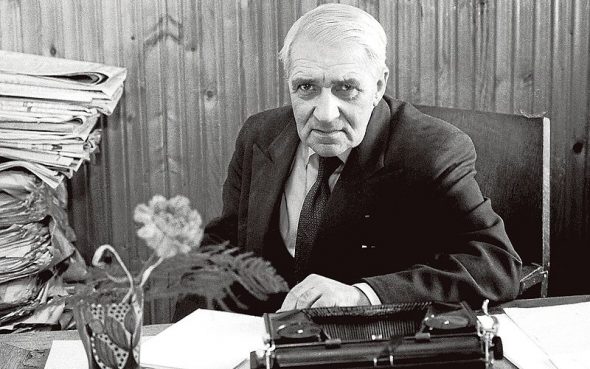
Gunnar Björling. Photo: Holger Eklund
Gunnar Björling (1887-1960) began his poetic career at the age of 35 with the collection of verse Vilande dag (‘Resting day’, 1922), which revealed the influence of romantic idealism and clearly showed its author’s preoccupation with ethical and philosophical problems of existence. Names such as those of Pascal and Spinoza, Guyau and Tagore, Dostoyevsky and Strindberg occur throughout this collection, the basis of which was formed by Björling’s study of the work of the great Finland-Swedish moral philosopher Edvard Westermarck, from whom the poet derived his concept of relativity and his philosophy of the unbounded. The dammed-up energy that can be sensed in this first volume breaks out with full force in Krosset och löftet (‘The cross and the promise’, 1925): with this, the phase of idealistic expectation comes to an end and Björling the expressionist emerges, giving utterance to ‘unbounded life’, in all its clarity and confusion, yet still within the same framework of ‘growing boundedness’: ‘We live in the concrete, and this gives our abstractions fateful wings.’ More…
The Storm • September
Issue 3/1982 | Archives online, Fiction, Prose
Bo Carpelan. Photo: Charlotta Boucht
Extracts from Jag minns att jag drömde (‘I remember dreaming’, 1979)
The Storm
I remember dreaming about the great storm which one October evening over forty years ago shook our old schoolhouse by the park. My dream is filled with racing clouds and plaintive cries, of roaring echoes and strange meetings, a witch’s brew still bubbling and hissing in the memory of those great yellow clouds.
Our maths teacher – a small sinewy woman who seemed to have swallowed a question mark and was always wondering where the dot had gone, so she directed us in a low voice and with downcast eyes as if we didn’t exist – and yet her little black eyes saw everything that happened in the class, and weasel-like, were there if anyone disobeyed her – was writing the seven times table on the blackboard, when a peculiar light filled our classroom. We looked across at the window; the whole schoolhouse seemed to have been suddenly transformed into a railway station, shaking and trembling, a whistling sound penetrating the cold thick stone walls, and at raging speed, streaky clouds of smoke were sliding past the window, hurtling our classroom forward as if we were in an aeroplane. Our teacher stopped writing and raised her narrow dark head. Without a word, she went over to the window and stood looking out at the racing clouds. More…
Poems
Issue 3/1977 | Archives online, Fiction, poetry
Poems from I de mörka rummen, i de ljusa (‘In the dark rooms, in the bright ones’, 1976). Introduction by Kai Laitinen
1
He covers his grey floor with glowing carpets.
He has bought them cheap. No one sees they are fakes
except The Great Specialist – but he never comes.
He covers the windows with curtains like waves of silk
and wraps himself up in his food with a blind look of hunger.
Those who follow him – the wife, the children – have to run.
He goes quickly through the dark as though it were hounding him.
He is right: it is hounding him, it catches up with him
when he wakes defenceless in the night. He is abandoned:
all the time there is a noise in the rooms, a burglary,
he is afraid and does not move but in the dark holds
his hand to his eyes, it is cold and strange.
Each day he goes to his life and comes from it.
He is like a wagon. A wagon has its uses.
It trundles heavily past sidestreets and down to the harbour.
He stops: it is light over the sea, a light
hidden by clouds. As though he had seen it once, before.
What he sees is nothing, stretching far away.
There are waves, but they are all standing still. More…