

Tag: short story
New from the archives
11 May 2015 | This 'n' that
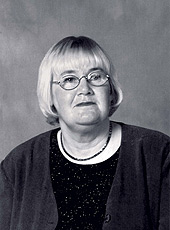
Sinikka Tirkkonen. Photo: Otava.
Short short prose from Sinikka Tirkkonen
This week, a short story by Sinikka Tirkkonen (born 1954), which we published in 1988 – a piece of confessional prose, ‘comfortless and depressed’, as Tero Liukkonen’s introduction has it, about life in a bleakly solipsistic world; the kind of writing, one’s inclined to say with hindsight, that only the young, or at least the not very old, have the leisure to produce.
‘Things are only right for me,’ says the unnamed narrator, ‘when they bring grief and distress in their train, when they pile up guilt feelings, harsh self-criticism and self-denial… All my life I’ll be deprived of something, always – full of cares, fears, terrible agonies. I’ve no right to live.’ There’s a train journey north, two women in a car on a long drive across Lapland, work, a husband’s unfaithfulness, pointlessness….
It’s beautifully done, though, with an appealing poetic minimalism. Enjoy!

The Books from Finland digitisation project continues, with a total of 388 articles and book extracts made available on our website so far. Each week, we bring a newly digitised text to your attention.
New from the archives
5 May 2015 | This 'n' that
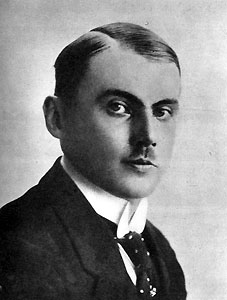
Runar Schildt
It’s a period that seems sometimes to have disappeared from view – Helsinki in the final years of Russian rule – but Runar Schildt’s short story brings it vividly to life. The characters – Sahlberg the baker and his mortal enemy, Johansson from the customs service; the restaurant-owner Durdin and Elsa, daughter of a commissionaire at the Senate, around whom the story revolves – spend a lazy but sexually charged summer Sunday in their villas just outside Helsinki, their hidden emotions all too familiar to those of a later age…
As the story’s translator, the formidably erudite George C. Schoolfield, remarks in his introduction, Runar Schildt (1888-1925) has often been hailed as a Finland-Swedish classic. There’s a quality of aesthetic decadence in his work that makes him very much a product of his time. There’s nothing, in Raketen, with its solid, belle epoque atmosphere, to foreshadow the change that was so soon to engulf Finland, with the granting of independence in 1917 and the bitter civil war that followed. Schildt was in Helsinki during the months when it was ruled by the Red side in the civil war; afterwards, he served as a clerk in the terrible detention camp for Red prisoners of war on Suomenlinna island. It was a new world, in which all the old certainties were questioned. Timid, conservative and something of a dandy (his friend Hans Ruin said he always looked as if he had stepped out of a bandbox), Schildt may well have felt out of tune with the times. By 1920 he had ceased to write the prose at which he excelled, and had turned to drama, with which he had much less success.
Schildt shot himself, in 1925, in the courtyard of the old university clinic in Helsinki. He was not yet 40.
New from the archive
26 March 2015 | This 'n' that
This week’s pick is a comic short story by Martti Joenpolvi about the gender divide
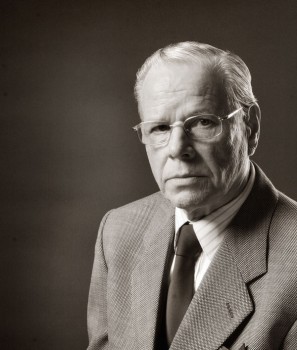
Martti Joenpolvi.
Photo: Janne Aaltonen.
We first published this short story by Martti Joenpolvi, an acknowledged master of the genre, in 1989; it comes from the collection Pronssikausi (‘The bronze age’, 1988), which was nominated for the Finlandia Prize.
The subject – the story is about a man taking his mistress on a secret visit to his summer-house – provides plenty of opportunity for sly humour. But it’s a more unsettling read in 2015 than we’re guessing it was twenty-five years ago – not so much for the plot itself, which makes ironic fun of the idea of woman-as-chattel, as for the characterisation, which subtly places the woman exactly where the story does.
Enjoy!
*
The digitisation of Books from Finland continues, with a total of 375 articles and book extracts made available online so far. Each week, we bring a newly digitised text to your attention.
A walk on the West Side
16 March 2015 | Fiction, Prose
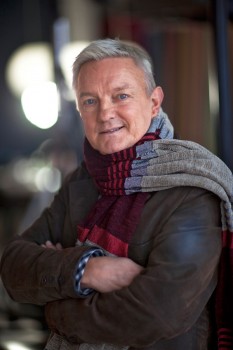
Hannu Väisänen. Photo: Jouni Harala
Just because you’re a Finnish author, you don’t have to write about Finland – do you?
Here’s a deliciously closely observed short story set in New York: Hannu Väisänen’s Eli Zebbahin voikeksit (‘Eli Zebbah’s shortbread biscuits’) from his new collection, Piisamiturkki (‘The musquash coat’, Otava, 2015).
Best known as a painter, Väisänen (born 1951) has also won large readerships and critical recognition for his series of autobiographical novels Vanikan palat (‘The pieces of crispbread’, 2004, Toiset kengät (‘The other shoes’, 2007, winner of that year’s Finlandia Prize) and Kuperat ja koverat (‘Convex and concave’, 2010). Here he launches into pure fiction with a tale that wouldn’t be out of place in Italo Calvino’s 1973 classic The Castle of Crossed Destinies…
Eli Zebbah’s shortbread biscuits
Eli Zebbah’s small but well-stocked grocery store is located on Amsterdam Avenue in New York, between two enormous florist’s shops. The shop is only a block and a half from the apartment that I had rented for the summer to write there.
The store is literally the breadth of its front door and it is not particularly easy to make out between the two-storey flower stands. The shop space is narrow but long, or maybe I should say deep. It recalls a tunnel or gullet whose walls are lined from floor to ceiling. In addition, hanging from the ceiling using a system of winches, is everything that hasn’t yet found a space on the shelves. In the shop movement is equally possible in a vertical and a horizontal direction. Rails run along both walls, two of them in fact, carrying ladders attached with rings up which the shop assistant scurries with astonishing agility, up and down. Before I have time to mention which particular kind of pasta I wanted, he climbs up, stuffs three packets in to his apron pocket, presents me with them and asks: ‘Will you take the eight-minute or the ten-minute penne?’ I never hear the brusque ‘we’re out of them’ response I’m used to at home. If I’m feeling nostalgic for home food, for example Balkan sausage, it is found for me, always of course under a couple of boxes. You can challenge the shop assistant with something you think is impossible, but I have never heard of anyone being successful. If I don’t fancy Ukrainian pickled cucumbers, I’m bound to find the Belorussian ones I prefer. More…
Elina Brotherus & Riikka Ala-harja
The passing of time
2 March 2015 | Extracts, Fiction, Prose
In 1999 the Musée Nicéphore Niépce invited the young Finnish photographer Elina Brotherus to Chalon-sur-Saône in Burgundy, France, as a visiting artist.
After initially qualifying as an analytical chemist, Brotherus was then at the beginning of her career as a photographer. Everything lay before her, and she charted her French experience in a series of characteristically melancholy, subjective images.
Twelve years on, she revisited the same places, photographing them, and herself, again. The images in the resulting book, 12 ans après / 12 vuotta myöhemmin / 12 years later (Sémiosquare, 2015) are accompanied by a short story by the writer Riikka Ala-Harja, who moved to France a little later than Brotherus.
In the event, neither woman’s life took root in France. The book represents a personal coming-to-terms with the evaporation of youthful dreams, a mourning for lost time and broken relationships, a level and unselfpitying gaze at the passage of time: ‘Life has not been what I hoped for. Soon it will be time to accept it and mourn for the dreams that will never come true. Mourn for the lost time, my young self, who no longer exists.’
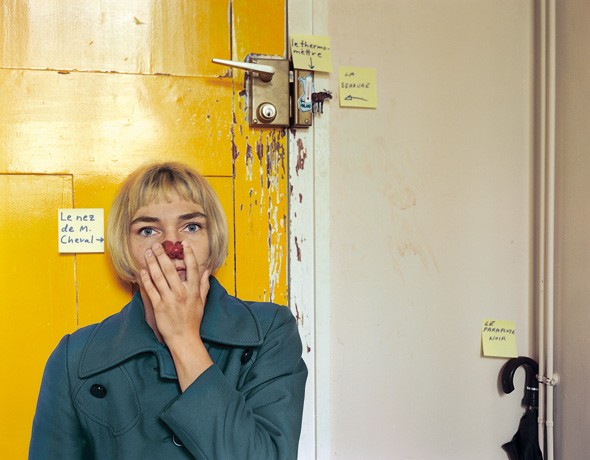
1999 Mr Cheval’s nose
New from the archives
19 February 2015 | This 'n' that
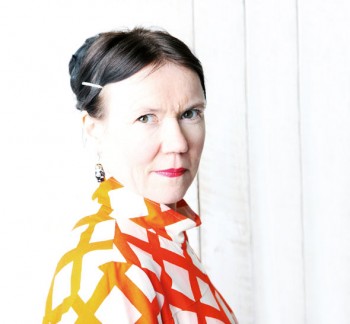
Rosa Liksom. Kuva: Pekka Mustonen
When the pseudonymous Rosa Liksom (born 1958; real name Anni Ylävaara) burst on the Finnish literary scene in 1985 with her first book, Yhden yön pysäkki (‘One night stand’), excitement was intense. For a start, she managed to keep her real identity secret, even when she appeared at public events and book-signings; then, she wrote generally in her native northern Finnish dialect, which hadn’t previously been heard very much in literary circles. Her very short short prose charted landscapes also not much represented in literature – the far north, the uneducated, the dispossessed.
This group of seven stories, from her second book, Tyhjän tien paratiisit (‘Paradises of the open road’, 1989), cover territory which has become familiar in her work: a woman who marries a layabout, a bellicose butcher’s son, a cleanliness fanatic for whom hygiene is more important than human relationships….
Rosa Liksom won the Finlandia Prize in 2011 for Hytti nro 6, which was published by Serpent’s Tail, London, in a translation by Lola Rogers last year.
*
The digitisation of Books from Finland continues apace, with a total of 360 articles and book extracts made available online so far. Each week, we bring a newly digitised text to your attention.
Archives open!
12 December 2014 | This 'n' that
Illustration: Hannu Konttinen
For 41 years, from 1967 to 2008, Books from Finland was a printed journal. In 1976, after a decade of existence as not much more than a pamphlet, it began to expand: with more editorial staff and more pages, hundreds of Finnish books and authors were featured in the following decades.
Those texts remain archive treasures.
In 1998 Books from Finland went online, partially: we set up a website of our own, offering a few samples of text from each printed issue. In January 2009 Books from Finland became an online journal in its entirety, now accessible to everyone.
We then decided that we would digitise material from the printed volumes of 1976 to 2008: samples of fiction and related interviews, reviews, and articles should become part of the new website.
The process took a couple of years – thank you, diligent Finnish Literature Exchange (FILI) interns (and Johanna Sillanpää) : Claire Saint-Germain, Bruna di Pastena, Merethe Kristiansen, Franziska Fiebig, Saara Wille and Claire Dickenson! – and now it’s time to start publishing the results. We’re going to do so volume by volume, going backwards.
The first to go online was the fiction published in 2008: among the authors are the poets Tomi Kontio and Rakel Liehu and prose writers Helvi Hämäläinen (1907–1998), Sirpa Kähkönen, Maritta Lintunen, Arne Nevanlinna, Hagar Olsson (1893–1979), Juhani Peltonen (1941–1998) and Mika Waltari (1908–1979).
To introduce these new texts, we will feature a box on our website, entitled New from the archives, where links will take you to the new material. The digitised texts work in the same way as the rest of the posts, using the website’s search engine (although for technical reasons we have been unable to include all the original pictures).
By the time we reach the year 1976, there will be texts by more than 400 fiction authors on our website. We are proud and delighted that the printed treasures of past decades – the best of the Finnish literature published over the period – will be available to all readers of Books from Finland.
The small world of Finnish fiction will be even more accessible to the great English-speaking universe. Read on!
Profiles
2 October 2014 | Fiction, Prose
Rosa Liksom’s first book, in 1985, was a collection of short prose; she has also written novels, children’s books, plays, comic and picture books. Her new book, Väliaikainen (‘Temporary’, Like, 2014) – a return to her signature very short prose – features beasts, machines and men
He’s there in the living room. We’ve gotta be very quiet. I left the computer on, and the reading lamp. I’ll go in and turn them off, quietly. Or the computer at least. I can watch Emmerdale on the little tv in the kitchen. You wait here. OK, I turned off the computer but I left the lamp on so I wouldn’t wake him up. I put his nap blanket over him. He’s laying on his left side now. That’s good. Whenever he wakes up on his right side he gets awfully grumpy. Let’s go in the kitchen so we don’t disturb him. The poor guy. It’s been hours since he’s had a good sleep. You know, I think it’s the depression again. It started on Monday when he was supposed to go to his guide’s job.He didn’t taste his breakfast, even though I brought it to him in bed. I had to go to the hospital, my shift was starting, and he just laid there in the bedroom with his eyes open… I don’t know how long it’s gonna last this time. Last month he was depressed for three days. I think it’ll pass more quickly this time because he’s napping a little bit, and licking his paw now and again.
The nursemaid
Lapsenpiika (‘The nursemaid’), a short story, first published in the newspaper Keski-Suomi in December, 1887. Minna Canth and a new biography introduced by Mervi Kantokorpi
‘Emmi, hey, get up, don’t you hear the bell, the lady wants you! Emmi! Bless the girl, will nothing wake her? Emmi, Emmi!’
At last, Silja got her to show some signs of life. Emmi sat up, mumbled something, and rubbed her eyes. She still felt dreadfully sleepy.
‘What time is it?’
‘Getting on for five.’
Five? She had had three hours in bed. It had been half-past one before she finished the washing-up: there had been visitors that evening, as usual, and for two nights before that she had had to stay up because of the child; the lady had gone off to a wedding, and baby Lilli had refused to content herself with her sugar-dummy. Was it any wonder that Emmi wanted to sleep? More…
The last Christmas tree
19 December 2013 | Fiction, Prose
A short story from Reikä (‘The hole’, Like, 2013)
A four-litre saucepan should last the whole holiday, Honkkila calculates, throwing a bay leaf into the borscht.
Borscht is excellent at Christmas, as it blends the traditional Finnish dishes – beetroot salad, baked roots, ham.
At the same time Honkkila remembers the tree. He’s always had a tree, for forty years. When he was a child his dad brought it in from the back forest. Since then Honkkila has fetched his tree from various places, from the market and last Christmas from the shopping centre parking lot, but for this Christmas he has no tree.
Honkkila looks at the clock. The shopping centre is open for another hour. Honkkila takes the soup off the hob and goes out.
The shopping centre loudspeakers are beeping out electronic Christmas tunes; there are patches of spruce needles on the empty parking lot.
‘Is there anything left?’ Honkkila asks the assistant. More…
AZ661748
19 September 2013 | Fiction, Prose
A short story from Novelli palaa! Matkanovelleja (‘The short story returns! Travel stories’, edited by Katja Kettu and Aki Salmela; WSOY, 2013)
Mum didn’t want to travel abroad. Mum wanted to tend her rose garden and her pea beds, which sloped down the hill towards the lake. In mum’s opinion, the view from the porch was the best view in the world.
Dad wanted to travel. He never got very far, because Mum wouldn’t go. Dad got as far as the neighbouring forest. In Mum’s opinion, there was no better long-haul destination than the lake at the bottom of the slope and the grove around the house, which was full of blueberries and raspberries and, in the spring, morel mushrooms.
In Dad’s opinion, the forest was full of mosquitoes and flies and ants and mites.
On the lake, the loons dived and called on late summer evenings, Mum thought it was the best sound in the world. Beautiful and harrowing, at the same time. The lamentations of the loon demonstrated that a living creature can be so completely happy that its cry is full of grief. Her children’s crying and whingeing and desire to go to the Linnanmäki funfair in Helsinki were, to Mum, a sign that they are ecstatically happy at home.
Little loons, Mum said to us. More…
Panu Rajala: Hirmuinen humoristi. Veikko Huovisen satiirit ja savotat [The awesome humorist. The satires and logging sites of Veikko Huovinen]
16 May 2013 | Mini reviews, Reviews
 Hirmuinen humoristi. Veikko Huovisen satiirit ja savotat
[The awesome humorist. The satires and logging sites of Veikko Huovinen]
Helsinki: WSOY, 2012. 310 p.
ISBN 978-951-0-38952-2
€38, hardback
Author Veikko Huovinen (1927–2009) became widely popular with the publication of his novel Havukka-ahon ajattelija (‘The backwoods philosopher’, 1952). Huovinen, who trained as a forest ranger, spent his life mainly in north-eastern Finland and did not like publicity; the author and theatre scholar Panu Rajala deals with Huovinen’s biography relatively briefly, focusing on a thematic analysis of Huovinen’s extensive and thematically rich output of novels and short stories. He places the the books in the context of Finnish literature, and also examines their film and television adaptations. Huovinen was an intellectually conservative, a highly original humorist; among his books are satirical biographies of Hitler and Stalin. His prose fiction, set in the natural wilds of the North, has not always won the appreciation of pro-modernist critics. Huovinen’s lively and original language is not easy to translate – for example, his only work published in English is a beautiful documentary novel Puukansan tarina (‘Tale of the forest folk’), which received a Finlandia Prize nomination in 1984.
Translated by David McDuff
Picture this
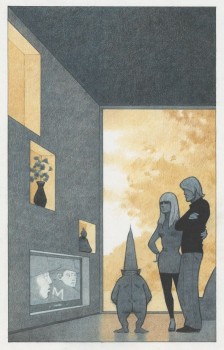 Accompanied by one or two sentences of the most gnomic kind, architect Mikko Metsähonkala’s illustrations speak volumes. The picture-stories in his book Toisaalta / (P)å andra sidan / In Other Wor(l)ds blend the real and the surreal using fairy tales, references to historical or fictional characters and episodes from everyday life.
(The Finnish composer Lauri Supponen was inspired by Metsähonkala’s ‘humaphone’ – see below –, and his composition The Dordrecht Humaphone was first performed at the Cheltenham Festival, England, in 2012, to favourable reviews.) More…
Can’t say it’s not spring
18 April 2013 | Fiction, Prose
Short prose from Mahdottomuuksien rajoissa. Matkakirja (‘In the realm of impossibility. A travel book’, Teos, 2013). Texts by Katri Tapola, illustrations by Virpi Talvitie. Interview by Anna-Leena Ekroos
The first try
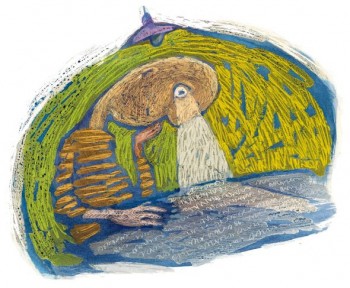
A reader doesn’t have to understand anything on the first try. You can always put a book aside and see if the second read will help. If the second, third, fourth, or even fifth read doesn’t help, that’s still all right. What is this constant compulsion to understand everything? There’s nothing wrong with not understanding – on the contrary, it is precisely the state of baffled befuddlement that hides the hope of light within it. I can’t understand any of this! I’m having fun! the reader happily exclaims, and goes on with his life, eyes overflowing with light. More…
Happy days, sad days
28 February 2013 | Reviews
 Pekka Tarkka
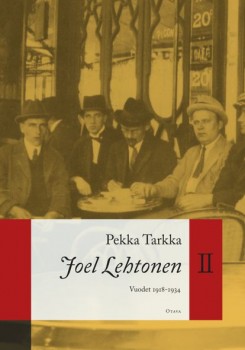
Joel Lehtonen II. Vuodet 1918–1934
[Joel Lehtonen II. The years 1918–1934]
Helsinki: Otava, 2012. 591 p., ill.
ISBN 978-951-1-25924-4
€38.50, hardback
A well-meaning bookseller’s idealism, inspired by Tolstoyan ideology, is brought crashing down by the laziness and ingratitude of the man hired to look after his estate: conflicts between the bourgeoisie and the ‘ordinary folk’ are played out in heart of the Finnish lakeside summer idyll in Savo province.
Taking place within a single day, the novel Putkinotko (an invented, onomatopoetic place name: ‘Hogweed Hollow’) is one of the most important classics of Finnish literature. Putkinotko was also the title of a series (1917–1920) of three prose works – two novels and a collection of short stories – sharing many of the same characters [here, a translation of ‘A happy day’ from Kuolleet omenapuut, ‘Dead apple trees’, 1918] .
In 1905 Joel Lehtonen bought a farmstead in Savo which he named Putkinotko: it became the place of inspiration for his writing. With an output that is both extensive and somewhat uneven, the reputation of Joel Lehtonen (1881–1934) rests largely on the merits of his Putkinotko, written between 1917 and 1920. More…