

Tag: travel
A perfect storm
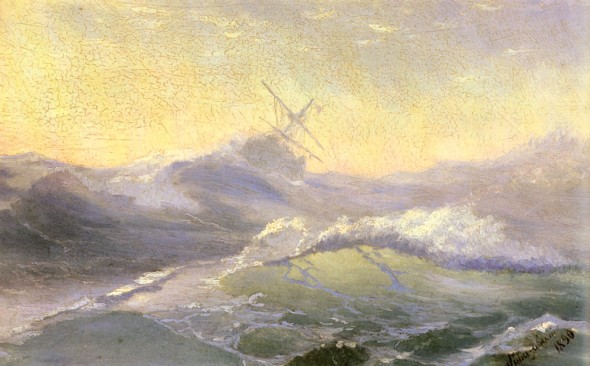
Bracing the waves. Ivan Aivazovsky, 1890.
According to Petri Tamminen, Finns are burdened by the need to succeed. Instead, he argues they should learn to fail better.
Part comedy, part tragedy, part picaresque novel, with a dash of Joseph Conrad – Tamminen’s new book, Meriromaani. Eräitä valoisia hetkiä merikapteeni Vilhelm Huurnan synkässä elämässä (‘A maritime novel. A few bright moments in Captain Vilhelm Huurna’s sombre life’, Otava, 2015) is set in an indeterminate seafaring past of the 18th or 19th century. It tells the story of the world’s most unsuccessful sea captain, Vilhelm Huurna who, one by one, sinks all the ships he commands.
Tamminen (born 1966) is a master of very short prose – this miniature novel is a a huge undertaking in the context of his work as a whole – and at Books from Finland we’re big fans. You can read more of his work here.
We join the story as Huurna, leaving behind him a failed romance in Viipuri, sets sail for Archangel, on the far north coast of Russia.

An excerpt from Meriromaani. Eräitä valoisia hetkiä merikapteeni Vilhelm Huurnan synkässä elämässä (‘A maritime novel. A few bright moments in Captain Vilhelm Huurna’s sombre life’, Otava, 2015)
The sun shone on the Arctic Ocean night and day, and the voyage went amazingly well, as did all the tasks and jobs that Huurna particularly feared beforehand.
Ships lay in Archangel harbour like objects on a collector’s shelf. They were waiting for timber cargo from the local sawmills where work was at a standstill because the mills lacked the machines and machine parts that they were now bringing them. When their cargo had been unloaded and the machines installed, timber began arriving from the sawmills. They found themselves at the end of the queue, and after the other ships had departed, one by one, they were still waiting in Archangel. That suited Huurna; in the first few days of his stay he had become acquainted with two English merchants and, through them, had received invitations to parties. He had stood in salons drinking toasts to the honour of this or that and made the acquaintance of some charming ladies into whose eyes he wished to gaze another time. He was quite moved by the whirl of this unexpected social life, and brightened at the thought that there was really nothing to complain about in his life apart from the fact that he happened still to be a bachelor. More…
Pekka Lassila: Maininki [Surge]
5 May 2015 | Mini reviews, Reviews
 Pekka Lassila
Maininki [Surge]
Helsinki: Tammi, 2014. 278 pp., ill.
ISBN 978-951-31-8126-0
€36, hardback
This book is a journal of a ‘survival project’: a continuous kayak voyage of 1,300 kilometres along the Finnish coast, from the eastern border (Russia) to the northwestern one (Sweden). Pekka Lassila (born 1959) is a photojournalist who, in an attempt to find a way out of the crisis of losing a job he had heald for thirty years, set off on his voyage in May, when the ice had only just melted. Nights were spent mostly in a tent; all washing up had to be done with sea water. Lassila blogged daily for newspapers by the power of his solar-charged phone and tablet. This solitary endeavour seems slightly obsessive at first – but the stories about the geography and history of the places passed by and the descriptions of the personal daily marine routines turn out to be interesting, never repetitive. The shallow west coast, the Gulf of Finland, even proves to be dangerous: the waves, growing rough, threaten to crush the kayak on the rocks, but Lassila’s paddling skills and luck save him. The photographs, taken each day, illustrate the voyage well (even though it is irritating that there are no captions!). Reaching his goal, after 31 days, Lassila manages to complete his ‘project’ – but confesses that he may only later fully understand the reasons why he set out.
Esko-Juhani Tennilä: Jäämeri kutsuu. Koillisväylä, Murmansk ja Suomen mahdollisuudet [The call of the Arctic Sea. The Northeast Passage, Murmansk and Finland’s opportunities]
11 December 2014 | Mini reviews, Reviews
 Jäämeri kutsuu. Koillisväylä, Murmansk ja Suomen mahdollisuudet
[The call of the Arctic Sea. The Northeast Passage, Murmansk and Finland’s opportunities]
Helsinki: Into Publishing, 2014. 332 pp., ill.
ISBN 978-952-264-197-7
€26, paperback
Esko-Juhani Tennilä is a Lapland-born editor, left-wing politician, former MP and author. The call of the Arctic Sea is a travel book and reportage book about Russia’s Murmansk and the neighbouring areas. Murmansk is a major port city whose harbour is ice-free in winter, and it is the largest city in the Arctic Circle. Nearby there are large ore, gas and oil resources. Global warming is beneficial to the region’s operating environment. Tennilä provides a fluent and well-backgrounded account of the experiences of entrepreneurs, politicians, decision-makers and ordinary people; he also meets Finns and Skolts, the Russian Sámi. Many foreign (e.g. Norwegian) companies are interested in the area. There is also activity by Finnish firms, but according to Tennilä not enough, and the Finnish State has not been able to actively take advantage of the economically important and interesting opportunities within the region along its northern border.
Translated by David McDuff
Through thick and thin
10 April 2014 | Comics, Fiction
Kaisa Leka is a thirty-something graphic artist who is into yoga and cycling, among other things. With her husband Christoffer they have pedalled, as ‘cyclotourists’, around in Iceland, eastern Europe, from Porvoo to Nice.
Cycling without calf muscles is not plain sailing though – Kaisa lost her legs to (voluntary) amputation in 2002, as her feet were malformed from birth and walking was getting more and more painful. She feels completely at ease with her technologically advanced new legs.
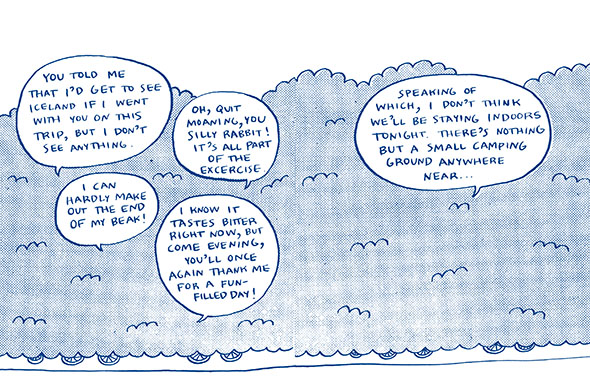
In their graphic novel Cycling around Iceland (2012) Kaisa and Christoffer describe their adventure (1,385 km, in 18 days). Not plain sailing, either: the wind in Iceland goes against you more often than not. In these extracts Christoffer gives a talk about the journey and shows slides to a small mixed audience. In Kaisa’s comics she herself is a mouse and Christoffer a duck. In this good-natured, humorous story they always support each other, come rain or shine.
The almost nearly perfect travel book
4 April 2014 | Articles, Non-fiction

Illustration: Joonas Väänänen
The question of what foreign people think of us Finns, and Finland has always been a particularly burning one in these latitudes: a young nation, a small people. Can we be as good as bigger and wealthier nations? Tommi Uschanov reads a new book on the Nordic countries published in England, keeping a sharp eye on what is being said about…. Finland, naturally
When an article based on The Almost Nearly Perfect People: The Truth About the Nordic Miracle by Michael Booth was published last January in the London Guardian, there was a nationwide outcry in Finland. ‘Finland being bashed in the British media,’ one tabloid headlined grandiosely, while a sober financial paper spoke of ‘a broadside full of stinky stuff’. It takes a re-reading of the article after having read the book to understand why. To create an artificial atmosphere of controversy, the article is lop-sidedly critical of Finland in a way which the book goes out of its way to avoid.
The Almost Nearly Perfect People belongs in a by now time-honoured genre within English letters: the humorous encomium to a host culture by an expatriate – or immigrant, as we hosts impolitely insist on calling them. The only difference is that Michael Booth, a British food and travel writer, does not discuss only Denmark, where he has lived for a decade, but visits each of the other four Nordic countries in turn. More…
No sex in Finland
31 July 2013 | Reviews
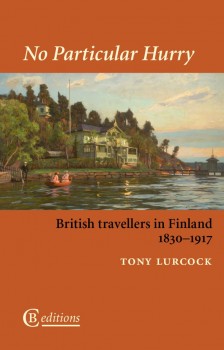 Tony Lurcock
No Particular Hurry. British Travellers in Finland 1830–1917
London: CB editions, 2013. 278 p.
ISBN 978-0-9567359-9-7
£10, paperback
For British travellers of the late 18th- and early 19th-century Finland was mainly a transit area between Stockholm and St Petersburg, or on the way to exotic Lapland. A century later, the country was already a tourist destination in itself, a newly emergent nation state, though still subordinate to Russia.
Tony Lurcock’s anthology of travel literature about Finland is a sequel to his collection ‘Not so Barren or Uncultivated’: British Travellers in Finland 1760–1830 (reviewed in Books from Finland in June 2013).
The practical conditions of tourism were changing. English-language tour guides were being published, and Britain now had direct steamship connections to Finland, where rail, road and inland waterway traffic had been established. In 1887 the Finnish Tourist Association was founded with the aim of making life easier for foreign tourists on selected travel routes. However, the British – like many other foreigners – marvelled at some of the country’s curious features: the excruciating rural journeys by horse and cart, the wretched inns and strange choice of food, the rye bread and milk-drinking, and of course the sauna. But to this there were also exceptions, in the form of new, surprisingly resplendent hotels, world-class dinners and the life of the modern city. More…
It’s a long way to Cameroon
18 October 2012 | This 'n' that
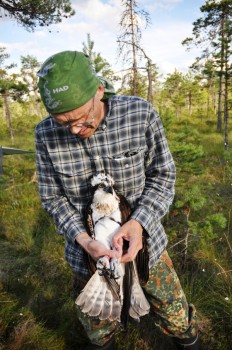
Before takeoff: Ilmari looks slightly annoyed here, as his ankle rings are checked by Harri Koskinen before his release. Photo: Juhani Koivu
An eight-year-old Finnish male, named Ilmari, has emigrated to Africa; on 13 October he was spotted in Cameroon. He set off for the journey on 16 September.
At the beginning of his journey, in Hattula, southern Finland, in August, he weighed 1,370g.
Ilmari is an osprey. The Osprey Foundation (more photos here too) fitted him with a Microwave GPS-Argos satellite transmitter (weighing just 30g and running on solar power). This allows osprey researchers to follow his journeys.
Actually Ilmari hasn’t emigrated – he will return to where he was born, in March 2013. As this is Ilmari’s first recorded migration, his final destination is not known. But one of his countrymen (-birds), carrying a transmitter, Jukka, liked it so much in Cameroon that he spent the winter there. Will Ilmari do the same? Watch this space!
The journeys of Finnish migrating birds are long (in this case, more than 6000 kilometres) and dangerous, so we wish Ilmari safe travel back home as well.
Northern exposure
21 June 2012 | Reviews
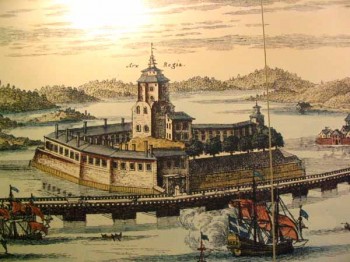
Between Helsinki and St Petersburg: Vyborg. Illustration of Vyborg Castle by an unknown artist, 1709, Wikimedia
Tony Lurcock
‘Not So Barren or Uncultivated’. British travellers in Finland 1760–1830
London: CB Editions, 2010. 230 p.
ISBN 9-780956-107398
£10.00, paperback
Finland is not unique in raising scholars who have often attempted to treat historical travellers’ accounts as source material for historical facts, and then prove how ‘wrong’ they are in relation to reality. This is an unproductive way in which to read them: travel books are nearly always based on the authors’ own country and experiences projected on what they encounter abroad.
Paradoxically, much of what was written about foreign countries in the past was really about conditions and problems in the author’s own land, and can be understood only against that background – something that also emerges in this book about British travellers in Finland. More…
Tero Tähtinen: Katmandun unet. Kirjoituksia idästä ja lännestä [Kathmandu dreams. Writings about East and West]
26 January 2012 | Mini reviews, Reviews
 Katmandun unet. Kirjoituksia idästä ja lännestä
[Kathmandu dreams. Writings about East and West]
Turku: Savukeidas, 2011. 332 p.
ISBN 978-952-268-005-1
€ 19.90, paperback
Tero Tähtinen’s second collection of essays is focused physically in the wilds of a Finnish national park and Nepal – where the author (born 1978), a literary scholar and critic, has frequently travelled – and mentally in the divergences of Western and Eastern thought, which Tähtinen, who is familiar with Zen and Buddhist philosophy, studies, occasionally by means of literary examples. The ‘Socratic ego’ of the Western egocentric, individual ‘I’, which strives in vain to understand the whole of reality by rationalising it, is his favourite bête noire. Tähtinen quickens the pace of his verbal virtuosity as he discusses both dogmatic, materialistic faith in science – as well as some of its representatives – and Christian faith: he considers that both, in their pursuit of an absolute and total explanation, end up in a metaphysical vacuum. Unlike them, Eastern philosophy, in which the individual ‘I’ is not the centre and measure of all things, does not give rise to the anxiety of compulsive cognition. The virtual narcissism of Facebook, a platform tailor-made for the Socratic ego, receives Tähtinen’s outright condemnation: ‘Facebook trivialises humanity,’ he declares. At the end of these passionate essays on the author praises silence.
Translated by David McDuff
Warmer climes
10 November 2011 | This 'n' that
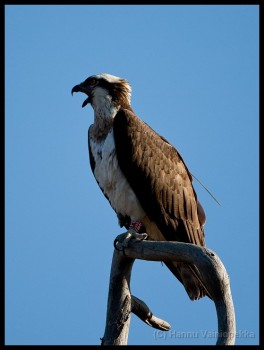
Up and away: Jukka is about to leave for the south. Photo: Hannu Vainiopekka /Finnish Museum of Natural History
Jukka spent the night of 9 October by the river Sana in Bosnia-Herzegovina. He then crossed the Croatian border, at times reaching a speed of 96 kilometres per hour.
By 15 October Jukka had crossed the border between Libya and Niger; 350 kilometres later he settled in the desert for the night. After entering Cameroon on the 21st, Jukka completed his journey of 34 days and 6,600 kilometres by landing on the bank of River Benoue and taking a well-earned break. In March it will be time to head homewards again, to Lake Pälkäne in Finland.
Jukka is a Finnish osprey.
Earlier, another osprey, Lasse, surprised the zoologists by spending his winter in Israel, instead of Africa. But Harri decided to wing his way as far as to South Africa, almost 12,000 kilometres from home, a distance he covered in some 57 days!
The Finnish Museum of Natural History / University of Helsinki and the Finnish Osprey Foundation track ospreys with the help of satellite tracking.
Long-distance travelling is dangerous, though: Eikka perished on his way to the south in Ukraine this autumn, and in 2008 Pete was probably eaten by a local eagle in Morocco: some of his feathers, as well as the transmitter were found beside a river by two officials of the Emirates Center for Wildlife Propagation, Eric Le Nuz and Rachid Khain.
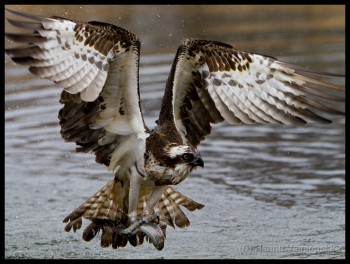
Gone fishing: Jukka the satellite osprey having lunch. Photo: Hannu Vainiopekka/Finnish Museum of Natural History
And why this interest in wildlife, you might wonder? Oh, as we sit here and edit Books from Finland in the semi-darkness of a November afternoon, creatures that migrate just seem to come to mind. Not to mention hibernation, but that’s another matter….
On the Trans-Siberian express
3 October 2011 | Authors, Reviews
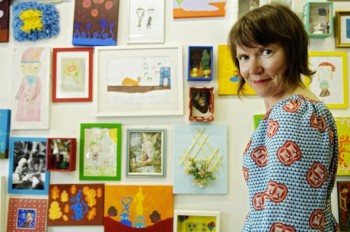
Rosa Liksom. Photo: Veikko Somerpuro
A Finnish girl studying archaeology in Moscow finds herself sharing a train compartment with a Russian man on the long journey from Moscow through Siberia to Ulan Bator. The girl travels for weeks to see the region’s ancient rock-paintings; the man’s destination is a big building site. The drama of the enclosed space is built of two people and two worlds that cannot escape one another.
The story, in Hytti no 6 (‘Compartment number 6’) by Rosa Liksom, develops through small stories and reminiscences as the backgrounds of the girl and the man open up. At the places where the train stops, other people from the steppe and cities of Russia become intertwined with the narrative.
The career of the Lapp writer Rosa Liksom spans more than 25 years and demonstrates a rare ability to master various fields of both writing and the visual arts. In the history of contemporary Finnish prose, her novels and collections of short prose are a fantastic chapter of originally developed Nordic localism and post-modernist world citizenship. Liksom’s first book, short prose, was published in 1985; her work has been translated into 14 languages. More…
Back in the USSR
3 October 2011 | Fiction, Prose
Extracts from Rosa Liksom’s novel Hytti nro 6 (‘Compartment no 6’, WSOY, 2011). Review by Mervi Kantokorpi
Moscow hunched itself in the dry, frosty March night, protecting itself from the touch of the icy red sun as it set. The girl entered the train’s last sleeping carriage, found her compartment, compartment number six, and breathed deeply. There were four beds in the compartment, the upper ones folded agains the wall, while between the beds was a small table, on the table a white table cloth and a plastic flower vase containing a bunch of pink paper carnations, faded by time; the shelf above the end of the bed was full of large, untidily secured parcels. The girl shoved her modest old suitcase, the one she had got from Zahar, into the metal luggage space under the hard, narrow bed; her small backpack she threw on the bed. When the station bell sounded for the first time, the girl went to stand by the corridor window. She breathed in the scent of the train, iron, coal-dust, the smells left behind by dozens of cities and thousands of people. Travellers and those who had come to see them off pushed past her, shoving her with their cases and parcels. The girl touched the cold window with her hand and looked at the platform. This train would take her through villages inhabited by deportees, through the open and closed towns of Siberia to the capital of Mongolia, Ulan Bator. More…
Utopia or cacotopia?
19 August 2011 | Extracts, Non-fiction
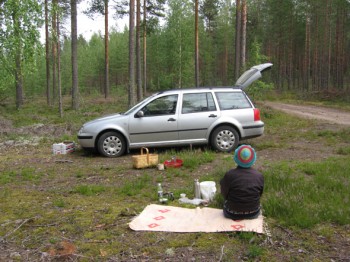
Viljakansaari, Finland, 2008. ©Merja Salo
Do we live in the age of autopia, and if we do, what does that mean? On this earth there are now perhaps 800 million cars, all vital to our modern lifestyles. Professor and photographer Merja Salo observes landscapes through her camera with this question in mind
Extracts and photographs from Carscapes. Automaisemia (Edition Patrick Frey & Musta Taide, 2011. Translation: Laura Mänki)
The car may be the vehicle for the everyman, but not every man is a good driver. According to Hungarian- born psychoanalyst Michael Balint, good drivers have the psychological structure of philobats. With their sense of sight, they perceive space well and control it by steering their vehicle skilfully. Ocnophiles, on the other hand, are more at home as passengers. They structure the world through intimacy and touch. When driving, they cling anxiously to the steering wheel and do not perceive the continously changing situations in traffic.
Gustaf Mannerheim: Dagbok förd under min resa i Centralasien och Kina 1906–07–08 [Journal of my travels in Central Asia and China 1906–07–08]
11 February 2011 | Mini reviews, Reviews
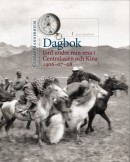 Dagbok förd under min resa i Centralasien och Kina 1906–07–08, Vol 1–3
[Journal of my travels in Central Asia and China 1906–07–08, Vol. 1–3]
Redaktör [Edited by]: Harry Halén
Bildredaktör [Photo editor]: Peter Sandberg
Helsingfors: Svenska litteratursällskapet i Finland, 2010. 1,128 p., ill.
ISBN 978-951-583-196-5 (complete set)
€ 80, hardback
Carl Gustaf Mannerheim (1867–1951), a Finnish officer in the Imperial Russian Army, later Commander-in-Chief of the Finnish Army and President of Finland, undertook a military reconnaissance mission, posing as an academic researcher, to Central Asia and China in 1906–1908. His journey on horseback across Asia to Peking also generated a wealth of ethnographic material: field notes, photographs and artefacts. In his travel diaries, Mannerheim describes the landscapes as well as his diverse encounters with the inhabitants of the areas he travelled through. During his visit to a Tibetan monastery, Mannerheim was pelted with stones by pilgrims. He gave the Dalai Lama an automatic pistol as a gift. These journals are now being published in full for the first time in their original language, Swedish, including Mannerheim’s own notes concerning his military mission. The photographs, some of which have never been published before, show that Mannerheim was a skilled photographer. Harry Halén, an expert in Central Asian languages and cultures, has contributed an extensive preface and copious notes.
Translated by Ruth Urbom
Stories in the stone
2 December 2010 | Extracts, Non-fiction
Extracts from Jägarens leende. Resor in hällkonstens rymd (‘Smile of the hunter. Travels in the space of rock art’, Söderströms, 2010)
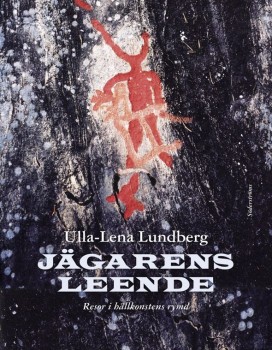 ‘Why do some people choose to expend what is often a great deal of effort hammering images in the bedrock itself, while others conjure up, in the blink of an eye, brilliantly radiant pictures on a rock-face that was empty yesterday but is now peopled by mythological animals, spirits and shamans?
‘I think about this often – I who love painting but who still chose a career that involves me sitting and hammering away, day in and day out, like a true rock-carver,’ writes author and ethnologist Ulla-Lena Lundberg in her new book on the art of the primeval man
When the children of Israel went into Babylonian captivity, hanging up their harps on the willow-trees and weeping as they remembered Zion, my sister and I were already sitting by the rivers of Babylon. We knew how they felt. Our father was dead and we had been sent away from our home. We sat there clinging to each other, or rather I was the one clinging to Gunilla, and she had to try to rouse herself and find something for us to do, to give us something else to think about. More…