

Articles
Picture this
9 April 2015 | Articles
It’s impossible to put Finnish graphic novels into one bottle and glue a clear label on to the outside, writes Heikki Jokinen. Finnish graphic novels are too varied in both graphics and narrative – what unites them is their individuality. Here is a selection of the Finnish graphic novels published in 2014
Graphic novels are a combination of image and word in which both carry the story. Their importance can vary very freely. Sometimes the narrative may progress through the force of words alone, sometimes through pictures. The image can be used in very different ways, and that is exactly what Finnish artists do.
In many countries graphic novels share some common style or mainstream in which artists aim to place themselves. In recent years an autobiographical approach has been popular all over the worlds in graphic novels as well as many other art forms. This may sometimes have led to a narrowing of content as the perspective concentrates on one person’s experience. Often the visual form has been felt to be less important, and clearly subservient to the text. This, in turn, has sometimes even led to deliberately clumsy graphic expression.
This is not the case in Finland: graphic diversity lies at the heart of Finnish graphic novels. Appreciation of a fluent line and competent drawing is high. The content of the work embraces everything possible between earth and sky.
Finnish graphic novels are indeed surprisingly well-known and respected internationally precisely for the diversity of their content and their visual mastery.
Life on the block
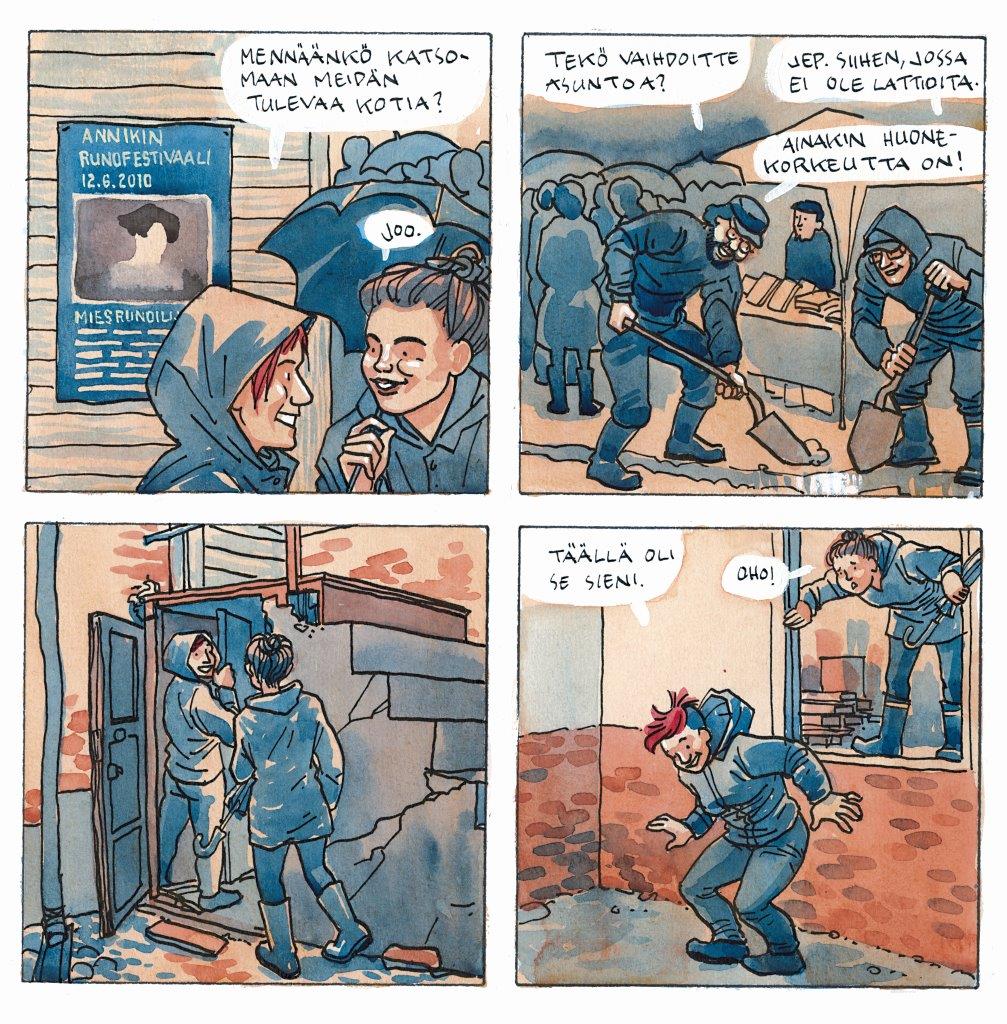
‘Shall we go and look at our new house? / Yeah. / Did you move house? / Yeah, to one without a floor. / At least you have head-space! / This is where the mould was. / Oh dear!’. Tiitu Takalo, Minä, Mikko ja Annikki (‘Me, Mikko and Annikki’, Suuri kurpitsa).
Not a world language, and yet….
16 January 2015 | Articles, Non-fiction
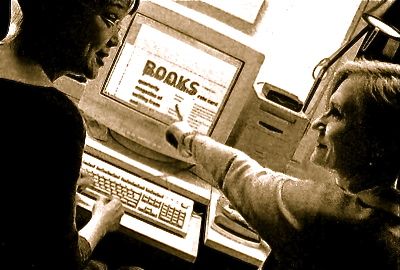
The editors (Hildi Hawkins and Soila Lehtonen) at the screen: we begun publishing material on our website in 1998. Photo: Jorma Hinkka, 2001
Longevity may not generally be a virtue of literary magazines – they tend to come and go – but Books from Finland, which began publication in 1967, has stuck around for a rather impressively long time. Literary life, as well as the means of production, has changed dramatically in the almost half-century we have been in existence. So where do we stand now? And what does the future look like?
This is the farewell letter from the current Editor-in-Chief, Soila Lehtonen – who began working for the journal in 1983
‘The literature of Finland suffers the handicap of being written in a so-called “minor” language, not a “world” language…. Finland has not entirely been omitted from the world-map of culture, but a more complete and detailed picture of our literature should be made available to those interested in it.’
Thus spake the Finnish Minister of Education, R.H. Oittinen, in early 1967, in the very first little issue of Books from Finland, then published by the Publishers’ Association of Finland, financed by the Education Ministry.
Forty-seven years, almost 10,000 printed pages (1967–2008) and (from 2009) 1,400 website posts later, we might claim that the modest publication entitled Books from Finland, has accomplished the task of creating ‘a more complete and detailed picture’ of Finnish literature for anyone interested in it. More…
Is less really more? On new books for young readers
18 December 2014 | Articles, Non-fiction
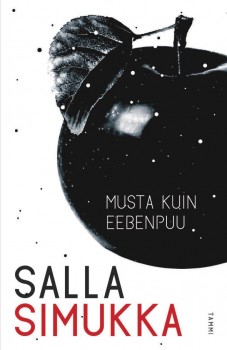
Black as ebony: volume three of the ‘Snow White’ trilogy for young adults by Salla Simukka
This year has been an eventful for Finnish literature in many ways, not least in terms of young adults’ and children’s books. The full ramifications of Finland’s turn as the theme country at this year’s Frankfurt Book Fair will only be known with the passage of time, but more mega-success stories to stand alongside Salla Simukka’s Lumikki (Snow White, Tammi) trilogy for young adults – now sold to almost 50 countries – are eagerly awaited. Visitors to the Frankfurt Book Fair also got a look at Finland-Swedish illustration at the By/Kylä (‘Village’) stand, which presented varied works by nine illustrators and animators in a memorable exhibit.
Book sales continue to fall in Finland. The major general-interest publishers – WSOY, Tammi, and Otava – have cut back on Finnish titles and are concentrating on high-sellers and proven authors.
Books in series are now a dominant phenomenon in literature for children and young adults, aiming to win readers’ loyalty with their continuing stories and characters. Many longtime authors and illustrators of books for children and young adults have had to look for new contacts, and publishers are increasingly hesitant to launch debut artists. More…
Encounters with a language
12 December 2014 | Articles, Non-fiction
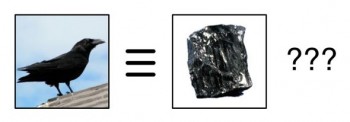
Mistranslation: illustration by Sminthopsis84/Wikimedia
Mother tongue: not Finnish. How do people become interested enough in the Finnish language in order to become translators? In the olden days some might have been greatly inspired by the music Sibelius (as were the eminent British translators of Finnish, David Barrett or Herbert Lomas, for example, back in the 1950s and 1960s). We asked contemporary translators to reminisce on how they in turn have become infatuated enough with Finnish to start studying and translating this small, somewhat eccentric northern language. Three translators into English, one into French, German and Latvian tell us why
The coder’s Latin
30 October 2014 | Articles, Non-fiction
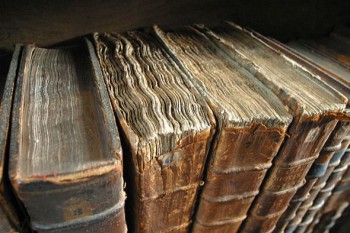
Pleasant interface still? Old book bindings (Merton College library, Oxford, UK). Photo: Wikipedia
Writing is arguably brain-control technology, notes our columnist Teemu Manninen. Writing might not be on its way out, at least not quite yet, he thinks, but the printed book might not stay with us for ever. And would that be a happier world?
When the future of literature is discussed, either here in Finland and elsewhere, topics usually revolve around changes in the economics and practicalities of reading, writing, and publishing: how will writers and publishers get paid, and how can readers find more books to read.
What is taken for granted in these instances is that literature itself will continue to be something that exists in a recognisable way – which itself of course implies that writing itself will remain a viable mass medium for the transmission of information over the transcendent, enormous, unfathomable gulfs of space and time, as it has been for thousands of years. More…
Finland, cool! The Frankfurt Book Fair 8–12 October
30 September 2014 | Articles, Non-fiction

Finnland. Cool. pavilion in Frankfurt, designed by Natalia Baczynska Kimberley, Nina Kosonen and Matti Mikkilä from Aalto University
It starts next week: Finland is Guest of Honour at the Book Fair in the German and global city of Frankfurt. This link will take you to it all.
Approximately 170,000 professionals from the literary world are expected to visit the exhibition halls from Wednesday to Friday; the weekend is reserved for the general public, c.100,000 visitors. Since 1980s different countries have been in focus each year. More…
Instant erudition, or, who are you kidding?
2 September 2014 | Articles, Letter from the Editors, Non-fiction
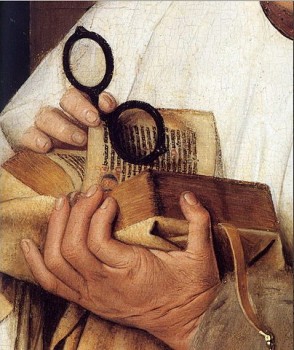
Time to read? Detail from Madonna with Canon van der Paele by Jan van Eyck (1439. The Groeninge Museum, Brugge). Wikipedia
In a recent ‘Saturday essay’ in the Helsingin Sanomat newspaper (9 August) journalist Oskari Onninen ponders the moral dilemma of pretending to be erudite. For example, who has the time to read books these days? ‘The Woolfs remain unread, Bergmans unwatched’, Onninen writes.
Our consumerist lifestyle forces us to follow the trends of ever-expanding, multiplying forms of entertainment. However, it is apparent that the need to know about culture in order to pass as a cultured, well-informed citizen still exists, to some extent at least.
According to Onninen, there is less and less time for unproductivity. ‘If one looks for measurable cost-benefit results from the reading of heavyweight fiction, the act of reading will certainly not always be worthwhile.’ Consuming art (reading books, going to art exhibitions, watching plays) requires time and effort, and how productive is that? More…
Online, offline?
17 April 2014 | Articles, Non-fiction
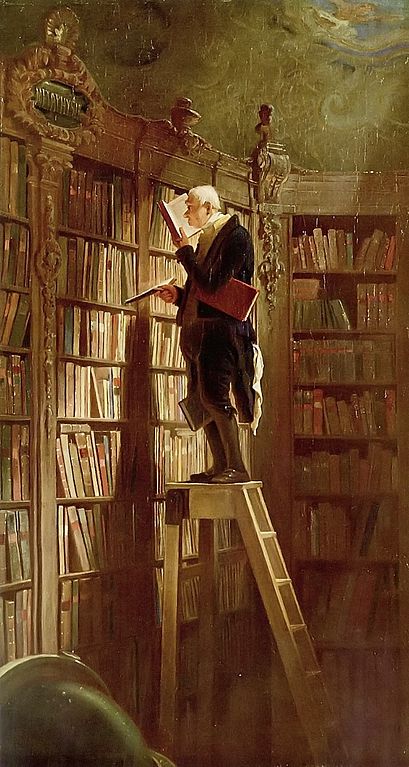
‘The bookworm’ (old-fashioned) by Carl Spitzweg, ca. 1850. Museum Georg Schäfer. Photo: Wikimedia
Ebooks are not books, says Teemu Manninen, and publishers who do not know what marketing them is about, may eventually find they are not publishers any more
At least once a year, there is an article in a major Finnish newspaper that asks: ‘So, what about the ebook?’ The answer is, as always: ‘Nothing much.’
It’s true. The revolution still hasn’t arrived, the future still isn’t here, the publishers still aren’t making money. In Finland, the ebook doesn’t seem to thrive. The sales have stagnated, and large bookstores like the Academic Bookstore are closing their ebook services due to a lack of customers.
Why is Finland such a backwater? Why don’t Finns buy ebooks?
The usual explanation is that Finland is a small country with a weird language, so the large ebook platforms like Amazon’s Kindle and Apple’s iBook store have not taken off here. Another patsy we can all easily blame is the government, which has placed a high 24% sales tax on the ebook. If that isn’t enough, we can always point a finger at the lack of devices and applications or whatever technical difficulty we can think of. More…
The almost nearly perfect travel book
4 April 2014 | Articles, Non-fiction
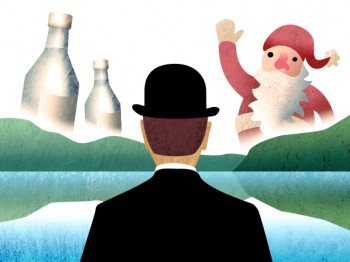
Illustration: Joonas Väänänen
The question of what foreign people think of us Finns, and Finland has always been a particularly burning one in these latitudes: a young nation, a small people. Can we be as good as bigger and wealthier nations? Tommi Uschanov reads a new book on the Nordic countries published in England, keeping a sharp eye on what is being said about…. Finland, naturally
When an article based on The Almost Nearly Perfect People: The Truth About the Nordic Miracle by Michael Booth was published last January in the London Guardian, there was a nationwide outcry in Finland. ‘Finland being bashed in the British media,’ one tabloid headlined grandiosely, while a sober financial paper spoke of ‘a broadside full of stinky stuff’. It takes a re-reading of the article after having read the book to understand why. To create an artificial atmosphere of controversy, the article is lop-sidedly critical of Finland in a way which the book goes out of its way to avoid.
The Almost Nearly Perfect People belongs in a by now time-honoured genre within English letters: the humorous encomium to a host culture by an expatriate – or immigrant, as we hosts impolitely insist on calling them. The only difference is that Michael Booth, a British food and travel writer, does not discuss only Denmark, where he has lived for a decade, but visits each of the other four Nordic countries in turn. More…
Human destinies
7 February 2014 | Articles, Non-fiction
To what extent does a ‘historical novel’ have to lean on facts to become best-sellers? Two new novels from 2013 examined
When Helsingin Sanomat, Finland’s largest newspaper, asked its readers and critics in 2013 to list the ten best novels of the 2000s, the result was a surprisingly unanimous victory for the historical novel.
Both groups listed as their top choices – in the very same order – the following books: Sofi Oksanen: Puhdistus (English translation Purge; WSOY, 2008), Ulla-Lena Lundberg: Is (Finnish translation Jää, ‘Ice’, Schildts & Söderströms, 2012) and Kjell Westö: Där vi en gång gått (Finnish translation Missä kuljimme kerran; ‘Where we once walked‘, Söderströms, 2006).
What kind of historical novel wins over a large readership today, and conversely, why don’t all of the many well-received novels set in the past become bestsellers? More…
Verse and freedom
16 January 2014 | Articles, Non-fiction
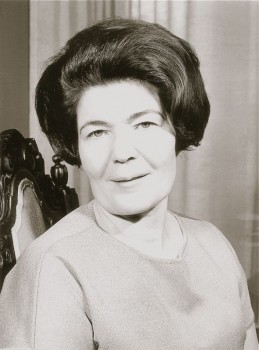
Aale Tynni (1913–1997). Photo: WSOY
Finnish poetic modernism, which with its freedom of rhythm came to dominate the literary mainstream of the 1950s, posed a particular challenge to the poets of the classical metrical and romantic poetic tradition. Aale Tynni (1913–1997) is not a poet of any one school or form, but rhythm is the deepest foundation of her poems, whether expressed in metre, free verse or the speech rhythms that characterise some of her poems of the 1950s and 60s, as well as those of her final years.
An Ingrian Finn, Tynni left Ingermanland near Petersburg for Finland as a refugee after the First World War, in 1919. The war and the period of uncertainty that followed it are present in her poems as an allegory, sometimes appearing as a dance of death or a carnival. At other times they emerge in the myth of Phaethon, who with his sun chariot is in danger of throwing Mother Earth off her axis, or as a game of chess in which God and the angel Gabriel play with the planets and moons as pieces. The poet makes use of mythic and cosmic references to widen her scope and to portray Man in the stages of history and the present age. More…
Reading matters? On new books for young readers
9 January 2014 | Articles, Children's books, Non-fiction
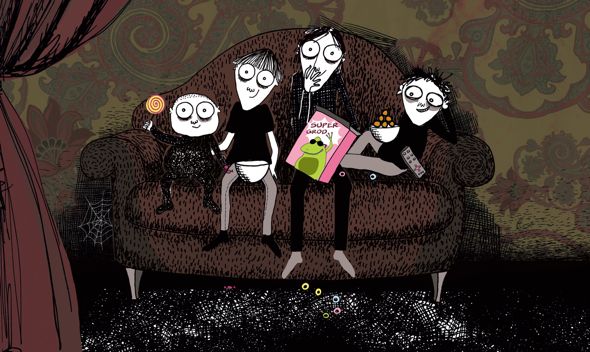
The Pixon brothers don’t read books, they love the telly: story by Malin Kivelä, illustrations by Linda Bondestam (Bröderna Pixon och TV:ns hemtrevliga sken, ‘The Pixon brothers and the homely shimmer of the telly’)
Finnish picture books for children have long been reliable export goods around the world. In the last few years, a number of novels for children have come along in their wake: works by authors such as Timo Parvela and Siri Kolu have been translated into a good many languages.
Now young adult literature has also blazed a trail on to the international market – in what also seems to be almost a matter of precision timing with regard to the Frankfurt Book Fair 2014. Finnish publishers have been investing in their home-grown lists of children’s and young adult books ever since the turn of the millennium, and now the time has come to harvest the fruits of their long-term efforts.
Decisions, decisions: the fate of virtual literature
28 November 2013 | Articles, Non-fiction
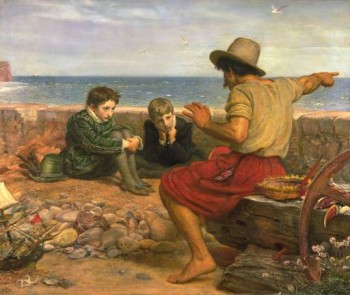
Once upon a time: ‘Boyhood of Raleigh’ by J.E. Millais (1871). Wikipedia
In an era of ‘liveblogging’‚ we are all storytellers. But what’s the story, asks Teemu Manninen
One score of years ago, when the internet was new, the cultural critics of the time were fond saying that it would usher in a new utopia of free distribution of information: we would be able to read everything, know everything and share everything anywhere and every day.
Truly, they told us, we would become enriched by the internet to the point of not knowing what to do with all that wealth of knowledge, the amount of connections between us and the ever-increasing online availability of anyone with everyone, every waking hour.
Now that we really do have this always-on connectivity, you will indeed be available every waking hour: you will update your status, check your inbox, post pics and be available for chatting, texting, a quick email and a message or two, just to make sure no one is offended by your unreachability, since – from experience – a week’s worth of not tweeting or facebooking can make someone think that something serious has happened, or that you don’t even exist anymore. More…
Cut time, paste space
12 September 2013 | Articles, Non-fiction
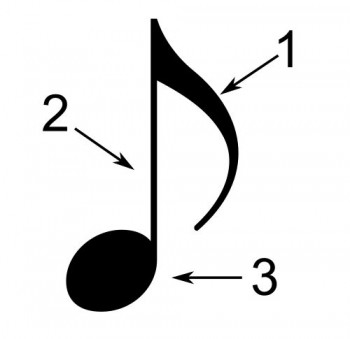
Back to basics. Parts of a musical note. Picture: Wikimedia
How different are the art of words and the art of sounds, author Teemu Manninen ponders, as he unexpectedly finds himself in the role of a musician in a performance. Time, space or both?
Some time ago I got the chance to participate in an unusual concert – as a performer: six players, myself included, were grouped around a table with a triangle in one hand and a glove in the other. Pieces of dry ice and a bucket of water were placed in front of each of us.
The performance began: we took a piece of dry ice and pressed it against the triangle. As the metal cooled, it burned through the ice, releasing gas, which in turn made the metal vibrate very fast. This produced a keening sound that filled the room. More…
Far from the madding crowd
21 February 2013 | Articles, Non-fiction
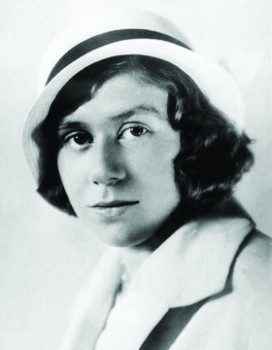
Saima Harmaja (1913–1937). Photo: WSOY
‘I don’t belong to the crowd,’ the young Saima Harmaja wrote in her diary in 1933. Her work as a poet was for her a vocation that superseded everything else. In her diaries she often speaks as a sociable young woman, with a delicious sense of humour, but her best poems seriously explore love, and death which cast its shadow over her. A selection of her poems – the best of which have made her a Finnish classic – is now published in English for the first time
In her diary the young poet claimed: ‘I think I would die if I could not write.’ What Harmaja shared with the poets of the early part of the twentieth century who influenced her was the private and personally experienced nature of poetry itself, rather than the realisation of any current aesthetic programme.
Harmaja is one of those poets whose works have passed through the hands of readers from decade to decade. She is also a prototype of the poet of her generation: gifts that led to the expectation of a brilliant career, a life that was brought to a tragic end by tuberculosis, leaving just five years of work as a poet. More…