

Mini reviews
Aleksi Mainio: Terroristien pesä. Suomi ja taistelu Venäjästä 1918-1939. [Terrorist lair. Finland and the fight for Russia 1918-1939.]
29 June 2015 | Mini reviews, Reviews
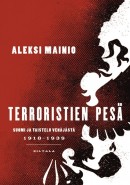 Aleksi Mainio
Terroristien pesä. Suomi ja taistelu Venäjästä 1918-1939. [Terrorist lair. Finland and the fight for Russia 1918-1939.]
Helsinki: Siltala, 2015. 380pp., ill.
ISBN 987-952-234-288-1
€34.95, hardback
After the October Revolution in Russia in 1917 and the rise of the Bosheviks to power, thousands of their opponents fled the country. The historian Aleksi Mainio’s book describes how many of the emigrants, who represented not only monarchists but many other ideologies, attempted to act against Soviet Russia through espionage and even terrorism from Finland and partly with funding from western powers. Their fighting organisations sent intelligence officers and bomb squads across the eastern border, often admittedly with poor results as the organisations had often been infiltrated by Soviet-sympathising double agents. The Tartu peace treaty between Finland and Russia, subsequently the Soviet Union, was signed in 1920. Nevertheless, many officials of the security police and the military were prepared to approve the emigrants’ attempts to weaken Soviet Russia. Some counter-revolutionaries also acted as assistants to the Finnish or, for example, British intelligence services. On the other hand, Finnish officials put a stop where necessary to illegal activities by emigrants. Mainio’s book, which is based on his doctoral thesis, paints a fascinating picture of espionage activity in Finland between the wars, although the sheer volume of detail and characters pose a challenge to forming an overview of the situation.
Jonna Pulkkinen: Kieltolaki. Kielletyn viinan historia Suomessa. [Prohibition. A history of prohibited liquor in Finland.]
29 June 2015 | Mini reviews, Reviews
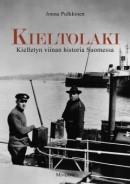 Jonna Pulkkinen
Kieltolaki. Kielletyn viinan historia Suomessa. [Prohibition. A history of prohibited liquor in Finland.]
Helsinki: Minerva, 2015. 213pp., ill.
ISBN 978-952-312-112-6
€32,90, hardback
Prohibition of the making and selling of strong liquor was in force in Finland between 1919 and 1932. In this approachable book, the journalist and non-fiction writer Jonna Pulkkinen charts Finnish attitudes to alcohol over the ages and describes the origin and effects of prohibition. Total abstinence was popular in Finland in the second half of the 19th century, and was adopted in particular by the working class. Limits on alcoholic consumption were first imposed as early as the First World War. When a prohibition law that had been passed a couple of years earlier came into effect in newly independent Finland in 1919, however, support had already begun to dwindle. Home stills proliferated, smuggling from abroad was considerable and broadly accepted, and enforcing the law was difficult. Pulkkinen has numerous interesting and even comical examples that flouted the law on prohibition. The law was broken in all social classes, the use of liquor and crime increased throughout the country, and taxation income on alcohol was lost. As public criticism grew, an advisory referendum was held in 1931, and as a result the prohibition law was abolished the following year.
Osmo Soininvaara: Jäähyväiset eduskunnalle [Farewell to Parliament]
23 June 2015 | Mini reviews, Reviews
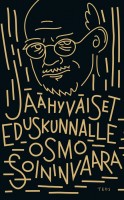 Osmo Soininvaara
Jäähyväiset eduskunnalle [Farewell to Parliament]
Helsinki: Teos, 2015. 247pp.
ISBN 978-951-851-649-4
€33, hardback
Long-time member of the Finnish Parliament Osmo Soininvaara, who has also worked as a minister, decided not to participate in the 2015 parliamentary elections. In this timely book, this expert in social politics and influential figure in the Green Alliance examines the reasons for political alienation, analyses politics more broadly and presents his own medicines for improving the situation. According to Soininvaara, the Finnish parliament has become superficial and publicity-seeking and there is much room for improvement in its work. The six-party ‘rainbow coalition’ of the outgoing parliament was incapable of action and the two largest, leftist, parties were continually at loggerheads, with the Social Democrats, in particular, demanding reforms. The divided opposition was toothless. Finland’s economy weakened still further, and it proved impossible to implement the administration’s central projects, reform of the social and health systems and of municipal administration, let alone others, among them the structural administrative changes essential for economic recovery. Writing fluently, Soininvaara examines politics and Parliament from many different perspectives, arguing eloquently for his views.
Risto Uimonen: Juha Sipilä. Keskustajohtajan henkilökuva. [Juha Sipilä. Portrait of a centrist leader.]
23 June 2015 | Mini reviews, Reviews
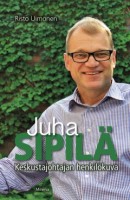 Risto Uimonen
Juha Sipilä. Keskustajohtajan henkilökuva. [Juha Sipilä. Portrait of a centrist leader.]
Helsinki: Minerva, 2015. 431pp., ill.
ISBN 978-952-312-125-6
€33,90, hardback
Juha Sipilä was an information technology millionaire and business entrepreneur when, in 2011, he became, at his first attempt, a member of parliament for the Finnish Centre Party, which represents principally country people, is considered conservative in its values and had lost support. The very next year this engineer from northern Finland was elected chairman of the party. Through, among other things, numerous interviews, the experienced non-fiction writer and journalist Risto Uimonen builds a nuanced portrait of a party leader with a strongly ethical value-system that lies on his Christian faith. Characteristic of Sipilä are informality, consideration of others, practicality and the ability to present issues clearly and pithily. In his party, he has focused on issues that are important to him, such as the promotion of biotechnology. Uimonen offers a fluent portrait of the background to Sipilä’s life and surprising career development, to which, as the book was being completed, a family tragedy brought darker tones. After the publication of the book, Sipilä led the Centre Party to victory in the parliamentary elections of April 2015. As chairman of the biggest party, he began to form a government and has already been praised for his efficiency.
Antero Holmila & Simo Mikkonen: Suomi sodan jälkeen. Pelon, katkeruuden ja toivon vuodet 1944-1949. [Finland after the war, 1944-1949. Years of fear, bitterness and hope.]
16 June 2015 | Mini reviews, Reviews
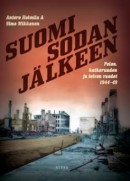 Antero Holmila – Simo Mikkonen
Suomi sodan jälkeen. Pelon, katkeruuden ja toivon vuodet 1944-1949. [Finland after the war, 1944-1949. Years of fear, bitterness and hope.]
Helsinki: Atena, 2015. 2650., ill.
ISBN 978-952-300-112-1
€34, hardback
Finland lost the Winter War and the Continuation War that followed, to the Soviet Union, and was then forced to engage in the short Lapland War to expel its former allies, the Germans. The return to peace was not easy, as the historians Antero Holmila and Simo Mikkonen demonstrate in this highly readable book. Loss of territory meant finding homes for more than 400,000 evacuees elsewhere in Finland, and this was not achieved without difficulty. Soldiers were demobilised and had to redomicile themselves in ordinary life and work; there was a shortage of housing; and heavy war reparations were to be paid to the Soviet Union. Leading politicians accused of appeasing the Soviet Union during the war received prison sentences, which many people considered wrong. The work highlights the aspirations of the Communists and the internal fighting on the political left. The Communist party, which had been banned, returned to the political stage and was successful in the 1945 elections. The majority of the nation was fearful of the growth of influence of the Communists and, through them, the Soviet Union. However, the Social Democrats, competing with the Communists for workers’ votes, succeeded in gaining considerably more votes than the Communists as early as 1948. Although strikes and conflicts occurred, conditions settled down gradually towards the end of the 1940s and the nation began to get back on its feet.
Kai Häggman: Pieni kansa, pitkä muisti. Suomalaisen Kirjallisuuden Seura talvisodasta 2000-luvulle. [Small nation, long memory. The Finnish Literature Society from the Winter War to the 21st century.]
16 June 2015 | Mini reviews, Reviews
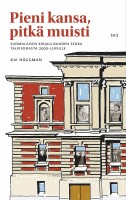 Kai Häggman
Pieni kansa, pitkä muisti. Suomalaisen Kirjallisuuden Seura talvisodasta 2000-luvulle. [Small nation, long memory. The Finnish Literature Society from the Winter War to the 21st century.]
Helsinki: SKS, 2015. 524pp., ill.
€48, hardback
The Finnish Literature Society, publisher of Books from Finland, is of unique importance as a collector of Finnish folk poetry and folk tradition, a publisher of literature and a promoter of research into the Finnish language and history; today it is known particularly as one of the most important publishers of the humanities. The historian Kai Häggman has published many works about publishing, and his new book, the third volume of a history of the Finnish Literature Society, describes events from the Second World War to the present day. Among other things, the book describes the Finnish Literature Society’s activities in conquered Eastern Karelia in what was then considered part of the Greater Finland, and its ideological development from narrow nationalism to the broader outlook of the post-war decades. In the late 20th century the generation that had lived through the war was replaced by younger people, and the study of the folk tradition embraced aspects of modern society; methods, too, were renewed. The book also casts light on relationships between Finnish scholars and those from kindred nations such as Estonia. Häggman gives a lively all-round view of the work of the Society as part of Finnish cultural history as a whole, emphasising the importance of the most important scholars, and not forgetting the occasional infighting.
Leena Krohn: Erehdys [‘The mistake’]
8 June 2015 | Mini reviews, Reviews
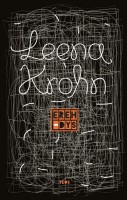 Leena Krohn
Erehdys [‘The mistake’]
Helsinki: Teos, 2015. 154 pp.
ISBN 978-951-851-575-6
€24.00, hardback
The protagonist of this new novel by Leena Krohn (born 1947) is an elderly author, E., who one dark and cold winter night arrives by car in a small town to perform in a literary event at a local library. The atmosphere does not seem very welcoming, and as the author begins reading extracts from his works, the comments and questions from the audience are mostly negative and impolite, even hostile. Gradually the sinisterness of the whole event becomes tragicomic; on leaving, the author has to fight his feelings of self-pity and anger. This novel frames E’s life in a portrait of a serious soul in constant pursuit of comprehending life – which he finally seems to acquire in death (in a car accident). The larger part of the novel consists of the stories the author reads; they will be familiar in style to fans of Krohn’s work. Unexpected, strange and unexplicable events and moments of everyday life take the characters by surprise; dreams, memories, remembering and forgetting what has taken place in the history – imagined or real – may perhaps change the way they have lived their lives.
Minna Lindgren: Ehtoolehdon tuho [The downfall of Twilight Grove]
1 June 2015 | Mini reviews, Reviews
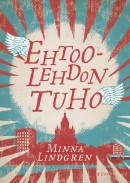 Minna Lindgren
Ehtoolehdon tuho [The downfall of Twilight Grove]
Helsinki: Teos, 2015. 288pp.
ISBN 978-951-851-646-3
€29.90, paperback
This is the final novel in a trilogy by the writer and music editor Minna Lindgren (born 1963). The protagonists in Kuolema Ehtoolehdossa (‘Death in Twilight Grove’, 2013) were lively ninety-something ladies in an assisted living facility in Helsinki. Now their life is turning more and more satirically and grotesquely absurd: as employing human workforce is becoming too expensive for the owners of the facility, the old folks are being cared for by electronic devices, monitors, cameras, ’smartwalls’ and cleaning robots, and their food – tasteless but colourful paste – is dispensed from 3D vending machines. In addition to all this, the members of a devious religious group, in pursuit of any money that the inhabitants may still have, begin to manipulate them. Things are not looking good, but the resourceful ladies are not about to give in, even though one of them will peacefully – and considering her age, naturally – pass away (in her bed, holding her favourite book, Thomas Mann’s The Magic Mountain). Lindgren defends the human rights of her characters with gusto. No wonder, then, that the trilogy will shortly appear in several languages, including English, German and French.
Hengen paloa & painettua sanaa. Renqvist-Reenpäät kustantajina 1815–2015. [A burning spirit & the printed word. The Renqvist-Reenpääs as publishers 1815-2015.]
25 May 2015 | Mini reviews, Reviews
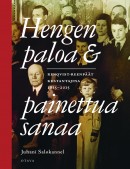 Juhani Salokannnel
Hengen paloa & painettua sanaa. Renqvist-Reenpäät kustantajina 1815–2015. [A burning spirit & the printed word. The Renqvist-Reenpääs as publishers 1815-2015.]
Helsinki: Otava, 2015. 344 pp., ill.
ISBN 978-951-1-27838-2
47, hardback
Otava is currently Finland’s biggest book publisher, and is also active in the fields of newspapers, printing and bookshops. Almost from the beginning, the Reenpää (originally Renqvist) family has been at the head of this family business. Otava was founded in 1890, but 200 years ago a family forefather, Henrik Renqvist, who was studying for the priesthood began to publish religious books. In 1893 his grandson, Alvar Renqvist became Otava’s longstanding editorial director. Through his enthusiasm for Finnish-language literature and education, it was he who formed the basis for the publisher’s growth. His five sons and their sons guided the publishing house in the same spirit through some difficult times to the 21st century, and today the fifth generation is still at work there. The Reenpää family has had an important position in Finnish cultural life both as influential figures and as patrons. The writer Juhani Salokannel’s generously illustrated, well-designed work is based on wide source material and interviews with members of the Reenpää family and does not hold back from describing conflicts between some strong characters. The book is, indeed, a lively depiction of the Reenpääs’ history and work at Otava; a history of the publishing house as such has already been published.
Riitta Nikula: Suomalainen rivitalo. Työväen asunnosta keskiluokan unelmaksi. [The Finnish terraced house. From worker housing to middle-class dream.]
18 May 2015 | Mini reviews, Reviews
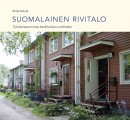 Riitta Nikula
Suomalainen rivitalo. Työväen asunnosta keskiluokan unelmaksi.
[The Finnish terraced house. From worker housing to middle-class dream.]
Helsinki: Suomalaisen Kirjallisuuden Seura (The Finnish Literature Society), 2014. 252 pp., ill.
ISBN 978-952-222-568-9
€ 37, hardback
In her extensive, well-researched book on the semi-detached house, Professor Emerita of Art History Riitta Nikula describes the housing history of a typical well-to-do Finn as setting off from a flat in an apartment building, continuing to a terraced house and ending up in a house of his or her own. In Finland rivitalo (simply, ‘row house’) became increasingly popular in the 1960s and the majority of houses of this type were built during the two decades that followed. However, in her book Nikula concentrates on the years 1900–1960, the decades of rapid industrialisation and urbanisation. In the 1930s Finland was eager to follow the renewal of town planning and architecture that was taking place elsewhere in Europe, and the rivitalo houses were part of the project of modernism. After the war the government funding system helped people to become owners of the properties they lived in, and the rivitalo became popular in growing towns. Prominent architects such as Eliel Saarinen, Alvar Aalto, Hilding Ekelund, Viljo Revell, and Kaija and Heikki Siren have all contributed to the development of this form of architecture. Nikula has travelled widely, in Europe and in Finland, researching this mode of living (the index of literature referred to alone fills seven large pages). The plentiful photographs and illustrations complement the text well.
Pekka Lassila: Maininki [Surge]
5 May 2015 | Mini reviews, Reviews
 Pekka Lassila
Maininki [Surge]
Helsinki: Tammi, 2014. 278 pp., ill.
ISBN 978-951-31-8126-0
€36, hardback
This book is a journal of a ‘survival project’: a continuous kayak voyage of 1,300 kilometres along the Finnish coast, from the eastern border (Russia) to the northwestern one (Sweden). Pekka Lassila (born 1959) is a photojournalist who, in an attempt to find a way out of the crisis of losing a job he had heald for thirty years, set off on his voyage in May, when the ice had only just melted. Nights were spent mostly in a tent; all washing up had to be done with sea water. Lassila blogged daily for newspapers by the power of his solar-charged phone and tablet. This solitary endeavour seems slightly obsessive at first – but the stories about the geography and history of the places passed by and the descriptions of the personal daily marine routines turn out to be interesting, never repetitive. The shallow west coast, the Gulf of Finland, even proves to be dangerous: the waves, growing rough, threaten to crush the kayak on the rocks, but Lassila’s paddling skills and luck save him. The photographs, taken each day, illustrate the voyage well (even though it is irritating that there are no captions!). Reaching his goal, after 31 days, Lassila manages to complete his ‘project’ – but confesses that he may only later fully understand the reasons why he set out.
Alpo Rusi: Etupiirin ote [The grip of the sphere of influence]
4 May 2015 | Mini reviews, Reviews
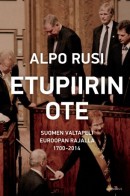 Alpo Rusi
Etupiirin ote [The grip of the sphere of influence]
Helsinki: Gummerus, 2014. 411p.
ISBN 978-951-20-9715-9
€34.90, hardback
In his work Etupiirin ote, the scholar, writer and former ambassador Alpo Rusi provides an interesting and polemical analysis of Finland’s foreign and security policies, particularly with regard to its neighbour, Russia / the Soviet Union. His premise is that from the 18th century onward Finland has, sometimes more broadly, sometimes more narrowly, formed part of the Russian sphere of influence. He gives a brief account of the end of the period of Swedish rule (until 1809) and that of Russian rule (1809-1917), as well as of the early decades of Finnish independence. The main emphasis of the book is on the period beginning with the Second World War. Rusi has a personal perspective on much recent history. He bases his evaluations on many diverse, sometimes controversial, sources and expresses strong opinions in his account, for example, of ‘Finlandisation’, Soviet influence on Finnish politics with its negative side effects. Rusi strongly criticises decision-makers who, as late as the 1980s and 1990s, believed in the desirability of trade with the east and the permanence of the Soviet Union, despite signals to the contrary. Following the collapse of the Soviet Union, Finland joined the European Union, but even as a member its attitudes towards, for example, Nato and Russia, have been problematic in many ways. Rusi ends his book on the theme of the Ukraine crisis, presenting his own proposal for the development of foreign and security policies.
Peter von Bagh: Muisteja [Memories]
17 April 2015 | Mini reviews, Reviews
 Peter von Bagh
Muisteja [Memories]
Helsinki: Like, 2014. 426 pp., ill.
ISBN 978-952-01-1093-2
€29.95, hardback
Peter von Bagh (1943–2014) became a cinephile legend in his lifetime. He was the son of a German emigrée, a psychiatrist from St Petersburg; his mother died when he was six, and his stepmother, ‘mean and stupid’, destroyed in his absence all his personal belongings, books and photographs. In this memoir von Bagh contends that his own films were to a large extent a means of reconstructing the past that his stepmother destroyed. Von Bagh was editor-in-chief of Filmihullu (‘Film fan’) magazine for 43 years, published more than 30 books on cinema and its history, worked in radio and for the National Film Archive, and directed dozens of films, mainly for television. He promoted the Midnight Sun Film Festival in Sodankylä, Lapland, for twenty-eight years, and held the post of artistic director of Bologna’s Il cinema Ritrovato festival for thirteen. This book presents the reader with a huge number of people, films, books, encounters and travels; although, typically of von Bagh, who, despite his doctorate, never cared for ‘formalities’, and rather annoyingly, there is no index. (Surely the publisher could have provided them!) But both self-criticism and the acidic, boldly blunt comments on anything – or anybody – that the writer considers ridiculous or stupid, the knowledge and the experience as well as the sardonic humour make the book a very worthwhile experience. The reader is very thankful for the fact that the author was able to finish writing this book of memoirs.
H. K. Riikonen: Nukuin vasta aamuyöstä. Olavi Paavolainen 1903–1964 [I didn’t fall asleep until morning. Olavi Paavolainen 1903–1964]
9 April 2015 | Mini reviews, Reviews
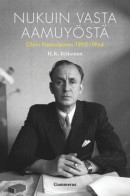 Nukuin vasta aamuyöstä. Olavi Paavolainen 1903–1964
[I didn’t fall asleep until morning. Olavi Paavolainen 1903–1964]
Helsinki: Gummerus, 2014. 584 pp., ill.
ISBN 978-951-20-9714-2
€36.90 , hardback
In the 1920s and 1930s the author and journalist Olavi Paavolainen was a prominent cultural figure among young writers and artists. Published after the Second World War, his controversial war diary, Synkkä yksinpuhelu (‘Sombre monologue’, 1946), remains his best-known literary work. This book, by Professor of Literature H.K.Riikonen, focuses on Paavolainen’s literary activities and his oeuvre; it complements and deepens another biography of Paavolainen published in 2014, Tulisoihtu pimeään (‘A torch into the darkness’) by Panu Rajala. Riikonen thoroughly examines Paavolainen’s works as well as his post-war career as a director at the Finnish Broadcasting Company. At times Riikonen’s views, based on careful research, differ from Rajala’s interpretations. Riikonen also features the cultural life and eminent contemporary figures of Paavolainen’s era. At times the text, with its precise references and culture-historical details, meanders somewhat. The book includes plenty of quotes from Paavolainen’s works as well as interesting fact boxes related to the circumstances of his life.
Hannu Rautkallio: Mannerheim vai Stalin. Yhdysvallat ja Suomen selviytyminen 1939–1944 [Mannerheim or Stalin. The United States and Finland’s survival 1939–1944]
2 April 2015 | Mini reviews, Reviews
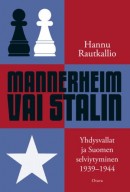 Mannerheim vai Stalin. Yhdysvallat ja Suomen selviytyminen 1939–1944
[Mannerheim or Stalin. The United States and Finland’s survival 1939–1944]
Helsinki: Otava, 2014. 463 pp., ill.
ISBN 978-951-1-27394-3
€39.70, hardback
In his book political historian Hannu Rautkallio explores American attitudes towards Finland during the Second World War, when the country fought a Winter War and Continuation War against the Soviet Union. He makes use both of older materials and of American documents that have only become accessible to researchers in the 2010s. During the war years two trends were dominant; one was sympathetic to the aims of the Soviet Union, while the other took a hostile view of them. The US political leadership had refused to support Finland in the Winter War, but as the World War progressed the United States tended to understand the small country’s objectives and also the special nature of its alliance with Germany. The two states shared intelligence and there were a large number of secret contacts with Finland’s top government leadership. At the end of World War II, the United States communicated to the Soviet Union, which was dictating peace terms to Finland, that it was important Finland should remain an independent state. Rautkallio’s account keeps branching out along interesting side-tracks, but the book’s central theme captures the reader’s interest.