

Essays
When the viewer vanishes
26 May 2015 | Essays, Non-fiction
 For the author Leena Krohn, there is no philosophy of art without moral philosophy
I lightheartedly promised to explain the foundations of my aesthetics without thinking at any great length about what is my very own that could be called aesthetics. Now I am forced to think about it. The foundations of my possible aesthetics – like those of all aesthetics – lie of course somewhere quite different from aesthetics itself. They lie in human consciousnesses and language, with all the associated indefiniteness.
It is my belief that we do not live in reality, but in metareality. The first virtual world, the simulated Pretend-land is inherent in us.
It is the human consciousness, spun by our own brains, which is shared by everyone belonging to this species. Thus it can be called a shared dream, as indeed I have done. More…
Why translate?
28 January 2015 | Essays, Non-fiction
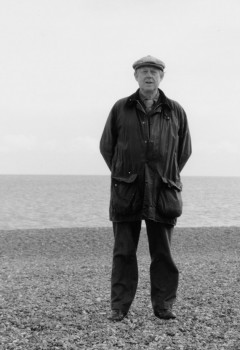
Down by the sea: Herbert Lomas in Aldeburgh. – Photo: Soila Lehtonen
‘People do not read translations to encourage minor literatures but to rediscover themselves in new imaginative adventures‚’ says the poet and translator Herbert Lomas in this essay on translation (first published in Books from Finland 1/1982). ‘Translation is a thankless activity,’ he concludes – and yet ‘you have the pleasure of writing without the agony of primary invention. It’s like reading, only more so. It’s like writing, only less so.’ And how do Finnish and English differ from each other, actually?
Any writer’s likely to feel – unless he’s a star, a celebrity, a very popular and different beast – that the writer is a necessary evil in the publisher’s world, but not very necessary. How much more, then, the translator from a ‘small’ country’s language.
Why do it? The pay’s absurd, you need the time for your own writing, it’s very hard to please people, and translation is, after all, the complacent argument goes, impossible. I’m convinced by all these arguments, and really I can’t afford to go on; but I don’t regret what I’ve done and, looking back, I can find two reasons for translating Finnish writing, one personal, the other cultural. More…
The magic box: childhood revisited
25 December 2014 | Essays, Non-fiction
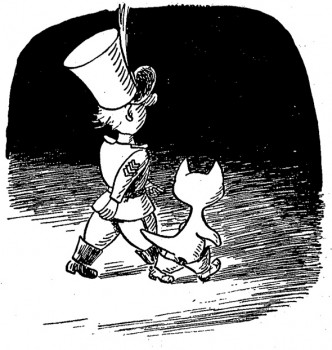
The tin soldier and the Blue Cat. Illustration: Usko Laukkanen
A tribute to Oiva Paloheimo’s children’s novel Tinaseppä ja seitsemän (‘The Tinsmith and the Seven’, illustrated by Usko Laukkanen, WSOY, 1956)
I’ve happened upon this (Christmassy) text of mine – first published in Books from Finland back in 1995 – when sorting through my papers as I begin to contemplate my retirement. With it I would like to offer my goodbyes, and many thanks, to you – to our readers, for whom I have been commissioning, editing and writing texts for the past thirty-one years – it’s time to do other things; time to read the books that still remain unread…
A dusky winter’s afternoon. Outside, soft and grey, a little snow is falling. I am sitting in our living-room, in an armchair covered in a pale yellow boucle fabric, my legs curled up, eating a carrot. In my lap is a book which I have fetched from the library after school. Conversation, the faint clattering of crockery, a singing kettle, the smell of food: grandmother and mother are cooking supper in the kitchen. My little sister is asleep.
But these sounds and the room around me do not really exist: there is only the world of make-believe in which Tiina sets off on her adventures with the Blue Cat, the Tinsmith, the St Bernard dog, the star and the spider: that world is a magic box which is able to contain all of childhood. More…
Back to the sources
23 October 2014 | Essays, Non-fiction, On writing and not writing
In this series, authors discuss the difficulties of their trade. Jari Järvelä finds it difficult to stop gathering source material which then gets piled in towers on his desk and in sacks around it. He knows that it’s got to stop though – for when it does, the stories will finally emerge, and life is a bliss… for a moment
When I was younger I thought that writing a novel began with the moment when I sat down at my desk and pressed a key for the first time. A. Hmmm…no, H. No, let’s make that S. No no no, I need a more original beginning…Z!
That’s not the case. The writing of a novel begins between two and twenty years before the choice of the first letter and the first word. Sometimes longer.
In the case of my novel Särkyvää (‘Fragile’, 2014), I know the exact moment of its birth.
Before I began to make a career as an author, I spent a year as a teacher at Hamari school in Porvoo. It was the beginning of the 1990s. Hamari was an old sawmill community on the sea, full of wooden houses more than a century old and motor boats put-putting toward the horizon. The headmaster looked more like a sea dog than a teacher; one morning he announced that it was his fortieth birthday. After that he sat down on the staff-room sofa, fell into deep thought and suddenly ejaculated, ‘Why the hell does a person have to gather so much junk in their life?!’ More…
Breadcrumbs and elephants
27 March 2014 | Essays, On writing and not writing
In this series, Finnish authors ponder the pros and cons of their profession. Alexandra Salmela operates in two languages, her native Slovakian and Finnish, which has become her literary language. Adventure and torture alternate as she attempts to shape reality into writing
I had started to write before I knew how. With fat wax crayons, in big stick-letters, I scratched my stories in old diaries. There were lots of pictures. From the very beginning, I wrote both poetry and prose. At 11 I didn’t finish my great sea-adventure novel, but at 12 I was already writing my memoirs. They, too, somehow remained unfinished.
Writing is… I wanted to write fun, but in the end I’m not quite sure about that. Writing is adventure and liberation and terribly hard work. Torture of the imagination and the pale copying of real events. Reading is a way to escape reality and at the same time a route to the sources of reality. By writing, you can shape reality in your own image: it’s your own character fault if the result is ugly and depressing.
If I were to write a pink world, it would be so sugary that it would make everyone sick, me and other people. More…
Girls just want to have fun
3 October 2013 | Essays, Non-fiction, On writing and not writing
In this series, Finnish authors ponder the complexities of their profession. Susanne Ringell describes her work as sailing on sometimes stormy seas – without a skipper certificate, but with conviction
We are such stuff as dreams are made on; / and our little life is rounded with a sleep. (William Shakespeare, The Tempest.) In Swedish – my mother tongue and the language in which my pencil writes – the play is called Stormen, ‘The storm’. There are a lot of storms on the sea of dreams. The sky suddenly grows dark, and deceptive whirlwinds blow up, there are cold shivers and tornadoes, there is the Bermuda Triangle and the mighty chasm of the Mariana Trench. In its southern part is the world ‘s deepest marine environment, Challenger Deep, 11 kilometres. Our boats are small and fragile, and it ‘s a miracle they haven’t capsized more often.
It’s a miracle that in spite of it all we still so frequently reach our home harbour, that we arrive where we were bound for. Or somewhere else, but we do get there. We come ashore, we come ashore with what we set our minds on. More…
Me by myself
20 June 2013 | Authors, Essays, Non-fiction, On writing and not writing
In this series, Finnish authors ponder their profession. Jyrki Kiiskinen casts light on the process of getting his books written: who is it that actually does the job?
People think I am a writer. But I am not. At literary events they sometimes come up and praise my most recent work, if they have happened to like it, not knowing that I have not written a single book. I try to ignore negative criticism, although it is not easy to put up with being blamed for other people’s work. I accept praise unhesitatingly, on those rare occasions when I receive it, although it feels strange.
It’s as if the person I’m talking to thinks I was someone else. He talks about the book’s style, its characters and its narrative voice, supposing that they are my invention.
At that moment I feel like a trickster. But I can’t be bothered to correct the misconception. I slurp my red wine happily and nod in false modesty, gazing deep into my interlocutor’s eyes. I keep chatting, to give him the impression that he’s met a living writer, myself – the person behind my words.
What does the neighbour think?
26 April 2013 | Essays, Non-fiction
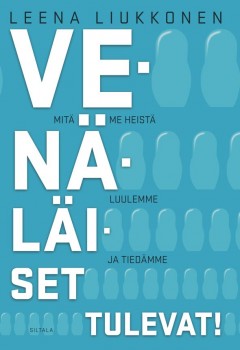 For more than 20 years journalist Leena Liukkonen has been thoroughly involved with Russian culture, commerce, language and psyche. The subtitle of her new book of essays Venäläiset tulevat! (‘The Russians are coming!’) is ‘What we think and know about them’, and refers to the fact that the Finns do not really know their eastern neighbours very well. Liukkonen writes with insight about the differences in history, mentality and world view
Extracts (under original subtitles) from Venäläiset tulevat! Mitä me heistä luulemme ja tiedämme (Siltala, 2013)
WAR, REMEMBERING AND FORGETTING
In café conversations with other visitors to Russia, we often react with exasperation to the fact that discussions in Finland only ever start with the Winter War. Sometimes we wonder why the threshold between us and our neighbour to the east is still so high. My own living contact with the past, however, makes it clear to me that everything the elderly carry round with them could not have been simply shaken off with the passage of time. Nor can the next generation just break away from it. My own experience also reminds me how distant our eastern neighbour was during peacetime. After all, a very few have made the long journey to the country next door. To many people, the old story was the only story there was about Russia. More…
Indifference under the axe
9 March 2012 | Essays, Non-fiction
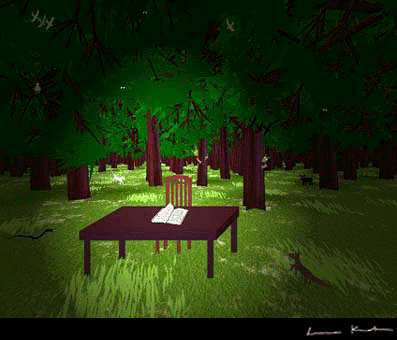
In the forest: an illustration by Leena Krohn for her book, Sfinksi vai robotti (Sphinx or robot, 1999)
The original virtual reality resides within ourselves, in our brains; the virtual reality of the Internet is but a simulation. In this essay, Leena Krohn takes a look at the ‘shared dreams’ of literature – a virtual, open cosmos, accessible to anyone, without a password
How can we see what does not yet exist? Literature – specifically the genre termed science fiction or fantasy literature, or sometimes magic realism – is a tool we can use to disperse or make holes in the mists that obscure our vision of the future.
A book is a harbinger of things to come. Sometimes it predicts future events; even more often it serves as a warning. Many of the direst visions of science fiction have already come true. Big Brother and the Ministry of Truth are watching over even greater territories than in Orwell’s Oceania of 1984. More…
Wo/men at war
9 February 2012 | Essays, Non-fiction
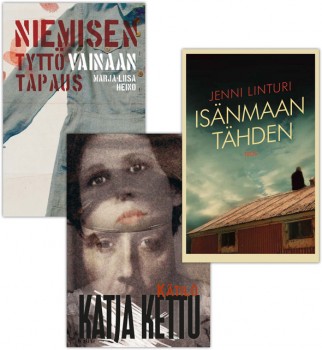 The wars that Finland fought 70 years and a couple of generations ago continue to be a subject of fiction. Last year saw the appearance of three novels set during the years of the Continuation War (1941–44), written by Marja-Liisa Heino, Katja Kettu and Jenni Linturi
In reviews of Finnish books published this past autumn, young women writers’ portraits of war were pigeonholed time and again as a ‘category’ of their own. This gendered observation has been a source of annoyance to the writers themselves.
Jenni Linturi, for instance, refused to ruminate on the impact of her sex on her debut novel Isänmaan tähden (‘For the fatherland’, Teos), which describes the war through the Waffen-SS Finnish volunteer units and the men who joined them [1,200 Finnish soldiers were recruited in 1941, and they formed a battalion, Finnische Freiwilligen Battaillon der Waffen-SS].
The work received a well-deserved Finlandia Prize nomination. Tiring of questions from the press about ‘young women and war’, Linturi (born 1979) was moved to speculate that some critics’ praise had been misapplied due to her sex. The situation is an apt reflection of the waves of modern feminism and the reasoning of the so-called third generation of feminists, who reject gender-limited points of view on principle. More…
Horse sense
2 February 2012 | Essays, Non-fiction
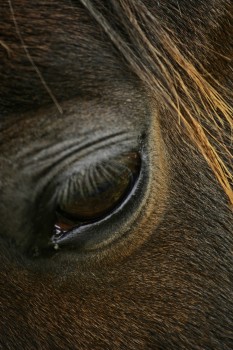
The eye that sees. Photo: Rauno Koitermaa
In this essay Katri Mehto ponders the enigma of the horse: it is an animal that will consent to serve humans, but is there something else about it that we should know?
A person should meet at least one horse a week to understand something. Dogs help, too, but they have a tendency to lose their essence through constant fussing. People who work with horses often also have a dog or two in tow. They patter around the edge of the riding track sniffing at the manure while their master or mistress on the horse draws loops and arcs in the sand. That is a person surrounded by loyalty.
But a horse has more characteristics that remind one of a cat. A dog wants to serve people, play with humans – demands it, in fact. With a dog, a person is in a co-dependent relationship, where the dog is constantly asking ‘Are we still US?’ More…
Sound and meaning
20 January 2012 | Essays, Non-fiction
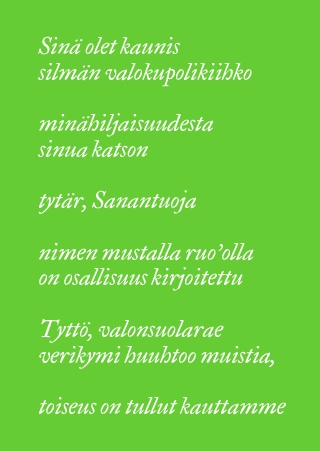
Harri Nordell’s poem from Huuto ja syntyvä puu (‘Scream and tree being born’, 1996)
Translating poetry is natural, claims Tarja Roinila; it is a continuation of writing it, for works of poetry are not finished, self-sufficient products. But is the translator the servant of the meaning – or of the letter?
I am sitting in a cafe in Mexico City, trying to explain in Spanish what valokupolikiihko, ‘light-cupola-ecstasy’, means. And silmän valokupolikiihko, ‘the light-cupola-ecstasy of the eye’.
I take to praising the boundless ability of the Finnish language to form compound words, to weld pieces together without finalising the relationships between them, never mind establishing a hierarchy: the eye is a light-cupola, the eye is ecstatic about light-cupolas, light creates cupolas, the cupola lets out the light, the eye, in its ecstasy, creates a light-cupola. More…
Round and round
2 December 2011 | Essays, Non-fiction
In this essay, Olli Löytty imagines himself in a revolving door that is able to spin his old family home and its inhabitants backwards in time – as far as prehistory. In addition to his own family’s past, Löytty zooms back into the history of the world’s great changes, for a moment playing the part of a cosmic god examining our globe
An essay from Kulttuurin sekakäyttäjät (‘Culture-users’, Teos, 2011)
If a film camera had stood outside my home from the time when it was built, I would rewind the movie it made from the end to the beginning. The story would begin with my children, one autumn morning in 2011, walking backwards home from school. The speed of the rewind would be so fast that they would quickly grow smaller; I, too, would get thinner and start smoking. I would curiously seek out the point where my wife and I are seen together for the last time, stepping out of the front door, back first, and setting out on our own paths, to live our own separate young lives.
At that time my grandmother still lives in the house with her two daughters and their husbands, and lodgers upstairs. The next time I would slow the rewind would be the point where, at the age of 18, finally move out of the house. The freeze-frame reveals a strange figure: almost like me, but not quite. In the face of the lanky youth I seek my own children’s features.
When I let the film continue its backwards story, I seek glimpses of myself as a child. Even though we lived in distant Savo [in eastern Finland], we went to see my grandmother in the city of Tampere relatively often. We called her our Pispala grandmother, although her house was located to the west of the suburb limit, in Hyhky. I follow the arrival of my grown-up cousins, their transformation into children, the juvenation of my grandmother and her daughters, the changing lodgers. At some point the film becomes black-and-white. More…
Weird and proud of it
5 September 2011 | Authors, Essays, Non-fiction, On writing and not writing
In this series Finnish authors ponder their profession. Johanna Sinisalo, detests literary pigeonholes: in her opinion, the genre isn’t the point, the story is. Instead of having her books labelled ‘fantasy’ or ‘science fiction’, she would like to coin a new term: Finnish weird
I’ve got a problem, and it’s a problem I share with my agent, my publisher, book retailers and librarians.
Nobody really knows which literary pigeonhole my works belong to. Almost without exception my stories include some element that is mystical, magical or otherwise at odds with our everyday reality, or they might be set in the future.
‘Doesn’t that make it fantasy?’ some might ask. ‘Or science fiction?’
Seasoned readers will of course appreciate that both ‘fantasy’ and ‘science fiction’ are very broad concepts that can encompass a whole variety of different texts. Even so, I still don’t want my works to be bunched into either of these categories. Why not? More…
A light shining
28 July 2011 | Essays, Non-fiction
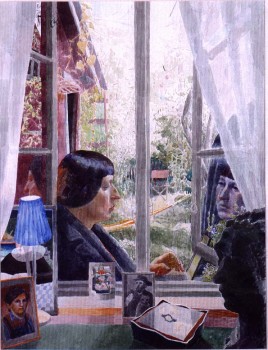
Portrait of the author: Leena Krohn, watercolour by Marjatta Hanhijoki (1998, WSOY)
In many of Leena Krohn’s books metamorphosis and paradox are central. In this article she takes a look at her own history of reading and writing, which to her are ‘the most human of metamorphoses’. Her first book, Vihreä vallankumous (‘The green revolution’, 1970), was for children; what, if anything, makes writing for children different from writing for adults?
Extracts from an essay published in Luovuuden lähteillä. Lasten- ja nuortenkirjailijat kertovat (‘At the sources of creativity. Writings by authors of books for children and young people’, edited by Päivi Heikkilä-Halttunen; The Finnish Institute for Children’s Literature & BTJ Kustannus, 2010)
What is writing? What is reading? I can still remember clearly the moment when, at the age of five, I saw signs become meanings. I had just woken up and taken down a book my mother had left on top of the chest of drawers, having read to us from it the previous day. It was Pilvihepo (‘The cloud-horse’) by Edith Unnerstad. I opened the book and as my eyes travelled along the lines, I understood what I saw. It was a second awakening, a moment of sudden realisation. I count that morning as one of the most significant of my life.
Learning to read lights up books. The dumb begin to speak. The dead come to life. The black letters look the same as they did before, and yet the change is thrilling. Reading and writing are among the most human of metamorphoses. More…