

Search results for "kjell west"
Back in the USSR
3 October 2011 | Fiction, Prose
Extracts from Rosa Liksom’s novel Hytti nro 6 (‘Compartment no 6’, WSOY, 2011). Review by Mervi Kantokorpi
Moscow hunched itself in the dry, frosty March night, protecting itself from the touch of the icy red sun as it set. The girl entered the train’s last sleeping carriage, found her compartment, compartment number six, and breathed deeply. There were four beds in the compartment, the upper ones folded agains the wall, while between the beds was a small table, on the table a white table cloth and a plastic flower vase containing a bunch of pink paper carnations, faded by time; the shelf above the end of the bed was full of large, untidily secured parcels. The girl shoved her modest old suitcase, the one she had got from Zahar, into the metal luggage space under the hard, narrow bed; her small backpack she threw on the bed. When the station bell sounded for the first time, the girl went to stand by the corridor window. She breathed in the scent of the train, iron, coal-dust, the smells left behind by dozens of cities and thousands of people. Travellers and those who had come to see them off pushed past her, shoving her with their cases and parcels. The girl touched the cold window with her hand and looked at the platform. This train would take her through villages inhabited by deportees, through the open and closed towns of Siberia to the capital of Mongolia, Ulan Bator. More…
A day in the life
30 September 1996 | Archives online, Fiction, Prose
Extracts from the novel Drakarna över Helsingfors (‘Kites over Helsingfors’, Söderströms, 1996). Introduction by Jyrki Kiiskinen
It is December 1970, it is Friday afternoon and Helsingfors is shrouded in a damp, leaden-grey fog when Jacke Pettersson, trainee electrician at Mid-Nyland Vocational College, signs a receipt for his driving licence at Vallgård Police Station.
At home in the flat in Svenska Gården in Munkshöjden: the very next evening Jacke sneaks his hand down into his father’s, typesetter K-G. Pettersson’s, overcoat pocket. It is getting on for 9 o’clock and KG is sitting deeply submerged in his favourite armchair, staring concentratedly at the premiere of a new show.
Six out of forty
make it every week
sings a bright girl’s voice.
Then: the Official Supervisors and their solemn ‘Good evening’. And then: the blonde girl in her mini-dress and high boots, the glass holder with its plastic balls, the plastic balls with numbers on. More…
Dead calm
31 December 2007 | Fiction, Prose
Extracts from the novel En lycklig liten ö (‘A happy little island’, Söderströms, 2007)
In the beginning the computer screen was without form, and void, and the scribe’s fingers rested on the keyboard.
The scribe bit his lower lip. His gaze travelled like a fly from the workroom’s crowded bookshelves to the rocking chair in front of the window and the coloured prints of birds on the walls. He went out into the kitchen and drank some water. Then he sat down in front of the computer again.
To create from nothing a fictitious world assisted only by the tools language places at our disposal, surely that must be a great and exacting undertaking!
The scribe hesitated and racked his brains for a long time before finally typing the first word: ‘sky’. Then after long thought he typed another word: ‘sea’. More…
Still alive
31 March 2000 | Fiction, Prose
Extracts from the novel Maa ilman vettä (‘A world without water’, Tammi, 1999)
The window opened on to a sunny street. Nevertheless, there was a pungent, sickbed smell in the room. There were blue roses on a white background on the wallpaper and, on the long wall, three landscape watercolours of identical size: a sea-shore with cliffs, a mountain stream, mountaintops. The room was equipped with white furniture and a massive wooden table. The television had been lifted on to a stool so that it could be seen from the bed.
The bed had been shifted to the centre of the room with its head against the rose-wall, as in a hospital. Between white sheets, supported by a large pillow, Sofia Elena lay awake in a half-sitting position. More…
On Matti Pulkkinen
30 June 1978 | Archives online, Authors
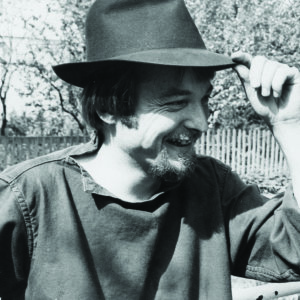
Matti Pulkkinen. Photo: Gummerus
Matti Pulkkinen’s grandfather was born in 1842 in a forest village close to the Russian border, in an area which could only be reached by water. When he grew up he became a tar-burner, a traditional occupation in north-east Finland. Pulkkinen’s father worked for the Otava Publishing Company in the early years of the present century, a time when ordinary Finns were beginning to show a real interest in literature. In his home in one of the most remote parts of North Karelia, he assembled a library which ranged from Mark Twain to the detective stories of G. K. Chesterton. He was 70 when his youngest son, Matti, was born in 1944. Dostoyevsky and Nietzsche were the two writers whose works did most to stimulate Matti Pulkkinen’s enthusiasm for literature. After leaving school he set out to see the world. He worked as a lumberjack, a primary school teacher, a statistics clerk in a gynaecological hospital, a bank teller, an accounts clerk, and later as a carpenter, took part in the restoration of the medieval church at Vanaja. From 1969 to 1971 Pulkkinen worked as a nurse in mental hospitals in Frankfurt, West Berlin and Bern. While in Switzerland he became interested in Jungian psychology and modern group therapy.
Pulkkinen’s novel, Ja pesäpuu itki (‘And the nesting-tree wept’, Gummerus), published in 1977, was awarded the J.H. Erkko Prize for the best first novel of the year and the Kalevi Jäntti Memorial Prize. It rapidly became a best seller and has already had two reprints. More…
Sealspotting
14 June 2009 | Reviews
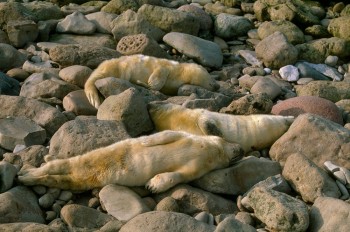
Zzzzzzz! In the grey seal kindergarten babies take a nap after dinner. – Photo: Seppo Keränen
Taskinen, Juha
Paluu Saimaalle
[Return to Lake Saimaa]
Helsinki: WSOY, 2009. 204 p., ill.
ISBN 978-951-0-33745-5
€ 38.90, hardback
Keränen, Seppo & Lappalainen, Markku
Hylkeet [The seals]
Helsinki: Maahenki, 2009. 151 p., ill.
ISBN 978-952-56-5266-6
€ 45, hardback
Sälar
Helsingfors: Söderströms, 2009.
151 p., ill.
Swedish translation: Annika Luther
ISBN 978-951-52-2603-7
€ 45, hardback
The private life of the species of seal that lives only in Lake Saimaa has been carefully investigated lately. Almost everything about this highly endangered species has been revealed, thanks to technological devices such as transmitters that can be glued to their backs…
STOP! WARNING: as I realise that not everybody wants to know what pinnipeds do in their spare time, I suggest you quit reading now, if you aren’t interested in the lives and fates of an obscure group of about 260 mammals that live in a lake in the remote west of Finland.
All aboard
30 December 2005 | Fiction, Prose
Extracts from the novel Nooakan parkki (‘Noahannah’s barque’, Tammi, 2005)
A Royal Navy Three-funnel Brig
The crew:
Matilda, an overeating cat
Five geese
20 hens
A fat narcoleptic cock
A couple of ducks
A goat
Three dogs
48 bats
Six woodpeckers
104 titmice
There’s a north-westerly blowing.
Djibouti 253
Three feet long from the east and five from the west, plus two hat-heights above the earth’s surface; standing on the sauna bench I scan the horizon for any omens – a raven, a woodpecker or a flock of waxwings. A crow would do. More…
Maire Gullichsen: Regnbågsfärger, mörka stänk. Minnesvandringar 1907–1928 [Rainbow colours, dark shadows. Journeys in memory 1907–1928]
19 March 2009 | Mini reviews
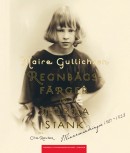 Maire Gullichsen: Regnbågsfärger, mörka stänk. Minnesvandringar 1907–1928
[Maire Gullichsen: Rainbow colours, dark shadows. Journeys in memory 1907–1928]
Red. [Ed. by] Cita Reuter
Helsingfors: Svenska Litteratursällskapet in Finland, 2008. 357 p., ill.
ISBN 978-951-583-165-1
€ 40, hardback
Maire Gullichsen, née Ahlström (1907–1990), an inheritor of the influential Ahlström timber, paper and metal company, was a prominent promoter of Finnish modern art, design and architecture and an art collector. In 1935, together with the architects Alvar and Aino Aalto and the journalist Nils-Gustav Hahl, she founded the design company Artek, which is still in business today. This book is based on her hitherto unpublished memoirs in which she recorded her life up to her marriage, to Harry Gullichsen, in 1928. Their home, Villa Mairea (1939) in the Ahlström family’s home district of Norrmark (Noormarkku) on Finland’s west coast, was designed by Alvar Aalto and remains one of the iconic examples of organic modernism. This richly illustrated volume gives a lively, detailed picture of a wealthy family during the tumultuous years of rapid industrialisation and struggle for independence in Finland. Maire Gullichsen’s daughter Professor Lilli Alanen and art historian Helen Woirhaye complement the author’s memoirs with articles providing information on the years after 1928.
Hamlet in blue velvet
22 January 2010 | Fiction, poetry
Physical, mythical, sensual, playful: Sirkka Turkka’s poems, never abstract, speak of life, death, dogs, horses, nature and humans. In her universe the humorous and the grave socialise without effort. These texts, in prose form, with Hamlet as one of the characters, are often set in a wintry landscape (see Nature girl)
Poems from Yö aukeaa kuin vilja (‘The night opens like corn’, Tammi, 1978)
Of his early childhood, Hamlet really only remembered his father’s slightly crooked and gnarled index finger, pointing at the lowest branch of a holly oak. A small owl sat on it. It can’t see anything, it’s asleep now. It won’t fly off until night. These were the only words Hamlet remembered his father saying to him during the first six years of his life. Later, all he saw of his father was his back, bent over in study of agricultural conditions in a village called Jawohl or of waterside traffic on the river Vistula at the turn of a particular century. When it came to governmental matters, the king placed his trust chiefly in his unconscious and in wheat bread, thick white slices of which he devoured from the moment he awoke. More…
Me and my shadow
Hotel Sapiens is a place where people are made to take refuge from the world that no longer is habitable to them; the world economy has fallen – like the House of Usher, in Edgar Allan Poe’s story – and with it, most of what is called a civilised society. A rapid synthetic evolution has taken humankind by surprise, and the world is now governed by inhuman entities called the Guardians. ‘Kuin astuisitte aurinkoon’ (‘As if stepping into the sun’) is a chapter from the novel Hotel Sapiens ja muita irrationaalisia kertomuksia (‘Hotel Sapiens and other irrational tales’, Teos, 2012), where several narrators tell their stories
The fog banks have dissipated; the sky is empty. I cannot see the sails or swells in its heights, nor the golden cathedrals or teetering towers. I would not have believed I could miss a fog bank, but that’s exactly what it’s like: its disappearance is making me uneasy. For all its flimsiness and perforations it was our protection, our shield against the sun’s fire and the stars’ stings. Now the relentlessly blazing sun has awakened colours and extracted shadows from their hiding places. The moist warmth has dried into heat and the Flower Seller’s herb spirals have dried up into skeletons. The leaves on the trees are full of bronze, sickly red and black spots. Though there is no wind and autumn is not yet here, they come loose as if of their own volition, as if they wanted to die.
This morning, as I was strolling up and down the park path as usual, I saw another shadow alongside my own.
– Ah, you’re back! I said. – I wondered what had happened to you after you lost your shadow; how did you manage to change into your own shadow yourself? More…
An end and a beginning
31 March 1982 | Archives online, Fiction, Prose
An extract from Det har aldrig hänt (‘It never happened’, 1977). Translated and introduced by W. Glyn Jones
There they are!
Over the ice they ride. The hoofs in rhythmical movement kick up the snow. The trail points north west. The sound of the hoofs is absorbed in the blue twilight of a March evening. The two horsemen push on, close together, passing one tiny island after another. Their eyes are fixed on a trail which has lain before them throughout the day. They are hunting like wolves. Yes, like wolves they are.
Or are they?
The twilight gives way to darkness and the black of night. The riders lean low over their horses in an attempt to follow the trail, but at last one of them raises his hand. The hunt is called off. The horses snort and toss their heads so their manes dance. Clouds of steam rise from them, enveloping the men as they dismount and lead their horses to an islet where the dark and deserted profile of a fisherman’s cabin can be glimpsed. Heaven knows who the hut belongs to, but it is a good thing that it is there with its walls and a roof, a shelter against the night. More…
Smart Moomins
27 June 2012 | This 'n' that
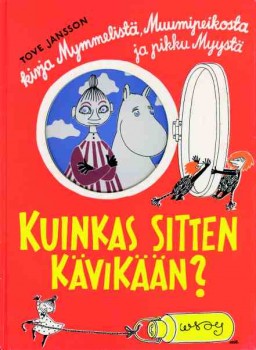
From page to screen: Tove Jansson's classic
‘Here’s little Moomintroll, none other,
Hurrying home with milk for Mother,’
are the opening lines of Tove Jansson’s classic 1952 illustrated children’s tale of a sister lost and found, The Book about Moomintroll, Mymble and Little My, in the English poet and novelist Sophie Hannah’s beguiling translation. (Swedish original: Hur gick det sen? Boken om Mymlan, Mumintrollet och Lilla My; illustration: the Finnish version.)
The book has now been released as a smartphone app by the London publisher Sort Of Books and Helsinki’s WSOY in collaboration with the Finnish developer Spinfy.
At the tap of a finger, birds fly, forest creatures crawl up and down tree-trunks, flowers open and close, fish jump and hattifatteners wiggle. Unlike in the Japanese animated cartoons that have done so much to make the Moomins well-known worldwide, this is achieved without doing any violence to Jansson’s original graphics.
The app can be played either in text or, for very small children, read-to mode, voiced by the actor Sam West. Three more Moomin apps are scheduled for release later this year.
Man and boy
31 December 2006 | Archives online, Fiction, Prose
Extracts from the novel Kansallismaisema (‘National landscape’ Tammi, 2006). Introduction by Tuomas Juntunen
Plans were afoot to establish boys’ camps across the country. This was an experiment, a chance to test the water, to be a pioneer. Here was the opportunity to be the first in line to conquer the Wild West, just as many a brave cowboy had done in years gone by. The Ministry of General Affairs planned to put all 15-year-olds to work for the duration of the summer holidays. Casual labourers were often even younger. Our task was to ascertain a suitable minimum age. In addition, special camps were planned for those not suited to normal work camps. In the summers to come the youth of Finland would be fully employed. Weren’t we in fact driven by the same desire, Tikka had wondered. We both cared about the next generation. We wanted to root out their deficiencies so that they would be able to face life’s challenges to the full. More…
Animal crackers
30 June 2004 | Children's books, Fiction
Fables from the children’s book Gepardi katsoo peiliin (‘A cheetah looks into the mirror’, Tammi, 2003). Illustrations by Kirsi Neuvonen
Rhinoceros
 The rhinoceros was late. She went blundering along a green tunnel she’d thrashed through the jungle. On her way, she plucked a leaf or two between her lips and could herself hear the thundering of her own feet. Snakes’ tails flashed away from the branches and apes bounded out of the rhino’s path, screaming. The rhino had booked an afternoon appointment and the sun had already passed the zenith.
When the rhinoceros finally arrived at the beautician’s, the cosmetologist had already prepared her mud bath. The rhino was able to throw herself straight in, and mud went splattering all round the wide hollow. More…