

Search results for "kjell west"
The summer of 1965
30 June 1995 | Archives online, Fiction, Prose
From Underbara kvinnor vid vatten (‘Wonderful Women by the Sea’, Söderströms, 1994; Finnish translation lhanat naiset rannalla, Otava, 1995). Introduction by Michel Ekman
The summer of 1965; this summer people go waterskiing. They go waterskiing behind the Lindberghs’ shining mahogany sportsboat, and from midsummer onwards they go water-skiing behind Gabbe’s outboard motorboat, an Evinrude bought second-hand from Robin Lindbergh. Now Bella and Rosa are skiing: Tupsu Lindbergh’s face is covered in freckles if you look at her close to, and it’s not particularly becoming, her fair hair is super-peroxided and she is as thin as a skeleton and everyone knows that it’s because she is so thin and ugly and not because she has a cold that she says she can’t take part in any watersports. There is something nervous about Tupsu Lindbergh. At Bella’s party at the beginning of the summer Tupsu Lindbergh sits on the white villa’s veranda, on the white villa’s lawn on a camping chair, on the white villa’s beach while Bella and Rosa go waterskiing and talk about Tupperware. Not Tupperware all the time, but Tupperware is the collective description. More…
Turku, city of culture 2011
21 January 2011 | In the news
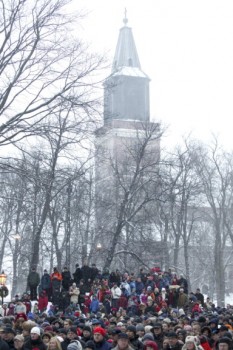
Passing the peace: citizens of Turku gathering to listen to the traditional declaration of peace at Christmas in front of the Cathedral. Photo: Esko Keski-oja
Since 1985, cities in the countries of the European Union have been chosen as European Capitals of Culture each year. More than 40 cities have been designated so far; a city is not chosen only for what it is but, more importantly, what it plans to do for year and also for what will remain after the year is over – the intention is that citizens and the local culture should profit from the investments made.
This year the two cities are Tallinn in Estonia and Turku, the oldest city and briefly (1809–1812) the capital of what was then the Grand Duchy of Finland, on the coast, 160 kilometres west of Helsinki. The pair will also co-operate in making this year a special one in their cultural lives.
The city of Turku declared its Cultural Capital year open on 15 January with a massive firework display glittering over the River Aura. This cultural capital enterprise, with a budget of 50 million euros and an ambitious programme will, hopefully, involve two million participants in the five thousand cultural events and occasions.
Front-Line Tourists
30 September 1976 | Archives online, Fiction, Prose
An extract from the novel Nahkapeitturien linjalla (‘On the tanners’ line’, 1976)
Paavo Rintala (born 1930) published his first novel in 1954 and since then has brought out a new book almost every year. A merciless critic of the myths surrounding certain national figures and events, he has written about Marshal Mannerheim, against attempts to glorify war, and the ‘inevitability’ of Finland’s involvment in the German Barbarossa plan. He has made considerable use of reportage technique to produce anti-war documentaries and in more recent years worked with international subjects.
His books have been widely translated and are popular in East and West Europe. Paavo Rintala’s novel Sissiluutnantti (‘Commando Lieuenant’, Otava 1963) and its reception were the subject of a book by the ltterary critic Pekka Tarkka (Paavo Rintalan saarna ja seurakunta. ‘Paavo Rintala’s sermon and congregation’, Otava 1966). Paavo Rintala is chairman of the Finnish Peace Committee. The passage below is taken from Nahkapeitturien linjalla (‘On the tanners’ line’, Otava 1976) in which he again turns his attention to the war years. Rintala looks at the events of the years leading up to the war and the course of the war itself through the eyes of many different people – from the leading politicians of the day to the ordinary soldier.
The novel has already been acclaimed as the monument to the ‘unknown soldier’ of the Winter War.

Hessu duly presented himself at the Viipuri office of the Army Information Department (Visitors’ Escort Section), where it was implied that the expected visitors were Very Important People and that a singular privilege was being conferred upon Hessu and such front-line troops that the party might visit. Although His Excellency Field-Marshal Mannerheim made it a rule never to allow front-line visits by ordinary journalists or even by special correspondents, these gentlemen were, it seemed, such influential people that H.E. had agreed to their visit without demur. “You understand, Padre, what a great responsibility this will be for you? These are very high-up people.” More…
Too much or too little love
31 March 1987 | Archives online, Authors, Reviews
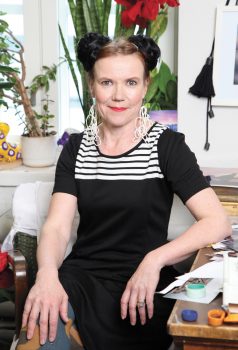
Rosa Liksom. Photo: Pekka Mustonen.
On the October day last year on which Rosa Liksom‘s second collection of short stories, Unohdettu vartti (‘The forgotten quarter’), was published, she also opened an art exhibition of her own work. The occasion took the form of a kind of cross between performance art and a practical joke. Young women dressed in Finnish military uniforms carried out body searches on every newcomer, changed the guard and drilled, while crackers exploded in the gallery. Many people were of the opinion that it was all no more than a silly joke. Even the art critics were not enthusiastic: they felt that Rosa Liksom’s felt pen work was derivative of a certain Danish artist who himself had copied the cartoon-like stick-men of the so-called Chicago school. But all the same, there emerged from the pictures a funny story about the artist’s adventures among the underground youth of Russia from Leningrad to Vladivostock.
Only her closest friends knew which of the soldiers in the gallery was Rosa Liksom, which her clones. Rosa Liksom is a pseudonym, and her little game of hide and seek has already lasted a couple of years. We know of her that she was born in Lapland, studied anthropology, has travelled in both East and West and lived for a long time in Copenhagen. Her writing was published for the first time in an anthology of the work of young authors, Kalenteri 84 (‘Calendar 84’, 1984). Her first work, the short story collection Yhden yön pysäkki (‘One-night stand’) was published in 1985 and achieved considerable success. More…
What God said
3 September 2009 | Fiction, Prose
Extracts from the novel Herra Darwinin puutarhuri (Otava, 2009; Mr Darwin’s Gardener, Peirene Press, 2013). Interview by Soila Lehtonen
The congregation sits in the church pews and the jackdaws caw in the belfry.
We smell of wet dog, the rain made us wet and it is cold but the singing warms us, the hymn rises to the roof and above the roof dwells God, Amen.
We saw Thomas Davies on the hill, he is working in Mr Darwin’s garden,
the atheist and lunatic, he stood in the field alone and the water lashed his face
an irreligious pit pony wandering in the darkness he is from Wales
does the godless man think he can stand in the rain without getting wet did he get an umbrella or bat wings from the devil
perhaps Thomas imagines that he can hold back the rain and the rain not hold him back, he thinks he is more exalted than God with his head in the clouds
The church’s hard pews press into posteriors, the poor man will not grow fatter, for there are no fat and lean years but only lean ones, and thin are the poor man’s sheep and cows and children too, but the rich man cultivates weeds for his amusement as Mr Darwin did and earns money and fame! More…
When sleeping dogs wake
31 December 1994 | Archives online, Fiction, Prose
Extracts rom the novel Tuomari Müller, hieno mies (‘Judge Müller, a fine man’, WSOY, 1994). Introduction by Soila Lehtonen
In due course the door to the flat was opened, and a stoutish, quiet-looking woman admitted the three men, showed them where to hang their coats, indicated an open door straight ahead of them, and herself disappeared through another door.
After briefly elbowing each other in front of the mirror, the visitors took a deep breath and entered the room. The gardener was the last to go in. The home help, or whatever she was, brought in a pot of coffee and placed it on a tray, on which cups had already been set out, within reach of her mistress. The widow herself remained seated. They shook hands with her in tum. The mayor was greeted with a smile, but the bank manager and the gardener were not expected, and their presence came as a shock. She pulled herself together and invited the gentlemen to seat themselves, side by side, facing her across the table. They heard the front door slam shut: presumably the home help had gone out. More…
Coolness and warmth
21 April 2011 | Reviews
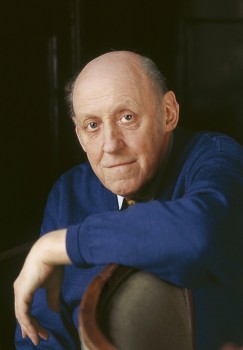
Bo Carpelan. Photo: Irmeli Jung
The coolness on the mountain
streams of water, black forests
in the west a growing light
foreboding sleep
These lines are from Gramina, the twenty-second and last collection of verse by the Finland-Swedish poet Bo Carpelan, which appeared last summer.
The short poem captures much of what was typical of Carpelan’s poetic style: a visually sharp and objective image which juxtaposes the world we see with a sense of something different, undefined. Time the unstoppable, which changes everything, was his central theme, and it also figures here.
Carpelan (1926–2011) made his debut in 1946 and was hailed early on as a renewer of the modernist tradition that in Finland began in the early 20th century with Edith Södergran (1892–1923) and Elmer Diktonius (1896–1961). He combined the Finnish-Swedish heritage of reflective nature poetry with imagistic stimuli from Swedish- and English-language modernism. More…
How to build a Finlandia Prize-winning novel
4 December 2009 | In the news
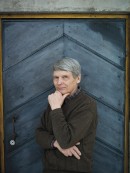
Antti Hyry
The Finlandia Prize for Fiction 2009, worth €30,000, was awarded to Antti Hyry (born 1931) on 2nd December; his novel about building a stove, Uuni (‘The stove’, Otava), was chosen by the art historian and former director of the Finnish National Gallery, Tuula Arkio, from a shortlist of six. More…
So many words
25 April 2012 | Articles, Non-fiction
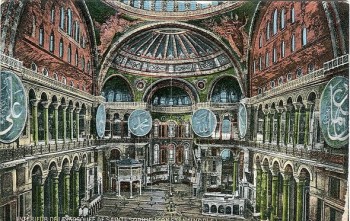
Hagia Sofia, Istanbul: from basilica to cathedral to mosque to museum. Postcard, c. 1914. Photo: Wikipedia/Xenophon
Sacred spaces, repositories of free speech, places of healing? Teemu Manninen awaits the day when libraries become virtual, enabling anybody to visit them, without having to travel across land and sea
The Bodleian Library in Oxford, the Vatican Library, the Bibliotheque Nationale in Paris, New York Public Library, the British Museum Reading Room, the Real Gabinete Portugues De Leitura in Rio De Janeiro, the Library of Congress and the National Library of Finland.
What do all of these have in common, except the obvious fact that they are all famous libraries? To put it another way: why are these famous libraries so famous?
It is not because they have books in them, although that has become one of the main tasks of the library system in the modern world. But a library is not simply an archive. If we in the West are a culture of the book – a culture of the freedom of information and expression – then a library is the architectural incarnation of our way of life: a church built for reading. More…
Dear diary
18 October 2012 | Authors, Extracts, Non-fiction, poetry
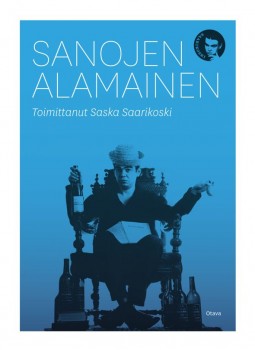 The poet and translator Pentti Saarikoski (1937–1983) was a legend in his own lifetime, a media darling, a public drinker who had five children with four women. His oeuvre nevertheless encompasses 30 works, and his translations include Homer and James Joyce. The journalist Saska Saarikoski (born 1963) has finally read all that work – in search of the father whom he seldom met. The following samples are from his annotated selection of Pentti Saarikoski’s thoughts over 30 years, Sanojen alamainen (‘Servant of words’, Otava, 2012; see Figuring out father)
I try to write books whose reading will bring enjoyment, in other words not entertaining ones.
Suomentajan päiväkirjat (‘Translator’s diaries’, 1970)
The term ‘world literature’ was invented by Goethe to describe the importance of Goethe.
Päiväkirjat (‘Diaries’, 1978)
A work of art is bad if it ‘makes you think’. About something other than itself. What is wrong with ‘art for art’s sake’ – or bread for bread’s sake? Art is art and bread is bread, and people need both in their diet.
Päiväkirjat (‘Diaries’, 1978) More…
Madness and method
10 May 2012 | Authors, Reviews
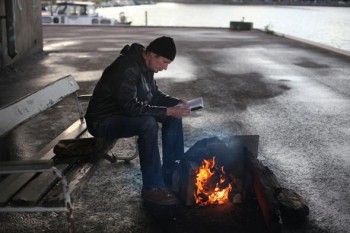
Juha Hurme. Photo: Stefan Bremer
One day during Advent in Helsinki the narrator in the novel Hullu (‘The lunatic’, Teos, 2012), a middle-aged man, goes mad.
Complete confusion fills his mind. He thinks he must be dead, but nevertheless manages to knock on the door of the mental hospital. To his amazement, he is admitted to the yellow building.
Because the boundaries between reality and self are, for him, completely blurred, he believes that the people in the hospital know absolutely everything about his unsuccessful life, and that he must expect humiliations and punishments. The people in white coats are aliens, or perhaps holograms. More…
On Eeva-Liisa Manner
31 December 1978 | Archives online, Authors
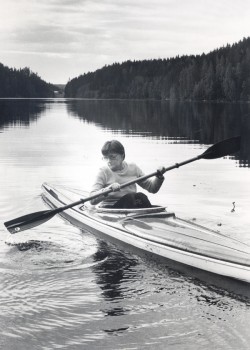
Eeva-Liisa Manner. Photo: Tammi.
It is difficult to discuss Eeva-Liisa Manner’s poetry in isolation from her other writing. In both prose and drama she is a significant figure in Finnish literature, and, for instance, one of her plays – Poltettu oranssi (‘The burnt-out orange’) – had a nine-year run at the Tampere Workers’ Theatre.
Seen from one angle, a Manner poem is an opportunity to speak, to have a say on the day’s occurrences, such as the occupation of Czechoslovakia in 1968. Yet a poem of hers is always distanced. Perhaps it is mediated through the eternal myth of the East and West; or perhaps the events are seen from some altered perspective – from ‘a distant present’. Our own time may be seen, for example, from the point of view of the Cambrian Age. Myths and the animals associated with myth are consciously brought forward by the ‘I’ of the poems, always with a delicate irony. The horse is the most prominent and beloved of these beasts (the Creator ‘succeeded best’ with him), and he is identified with Jung’s animus. Discursive philosophy is not prominent in Finland. Finnish philosophers tend to be philosophers of science and technology – the purveyors of wisdom are the poets, and they are by no means bad at it. Taking a risk with the reader’s indulgence I could define Eeva-Liisa Manner as a philosophical poet meaning that her lyricism is charged with implication. The fine control of semantic content, as always in lyrical poetry, is achieved through her imagery and music; but her thematic centres, the problems she confronts, are seriously or ironically philosophical. In some of her poems, such as ‘A Logical Tale’. she may actually build up the lyric within an apparently tight case of thought; this is, of course, both a dig at philosophy and a philosophical point. Sometimes the digs are very hard. The nuances are many. More…
Air, blue and gold
16 January 2014 | Fiction, poetry
Poems. Introduction by Tuula Hökkä
The arch bridge
From Ylitse vuoren lasisen (‘Over the glass mountain’, 1949)
And God said: to others I’ll give other tasks, but the task I’ll give to you
is to make a curving bridge, my child, with an arch that’s round and true.
For everywhere around the earth human beings are laden with gloom,
and they’ll come to cross an arching bridge in their anguish and their doom.
Make a bridge that spans the precipice, a bridge over the abyss,
one that shines to my glory with radiance, sparkling like this.
I said: They will come with heavy boots, and heels caked with clay –
how can my bridge withstand their weight, yet also shine this way,
not tarnish or break apart as their crowding presence nears?
And God said: well, it can only be done by means of blood and tears.
Your heart is stronger than mountain rock, the ore that’s buried there –
Put a piece of it into the bridge support, and you’ll get the bridge to bear.
Add a piece of the hearts of those you love, and I know they won’t condemn,
but will surely grant you forgiveness if you make a bridge for them.
Make a bridge to the glory of God, my child, make a bridge with arching light
that will span the depths and shine for ever, with radiance sparkling bright.
Don’t lock the sorrow out of your heart as the bridge you make appears.
Nothing gleams more beautifully than the brilliance of pure tears. More…