

Search results for "kjell west"
The Conference
31 December 1978 | Archives online, Fiction, Prose
A short story from Alamaisen kyyneleet (‘Tears of an underdog’, Karisto 1970). Introduction by Pekka Tarkka
Dr Smith said that he did not believe that any immediate threat of an invasion from Space was likely to arise for some time. Observations to date had given no support to the view that any such preparations had been put in hand. Technically they were of course ahead of us, but in his opinion there was no cause for panic. Nor could he endorse the widespread but naive assumption that any confrontation with beings from Space must inevitably lead to war. If human beings had reason to feel threatened, it was from each other that the chief threat came. He urged the Conference to work for a situation in which every country would be preparing for peace rather than for war. He said he had no wish to sound sardonic, but that he had noticed that when war was prepared for, it was usually war that ensued. More…
Onward, downward!
31 March 1994 | Archives online, Fiction, Prose
Lauri Viita (1916–1965) was one of the self-taught writers who made his debut after the Second World War. His extensive, realist novel Moreeni (‘Moraine’, 1950) taking place in Viita’s native Tampere, begins with this prose poem
…over wolds, hummocks, ridges, between boulders, under branches, from cabin to cottage to manor, from coppice to fen, and ditch to puddle – down it drew us, the sloping earthcrust, southward the magnificent granite ploughland slanted.
Paths linked to paths, brooks joined brooks. Onward, downward! The roads widened, the currents strengthened. Bigger and bigger, heavier and heavier were the loads they could sustain. More and more trees, bread, potatoes, butter, meat, people and gravestones, huge boulders, rocks, went into the maw of those channels, and the hunger only redoubled. From channel to strait, from hour to hour, the lines of barges crawled along; from day to day the broad rafts of logs passed their sleepless summer on the long blue strip of Lake Näsijärvi. Spruce, pine, birch, aspen – different pieces for different purposes. How vast the supply and how vast the need! The months and days went by; in the depths of the lake, layer after layer, there wandered the shades of clouds, ships, faces. More…
Breton without tears
31 March 1994 | Archives online, Fiction, Prose
Extracts from Euroopan reuna (‘The edge of Europe’, Otava, 1982). Introduction by H. K. Riikonen
I am reading a book, it says pour l’homme latin ou grec, un forme correspond à un être; pour le Celte, tout est metamorphose, un même individu peut prendre des apparences diverses, so it says in the book. A strange claim, considering that the word metamorphosis is Greek, and that the best-known book about metamorphoses, Ovid’s Metamorphoseon libri XV was written in Latin. In the myths of all peoples, at least the ones whose oral poetry was recorded in time, such as the Greeks, Serbs, Slavs, Finns, or Aztecs, metamorphoses play a very important part, the Celts are not an exceptional tribe in this respect. The author must mean that the Celts still live in mythical time, the time of metamorphoses when the human being assumed shapes, was able to fly as a bird, swim as a fish, howl as a wolf, and to crown his career by rising up into the sky as a constellation. Brittany is part of the Armorica Joyce tells us about in Finnegans Wake, that book is incomprehensible if one does not know Ireland, and now I see that Brittany is the key to one of the book’s locked rooms. I thought I already had keys to all the rooms after Dublin, the Vatican, and Athens, but one door was and remained closed, the key is here now, in my hand, I can get into all the rooms in the book, and I am home even if I should happen to get lost. The room creates the person, she becomes another when she goes from one room to another, this is metamorphosis, and when she leaves the house she disappears, she no longer exists. The legend on the temple at Delphi, gnothi seauton, know thyself, has led Occidentals onto the false track that is now becoming a dead end, polytheistic religions correspond to the order of nature, but as soon as the human starts to imagine that she knows herself, as soon as the metamorphic era ends, monotheism is born, the human being creates god in her own image, and that is the source of all evil. Planted like traffic signs at the far end of this cul-de-sac stand the hitlers and brezhnevs and reagans and thatchers, new leaves are appearing on the trees, the sun is shining. Landet som icke är* är en paradox: landet blev befintligt därigenom att Edith Södergran sade att det icke är. On the sea sailed a silent ship*, as I tracked my shoeprints across the sand on the beach, it was like walking on a street made out of salty raw sugar, I felt desolate. The wind bent the grasses, the sun warmed the back of my sweater, of course the sun always has the last word, I thought, things should be as they are, this thought gave me peace of mind. I walked past the cows, two of them already chewing the cud, the others still grazing, they stood in a line and raised their heads, stood at attention, as it were, as I walked past. I was not entirely sure that I was heading in the right direction, but then I saw the boucherie and knew that there was a café nearby. Madame greeted me in a friendly fashion, brought me a calvados and a beer and sat down for a chat, wanted to know if I liked the countryside here. I said that things looked the same here as in Ireland, she said that was true, but she had never been to Ireland. I finished my drinks and paid, left, decided to walk along the beach. I saw gun emplacements and two bunkers. I crawled into a bunker. Inside, it was dark and damp. I looked through the embrasure at the sea. I thought of the boys who had been incarcerated here. They had been given a death sentence. I examined a rusty object, what was it, I looked at it more closely, it was an axle from a gun’s undercarriage. As I arrive in my home yard, I note that the lilacs are beginning to bloom. More…
Letter to the wind
30 September 2002 | Archives online, Fiction, Prose
A short story from Haapaperhonen (‘The butterfly’, Gummerus, 2002). Introduction by Kristina Carlson
When Father comes to visit me, he sometimes sings a hymn. I can’t ask him not to. But when he doesn’t, I wonder why not, whether there’s something up with him. I can’t ask him to sing, but something is missing, the same thing that there seems to be too much of when he sings. It’s too much, but I miss it when it’s not there. I wonder about it after Father’s gone; my thoughts curl into dreams and I sleep.
When I sleep I don’t know I’m here, in a strange place. I’m at home, sleeping at home, in my own bed. The window is the right size, not too big like it is here; here there isn’t really a window at all, half the wall is missing and instead there’s glass. Behind a glass wall it’s not safe, everything is taken through it, including me. But sleep takes me to safety; I’m at home there. I breathe it peacefully. In the cabin there are two breathings, mine and Turo’s, and in the bedroom Father’s breathing. They are in no hurry to drive time away; time can linger, sleep, the moment of night, and when sleep withdraws there is no hurry either; I can sit in peace on the window seat and gaze at the cloudy, moonlit yard. The apple tree is asleep; it’s the only one. The fieldfares ate the apples before we could pick them, but it did not bother me or Father. It was good to look at the flock of fieldfares making a meal of the apple tree. Then they went away. More…
Do you remember the yellow house?
14 February 2011 | Fiction, Prose
Extracts from the novel Enkelten kirja (‘The book of angels’, Tammi, 2010)
[Tallinn, summer] The past will not go away
and the present is insurmountable. Summer vacation has begun, the newspaper hasn’t come; it doesn’t get delivered here anyway. Can you remember the Isabelline yellow house? Remember the alley with the name that means hurry? Surely you remember the home with all the maps on the shelves, the important papers and the brass objects bought from nearby antique dealers? Also the rugs from North Africa and the obligatory cedar camel figurines on the windowsill. And so many glasses and plates and empty lighters in a cardboard box on the shelf on the left hand side of the kitchen.
Tallinn, June 7th. The floors creak. One step has split in half; some of the lights have burned out. This is a lovely home. A small window upstairs is ajar to the courtyard. Tuomas had latched it behind the Virginia creepers. The fountain in the courtyard is dry. On cold nights the smoke from the fireplace grows like a statue for the crows until it wraps around over the layered rooftops like a snake eating its tail. Russian men are repairing the attic of the house across the street for wealthy people to live in; they laugh in front of the window and smoke. Tuomas waves at them, and they wave back. The courtyard is creepy when it’s empty. Soon the neighbours would go about their day and quietly close their doors behind them, and two nearby churches would divide the hours into quarters, Russians and their gossip would make their way to the Alexander Nevski Cathedral, and the Estonians and their gossip would go to their own churches where a wise and peculiar, almost human scent would rise from between the headstones. Tuomas wouldn’t smell it, Aino would and would move to stand beneath the the center tower. More…
The faraway island
31 March 2007 | Archives online, Fiction, Prose
Kaukainen saari, a short story from the collection Elämän ja kuoleman pidot (‘The feast of life and death’, 1945). Introduction by Juhani Niemi
For as long as they could remember, Hannes and Pekka had felt a great fascination for the lonely little island out in the open sea, clearly visible from the shore at home. Thickly overgrown with unusually tall pines, the island was like a wondrous bouquet in a great vase of sea. It was in sunshine from morning till night. At the very instant that the tip of the sun peeped up over the horizon, its rays were already caressing the tops of the little island’s tallest trees, and when the sun set behind the blackness of the islands to the west, those same treetops were tinged with a bright, hot glow. The winds and storms touched it more vehemently than any other place. No matter which direction the wind came from, the island was always defenseless, but, happily, ready for anything. In stormy weather the waves flung themselves against its stony shore and sometimes nearly as high as the treetops. The wind roared in the dense branches of its trees more wildly and violently than anywhere else. When it rained, it was as if the island were hiding among the grey curtains of mist, looming dimly and secretly. In the autumn, when all the other woods were splashed along their flanks with yellow and russet, and gradually undressed until they were half-naked, the little island’s tall pine trees rose up from the grim autumn surf as lush and green as always. And in the winter, when the sea froze and snow covered everything in a mantle of white, the island dressed itself in ice and rimy frost like royal robes covered in millions of sparkling diamonds. More…
New from the archive
17 March 2015 | This 'n' that
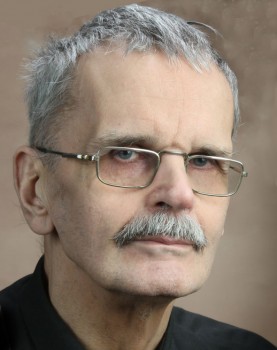
Gösta Ågren. Photo: Studio Paschinsky
Back in the day, in one of our periodic excursions into merchandising – the main criteria were that our goods should be flat (to fit into an envelope) and, of course, literary – we printed Books from Finland t-shirts. They were wildly popular – we must have sold, oh, dozens of them – and top of the list was a shirt with a laconic couplet by Gösta Ågren: ‘Don’t worry / it will never work out.’
Writing in Swedish and hailing from a small village in Ostrobothnia, in the far north-west of Finland, Ågren (born 1936) is the author of poems, essays and biographies. He may often choose to adopt the persona of a country curmudgeon, but the laconic tone of his poems belies a tenderness, a universalism, and an underlying political commitment, that speaks of a love of the world, a desire to make it into a better place.
The volume from which these poems are taken, Jär (‘Here’, 1989), won the Finlandia Prize for Literature in 1989.
*
The digitisation of Books from Finland continues, with a total of 372 articles and book extracts made available online so far. Each week, we bring a newly digitised text to your attention.
Pekka Lassila: Maininki [Surge]
5 May 2015 | Mini reviews, Reviews
 Pekka Lassila
Maininki [Surge]
Helsinki: Tammi, 2014. 278 pp., ill.
ISBN 978-951-31-8126-0
€36, hardback
This book is a journal of a ‘survival project’: a continuous kayak voyage of 1,300 kilometres along the Finnish coast, from the eastern border (Russia) to the northwestern one (Sweden). Pekka Lassila (born 1959) is a photojournalist who, in an attempt to find a way out of the crisis of losing a job he had heald for thirty years, set off on his voyage in May, when the ice had only just melted. Nights were spent mostly in a tent; all washing up had to be done with sea water. Lassila blogged daily for newspapers by the power of his solar-charged phone and tablet. This solitary endeavour seems slightly obsessive at first – but the stories about the geography and history of the places passed by and the descriptions of the personal daily marine routines turn out to be interesting, never repetitive. The shallow west coast, the Gulf of Finland, even proves to be dangerous: the waves, growing rough, threaten to crush the kayak on the rocks, but Lassila’s paddling skills and luck save him. The photographs, taken each day, illustrate the voyage well (even though it is irritating that there are no captions!). Reaching his goal, after 31 days, Lassila manages to complete his ‘project’ – but confesses that he may only later fully understand the reasons why he set out.
Being God
30 September 2006 | Fiction, Prose
Extracts from the novel Gud (‘God’, Schildts, 2006)
Side by side, wolves and antelopes graze on the juicy grass.
A deer playfully chases a lion through the bushes.
‘Can you do this?’
Adam crosses his arms in front of his chest and folds his hands back to front so that the right hand is on the left and the left hand is on the right. With his hands folded he twists them downwards and holds them out. Now they point to Eve, still folded, and still with the right hand on the left.
Eve tries. She succeeds, and laughs with delight.
A gentle breeze is blowing from the east, just strongly enough for the couple not to be troubled by the heat, but not so they would feel the need for clothes to keep them warm. More…
Two men in a boat
The meaning of life, Bob Dylan, the broken thermostat of the Earth, the authors Ambrose Bierce and Aleksis Kivi…. Two severely culturally-inclined men set out to row a boat some 700 kilometres along the Finnish coastline, and there is no shortage of things to discuss. Extracts from the novel Nyljetyt ajatukset (‘Fleeced thoughts’, Teos, 2014)
The red sphere of the sun plopped into the sea.
At 23.09 official summertime Köpi announced the reading from his wind-up pocket-watch.
‘There she goes,’ commented Aimo, gazing at the sunken red of the horizon, ‘but don’t you think it’ll pop back up again in another quarter of an hour, unless something absolutely amazing and new happens in the universe and the solar system tonight!’
Aimo pulled long, accelerating sweeps with his oars, slurped the phlegm in his throat, spat a gob overboard, smacked his lips and adjusted his tongue on its marks behind his teeth. There’s a respectable amount of talk about to come out of there, thought Köpi about his old friend’s gestures, and he was right.
‘Sure thing,’ was Aimo’s opening move, ‘darkness. Darkness, that’s the thing. I want to talk about it and on its behalf just now, now in particular, while we’re rowing on the shimmering sea at the lightest point of the summer. More…