

Search results for "tommi+musturi/2010/05/song-without-words/2009/09/what-god-said"
Decent people
30 December 1998 | Fiction, Prose
The former newspaper reporter Jari Tervo (born 1959), now a successful novelist and quiz-show celebrity, writes about the seamier side of life. His subjects are mostly petty criminals and losers, but his crisp language is always a winner. And he can find a story even in a pork chop…. A short story from Taksirengin rakkaus (‘The love of the taxi-driver’, WSOY, 1998). Introduction by Suvi Ahola
The shopkeeper ran after the thief and caught him. The people in the parking lot of the S-Market made a fuss. The thief took fright when he found himself grasped by the scruff of the neck by a man the size of a baseball player. The shopkeeper removed the thief’s stomach. It turned out to be a packet of pork chops. They were not on special offer.
The thief stammered. The shopkeeper just had time to think that was the worst thing after snivelling when the thief started to snivel. The shopkeeper began to feel infuriatingly sorry for the thief’s arm, which was in a sling. Even his clothes were ugly. He let the thief go with a kick. I’m too good to be a shopkeeper, the shopkeeper thought delightedly, thanked the onlookers for their applause and put the packet of chops back on the shelf, where it was bought by a housewife. More…
It’s only me
Extracts from the autobiographical novel Pienin yhteinen jaettava (‘Lowest common multiple’, WSOY, 1998)
The weather had not yet broken, although it was September; I had been away for two weeks.
The linden trees of the North Shore drooped their dusty leaves in a tired and melancholy way. Even the new windows were already sticky and dusty. The flat was covered in thick, stiff plastic sheeting. The chairs, the books, the Tibetan tankas and the negro orchestra I had bought in Stockholm glimmered beneath the plastic ice like salvage from the Titanic.
The windows had been replaced while I had been in Korea.
I unpacked the gifts from my suitcase. Lost in the sea of plastic, the little Korean objects looked shipwrecked and ridiculous.
My temperature was rising; it had been troubling me for more than a week.
I smiled and said something, not mentioning my temperature.
It was time to be a mother again, and a life-companion.
And a daughter…. More…
Oedipus Cleverclogs
30 September 1997 | Archives online, Fiction, Prose
A short story from Ammattimies (‘The professional’, Tammi, 1997)
I had just pounded the life out of a couple of Germans when mother appeared at the door of my room, her blonde hair in a bun, in her white nightdress, through which I could clearly see the outline of her figure. She looked at me a little pityingly and suggested that we should go out for a meal at the weekend, just the two of us. I nodded and went back to concentrating on my acts of heroism.
And mother did not break her promise. Although she did not earn much as the junior cook at the children’s home, that did not stop us eating out. She took me to a good restaurant that was right on the harbour, in the shadow of the old steamships. The night before, she had ironed my only white shirt and hung it on a hanger with my terylene trousers. My mother had dressed me in the same outfit on my first day at school. I was decidedly over-dressed that day, but I put a good face on it. Mother’s men must always look their best. More…
Journey to the first palm tree
16 October 2014 | Fiction, Prose
Teemu is a fat, desperate middle-aged man who’s had it with life – he drives his old Lada to Spain, where he intends to commit suicide by letting himself be trampled to death by bulls in the Pamplona bullrun. (However, there is a chance of this tragedy being cancelled, thanks to a tenacious hitch-hiker, female.) An extract from the novel Särkyvää (‘Fragile’, Tammi, 2014)
When I was seventeen, I yearned to leave behind the small town where I grew up. I heard the owl hooting in the forest: go to Europe.
I heard the dirt-track gravel crunching beneath my shoes: run, lad, run.
The birch in the yard rustled and whispered: if you spend one more summer hanging around the garden of your childhood, you’ll stay here forever.
A frog in the ditch gave a stern croak: look at your father; if you don’t escape you’ll end up an old codger just like him.
Even the smoke twirling up from the sauna chimney spoke to me in billows: I’ll show you the right direction, head south, and don’t stop until you see the first camel. More…
An evening with Mr Popotamus
31 March 2004 | Archives online, Fiction, Prose
‘Hippopotamus’, a short story from Kävelymusiikkia pienille virtahevoille (‘Passacaglia for small hippopotami’, Tammi, 1958). Introduction by Tuula Hökkä
Someone came gasping up behind me at high speed, stopped, and thrust a bundle under my arm, whispering hoarsely and agitatedly: ‘Keep hold of this, hide it! They’re after me –’ And before I’d woken up to what was going on he’d disappeared round a corner.
I was holding a warm living creature, a hippopotamus. Presumably stolen from some zoo or some private person who loved hippopotami; perhaps the man was a sailor and had brought the animal from abroad.
However it was, the hippo needed a safe place. I decided to take it home; I’d had cats and dogs, hadn’t I? – and once a little marmot. I’d always longed for a giraffe. OK, a hippo was just as good. After all, I could put an ad in the paper later: ‘Found: a hippopotamus. Hippo returned on production of identification marks.’ More…
The storm
From the collection of short stories Tvåsamhet (‘Two alone’, Söderströms, 2005). Introduction by Tiia Strandén
A storm blows up during the night. As he lies in bed, not yet asleep, just lingering on the brink of falling, in that soft yet sensitive state where sounds seem to grow and get bigger, he can hear the clattering, hissing sound of the wind coming up out there and sweeping up everything not fastened down, capable of being put in motion. It scrapes against the roof and window, loosens leaves and pine needles which scud across the ground, and it whistles and whines round the chimney and the windows, and it even beats against the shed door, which Dad must have forgotten to shut properly before he came in. Before he stamped the mud off his boots in the front hall. Before he had a chance to pull the front door shut firmly as well, because Joakim can hear how he brings the storm into the hall with him, and it sweeps through the kitchen faster than he ever could have imagined. Joakim shuts his eyes tighter, even though he is no longer really awake, and he hears the powerful gust flap past Dad, who is still standing with his hand on the door handle, and then Mum starts shouting because the wind is slamming into the furniture and making dishes crash to the floor and making pots and pans do the same. When Dad starts shouting as well, Joakim lets go of the last little bit of wakefulness and lets himself sink down into the cradle of dreams to be carried along until the morning. It is the sun that wakes him, or maybe the sound of the telephone, because he wakes up just as it rings, but in any case it has stopped blowing, and the branches of the big lilac bush outside the window are completely still. More…
Arrest
31 December 1990 | Archives online, Fiction, Prose
An extract from the novel Jäniksen vuosi (‘The year of the hare’). Introduction by Mirja Bolgár
About mid-June Vatanen’s travels had taken him as far as the road to Nurmes. It was raining. He was cold.
He’d just hopped out of the coach from Kuopio, now on its way to Nurmes; so here he was, stuck on a rainy highway, getting soaked because of a snap decision. The village of Nilsiä was miles off.
The hare’s back leg had mended. Almost full-grown it was, now, that hare: good job it still fitted into the basket.
But, anyway, round the comer was a house: a bungalow with attic space – not a bad-looking set-up. Might as well call, Vatanen decided, and see if there’s a night’s lodging going. A woman in a raincoat was scratching away at the garden, her hands black with soil. And old woman – and a picture of his wife flashed though his mind: there was something of his wife about her. More…
A womanly pursuit
30 December 2007 | Archives online, Authors, Reviews
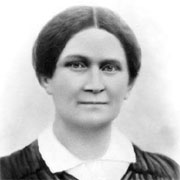
Fredrika Runeberg. Photo: Svenska litteratursällskapet i Finland
The wife of the national poet was not herself expected to write – quite the reverse, in fact. But, says Merete Mazzarella, Fredrika Runeberg (1804–1877) did
She was married to the national poet.
What is a national poet? Someone who is hugely admired in his own time, who helps to forge a national identity, who appears to bear the responsibility for the future of his people on his shoulders. Young nations like Finland – before 1809 a part of Sweden, from 1809 to 1917 an autonomous Grand Duchy under the Russian tsar – need national poets; old nations – like Sweden or Denmark – do not. A national poet is a father figure, thus almost inevitably a man.
Johan Ludvig Runeberg (1804–1877) was to become the national poet of Finland; a journalist, teacher and writer. The first poem from his collection of epic poems, Fänrik Ståls sägner (‘The tales of Ensign Stål’, 1848–60), became the national anthem. Since he was Swedish-speaking – as was the whole of the educated class at that time – we have an interesting paradox: his concept of the Finnish national character was actually created in Swedish. More…
About us
8 January 2009 |
The Books from Finland online journal ceased operation on 1 July 2015, and no new articles will be published on the site.
A comprehensive online archive is available for readers to access. Brief extracts from Books from Finland may be quoted, provided that the source is cited.
If you wish to use longer extracts, please contact .

Books from Finland, an independent English-language literary journal, was aimed at readers interested in Finnish literature and culture. Its online archive constitutes a wide-ranging collection of Finnish writing in English: over 550 short pieces and extracts from longer works by Finnish authors were published from 1967 onwards.
Books from Finland featured classics as well as new writing, fiction and non-fiction, and other materials aimed at giving readers additional information on Finnish society and the wellsprings of Finnish literature. The target audience encompasses literary and publishing professionals, editors, journalists, translators, researchers, students, universities, Finns living abroad and everyone else with an interest in Finland and its literature.
Of course, publishing Finnish and Finland-Swedish literature in English requires skilled translators. Books from Finland’s editorial policy was always to use native English-speaking translators. In recent years David Hackston, Hildi Hawkins, Emily & Fleur Jeremiah, David McDuff, Lola Rogers, Neil Smith, Jill Timbers, Ruth Urbom and Owen Witesman translated for us.
Books from Finland was founded in 1967 and appeared in print format up to the end of 2008. From 2009 to 2015 it was an online publication. The journal’s archives have been fully digitised, and remaining issues will be made available in late 2015.
The Finnish Book Publishers’ Association (Suomen Kustannusyhdistys, SKY) began publishing the print edition of Books from Finland in 1967 with grant support from the Finnish Ministry of Education and Culture. In 1974 the Finnish Library Association (Suomen Kirjastoseura) took over as publisher until 1976, when it was succeeded by the Helsinki University Library, which remained as the journal’s publisher for the next 26 years. In 2003 publishing duties were handed over to the Finnish Literature Society (Suomalaisen Kirjallisuuden Seura, SKS) and its FILI division, which remained its home until 2015. The journal received financial assistance from the Finnish Ministry of Education and Culture throughout its 48 years of existence.
The editors-in-chief of Books from Finland were Prof. Kai Laitinen (1976–1989), journalist and critic Erkka Lehtola (1990–1995), author Jyrki Kiiskinen (1996–2000), author and journalist Kristina Carlson (2002–2006), and journalist and critic Soila Lehtonen (2007–2014), who had previously been deputy editor. The journal was designed by artist and graphic designer Erik Bruun from 1976 to 1989 and thereafter by a series of graphic designers: Ilkka Kärkkäinen (1990–1997), Jorma Hinkka (1998–2006) and Timo Numminen (2007–2008).
In 1976 Marja-Leena Rautalin, the director of the Finnish Literature Information Centre (now known as FILI), became deputy editor of Books from Finland. She was succeeded by Anna Kuismin (neé Makkonen), a literary scholar. Soila Lehtonen served as deputy editor from 1983 to 2006. Hildi Hawkins, who had been translating texts for the journal since the early 1980s, held the post of London editor from 1992 until 2015.
The editorial board of Books from Finland was chaired from 1976 to 2002 by chief librarian Esko Häkli, from 2004 to 2005 by the Secretaries-General the Finnish Literature Society, Jussi Nuorteva and Tuomas M.S. Lehtonen, and from 2006 to 2015 by Iris Schwanck, director of FILI. Members of the board included literary scholars, journalists, authors and publishers.
This history of Books from Finland was compiled by Soila Lehtonen, who served as the journal’s deputy editor from 1983 to 2006 and editor-in-chief from 2007 to 2014. English translation by Ruth Urbom.
Jukka Laajarinne: Ruoalla ei saa leikkiä [Don’t play with your food]
5 February 2010 | Mini reviews, Reviews
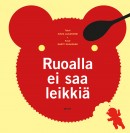 Ruoalla ei saa leikkiä
[Don’t play with your food]
Kuvitus [Ill. by]: Martti Ruokonen
Helsinki: WSOY, 2009. 60 p.
ISBN 978-951-0-35040-9
18.20 €, hardback
Jukka Laajarinne (born 1970) exercises his obsession with challenging authority again, stretching the boundaries of traditional children’s literature. It seems that becoming a father has made him wonder at the dominant role of food in everyday life: this book deals broadly with food, eating, and food culture. The impetus for the stories might be an ordinary figure of speech or adage that is taken apart and played with. For instance, King Midas, familiar from Greek mythology, who turned everything to gold with his touch, is transformed in Laajarinne’s retelling into a sticky-fingered kid who makes a mess of everything around him. Martti Ruokonen’s graphic illustrations are stark and even coarse in places, their colour choices and rounded forms reminiscent of visual images made for the first books for babies.
Lasse Rantanen & Hannu Tarmio: Lapin sydän [Heart of Lapland]
20 August 2010 | Mini reviews, Reviews
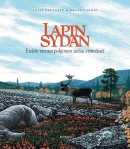 Lapin sydän. Etelän vieraat pohjoisen sielua etsimässä
[Heart of Lapland. Visitors from the south in search of the Northern soul]
Helsinki: Nemo Publishing Company, 2009. 216 p., ill.
ISBN 978-952-240-015-4
€ 33, hardback
Lapland and its myths have always inspired artists and tourists. In this book two Lapland enthusiasts ponder the things that make Finns from the south return to the north over and over again. Former publisher Hannu Tarmio lost his heart to Lapland 60 years ago; Lasse Rantanen is a graphic designer who is building his own cabin in Savukoski, eastern Lapland. The book is illustrated with his ink-and-abrasive drawings. Tarmio discusses Sámi identity, the history of log floating and gold panning, river pearl mussel fishing, alcohol use, mythology, and tourism and its impact on the environment. The book contains excerpts from literature on Lapland and portraits of its authors (including Yrjö Kokko, Timo Mukka and Nils-Aslak Valkeapää) and presents indigenous Lapps – one of them was Aleksi Hihnavaara, nicknamed Mosku, a legendary but controversial reindeer herder and hunter who fought the Russian Skolt reindeer poachers.
Maria Vuorio: Kiitollinen sammakko [The grateful frog]
5 February 2010 | Mini reviews, Reviews

Kiitollinen sammakko ja muita satuja järviseudulta
[The grateful frog and other stories from the lake country]
Kuvitus [Ill. by]: Virpi Penna
Helsinki: Tammi, 2009. 111 p.
ISBN 978-951-31-5017-4
18.20 €, hardback
There is no need to categorise Maria Vuorio’s original yet tradition-conscious prose and poetry as being for readers of a particular age. A father and son, Aatos and Justus, are spending their vacation at a summer cabin. Justus rescues a frog from a well, setting in motion a chain of events that leads the boy to see the world through different eyes. The frog happens to be the king of the frogs, and wishes to reward Justus for his good deed. The stories are wonderful explorations of humble, reticent animals – a perch, a dragonfly, a spider, a crab, a mole. A bumblebee’s leg in a cast has probably never been described with such devotion before. Today, Finnish children’s relationship with nature is limited to the surroundings of the summer cabin. But Vuorio’s view of the relationship of child with nature is still a romantic one. Dazzled by the moonlight, Justus wonders to himself, ‘Why is there such beauty, if no one ever sees it?’
Paris, je t’aime
7 May 2010 | This 'n' that
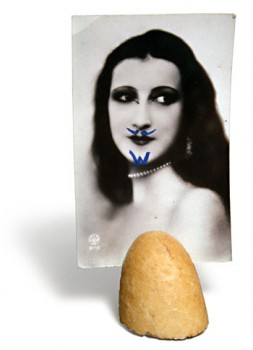
Ismo Kajander: Miss France, 1998
‘Paris traverse la pensée comme une encyclopédie de la vie, où l’on découvre des passages, des cours intérieures, des ruelles et des autoroutes, toujours plus surprenants. La ville ne se vide ni n’abandonne jamais, n’accorde ni ne refuse.’
‘Paris permeates your mind like an encyclopaedia of life in which you will incessantly discover astonishing new passages, courtyards, alleys and avenues. It will never either run empty or surrender, it won’t admit or refuse.’
L’air de Paris / Pariisin tuoksu (‘Air of Paris’, Musta Taide, 2009) is an elegant little book that features artwork by Ismo Kajander and texts by Anna Kortelainen relating to the mother city of all artists. More…
Siiri Enoranta: Painajaisten lintukoto [Sweet haven of nightmares]
24 January 2013 | Mini reviews, Reviews
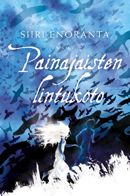 Painajaisten lintukoto
[Sweet haven of nightmares]
Helsinki: WSOY, 2012. 330 pp.
ISBN 978-951-0-38932-4
€26.90, hardback
Siiri Enoranta’s debut novel, Omenmean vallanhaltija (‘The Ruler of Omenmea’, Robustos, 2009) was nominated for the Finlandia Junior award, while another of her novels, Gisellen kuolema (‘The death of Giselle’) was nominated for the Runeberg Prize. Painajaisten lintukoto marks a departure from the genre Enoranta had focused on in her previous works. Her books incorporate the joy of spellbinding, spontaneous fantasy and skill at creating ever more uncanny settings. This novel is situated in the vacillating borderlands between sleep and the waking world. Lunni is a teenage boy who has been set a challenging task of overcoming nightmares and restoring natural sleep to people. The boy is joined by Tui, a mechanical girl. Other important figures in the story are giant tame birds that help Lunni and Tui get from place to place. The prose of Siiri Enoranta (1987) is lyrical, but it also contains points of contact for fans of fantasy writing of many different ages.
Translated by Ruth Urbom
Lauri Timonen: Lähikuvassa Matti Pellonpää [Matti Pellonpää in closeup]
16 July 2009 | Mini reviews, Reviews
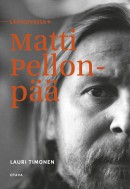 Lähikuvassa Matti Pellonpää
[Matti Pellonpää in close-up]
Helsinki: Otava, 2009. 335 p., ill.
ISBN 978-951-1-22903-2
€ 25, hardback
Matti Pellonpää (1951–1995) was one of the trusted actors, almost a trademark, of the film director Aki Kaurismäki. In 1993 he won the Felix Prize for best European male actor at the Berlin Film Festival for his role in La Vie de Bohéme. With his characteristic restrained empathy Pellonpää mostly played bohemians, unemployed people and outcasts. This portrait is built on the recollections of his friends and colleagues, as well as on the interviews by the author. These conversations deal with Pellonpää’s theatrical career and the musical experiments of his highly original band, Peltsix. The actor spent most of his free time in restaurants, where he eavesdropped on table talk and watched the eccentric personalities he encountered; the reader is also offered a sample of Pellonpää anecdotes.