

Search results for "Riikka/2010/10/mikko-rimminen-nenapaiva-nose-day/2011/04/matti-suurpaa-parnasso-1951–2011-parnasso-1951–2011"
The way to heaven
30 June 1996 | Archives online, Fiction
Extracts from the novel Pyhiesi yhteyteen (‘Numbered among your saints’, WSOY, 1995). Interview with Jari Tervo by Jari Tervo
The wind sighs. The sound comes about when a cloud drives through a tree. I hear birds, as a young girl I could identify the species from the song; now I can no longer see them properly, and hear only distant song. Whether sparrow, titmouse or lark. Exact names, too, tend to disappear. Sometimes, in the old people’s home, I find myself staring at my food, what it is served on, and can’t get the name into my head. The sun came to my grandson’s funeral. It rose from the grave into which my little Marzipan will be lowered. I don’t remember what the weather did when my husband was buried.
A plate. Food is served on a plate. There are deep plates and shallow plates; soups are ladled into the deep ones. More…
Growing together. New Finnish children’s books
28 January 2011 | Articles
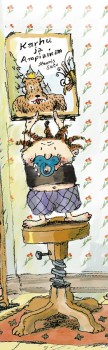
Hulda knows what she wants! From the cover of a new picture book by Markus Majaluoma (see mini reviews*)
What to choose? A mum or dad buys a book hoping it will be an enjoyable read at bedtime – adults presume a book is a ‘good’ one if they themselves genuinely enjoy it, but children’s opinions may differ. Päivi Heikkilä-Halttunen reviews the trends in children’s literature published in Finland in 2010, and in the review section we’ve picked out a handful of the best on offer
Judging by the sheer number and variety of titles published, Finnish children’s and young people’s fiction is alive and well. If I had to describe the selection of books published in 2010 in just a few words, I would have to point to the abundance of titles and subject matters, and the awareness of international trends.
Since 2000 the number of books for children and young people published in Finland each year – including both translated and Finnish titles – has been well in excess of 1,500, and increasing, and this growth shows no signs of slowing down.
Little boys, ten-year-olds who don’t read very much and teenage boys, however, were paid very little attention last year. Although gender-specificity has never been a requirement of children’s fiction, boys are notably pickier when it comes to long, wordy books, especially those that might be considered ‘girly’. More…
High above the years
23 September 2011 | Fiction, poetry
In Gösta Ågren’s poetry austere aphorisms alternate with concrete observations of life in a small village that was and again is his home, and with portraits of people he has met on his journey in the world. Introduction by David McDuff
Poems from the collection I det stora hela (’On the whole’, Söderströms, 2011)
Father’s hands
(1945)
Father’s hands were like stiff
gloves; a furious
kettle had bewitched them
in his childhood. We ride
from the church’s tall letter
along the river’s long sentence
to the parenthesis of the bridal house,
and the thunder of three hundred hooves
fills the space beneath the clouds.
I saw father driving through
his life with those numbly
gripped reins, and later,
right now, I think of the
life-long body in which a man
comes, is wounded, and goes. More…
Animals, thy neighbours
30 March 2005 | Authors, Reviews

Sirkka Turkka. Photo Tomi Kontio
‘Everyone’s always in a hurry. In the grave it stops.’
In her new volume Sirkka Turkka (born 1939) appears as an even greater and more pitiless poet. Niin kovaa se tuuli löi (‘So bitterly the wind struck’, Tammi, 2004) – her twelfth volume, the first having being published in 1973 – is an unadorned and searching portrayal of death and the grief that accompanies it. It takes a thoroughly mature poet to handle major feelings as uninhibitedly as she does, and without letting the empathetic glow fade under the documentation.
Animals have always played an important role in Turkka’s somewhat melancholy but vital verse, with its highly individualised concrete language. In 1987 she received the Finlandia Literature Prize for her Tule takaisin, pikku Sheba (‘Come back, little Sheba’, Tammi, 1986; see Books from Finland 4/1988). Little Sheba was a small dog, one of the poet’s dearest friends. Turkka has worked as a stable manager, and horses are frequently central in her work. Domestic and farm animals are always a presence, and here they appear as tokens of the fragility of life and mortality. A hare, a horse, a dog and a lamb are among the animals whose deaths are dramatised. More…
Writers meet again in Lahti
14 May 2009 | In the news
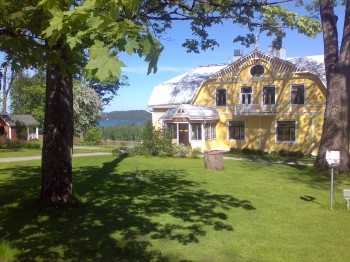
In other words: LIWRE at Messilä Manor
The Lahti International Writers’ Reunion (LIWRE; www.liwre.fi) will be held this year between 14 and 16 June.
In the politically and culturally active 1960s, marked by the confrontation between East and West, an idea was born to found an international, bi-annual rendezvous where writers from all over the world could freely engage in discussions on various themes.
Crème de la crème
31 January 2013 | Fiction, Prose
Such straining and pasteurising is going on in the city that Arabs and other Muslims, the unemployed, drunkards, poor people and lunatics have been eliminated. By chance I became a cultural figure, and I was invited to a cultural evening whose invitation had been personally written by the Anarchist. At the restaurant table sat the Anarchist, the Psychoanalyst and the Psychologist’s boyfriend, 20 years younger, the Journalist, the Gift-Shop Owner, a Librarian and the Deputy Rector of a community college. Accompanying me to the restaurant, too, were the Wolf and the Deer, who hadn’t been invited. Sparse white fur grew on the Wolf’s narrow muzzle and there were teeth missing from his mouth. The Deer was beautiful, with huge eyes. And of course both of them were drunk. I asked them to come along because I believed that intellectuals are warm-hearted and open-minded. A really dumb idea. More…
New from the archives
19 February 2015 | This 'n' that
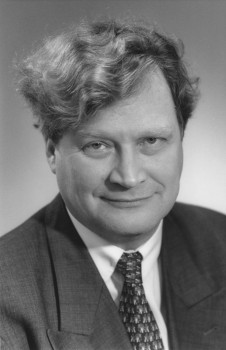
Jarkko Laine. Photo: Kai Nordberg
Our archive find this week is ‘The 101 year anniversary celebration’, a short story by Jarkko Laine.
‘Child of Marx and Coca-Cola’, ‘Nordic beatnik’, Jarkko Laine (1947-2006) published his first work, a volume of poetry entitled Muovinen Buddha (‘Plastic Buddha’) in the 1960s and was immediately hailed as the mouthpiece of his generation. He went on to make his career as a literary all-rounder – poet, writer, playwright, translator, long-time editor of the literary magazine Parnasso and chair of the Finnish Writers’ Union. His wryly ironic story, ‘The 101 year anniversary celebration’ tells the story of what every writer must dread: a guest appearance in a local library where literature from the local town, let alone further afield, is regarded with suspicion.
We’ve also unearthed a 1989 interview, by our late, genial editor-in-chief Erkka Lehtola with a grey-suited Laine who looks more like a civil servant than a 1960s radical – but still doesn’t let a day go by without writing.
*
The digitisation of Books from Finland continues apace, with a total of 360 articles and book extracts made available online so far. Each week, we bring a newly digitised text to your attention.
In memoriam Kai Laitinen 1924–2013
14 March 2013 | In the news
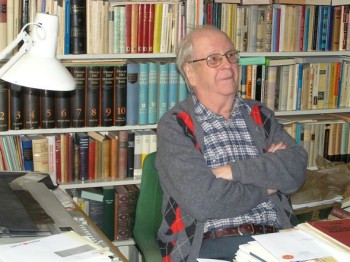
Kai Laitinen. Photo: Ilkka Välimäki (the literature archive/Finnish Literature Society, 2006)
The journalist, critic, author and professor Kai Laitinen died on 11 March in Helsinki, aged 88.
He began his literary career as a critic in the daily paper Helsingin Sanomat in 1950. As the Editor-in-Chief of the new literary journal Parnasso he was able to promote the new trends in modernist fiction and poetry which began to flourish in post-war Finland.
Laitinen’s academic career at Helsinki University involved serving as Associate Professor and Professor of Finnish literature (1975–1989). From the 1950s onwards he was actively involved in the work of dozens of literary societies, publications and organisations, both in Finland and abroad.
Among his publications are two collections of essays, a book of memoirs and two popular books on history of literature: Suomen kirjallisuus 1917–1967 (‘Finnish literature 1917–1967’) and a more concise work, Suomen kirjallisuuden historia (1981‚ Literature of Finland in Brief), which has been published in eleven languages.
Kai Laitinen was appointed Editor-in-Chief of Books from Finland in 1976 when the little magazine, then in its tenth year, began to take the form of a proper literary journal and to be published by Helsinki University Library. He held the job until 1989.
In issue 4/1977 of Books from Finland, on the theme of the 60th anniversary of Finland’s independence and the changing role of literature, Kai wrote in the editorial: ‘Literature is, and must be, much more than a chronicle of national and social history, or the mere accumulation of changing styles and genres. So often it is an author’s critical insight or his struggle against prevailing literary norms that gives birth to the works of the greatrest artistic importance. One of the main tasks of literature, both on a national and a human level, can be summed up succinctly in two lines from T.S. Eliot’s Little Gidding – “To purify the dialect of the tribe / And urge the mind to aftersight and foresight.” This comes close to describing what Finnish literature has achieved over the past sixty years.’
T.S. Eliot was the poet who perhaps had a permanent place in Kai’s personal literary cosmos – he introduced Eliot’s poetry to Finnish readership in the late 1940s. This passage, from Little Gidding, might well serve as his epitaph.
….We shall not cease from exploration
And the end of all our exploring
Will be to arrive where we started
And know the place for the first time.
Mishaps, perhaps
30 September 1976 | Archives online, Fiction, poetry
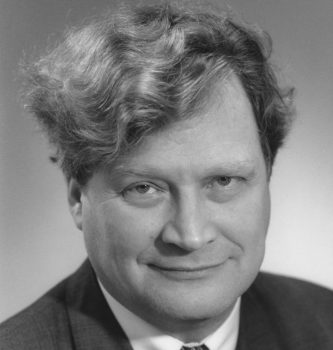
Jarkko Laine. Photo: Kai Nordberg
Jarkko Laine (born 1947) writes both prose and verse. He is the author of several hilarious and highly imaginative novels and a pioneer of the generation of Finnish underground poets. One of the most productive of younger Finland’s poets, he draws on the language and forms of mass commercial entertainment, comics, and pop music to write about people of today.
He is currently the editorial secretary of the literary periodical Parnasso. The poem below is from his latest collection Viidenpennin Hamlet (‘Fivepenny Hamlet’, Otava 1976)

1
In Turku again
the taxi’s travelling East Street
whose wooden sides have gone,
the radio’s laryngeal with static, VHF, the driver’s
telling me the tale,
the ice hockey season’s on us already,
even though there’s rain, green in the park,
I’m staring at the lifted houses
stuffed with sleeping persons,
the landmarks are going out one by one, all of them,
you might as well be
in the middle of the sea in a rubber dinghy,
soon I shan’t recognize anything here but
the cathedral, the castle,
my own name in the telephone directory. More…
Tchotchkes for the tsar
11 August 2011 | Reviews
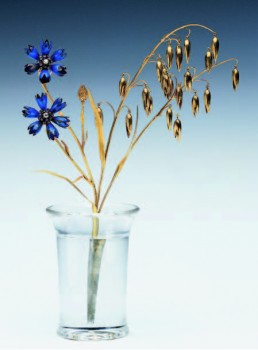
Cornflower and ear of oats: one of the several Fabergé gemstone ornaments now owned by Queen Elizabeth of England (gold, rock crystal, diamonds, enamel, ca 18 cm)
Ulla Tillander-Godenhielm
Fabergén suomalaiset mestarit
[Fabergé’s Finnish masters]
Design: Jukka Aalto/Armadillo Graphics
Helsinki: Tammi, 2011. 271 p., ill.
ISBN 978-951-31-5878-1
€57, hardback
In its online shop, the Hermitage Museum in St Petersburg sells a copy of a most delicate, enchanting little nephrite-and-opal lily of the valley that perfectly imitates nature, sitting in a vase made of rock crystal that looks like a glass of water.
These small flowers made of gold and gemstones were manufactured by the jeweller Fabergé a hundred years ago. The lily of the valley was the most frequently used floral motif in the Fabergé workshops – it was the favourite flower of Empress Alexandra (1872–1918), and the imperial family was the the foremost client of the world’s foremost jeweller.
The replica (13.5 centimetres high) is available at the Hermitage as a ‘luxury gift’ for the price of mere $3,300. (N.B. Since we published this review, the ‘luxury gift’ items seem to have disappeared from the Hermitage online shop selection, so we have removed the link. Several Fabergé egg replicas are available though, ranging in price from $200 upwards – link below.)
For those who feel the price is excessive, there is also a rather modestly-priced little bay tree (original: gold, Siberian nephrite, diamonds, amethysts, pearls, citrines, agates and rubies as well as natural feathers, about 30 centimetres tall, featuring a little bird that emerges flapping its wings and singing when a small key is turned) at just $ 219,95. Despite its form, it is classified as one of the famous imperial Easter eggs. (However, as I write, this item is unfortunately sold out…) More…
Gustaf Mannerheim: Dagbok förd under min resa i Centralasien och Kina 1906–07–08 [Journal of my travels in Central Asia and China 1906–07–08]
11 February 2011 | Mini reviews, Reviews
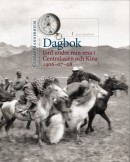 Dagbok förd under min resa i Centralasien och Kina 1906–07–08, Vol 1–3
[Journal of my travels in Central Asia and China 1906–07–08, Vol. 1–3]
Redaktör [Edited by]: Harry Halén
Bildredaktör [Photo editor]: Peter Sandberg
Helsingfors: Svenska litteratursällskapet i Finland, 2010. 1,128 p., ill.
ISBN 978-951-583-196-5 (complete set)
€ 80, hardback
Carl Gustaf Mannerheim (1867–1951), a Finnish officer in the Imperial Russian Army, later Commander-in-Chief of the Finnish Army and President of Finland, undertook a military reconnaissance mission, posing as an academic researcher, to Central Asia and China in 1906–1908. His journey on horseback across Asia to Peking also generated a wealth of ethnographic material: field notes, photographs and artefacts. In his travel diaries, Mannerheim describes the landscapes as well as his diverse encounters with the inhabitants of the areas he travelled through. During his visit to a Tibetan monastery, Mannerheim was pelted with stones by pilgrims. He gave the Dalai Lama an automatic pistol as a gift. These journals are now being published in full for the first time in their original language, Swedish, including Mannerheim’s own notes concerning his military mission. The photographs, some of which have never been published before, show that Mannerheim was a skilled photographer. Harry Halén, an expert in Central Asian languages and cultures, has contributed an extensive preface and copious notes.
Translated by Ruth Urbom
Winner of the Susan Sontag Prize
25 December 2010 | In the news
The Susan Sontag Foundation was established in New York in 2004 in memory of the celebrated author and cultural journalist Susan Sontag (1933–2004). The Foundation grants a prize to a young American who translates from other languages into English. In 2010 the prize was awarded for the third time.
Benjamin Mier-Cruz is currently pursuing his PhD in Scandinavian Languages and Literatures at University College Berkeley, with a particular interest in Finland-Swedish modernism and German expressionist poetry. His winning translation proposal is entitled Modernist Missives of Elmer Diktonius – Letters and Poetry of Elmer Diktonius.
Elmer Diktonius (1896–1961) was a rebellious Finland-Swedish avant-garde poet and composer, who was fluent in Finnish as well as his native Swedish. His letters to a wide range of European authors and critics, written between 1919 (the year of the Finnish Civil War) and 1951, reflect the political, artistic and personal developments in Finland and Europe.
The prize ceremony took place first in Helsinki on 5 November in a seminar at the Svenska litteratursällskapet i Finland (the Society of Swedish Literature in Finland), then at Scandinavia House, New York, on 12 November.
Between covers
31 December 1990 | Archives online, Children's books, Fiction
Extracts from Lastenkirja (‘Children’s book’, WSOY, 1990, illustrated by the Estonian animator and graphic artist Priit Pärn)
CHILDREN’S BOOK IS BORN
Children are wafting around the world: they come spilling out of the chimneys and clattering out of the pipes. They worm around cramped places in the nether regions, rise up through stiff roots into the treetops and muss up the clouds. Children just happen anywhere and bring the Adults along with them. More…
The son of the chimera
30 September 1999 | Fiction, Prose
A short story from Pereat mundus. Romaani, eräänlainen (‘Pereat mundus. A novel, sort of’, WSOY, 1998)
I was born, but not because anyone wanted it to happen. No one even knew it was possible, for my mother was a human being, my father a chimera. He was one of the first multi-species hybrids.
Only one picture of my father survives. It is not a photograph, but a water-colour, painted by my mother. My father is sitting in an armchair, book in hand, one cloven hoof placed delicately on top of the other. According to my mother, he liked to leaf through illustrated books, although he never learned to read. He is wearing an elegant, muted blue suit jacket, but no trousers at all. Thick grey fur covers his strong legs, right down to his hoofs. Small horns curve gracefully over his convex forehead. Striking in his face are his round, yellow eyes, his extraordinarily wide mouth, his tiny chin and his surprisingly large but flat nose. More…