

Search results for "Riikka/2010/10/mikko-rimminen-nenapaiva-nose-day"
The miracle of the rose
30 June 1997 | Archives online, Fiction, Prose
Extracts from the novel Naurava neitsyt (‘The laughing virgin’, WSOY, 1996). The narrator in this first novel by Irja Rane is an elderly headmaster and clergyman in 1930s Germany. In his letters to his son, Mr Klein contemplates the present state of the world, hardly recovered from the previous war, his own incapacity for true intimacy – and tells his son the story of the laughing virgin, a legend he saw come alive. Naurava neitsyt won the Finlandia Prize for Fiction in 1996
28 August
My dear boy,
I received your letter yesterday at dinner. Let me just say that I was delighted to see it! For as I went to table I was not in the conciliatory frame of mind that is suitable in sitting down to enjoy the gifts of God. I was still fretting when Mademoiselle put her head through the serving hatch and said:
‘There is a letter for you, sir.’
‘Have I not said that I must not be disturbed,’ I growled. I was surprised myself at the abruptness of my voice.
‘By your leave, it is from Berlin,’ said Mademoiselle. ‘Perhaps it is from the young gentleman.’
‘Bring it here,’ I said. More…
A toast before dying
30 June 2005 | Archives online, Fiction, Prose
Extracts from the novel Voin jo paljon paremmin. Tšehov Badenweilerissa (‘I already feel much better. Chekhov in Badenweiler’, Loki, 2004). Introduction by Hannu Marttila
I went to meet them Friday and I did not plan to take other patients that week. They had a small but comfortable room with striped wallpaper.
The Russian was a tall man, but stooped. It soon became apparent that his wife spoke fluent German because she was of German descent. That made it much easier to take care of things.
Of course I knew who the patient was. I have always enjoyed literature and other forms of art. I could play several pieces rather well on the piano. When I was younger I had even written a couple of stories set in the mountains, though I had never offered them for publication. As for Chekhov, I had read a couple of his stories that had just come out in German translation, and I had liked them quite a lot in a way, even though they of course reflected that characteristic Russian nature, with its vodka and untidiness.
The patient’s wife seized both my hands when I entered. It was a bit confusing, but not necessarily unpleasant.
‘Our name is Chekhov. We have come from Russia,’ the woman said in a strong, carrying voice. ‘I trust you’ve been told?’ More…
In your own time
16 March 2010 | This 'n' that
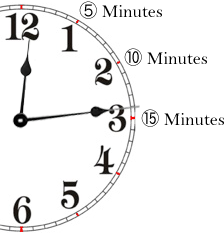 Ever wished there were just a few more hours in the day? We certainly have. Forgive us if you’ve seen it before, but this little homily has been doing the rounds on the internet in Finland. It made us laugh, if a little hollowly.
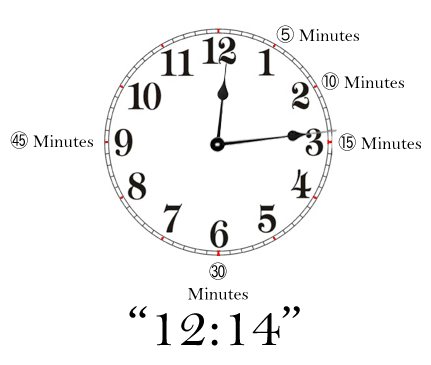
It’s healthy to eat an apple a day, and a banana, for the calcium, and an orange, for the vitamin C, and you need to drink a cup of green tea to reduce your cholesterol. You should also drink two litres of water (and wee the same amount, which doubles the amount of time you spend in the bathroom). And don’t forget the two decilitres of yogurt that you should eat to keep the bacterial flora of your stomach healthy. No one really knows what these bacteria are, but you MUST have at least a million of them, or you won’t be well! You must also drink a glass of red wine a day so you don’t have a heart attack, and a glass of white wine to protect your nervous system! And a glass of beer (I can’t quite remember why), but if you drink them all at the same time you may have a stroke. That won’t matter, though, as you won’t notice it. Everyone should also eat nuts and beans/peas every day. You should eat 4-6 times a day, light meals, but don’t forget that each mouthful should be chewed at least 36 times. That will take up 5 hours of your day! More…
Plain sailing
31 March 1996 | Archives online, Fiction, Prose
An extract from Alastalon salissa (‘In Alastalo’s parlour’, 1933). Introduction by Kai Laitinen
A letter from the translator:
Dear Editors,
Reluctantly (I really have tried) I have been driven to conclude that Alastalon salissa is untranslatable, except perhaps by a fanatical Volter Kilpi enthusiast who is prepared to devote a lifetime to it. To mention only one of the difficulties, there is no English equivalent to the style of the Finnish ‘proverbs’ (real or imaginary) with which the main character Alastalo’s thoughts are so thickly larded. Add to this the richness and, yes, eccentricity, of Kilpi’s vocabulary, and the unfamiliarity of much of the subject-matter, centred as it is on the interests of a sea going community that hardly exists any longer, even on the islands, and you have a text that is full of pitfalls for the translator. As for the humour, I’m sorry to say that it depends so much on the idiom and presentation that it doesn’t come over at all. If I did any more, I’m afraid it would just have to be a laborious paraphrase, and I don’t think I’m capable of making it effective, or even readable, in English.
Apart from that, although I’m very grateful for your explanations of the many unfamiliar words and phrases, I’m very unwilling to commit myself to the translation of any of them on the basis of a mere ‘gloss’ (technical word): I need to know the associations, and possible sound-echoes, of every one of them before I can be sure of getting it right. And getting it right affects the rhythm of every sentence: it’s not just a matter of filling in blanks with ‘equivalents’ provided by someone else.
I’ve no objection to your using my version of the opening pages. If you decide to follow it with some kind of comment, do borrow, if you need to, from my remarks above, giving the translator’s point of view. Sorry to have failed you so badly.
Yours, David Barrett More…
Higher goals
31 December 1987 | Archives online, Fiction, Prose
An extract from the novel Tammerkosken sillalla (‘On Tammerkoski bridge’, 1982). Introduction by Panu Rajala
I had thought there were a lot of books in the libraries in Oulu. But both those libraries were totally overshadowed when, having climbed up to the top of the Messukylä Workers’ House, I began to cast my eyes along the bookshelves in the attic. A tallish and refined-looking librarian responded when I exclaimed aloud.
‘Just under seven thousand volumes altogether. Some of them are out on loan. We’d like to have a lot more books, but getting the money to buy them is like getting water from a stone.’
‘But you’ve already got an incredible amount compared to what we have in the rural library at home… In Taivalkoski during the war all we had was two cupboardsful.’
‘You didn’t have a lot of choice there,’ agreed the librarian. More…
Presence and absence
31 December 1993 | Archives online, Fiction, Prose
Extracts from the novel Urwind (Schildts, 1993). Introduction by David McDuff
Snow letter
I have written you a snow letter. The day was clear, with clouds like drifting mist, woolly and small. In January the wind’s paintbrush is allusive and creates distance. But the darkness rises from the forests around the city; a pregnant bank of cloud, blue violet, is suddenly there, and it gets dark in the middle of the day. Then it reaches my room, too, and the silence thickens. The first snow falls, gleams like dust and down in the light from the setting sun. Then the snowstorm is there, whirls through gateways and along streets, stops, rises, turns, rushes onwards again under the courtyard’s swaying lamps. How long did I sit there, on the staircase, after Mrs Rosendal slammed her door shut, watching the darkness rising, stair by stair? Each year is a snowflake that blows around between now and the past. A door crashes shut, a door crashes open, out flies a grey soldier’s uniform and is followed, mumbling and swaying, by a man in long johns while a woman screams: ‘Swine!’ And again the staircase booms with the sound of a door being slammed shut. People stride through one another and leave traces of blood. More…
Could you drop me a line?
31 March 2003 | Archives online, Fiction, poetry
Poems from Kirjoittamaton (’Unwritten’, WSOY, 2002). Introduction by Jukka Koskelainen
[Chekhov visits a French prostitute]
The room brightly lit like a library that stays open at night.
From the threshold onward, a scent of freshly cut damp grass
and resin. In the curtain swim black goldfish, gasping for air
and the carpet glows, all too red, a red carpet to hell.
The girl sits on the edge of the bed, her face
as expectant as a stuffed nightingale, stares inscrutably
at the guest, until the ice age his presence has brought
begins to melt a little around the edges. Drop by drop,
dripping. He takes his coat off, his shirt
but keeps the pince-nez on his nose. ‘Because without it,
I won’t be able to see you at all.’ The candle
smokes, hisses, even, if you listen to it up close.
On the wall next to the bed the guest’s shadow melts
into the girl’s. Then two horns appear on top of her head
and her shadow bursts into shaky laughter. Then she stops,
takes his mocking fingers into both her hands, kisses them
lightly and says, ‘Let’s do it quickly, and then you’ll just hold me quietly,
so I can tell you about my greatest dream.’
‘What is it,’ he asks, his hair entangled in hers. Now
there’s another scent in the room, the acrid odor of rails
made more intense by a hot summer’s day, and the girl
whispers: “That my two sisters and I could leave here
and go back to Paris. Home to Paris. Oh, Paris!” More…
The snake
31 March 1998 | Fiction, Prose
In this horror story by the Finland-Swedish author Kjell Lindblad (born 1951), a man believes he is wandering among art installations in an apartment block – but the reality he is experiencing turns out to be much more sinister. From the collection of short stories Oktober-mars (‘October-March’, Schildts, 1997)
I only noticed the poster on the notice board in the vegetarian restaurant because it was so obviously different from the rest of the colourful items there, with their large headlines offering everything from Atlantic meditation to Zen ping-pong, together with promises of a new and fulfilled life in harmony with the soul and the cosmos. Poster is perhaps an overstatement it was a white sheet of paper with an egg-shaped oval in the middle. Inside the oval there was a horizontal row of seven numbers. For some reason, perhaps because the row of numbers was the only information on the piece of paper, it stuck in my memory and when I got home I had a compulsive desire to find out if it was a phone number. So I dialled the number and a tape-recorded voice that could have belonged to a man but equally well to a woman, said:
‘We bid you welcome. Please don’t write down the address just memorise it….’ More…
That remarkable man
31 December 1988 | Archives online, Fiction, poetry
Poems by Lauri Viita. Introduction by Kai Laitinen
Alfhild
Mothers alone, endowed
with hope, see God.
They’re given strength and given will,
to climb in dream from under the cloud,
and look from a higher hill.
Alfhild, she who gave me birth,
nightly sailed away from earth
to where her Eemeli growled his say,
coming and going, as he did in his day.
Now they walk
the bright star track,
father and mother, looking back
at the little hill and the family home,
the cats, the dogs, the people they’ve known,
waving and calling as best they can
lest any of us trip on Pispala’s stone.
On a distant planet on a garden swing
under a rowan they linger and cling
and silently remember their light and dark
as a courting couple in Tampere Park –
and if it was payday, the extra fun
of tucking away a coffee and bun. More…
The personal and the political
In his new collection, Claes Andersson (born 1937) – poet, pianist and politician – takes a look at what human existence is about: excess, apathy, greed, devotion, freedom, and the simple pleasures of everyday life (see the introduction)
Poems from Lust (‘Desire’, Söderströms, 2008), translated by David McDuff and David Hackston
A Finnish translation, by Jyrki Kiiskinen, is entitled Ajan meno (WSOY, 2008)
(easter)
Despite the prognoses of the Earth's imminent warming
today April 8 it is cold enough to make one’s teeth chatter

In a few weeks I will turn seventy, my ninth grandchild
  August (Siiri's younger brother)
was born two months ago and the tenth is on the way
Manmother
31 December 2002 | Archives online, Fiction, Prose
Extracts from the novel Granaattiomena (‘Pomegranate’, WSOY, 2002). Introduction by Kristina Carlson
The journey
Mother had sent her son to the island of Rome.
She’d sent him for pleasure and recreation, and also to have a little time by herself. Even though their life together was on an even keel, it was sensible to have some time away from each other. She herself was sixty-eight, and her son an unmarried hermit in his thirties, on sickness allowance for the last couple of years. He was afflicted with chronic depression. The doctors had been unable to identify the cause. The origin of a disorder of that sort was often looked for in some infant trauma; but the boy’s childhood, from all appearances, had been harmonious. One doctor suspected the time of his father’s terminal illness, when the boy had had to nurse his father for a long while. More…
AZ661748
19 September 2013 | Fiction, Prose
A short story from Novelli palaa! Matkanovelleja (‘The short story returns! Travel stories’, edited by Katja Kettu and Aki Salmela; WSOY, 2013)
Mum didn’t want to travel abroad. Mum wanted to tend her rose garden and her pea beds, which sloped down the hill towards the lake. In mum’s opinion, the view from the porch was the best view in the world.
Dad wanted to travel. He never got very far, because Mum wouldn’t go. Dad got as far as the neighbouring forest. In Mum’s opinion, there was no better long-haul destination than the lake at the bottom of the slope and the grove around the house, which was full of blueberries and raspberries and, in the spring, morel mushrooms.
In Dad’s opinion, the forest was full of mosquitoes and flies and ants and mites.
On the lake, the loons dived and called on late summer evenings, Mum thought it was the best sound in the world. Beautiful and harrowing, at the same time. The lamentations of the loon demonstrated that a living creature can be so completely happy that its cry is full of grief. Her children’s crying and whingeing and desire to go to the Linnanmäki funfair in Helsinki were, to Mum, a sign that they are ecstatically happy at home.
Little loons, Mum said to us. More…
The lady who could fly
30 June 1989 | Archives online, Fiction, Prose
A short story from Kenkää suurempi jalka (‘The foot bigger than the shoe’, 1992)
A day came when she felt she could fly. You used technological gear and gadgets for flying, or meteorological shifts in the air masses: rising currents gave you a weightless ecstasy with the lightest of equipment. But that wasn’t it.
To begin with it was one of those typical flying dreams, which gradually extended into the waking state: she could feel it coming in her sinews, her nervous system, her cortex. She was acquainted with Freud and Jung and the other dream-interpreters of today. Characters in the myths and fairytales flew; cruel princesses flew on the wings of the storm; Gogol’s overcoats, Chagall’s lovers, cows and cats flew; and vampires – those last leather-winged flutterings of the prehistoric archaeopterix in the mud of the gene pool. More…
Human Freedom
30 June 1986 | Archives online, Fiction, Prose
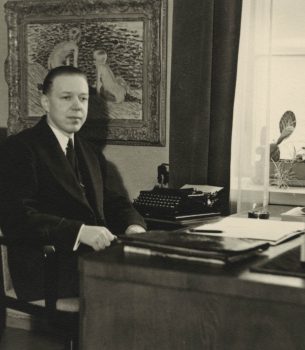
Mika Waltari. Photo: SKS Archives
Extract from lhmisen vapaus (‘Human Freedom’, 1950)
‘Where are we?’ Yvonne asked. ‘This isn’t the right street either. Somewhere between Alma and Georges V, they said. But there’s no sign of an aquarium.’
‘Talking of aquariums’, I suggested, ‘there’s a dog shop near here where they wash dogs in the back room. If you like, I’ll take you to see how they wash a dog. It’s a very soothing experience.’
‘You’re crazy’, said Yvonne.
My feelings were hurt. ‘I may sleep badly’, I admitted, ‘but I love you. I walk up and down the embankments all night. My heart aches, my brain is on fire. Then comes blissful intoxication, and for a little while I can be happy. And all you can do is to keep nagging, Gertrude.’
She wrinkled her brow, but I went on impatiently, ‘Look, Rose dear, just at present I have the whole world throbbing in my temples and in my finger-tips. Age-old poems are bubbling up within me. I am grieving for lost youth. I am boggling at the future. For just this one moment it is given to me to see life with the living eyes of a real human being. Why won’t you let me be happy?’
‘I have walked two hundred kilometres’, said a low, timid voice at my elbow. I stopped. Yvonne had stuck her arm through mine. She, too, stopped. We both looked down and saw a little man. He doffed a ragged cap and bowed. Flushed scars glowed through a grey stubble of beard. He was wearing a much-patched battle-dress from which the badges had long since disappeared. His face was wrinkled, but the little eyes were animated and sorrowful. More…