

Search results for "Riikka/2010/10/mikko-rimminen-nenapaiva-nose-day"
Caravans of winds
30 June 1988 | Archives online, Fiction, poetry
Poems from three collections. Introduction by Kaija Valkonen
The river of death froze
It froze, the river of death,
	froze too the boat of death in the nights of the Winter War,
			in the Winter War's nights.
The men shed blood,
				shed blood ,
		and it froze, the river of death.
In the nights of the Winter War, it froze, the river of death.
Day of mourning
For one day I’ve the right to mourn,
for one day I’ll shut the windows of the sky,
I’ll dismiss the blue,
I’ll raise a black sun to mark my mourning.
For one day I’ll wilt the flowers,
for one day I’ll silence the birds. More…
Solitude growing
30 June 1995 | Archives online, Fiction, Prose
Extract from Häiriö maisemassa (‘A disturbance in the landscape’, Otava, 1994). In this, her first novel, Raija Siekkinen – well-known for the fragile prose fof her short stories – continues her dissection of the soul with an account of the experience of a womanwho finds that many lives are being lived through her own
She was pregnant. After all these years, the woman finally found she was pregnant: it was as if the man had made a last attack to retain his hold on a country he had once conquered.
She let the days go by, the days of autumn, which night by night edged more shadow across the damp lawn. She looked at the man from a distance, not seeing him; her mind rehearsed what she knew about him. The man had two children from a previous marriage. The woman had not wanted the children to come here, and neither did their mother; that was, indeed, the only subject on which they agreed. The man went to visit his children; they never spoke about what happened on those occasions. More…
A good day
30 June 2001 | Archives online, Fiction, poetry
From Juomarin päiväkirjat (’A drunkard’s journals’, edited by Pekka Tarkka, Otava, 1999). Introduction by Claes Andersson
Iceland, Summer 1968
I don’t know how to describe what I see,
           the lava’s colors; the afternoon green of the grass,
      and I can’t tell if that white is buildings or snow.
The mountains are fortresses of the gods, and if
      people’s construction projects irritate them
          too much, they let the ground shake, volcanos
erupt and tum everything upside down, assign new sites
      to houses and different routes for cars.
      The gods’ noses itch when their breath
          is caught in pipelines and
      channeled into radiators and greenhouses.
Sheep tear the grass but horses
                                             browse in a civilized manner.
Jónas does not believe in the gods, but he
                             is afraid of them, the gods are not pleased
      with the Americans, who do not know
          anything about the gods or history yet come here
                 and start interfering with the land
                                                            as if it were theirs.
*** More…
Brighter than darkness
30 June 2002 | Archives online, Fiction, Prose
An extract from the novel Eksyneet (‘The lost’, WSOY, 2001). Interview by Markus Määttänen
It was a white tiled wall. Too white. Sterile. He wondered how long he had been looking at it. In any case long enough to have forgotten it was a wall. It had changed into a vacuum opening up before him and then shrunk into a tunnel through whose irresistible suction he had hurtled toward the painful images of the past. The past. Yesterday. Almost yesterday. He had stared at the nocturnal entrance, clearly divided in two by the street lamps, and not just that, but now saw only a lifeless and, in its lifelessness, repellant wall. He sighed, rubbed his numb face, pushed himself off the floor and stood up.
The dog
30 September 1992 | Archives online, Fiction, Prose
From the collection of short stories Matka Grönlannin halki (‘A journey across Greenland’, Tammi, 1992)
The water in this town tasted of shit. Unto swallowed a couple of mouthfuls, gargled the rest and spat it into the wash-basin. The taste of garlic and old booze disappeared and only a flavour of metal remained on his palate. Unto glanced at the mirror and began to fumble for a comb. The bags under his eyes were flushed.
He pulled a clean shirt from his suitcase, and suddenly remembered how Mervi smelt in bed. There was a stirring in his groin, and unconsciously Unto sniffed at his shirt-sleeve as he buttoned his cuffs. In front of the mirror, he straightened the hem of his cardigan, combed his moustache and drew a deep breath. He felt like some meat soup. More…
I, Vega Maria Eleonora Dreary
30 December 2008 | Archives online, Fiction, Prose
Extracts from the novel Chitambo (Schildts, 1933)
I was born in 1893, of course. That, as everyone knows, is the proudest year in the history of Nordic polar research. It was the year in which Fridtjof Nansen began his world-famous voyage to the North Pole aboard the Fram. Mr Dreary viewed this as a personal distinction and a sign that fate had fixed its gaze on him. He at once took it for granted that I was destined for great things, and he showed much skill in fostering the same foolish idea in me…. More…
Tiger in the grass
31 March 2001 | Fiction, Prose
Extracts from the novel Maan ääreen (‘To the end of the earth’, Otava, 1999)
I left Kronstadt at the end of October in the year 1868, when I was 22 years old.
The Mozart was a three-hundred-ton barque. Even on the journey to Tvedestrand in Norway I vomited yellow bile and my toes and fingers froze. We lingered in Tvedestrand for three months while the vessel was repaired in dock. To amuse myself, I drew and wrote an accurate description of the ship. That work ended up in the sea. From the harbour captain’s library I borrowed German books which dealt with geology and topology. Their reality was different from that of the law and the interpretation of its letter and spirit. When a topologist draws a map, it has to be true. Otherwise travellers will get lost, I thought childishly, as if it were possible to draw a line between true and true. More…
Northern exposure
3 September 2005 | Archives online, Fiction, Prose
Extracts from the novel Valon reunalla (‘At the edge of light’, Teos, 2005). Introduction by Kristina Carlson
Kari
The village despised all those who left. They hated us too, though we were still only planning our final escape.
We used to escape the village. We would hide from its gaze in the forest or the cemetery where the gravestones were so close together that there was no room for the trees to grow. We knew why the freight train brought the village so many dead and so few living. It was the village’s fault. It had a wicked soul. The grown-ups didn’t know it. We knew it, but no one asked us. Death was within us; it was alive. Asking would have been too dangerous….
On the backs of the headstones we carved our own marks with the end of a knife. We blew out the candles laid at the graves of suicide victims. We worshipped them in the dark and no new candles were ever brought to their graves. The parents of those who died so young drove south. They were looking for stations with real waiting rooms and staff that made announcements. They sat on the hard benches waiting, waiting for the trains to come, at the right time; hoping the years wouldn’t wreak havoc after all, hoping they’d roll slowly back along the tracks, to brighten as they approached the village, giving life once again to their children. And everything could start over. More…
Wolf-eye
30 June 2004 | Archives online, Fiction, Prose
Extracts from the novel Käsky (‘Command’, WSOY, 2003). Introduction by Jarmo Papinniemi
Only once he had led the woman into the boat and sat down in the rowing seat did it occur to Aaro that it might have been advisable to tie the woman’s hands throughout the journey. He dismissed the thought, as it would have seemed ridiculous to ask the prisoner to climb back up on to the shore whilst he went off to find a rope.
It was a mistake.
After sitting up all night, being constantly on his guard was difficult. Sitting in silence did not help matters either, but they had very few things to talk about. More…
The house in Silesia
31 December 1989 | Archives online, Fiction, Prose
A short story from Talo Šleesiassa (‘ The house in Silesia’, 1983). Read the interview
We set off, my brother-in-law and I, at the beginning of September. The tourist season was already over, and on the Gdansk ferry there was stacks of room for my brother-in law’s Volvo and the two of us.
We’d driven from his home on the shore of Lake Mälar to the ferry port at Nynäshamn, about fifty miles south of Stockholm. We’d driven in an atmosphere of cheerful resolution, accelerator down, but going steadily. The resoluteness was due to my brother-in-law’s decision after forty years’ absence to visit his childhood home. If it was still standing, that is – or whatever of it was.
‘Oh the house is definitely still in place there all right,’ he said: ‘I’ve got that sort of tickly feeling in my arse.’ It was a direct translation from the German – German humour of the vulgar variety centring round the bottom. More…
What God said
3 September 2009 | Fiction, Prose
Extracts from the novel Herra Darwinin puutarhuri (Otava, 2009; Mr Darwin’s Gardener, Peirene Press, 2013). Interview by Soila Lehtonen
The congregation sits in the church pews and the jackdaws caw in the belfry.
We smell of wet dog, the rain made us wet and it is cold but the singing warms us, the hymn rises to the roof and above the roof dwells God, Amen.
We saw Thomas Davies on the hill, he is working in Mr Darwin’s garden,
the atheist and lunatic, he stood in the field alone and the water lashed his face
an irreligious pit pony wandering in the darkness he is from Wales
does the godless man think he can stand in the rain without getting wet did he get an umbrella or bat wings from the devil
perhaps Thomas imagines that he can hold back the rain and the rain not hold him back, he thinks he is more exalted than God with his head in the clouds
The church’s hard pews press into posteriors, the poor man will not grow fatter, for there are no fat and lean years but only lean ones, and thin are the poor man’s sheep and cows and children too, but the rich man cultivates weeds for his amusement as Mr Darwin did and earns money and fame! More…
Country matters
30 June 2001 | Archives online, Fiction, Prose
A short story from Peili (‘Mirror’, Tammi, 2000). Introduction by Suvi Ahola
I’m getting so old, my Master and Mistress no longer take note of when I’m on Heat. They don’t even notice when some moisture comes dripping out of my innards, as a sign of it, like they did in the good old days. Anyway, this time I really boobed, I dirtied my Mistress’s Christmas slippers with my secretions. So what could I do? – if it drips it drips. I happened to be lying on my Mistress’s feet at the time, she’d invited me there herself. ‘Spot, Spot, come and warm my feet,’ she said. Of course I went, I always have done when I’m called, it’s rather nice. Your belly gets nice and warm there, and if you’re lucky your Mistress scratches your back now and then with her knitting needle. I sleep and snore a little – it amuses my Mistress and Master. But then the warming of my belly led to this boob – a big dose of this wetness slurped onto my Mistress’s feet. It caused a sudden departure. My Mistress yelled, and my Master flung me out into the yard. I’d scarcely managed a squeak before I found myself in the snow. I shan’t forgive them, no. It’s beyond my comprehension.
In pursuit of a conscience
19 March 2012 | Drama, Fiction
‘An unflinching opera and a hot-blooded cantata about a time when the church was torn apart, Finland was divided and gays stopped being biddable’: this is how Pirkko Saisio’s new play HOMO! (music composed by Jussi Tuurna) is described by the Finnish National Theatre, where it is currently playing to full houses. This tragicomical-farcical satire takes up serious issues with gusto. In this extract we meet Veijo Teräs, troubled by his dreams of Snow White, who resembles his steely MP wife Hellevi – and seven dwarves. Introduction by Soila Lehtonen
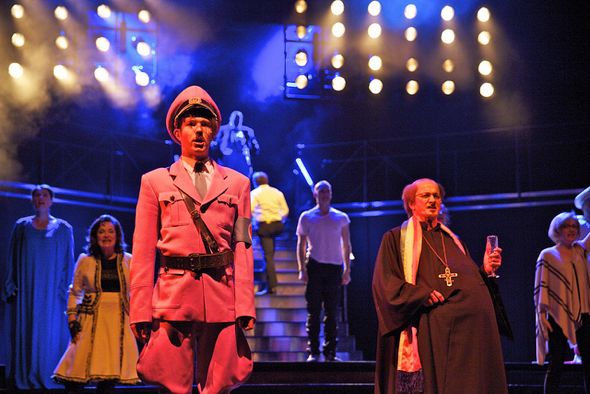
Dictators and bishops: Scene 15, ‘A small international gay opera’. Photographs: The Finnish National Theatre / Laura Malmivaara, 2011
CAST OF CHARACTERS
Veijo Teräs
Hellevi, Veijo’s wife and a Member of Parliament
Hellevi’s Conscience
Rebekka, Hellevi and Veijo’s daughter
Moritz, Hellevi and Veijo’s godson
Agnes af Starck-Hare, Doctor of Psychiatry
Seven Dwarves
Tom of Finland
Atik
The Bishop of Mikkeli
Adolf Hitler
Albert Speer
Josef Stalin
Old gays: Kale, Jorma, Rekku, Risto
Olli, Uffe,Tiina, Jorma: people from SETA [the Finnish LGBT association]
Second Lieutenant, Private Teräs, the men in the company
A Policeman
Big Gay, Little Gay, Middle Gay
William Shakespeare
Hermann Göring
Hans-Christian Andersen
Teemu & Oskari, a gay couple
The Apostle Paul
Father Nitro
Winston Churchill
SCENE ONE
On the stage, a narrow closet.
Veijo Teräs appears, struggling to get out of the closet.
Veijo Teräs is dressed as a prince. He is surprised and embarrassed to see that the audience is already there. He seems to be waiting for something.
He speaks, but continues to look out over the audience expectantly.
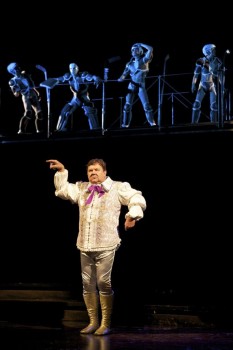
Snow White's spouse, Veijo (Juha Muje), and the dwarves. Photo: Laura Malmivaara, 2011
VEIJO
This outfit isn’t specifically for me, because… I mean, it’s part of this whole thing. This Snow White thing. I’m waiting for the play to start. Just like you are. My name is Veijo Teräs and I’m playing the point of view role in this story. Writers put point of view roles like this in their plays nowadays. They didn’t use to.
Just to be clear – this isn’t a ballet costume. I’m not going to do any ballet dancing, but I won’t mind if someone dances, even if it’s a man. Particularly if it’s a man. But I don’t watch. Ballet, I mean. Not at the opera house, or on television, or anywhere, and I have no idea why we had to bring up ballet – or I had to bring it up – because this is a historical costume, so it’s appropriate. This is what men used to wear, real men like Romeo and Hamlet, or Cyrano de Bergerac. But we in the theatre these days have a hell of a job getting an audience to listen to what a man has to say when he’s standing there saying what he has to say in an outfit like this. People get the idea that it’s a humorous thing, but this isn’t, this Snow White thing, where I play the prince. Snow White is waiting in her glass casket, she died from an apple, which seems to have become the Apple logo, Lord knows why, the one on the laptops you see on the tables of every café in town. More…
No place to go
30 March 2008 | Archives online, Fiction, Prose
Extracts from the novel Lakanasiivet (‘Linen wings’, Otava, 2007)
The clothesline swayed in the wind. Helvi closed her eyes and felt herself flutter into the air with the laundry. She flapped her white linen wings, straining higher, now seeing below the whole small peninsula city, its damp rooftops glittering in the morning sun, the blue sighs of the chimneys, the steamboats toiling on the lake and the trains chugging on their tracks. The whole of heaven was clear and blue; only far off in the east were there white pillars roiling – whether smoke or clouds, Helvi could not tell.
She flew north on her linen wings and saw the great bridges leading to the city, on whose flanks the hidden anti-aircraft batteries gasped the fumes of gun oil and iron, and continued her journey over the land, following the straight lines of the telephone wires. She flew over wooded hills and deep green fields, finally arriving on the slope of the great hill where her daughter now lived, in hiding from the war. More…
Dog days
30 September 2008 | Fiction, Prose
A story from Avantgarderob ja muuta irtaimistoa (‘Avantgarderobe and other moveables’, Tammi, 2008). Introduction by Soila Lehtonen
The air between the old dog’s teeth cuts like a crosscut saw.
There is a furious rhythm in her bark.
She’s been left out of the moose-hunting pack.
The more decrepit her body is, the stiffer her joints, the more her bark is filled with passion for the hunt. But she shows no sign of nostalgia, she’s not hankering after some long-ago days of glory, when she was the leader of the pack. This is clearly a bark of command. Even from kilometres away, she tells the other dogs where to go — not that way — a little more to the left — behind that stump, you blockheads! More…