

Search results for "Riikka/2010/10/mikko-rimminen-nenapaiva-nose-day"
Looking for Moominpappa
30 June 1994 | Archives online, Children's books, Fiction
Tove Jansson wrote the first Moomin book in the dark days of Finland’s Winter War in 1939. This extract, from Småtrollen och den stora översvämningen (‘The little trolls and the big flood’, Schildts, 1945, 1991), tells the story of how the Moomins found their home
It had become very hot late in the afternoon. Everywhere the plants drooped, and the sun shone down with a dismal red light. Even though Moomins are very fond of warmth, they felt quite limp and would have liked to rest under one of the large cactuses that grew everywhere. But Moominmamma would not stop until they had found some trace of Moomintroll’s Papa. They continued on their way, even though it was already beginning to get dark, always straight in a southerly direction. Suddenly the small creature stopped and listened. ‘What’s that pattering around us?’ he asked.
And now they could hear a whispering and a rustling among the leaves. ‘It’s only the rain,’ said Moominmamma. ‘Even so, now we must crawl in under the cactuses.’
All night it rained, and in the morning it was simply pouring down. When they looked out, everything was grey and melancholy. More…
Poems
31 December 1986 | Archives online, Fiction, poetry
Introduction by Kai Laitinen
Evening Mood
It’s widening:
an evening like a sigh –
languidly spreading across the land.
The tree’s unclothing
its branches of their colours, darkening.
As if something somewhere
were ringing and ringing –
a song straying like an orphan.
The words seem
something I’ve heard:
‘only a shadow –
only a shadow of a dream’
It’s slipping away. It’s dwindling.
Everything – everything – I’ve been given
I’ll give away. More…
Year of the cat
13 November 2014 | Fiction, Prose
Extracts from the novel Kissani Jugoslavia (‘Yugoslavia, my cat’, Otava 2014). Introduction by Mervi Kantokorpi
I met the cat in a bar. And he wasn’t just any cat, the kind of cat that likes toy mice or climbing trees or feather dusters, not at all, but entirely different from any cat I’d ever met.
I noticed the cat across the dance floor, somewhere between two bar counters and behind a couple of turned backs. He loped contentedly from one place to the other, chatting to acquaintances in order to maintain a smooth, balanced social life. I had never seen anything so enchanting, so alluring. He was a perfect cat with black-and-white stripes. His soft fur gleamed in the dim lights of the bar as though it had just been greased, and he was standing, firm and upright, on his two muscular back paws.
Then the cat noticed me; he started smiling at me and I started smiling at him, and then he raised his front paw to the top button of his shirt, unbuttoned it and began walking towards me. More…
On Mirkka Rekola
30 June 1978 | Archives online, Authors
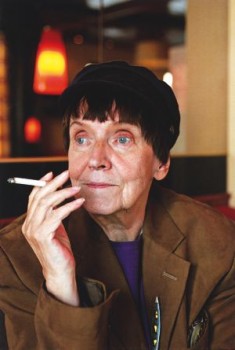
Mirkka Rekola. Photo: Elina Laukkarinen/WSOY
The very title of Mirkka Rekola‘s latest collection of poems, Kohtaamispaikka vuosi (‘Meetingplace the year’, Werner Söderström, 1977), reveals a theme central to Rekola’s poetry: that of unity. The time is the place. ‘I do not imagine I shall meet you this year. / This place will be here in summer.’ Rekola has a particular way of using language of the most intense concentration, so that it brings out unity between a wide variety of moods. ‘I shall meet you this year’ also means that you are this year. ‘This place will be here in the summer’ means that it is autumn and this place (a summer café) will remain deserted until the summer, but also that this place will remain there as the summer.
‘The world, a table already laid, there you see your hunger.’ ‘At the same time a little thirsty and a cowberry.‘ The correspondence of place, the synchrony of season and the general sense of undividedness produce countless pictorial and therefore concrete expressions throughout Rekola’s poetry. ‘I spread my hands / and someone yawned, / I held my fingertips in the breeze / and the boats slid into the water.’ ‘The child said to the old man: you are bent, while I am so little.’ ‘A shout is heard which is no other’s.’ Rekola’s concrete and graphical mode of expression is also based on the same philosophy: ‘Do not make a picture, everything is [a picture]’. ‘The sun, star of the night, introduces the day. And the world is so talkative in its dreams.’ More…
For your eyes only
11 May 2015 | This 'n' that

Photo: Steven Guzzardi / CC BY-ND 2.0
Imagine this: you’re a true bibiophile, with a passion for foreign literature (not too hard a challenge, surely, for readers of Books from Finland,…). You adore the work of a particular writer but have come to the end of their work in translation. You know there’s a lot more, but it just isn’t available in any language you can read. What do you do?
That was the problem that confronted Cristina Bettancourt. A big fan of the work of Antti Tuuri, she had devoured all his work that was available in translation: ‘It has everything,’ she says, ‘Depth, style, humanity and humour.’
Through Tuuri’s publisher, Otava, she laid her hands on a list of all the Tuuri titles that had been translated. It was a long list – his work has been translated into more than 24 languages. She read everything she could. And when she had finished, the thought occurred to her: why not commission a translation of her very own? More…
All aboard
30 December 2005 | Fiction, Prose
Extracts from the novel Nooakan parkki (‘Noahannah’s barque’, Tammi, 2005)
A Royal Navy Three-funnel Brig
The crew:
Matilda, an overeating cat
Five geese
20 hens
A fat narcoleptic cock
A couple of ducks
A goat
Three dogs
48 bats
Six woodpeckers
104 titmice
There’s a north-westerly blowing.
Djibouti 253
Three feet long from the east and five from the west, plus two hat-heights above the earth’s surface; standing on the sauna bench I scan the horizon for any omens – a raven, a woodpecker or a flock of waxwings. A crow would do. More…
The bodyguard
31 March 1991 | Archives online, Fiction, Prose
An extract from Henkivartija (‘The bodyguard’), winner of the Runeberg Prize, 1991. Introduction by Suvi Ahola
When spring comes Ossi’s sister tries to reach him on the telephone. She is worried; it sounds as if Ossi is partying constantly. Mostly she is told that Ossi is asleep, Ossi has just gone out, Ossi does not feel like talking. Unknown women call her a whore, tell her to fuck off. In the background she can hear muffled roars, shouts of laughter, music, shouting, the clink of glasses.
Ossi’s sister is irritated to have been left to arrange the practical affairs relating to her father’s death. There will not be much to be had from the smallholding, squeezed between two roads, and the fields have long since been sold. All the same, you might have thought that Ossi would be interested in this possible source of funds; it isn’t as if he has a job, at least not a permanent one. More…
Man and boy
31 December 2006 | Archives online, Fiction, Prose
Extracts from the novel Kansallismaisema (‘National landscape’ Tammi, 2006). Introduction by Tuomas Juntunen
Plans were afoot to establish boys’ camps across the country. This was an experiment, a chance to test the water, to be a pioneer. Here was the opportunity to be the first in line to conquer the Wild West, just as many a brave cowboy had done in years gone by. The Ministry of General Affairs planned to put all 15-year-olds to work for the duration of the summer holidays. Casual labourers were often even younger. Our task was to ascertain a suitable minimum age. In addition, special camps were planned for those not suited to normal work camps. In the summers to come the youth of Finland would be fully employed. Weren’t we in fact driven by the same desire, Tikka had wondered. We both cared about the next generation. We wanted to root out their deficiencies so that they would be able to face life’s challenges to the full. More…
The strike
13 December 1980 | Archives online, Fiction, Prose
An extract from Täällä Pohjantähden alla (‘Here beneath the North Star’), chapter 3, volume II. Introduction by Juhani Niemi
With banners held aloft, the procession of strikers moved towards the Manor. It was known that the strikebreakers had arrived early and that the district constable was with them. Just before reaching the field the marchers struck up a song, and they went on singing after they had halted at the edge of the field. The men at work in the field went on with their tasks, casting occasional furtive glances at the strikers. Nearest to the road stood the Baron and the constable. Uolevi Yllö’s head was bandaged: someone had attacked him with a bicycle chain as he left the field at dusk the evening before. Arvo Töyry was in the field too, the landowners having agreed that those who had got their own harrowing and sowing done should lend the others a hand. Not all the men in the field were known to the strikers. The son of the district doctor was there they noticed, and the sons of several of the village gentry, as well as the men from the smallholdings. More…
Kullervo
31 March 1989 | Archives online, Drama, Fiction
An extract from the tragedy Kullervo (1864). Introduction by David Barrett
The plot of the Kullervo story as told in the Kalevala: Untamo defeats his brother Kalervo’s army, and Kalervo’s son Kullervo is born a slave. Untamo sells him as a young child to llmarinen whose wife, the Daughter of Pohjola, makes the boy a shepherd and bakes him a loaf with a stone inside it. Kullervo takes his revenge by sending home a flock of wild animals, instead of cattle, who tear her to pieces. He flees, and discovers that his parents and two sisters are alive on the borders of Lapland. He finds them, but one of his sisters is lost. Life in the family home is unhappy: Kullervo fails in all the tasks his father sets him. On his way home one day he finds a girl in the forest whom he abducts in his sledge and seduces. It turns out the girl is his lost sister, who drowns herself when she learns that Kullervo is her brother. Kullervo sets out to revenge himself on Untamo; he kills and destroys. When he returns home, he finds the house empty and deserted, goes into the forest and falls on his sword.
ACT II, Scene 3
Kalervo’s cottage by Kalalampi Lake. It is night-time. Kimmo, seated by a fire of woodchips, is mending nets. More…
Arska
30 September 1982 | Archives online, Fiction, Prose
A short story from Kaksin (‘Two together’). Introduction by Pekka Tarkka
A landlady is a landlady, and cannot be expected – particularly if she is a widow and by now a rather battered one – to possess an inexhaustible supply of human kindness. Thus when Irja’s landlady went to the little room behind the kitchen at nine o’clock on a warm September morning, and found her tenant still asleep under a mound of bedclothes, she uttered a groan of exasperation.
“What you do here this hour of day?” she asked, in a despairing tone. “You don’t going to work?”
Irja heaved and clawed at the blankets until at last her head emerged from under them.
“No,” she replied, after the landlady had repeated the question.
“You gone and left your job again?”
“Yep.” More…
As in a dream
31 December 1992 | Archives online, Fiction, Prose
From Kun on tunteet (‘When you have feelings’, 1913). Introduction by Irmeli Niemi
‘No, they’re not rich, those Kolehmainens, not rich at all. Even the house is a bit on the small side.’
‘So how did you end up there? That’s one thing I’ve often wondered about.’
‘How did I end up there? Well, it must have been my fate.’
‘You sure weren’t looking to get rich.’
‘No, I sure wasn’t. Got married when I had to.’
‘Had to. You can’t tell me it had to be to him. You, with suitors in every size and shape. All you had to do was pick out the best, but no, you just up and take off with somebody from out of town, and a poor man at that.’ More…
Boys Own, Girls Own? –
Gender, sex and identity
30 December 2008 | Essays, Non-fiction
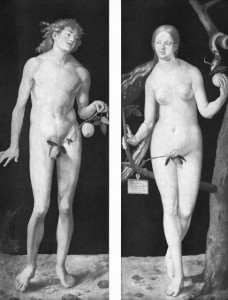
Knowing good and evil: Adam and Eve (Albrecht Dürer, 1507)
In Finnish fiction of the present decade, both in poetry and in prose, there seems to be at least one principle that cuts across all genres: an overt expression of gender, writes the critic Mervi Kantokorpi in her essay
Relationships and family have always been central concerns of literature; questions about gender and individual identity have received a new emphasis in Finnish literature from one season to the next. The gender roles represented in contemporary literature appear to become ever more stereotypical. The question is no longer only of the author consciously setting his or her gender up as the starting point for expression, as has already long been the case with modern literature written by women. More…