

Search results for "Riikka/2010/10/mikko-rimminen-nenapaiva-nose-day"
Nordic prize to Sofi Oksanen
31 March 2010 | In the news

Sofi Oksanen. Photo: Toni Härkönen
The Nordic Council’s Literary Prize 2010 has been awarded to Sofi Oksanen for her novel Puhdistus (‘Purge’, WSOY, 2008).
The winning novel was selected by a jury from a shortlist of 11 works from the Nordic countries. The prize, worth approximately 47,000 euros, will be awarded in Reykjavik in November.
The novel, about women’s fates in the violent history of 20th-century Estonia, was awarded both the Finlandia Prize for Fiction and the Runeberg Prize in Finland, where it has sold more than 142,000 copies.
So far publication rights have been sold to 27 countries; the English translation, by Lola Rogers, will appear next month in the US, published by Grove Press.
Notes related to pharmacist Pemberton’s holy nectar
Extracts from the novel Vådan av att vara Skrake (‘The perils of being Skrake’, Söderström & Co.; Isän nimeen, Otava, 2000)
At the time of Werner’s stay in Cleveland Bruno and Maggie had already been divorced for some years, and in an irreconcilable manner. But they were still interested in their grown-up son, each in their own way; Maggie wrote often, and Werner replied, he wrote at length, and truthfully, for he knew that Bruno and Maggie no longer communicated; to Maggie he could admit that he hated corporate law and bookkeeping, and to her he dared to talk about the raw music he had found on the radio station WJW, he wrote to her that the music of the blacks had body and that he had found a great record store, it was called Rendezvous and was situated on Prospect Avenue and there he had also bought a ticket for a blues concert, wrote Werner, he thought that Maggie would understand. More…
Big-city blues
30 September 2005 | Fiction, Prose
Extracts from the novel Beige. Eroottinen kesä Helsingissä (‘Beige. An erotic summer in Helsinki’, Sammakko, 2005). Introduction by Tuva Korsström
Helsinki starts – where? Where a country girl will wear white corduroy pants if she’s eight and her pen pal tells her to. Where you’re allowed to jump in at the public swimming pool, and water splashes in your face no matter what you do, and it’s a long way to the bottom, you can’t touch. Unreal. That’s what Helsinki was like. Buildings that you recognized from pictures. A city where pictures were the starting point of your life, not experience. You step into the picture and begin your life. The step takes a long time. An entire youth. The first few days go well. You’re a tourist. The crowd of anonymous, noisy people is relaxed, you feel uninhibited. Nobody pays any attention to you. Then you start to want to feel. To talk. To say hi to somebody. The waiting begins, and there’s nothing you can do to speed it up. You have to live in the city. Ten years and you’re in, maybe, a little. Be there. Stay. You’ll circulate around the triangle formed by Sokos, Stockmann, and Forum department stores. They’re familiar from pictures, you’re wary of the others. The streetcar home. Home and downtown. The city. The lanes. Conduits. Lights. Trams. Taxis. Buses. The first negro. The first stop at a traffic light. The yellow stone building. The colorful cottages at the foot of the bridge. More…
To sleep, to die
30 September 2004 | Fiction, Prose
Extracts from the novel Unelmakuolema (‘Dreamdeath’, Teos, 2004)
Dreamdeath
Who would not like to cheat the grim reaper? Ways are known, of course, both scientific and non-scientific, but all of them are uncertain and temporary. Except for the simplest: to get there first oneself.
The refinement of this idea was Dreamdeath’s business idea. ‘Dreamdeath – because you deserve it!’ went Dreamdeath’s slogan.
The Dreamdeath home offered those who wished it the means to the most pleasant, even luxurious realisation of an autonomic death in an atmosphere of moral approval, against a suitable fee. At Dreamdeath the client himself decided when and in what conditions he would leave his mortal clay. More…
Correspondence
31 March 1996 | Archives online, Fiction, Prose
A short story from Resa med lätt bagage (‘Travelling light’, Schildts, 1984)
Dear Jansson san
I am a Japanese girl.
I am thirteen years and two months old.
I will be fourteen on the eighth of March.
I have a mother and two little sisters.
I have read everything that you have written.
When I have read it I read it again.
Then I think about snow and being allowed to be by myself.
Tokyo is a very big city.
I am learning English and I am a very diligent student.
I love you.
I dream of one day being as old as you and as wise.
I have a lot of dreams.
There is a Japanese poem called haiku.
I will send you a haiku.
It is about cherry-blossoms.
Do you live in a big forest?
Forgive me for writing to you.
I wish you health and long life.
Tamiko Atsumi More…
Me and my shadow
Hotel Sapiens is a place where people are made to take refuge from the world that no longer is habitable to them; the world economy has fallen – like the House of Usher, in Edgar Allan Poe’s story – and with it, most of what is called a civilised society. A rapid synthetic evolution has taken humankind by surprise, and the world is now governed by inhuman entities called the Guardians. ‘Kuin astuisitte aurinkoon’ (‘As if stepping into the sun’) is a chapter from the novel Hotel Sapiens ja muita irrationaalisia kertomuksia (‘Hotel Sapiens and other irrational tales’, Teos, 2012), where several narrators tell their stories
The fog banks have dissipated; the sky is empty. I cannot see the sails or swells in its heights, nor the golden cathedrals or teetering towers. I would not have believed I could miss a fog bank, but that’s exactly what it’s like: its disappearance is making me uneasy. For all its flimsiness and perforations it was our protection, our shield against the sun’s fire and the stars’ stings. Now the relentlessly blazing sun has awakened colours and extracted shadows from their hiding places. The moist warmth has dried into heat and the Flower Seller’s herb spirals have dried up into skeletons. The leaves on the trees are full of bronze, sickly red and black spots. Though there is no wind and autumn is not yet here, they come loose as if of their own volition, as if they wanted to die.
This morning, as I was strolling up and down the park path as usual, I saw another shadow alongside my own.
– Ah, you’re back! I said. – I wondered what had happened to you after you lost your shadow; how did you manage to change into your own shadow yourself? More…
Six letters
31 March 1986 | Archives online, Fiction, Prose
From Tainaron (1985). Introduction by Soila Lehtonen
The whirr of the wheel
Letter II
I awoke in the night to sounds of rattling and tinkling from my kitchen alcove. Tainaron, as you probably know, lies within a volcanic zone. The experts say that we have now entered a period in which a great upheaval can be expected, one so devastating that it may destroy the city entirely.
But what of that? You need not imagine that it makes any difference to the Tainaronians’ way of living. The tremors during the night are forgotten, and in the dazzle of the morning, as I take my customary short cut across the market square, the open fruit-baskets glow with their honeyed haze, and the pavement underfoot is eternal again.
And in the evening I gaze at the huge Wheel of Earth, set on its hill and backed by thundercloud, with circumference, poles and axis pricked out in thousands of starry lights. The Wheel of Earth, the Wheel of Fortune… Sometimes its turning holds me fascinated, and even in my sleep I seem to hear the wheel’s unceasing hum, the voice of Tainaron itself. More…
Poems
31 December 1985 | Archives online, Fiction, poetry
Introduction by George C. Schoolfield
Birds of passage
Ye fleet little guests of a foreign domain,
When seek ye the land of your fathers again?
When hid in your valley
The windflowers waken,
And water flows freely
The alders to quicken,
Then soaring and tossing
They wing their way through;
None shows them the crossing
Through measureless blue,
Yet find it they do.
Unerring they find it: the Northland renewed,
Where springtime awaits them with shelter and food,
Where freshet-melt quenches
The thirst of their flying,
And pines’ rocking branches
Of pleasures are sighing,
Where dreaming is fitting
While night is like day,
And love means forgetting
At song and at play
That long was the way. More…
The Confirmation Present
30 June 1980 | Archives online, Fiction, Prose
An excerpt from Rakas rouva K (‘Dear Mrs K.’, 1979). Introduction and interview by Auli Viikari
Lahtinen read through what he had written so far, and it pleased him, especially the quotation from Clausewitz. “It could be said,” he went on, “that the victories of the French Revolution during those two decades were due in most cases to the mistaken policies of its opponents, even though the actual coup that shook the world took place within the framework of war.” His article was about the British attitude to Germany’s expansionist policies. There would not be another Munich, he felt sure: the House of Commons had cheered Chamberlain for the last time. Where, he asked himself, would England eventually abandon the role of passive onlooker? At Danzig, surely. It would not be like Poland to give something for nothing. She would set a world war in motion, of that he had no doubt. And he could see Poland dissolving into ruin before his very eyes. More…
In the detail?
11 December 2009 | Essays, Non-fiction
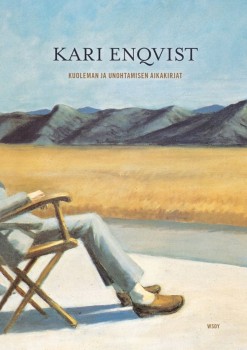 Extracts from Kuoleman ja unohtamisen aikakirjat (‘Chronicles of death and oblivion’, WSOY, 2009)
What’s the meaning of life? There are those who seek it in religion, while for others that is the last place to look. The scientist Kari Enqvist ponders why some people, including himself, seem physiologically immune to the lure of faith. Perhaps, he suggests, we should look for significance not in the big picture, but in the marvel of the fleeting moment
As a young boy I must have held religious beliefs. However, I cannot pinpoint exactly when they disappeared. At some point I eventually stopped saying my evening prayers, but I am unable to remember why or when this happened. ‘I was born in a time when the majority of young people had lost faith in God, for the same reason their elders had had it – without knowing why,’ writes the Portuguese poet Fernando Pessoa in The Book of Disquiet. More…
Notes for an unwritten autobiography
15 September 2011 | Fiction, Prose
Extracts from the novel William N. Päiväkirja (‘William N. Diary’, Otava, 2011). Interview by Soila Lehtonen
Paris, 15 November 1897
Constance probably bought this notebook for housekeeping purposes, but forgot it when she left, so I shall take it for my use, and I am not going to tear a single page, because the paper is of good quality and the covers are made of calico. When I write in a small hand there is plenty of room for the text, and when I write in Swedish Constance will not understand, if she chances to see the notebook. She has promised to visit once or twice a week and continue to bring food and do the cleaning (we cleared up the differences of opinion that were related to her departure), even though she has now moved and married a retired officer, having been my housekeeper for nearly 30 years. The laundry she has delegated to Madame L., who lives in this house, although that lady is intolerably nosy and talkative, and she has six smutty children. I have decided to write my autobiography, so that posterity shall receive a full and proper impression of my work. (Let Prof. Schwendener from Berlin and Dr Louis Pasteur be content with minor roles!) I shall not begin until tomorrow, for today I intend to study the specimens of South American lichens Prof. D. has sent if there is enough daylight. More…
Hotel for the living
30 June 1984 | Archives online, Fiction, Prose
An extract from Hotelli eläville (‘Hotel for the living’, 1983). Introduction by Markku Huotari
Raisa and Pertti are a married couple with three children, Katrielina, Aripertti and Artomikko. When she discovers she is to have another, whom she names Katjaraisa, Raisa decides to have an abortion, because another child, even if welcome, would now jeopardise her career – she has been offered a job with an international company at the very top of the advertising world. Raisa is the successful entrepreneur of the novel – on the one hand coldly calculating, without feeling, on the other superficially sentimental, perhaps the most startlingly ironic of the characters in Jalonen’s novel. His image of the brave new woman?
During her lunch hour Raisa took a walk via the laboratory, asked reception for the envelope and thrust it unregarded into her handbag. She was aware of her already knowing, but short of the envelope, there would as yet be no restrictions, nor were there any decisions that would have to be made. She had called Tom Eriksson, discussed yet again the same points and particulars, and ended tracing a finger over the two beautiful pictures on her wall. ‘The loveliest of seas has yet to be sailed’ and ‘I am life! For Life’s sake.’
She thought of Katjaraisa, her features, the palms the breadth of two fingers, just as Katrielina’s had been, and the same button-eyed gazing look as Katrielina. More…
Speaking about the heart
30 June 1991 | Archives online, Articles
New Finnish poetry, translated and introduced by Herbert Lomas
The ‘modernist’ revolution in Finnish poetry is now 40 years old, and the art must be ripe for changes.
Of course, the modernism of post-war Finnish poetry was not – except in Haavikko and to some extent in Saarikoski – extremely modernist. The poets were more interested in their content than their experiments. They were perhaps closer to ancient Chinese poets and early Pound than to Eliot in their elided brief juxtapositions and meditations on nature, society and moment-to-moment transience. The poets picked up a few liberties that unshackled them from metrical and rhyming formalities uncongenial to Finnish stress, syntax and phonemics; and they took off to speak about the heart. That is the strength of this poetry, and its originality, since all originality consists in being oneself – which includes one’s national self, and ultimately other people’s selves. And every generation still has to make a new start, admittedly in new circumstances, with the experience of its forefathers from birth to death. More…
What about me?
30 September 2008 | Fiction, Prose
Extracts from the novel Mitä onni on (‘What happiness is’, Otava, 2008)
I was lying on the sofa watching Sports Roundup. The ski jumpers were flying at Zakopane. When I go one day, I want the cantor to play the Sports Roundup theme on the harmonium and the pallbearers to look on like skiing judges down into the pit.
‘I have an idea,’ Liisa said, sitting down at the other end of the sofa. I muted the television and adopted a focused expression. I focused on thinking about my expression.
‘Finnish happiness,’ Liisa pronounced solemnly. ‘I’ll illustrate, and you write.’
‘A book again,’ I said and turned the sound back on. They were reading off the women’s basketball scores now. Liisa waited patiently. I was disarmed enough by this that I turned the television off. More…