

Search results for "Riikka/2010/10/mikko-rimminen-nenapaiva-nose-day"
Poems
30 September 1979 | Archives online, Fiction, poetry
Introduction by Thomas Warburton
1
What about going up into the birch tree together
so high till it bends with our weight
and we’re thrown, two seeds on one dandelion chute
down into the lake and its quaking looking glass
There we wash around together without
a stitch on our feelings
We let ourselves sink down to the lakefloor and set up
house there for a time
Among the fakirs the watercolourists and the alcoholics
we can hear the water sprite fluting, all out of tune
like a gipsy band gone down with the ship. More…
Shards from the empire
5 February 2010 | Fiction, Prose
‘Imperiets skärvor’, ‘Shards from the empire’, is from the collection of short stories, Lindanserskan (‘The tightrope-walker’, Söderströms, 2009; Finnish translation Nuorallatanssija, Gummerus, 2009)
Gustav’s greatest passion is for genealogy. He dedicates his free time to sketching coats of arms; masses of colourful, noble crests.
Gustav asked me to do a translation. I sat for ten days trying to decipher a couple of pages from a Russian archive dating from the 1830s. Sentences like, With this letter, we hereby give notice of our gracious decision.‘
The intricate handwriting belonged to some collegiate registrar or other. Perhaps Gogol’s Khlestakov. More…
Decisions, decisions: the fate of virtual literature
28 November 2013 | Articles, Non-fiction
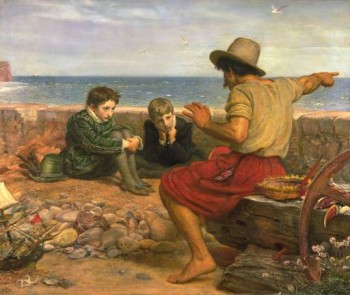
Once upon a time: ‘Boyhood of Raleigh’ by J.E. Millais (1871). Wikipedia
In an era of ‘liveblogging’‚ we are all storytellers. But what’s the story, asks Teemu Manninen
One score of years ago, when the internet was new, the cultural critics of the time were fond saying that it would usher in a new utopia of free distribution of information: we would be able to read everything, know everything and share everything anywhere and every day.
Truly, they told us, we would become enriched by the internet to the point of not knowing what to do with all that wealth of knowledge, the amount of connections between us and the ever-increasing online availability of anyone with everyone, every waking hour.
Now that we really do have this always-on connectivity, you will indeed be available every waking hour: you will update your status, check your inbox, post pics and be available for chatting, texting, a quick email and a message or two, just to make sure no one is offended by your unreachability, since – from experience – a week’s worth of not tweeting or facebooking can make someone think that something serious has happened, or that you don’t even exist anymore. More…
Midsummer madness
31 December 2005 | Archives online, Fiction, Prose
An extract from the novel Voimattomuus (‘Powerlessness’, WSOY, 2005). Introduction by Maila-Katriina Tuominen
Cast:
a man
a woman
a boy
Midsummer Eve. A cabin.Outside it’s raining a little, but the blanket of clouds is already breaking up.
It’s bright in the cabin, like daylight. The table is set.
A bunch of wild violets, torn from its means of support, droops in the middle of the table, surrounded by stemmed glasses and paper napkins folded into the shape of swans. The champagne, aquavit and white wine are still chilling.
A man and a woman walk into the cabin wearing bathrobes. She has a terrycloth towel wound around her head like a turban. They’re coming from the sauna. He looks at the table with surprise. The table is set for three.
She notices the man’s gaze and hurries into the bedroom to get dressed.
He takes a beer out of the refrigerator and sits down at the table in his bathrobe.
A long silence. More…
The man and his work
30 September 1984 | Archives online, Authors
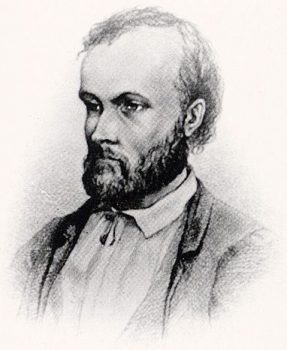
Aleksis Kivi. Drawn in 1873 almost certainly by Albert Edelfelt (1854–1905).
Aleksis Kivi’s Seitsemän veljestä (Seven Brothers, English translation 1929), is the best known and the most beloved in Finland. Its sentences have become part and parcel of the common tongue. Its events are often cited as historical happenings, its characters and their vicissitudes are now permanent national property just as the characters of Shakespeare are for the English, those of Molière for the French, or those of Cervantes for the Spaniards.
Aleksis Kivi’s life (1834–1872) is filled with paradoxes and unanswered questions. How could a village tailor’s son who has acquired only a little learning at home and who managed to graduate from secondary school, after many efforts, only at the age of 23, became an author of the first rank? How could a man who travelled within a radius of only a few dozen miles during his life know the Finnish landscape and the Finnish mind so thoroughly that his novel even today, mutatis mutandis, conveys a true picture of an entire nation? How could he free himself from the spirit and the idealised conception of the art of his own day so completely as to be able to write books sharply at variance with the other literary works of the same era, in which he followed his own path and found fully independent artistic solutions? And how could a book which is, practically speaking, the first Finnish-language novel and which thus springs up as a unique phenomenon from an inadequately cultivated linguistic soil, reach such heights as to become the supreme achievement of all Finnish literature? The enigmatic quality of Kivi’s character is further enhanced by the fact that there exists only one authentic portrait of him, drawn when he already lay dead; that the original manuscript of Seitsemän veljestä is not extant; and that of his letters, only about seventy have been preserved, some only brief notes and most of them dealing with financial arrangements. More…
Temporarily out of order
Extracts from the novel Hullu (‘The lunatic’, Teos, 2012). Introduction by Soila Lehtonen
I found myself standing in front of the noticeboard. The rules were on a sheet of paper:
Ward 15 5-C
MEAL TIMES:
Breakfast 8:00 AM
Lunch 11:45 AM
Dinner 4:30 PM
Evening Snack 7:30 PM
COFFEE:
After lunch
We recommend leaving money, valuables, and bankbooks for storage in the ward valuables locker. We take no responsibility for items not left in the locker! Money may be retrieved 1–3 times per day. Use of mobile phones on the ward by arrangement.
VISITING HOURS:
M–F 2–7 PM
Sa–Su 12–7 PM
PERSONAL CLOTHING:
Use of one’s own clothing by individual arrangement. Clothing care individual. Washer and dryer available for use in the evenings after 6 PM.
OUTDOOR RECREATION:
Arranged individually according to health condition. Outdoor pass does not include the right to leave the area.
VACATIONS:
Vacations arranged during morning report, according to health condition.
NOTA BENE!
Smoking is only allowed on the smoking balcony! Smoking prohibited from 11 PM to 6 AM.
Pastor Karvonen available by appointment.
These were impossibly difficult rules. I read them through three times and simply did not understand. ‘Clothing care individual.’ ‘Outdoor pass does not include the right to leave the area.’
What did these sentences mean? With whom did you schedule the pastor and how? And why? More…
In the early hours
31 March 1976 | Archives online, Fiction, Prose
An extract from Dyre Prins (‘Sweet Prince’, 1975). Introduction by Ingmar Svedberg
Donald Blaadh, a retired businessman, has been called to visit an influential acquaintance in the middle of the night.
He was sitting in the library, listening to Shostakovich, the Leningrad Symphony. The slow crescendo. The insistent march rhythm. Dogged endurance. Indomitability. He switched it off when I came in.
“I can’t sleep,” he said.
“Neither can I.”
He ignored the ironic undertone. “Shostakovich sharpens the decisionmaking faculties, the way chess sharpens the wits,” he said. “A sort of exercise routine … but I forgot, you don’t play chess.”
“No, but I do play the gramophone.”
“To-day I’m going to start you off with a quiz: whose immortal words were these, ‘Minerva’s owl never takes to the air till twilight is falling’?”
“I don’t know.” More…
The last lap
30 June 2001 | Archives online, Fiction, Prose
A short story from Ilmatasku (‘Air pocket’, Otava, 2000). Introduction by Soila Lehtonen
Father arrived by taxi with his black suitcases.
He stood in the hallway, casting a glance over father’s shoes, his trouser-legs. Under his arm was a folded newspaper; it fell to the ground when father bent to undo his shoelaces.
The newspaper was written in strange letters. It felt as if the saliva would not leave his mouth however hard he swallowed. Mother jumped back and forth; mother’s mouth chattered. He scratched the wall with his nail; it was scored with pencil lines recording how much he had grown.
When father straightened up, he filled the whole room. More…
The report
30 September 1984 | Archives online, Fiction, Prose
A short story from Kesä ja keski-ikäinen nainen (‘Summer and the middle-aged woman’) Introduction by Margareta N. Deschner
Dear Colleague,
First of all, I want to thank you and your wife for the pleasant evening I and my wife had in your summer villa in August. Briitta (since we are old acquaintances: with two i’s and two t’s, remember?) especially wants me to mention that she will never forget the half moon climbing the hill behind your sauna, surprising us with its speed. The next time we looked it was half-way up the sky! Without doubt, your fine tequila had something to do with the matter, one shouldn’t forget that. Even so, it was quite a show, just like the time a bunch of us guys had gone skiing and you bragged that you had arranged for the barn to catch fire. I hope that you and your wife – I mean Alli – will be able to visit us next winter and taste a superb Mallorca red wine called Comas, which we brought home. It is by far the best red I have ever tasted and indecently cheap to boot. I hope you will come soon. The wine won’t keep indefinitely, as you well know. We’ll save it for you. So thanks again.
Poems
31 March 1979 | Archives online, Fiction, poetry
Poems from Lähdössä tänään (‘Leaving today’, 1977) Introduction by Jouko Tyyri
1
‘The wind’s speaking.’ If the wind were really speaking
could we endure its words
so void, flinty, so groping?
Inside them
they have
salt, horror,
mania: a long-drawn black speechless
roller that wipes the coast clean
of houses, woods, junk. It swashes
your eyes. If I’d had some
feeling. Or thought. If
I was something. If I was I.
It’s gone.
There’s nothing here. Only a draught.
The air moving back and forth, soon to drop.
2
Orlando di Lasso's melodies
airy, without a touch of soil
                           a little dust on
as much as might be on a butterfly's wing
                           only just so much
Orlando himself, four hundred years
remoulded into loam, coalesced with dust
just like you, you, just like you More…
A sweep is as lucky as lucky can be
27 August 2009 | Authors, Reviews

Jari Järvelä. Photo: Ville Palonen
The heroine of Jari Järvelä’s new novel begins telling the story of her life from inside an oven, beneath which a murderer is stoking a fire: a gripping start.
The reader of Mistä on mustat tytöt tehty? (‘What are black girls made of?’) has to wait until the end of the novel to find out what happens to the captive female chimney sweep, Katariina or ‘Rööri’ (‘Pipey’). In those moments in the oven, Pipey’s life flashes before her eyes.
In his previous novels, Jari Järvelä (born 1966) has concentrated on exploring people on the margins of Finnish history; rather than portraying the lives of significant figures, he chooses instead to depict everyday people and their day-to-day lives.
In his recent trilogy, Järvelä gave an account of the years between Finland’s independence in 1917 and the beginning of the Second World War. (The final part of this trilogy, Kansallismaisema [‘National landscape’, 2006] was featured in Books from Finland 4/2006). Since 1995 his output has included seven novels, collections of short stories and radio plays. More…
The summer of 1965
30 June 1995 | Archives online, Fiction, Prose
From Underbara kvinnor vid vatten (‘Wonderful Women by the Sea’, Söderströms, 1994; Finnish translation lhanat naiset rannalla, Otava, 1995). Introduction by Michel Ekman
The summer of 1965; this summer people go waterskiing. They go waterskiing behind the Lindberghs’ shining mahogany sportsboat, and from midsummer onwards they go water-skiing behind Gabbe’s outboard motorboat, an Evinrude bought second-hand from Robin Lindbergh. Now Bella and Rosa are skiing: Tupsu Lindbergh’s face is covered in freckles if you look at her close to, and it’s not particularly becoming, her fair hair is super-peroxided and she is as thin as a skeleton and everyone knows that it’s because she is so thin and ugly and not because she has a cold that she says she can’t take part in any watersports. There is something nervous about Tupsu Lindbergh. At Bella’s party at the beginning of the summer Tupsu Lindbergh sits on the white villa’s veranda, on the white villa’s lawn on a camping chair, on the white villa’s beach while Bella and Rosa go waterskiing and talk about Tupperware. Not Tupperware all the time, but Tupperware is the collective description. More…
Away with darkness
28 December 2011 | This 'n' that
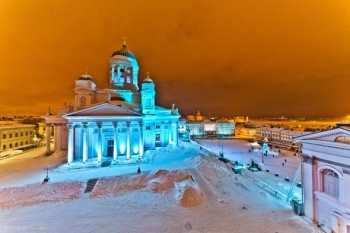
Helsinki Cathedral, lit by Martin Kuhn. Photo: Ralph Larmann
Helsinki is about to celebrate its third Season of Light. A team of designers and artists have created a series of works that will transform the urban milieu and buildings into ‘an experience for the senses and emotions’ in early January (31st December to 9 January).
For example, Helsinki Cathedral will be illuminated by light artist Mikki Kunttu, accompanied by a special sound environment. The light installation will run every day from 5 pm to 11 pm.
The German lighting designer Martin Kuhn will create an installation around Unioninkatu street, using LED technology. It will run from 6 pm to 10 pm.
Take a look at the programme – there are also photo and video samples from the previous Seasons of Light – here.
Who knows whether Helsinki will see any snow at New Year either (Christmas was black this time); nevertheless, these colours will brighten up the darkest hours in the city.
And hey, the winter solstice is already behind us, there is going to be more and more light each day!