

Search results for "Riikka/2010/10/mikko-rimminen-nenapaiva-nose-day"
The oldest language
30 June 2003 | Archives online, Fiction, poetry
Poems from Istun vastapäätä (‘I’m sitting across from’, WSOY, 2002). Introduction by Anselm Hollo
After the last lines spoken, snowflakes fall into the river.
You flow on out. Stop.
People keep going, as do the credits,
into the dark, out of sight.
You don’t remember the name of this street
but its back hunches up into a bridge across the fog.
From when on have we been terrified? The heart
wants to say something about that, to whomever
happens to cross its path, one’s own heart,
the beat that keeps on repeating itself.
An unpleasant warmth
on the seat that has just been abandoned. More…
New worlds
30 September 1998 | Authors, Interviews
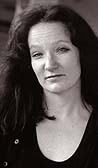
Photo: Ulla Montan
The heroine of Monika Fagerholm’s novel Diva is a teenage girl. But this is a Lolita with a difference; for this is an intelligent Lolita, with a voice of her own. Silja Hiidenheimo interviews her creator
In Monika Fagerholm’s best-selling book Underbara kvinnor vid vatten (1994, English translation:Wonderful Women by the Water), the sun shines and the women really are wonderful. If there is a certain melancholy about the story, it is born more of longing and the unrealised dream of freedom. And although all those of us who were born in the 1960s thought Monika had stolen precisely our childhood memories of summer, that she had leafed through our photograph albums, the work is, in the melancholy lightness of its narrative, an exception in Finnish realism. While the book forces its readers to empathise so completely that one cannot imagine Monika has invented anything in the whole story, but merely, like a camera, has registered everything just as it happened, an ironic laugh is heard in the book: realism is just as banal as life itself. If one were to summarise the plot of either, one would not be able to repeat it without blushing. More…
To live, to live, to live!
31 December 2001 | Archives online, Fiction, poetry
From Kaukainen puutarha (‘A distant garden’, WSOY, 1924). Introductions by Vesa Mauriala and Leena Krohn
Flowering earthThe earth’s spilling out purple lilac clusters, To live, to live, to live! So what if death’s coming! |
Kukkiva maaMaa kuohuu syreenien sinipunaisia terttuja. Elää, elää, elää! Mitä siitä, että kuolema tulee! |
Virtual realities
30 September 1993 | Archives online, Fiction, Prose
Prose pieces from Bamalama (WSOY, 1993)
After eating his family, he went abroad. There was a heatwave in Torremolinos. The sandy beaches were empty despite the Mediterranean waves’ enticing glitter. Although it was so hot, not a trace of the sun could be seen in the sky, and no clouds either. He sat in an armchair in his modest hotel room and breathed deeply. He thought about the pretty young girls on the beaches just waiting to be casually plucked, bony adolescent bodies, opulent and luscious adult female forms, and lips beyond all powers of description. He sat there, and time passed. Soon darkness spread over the beach, and he could see nothing but velvety black nothingness stretching out to the horizon. He was overcome by a powerful sense of fear, caused by the bleak desolation of the scene, this gloomy darkness that covered and hid the millions of shades of natural colors. He accepted his feelings and let them flow into himself, because he knew that morning, sunrise, and the play of nature’s colors down there on the beach boulevards, would resuscitate within him a great dreamer, impervious to the storms of the world. More…
A dictionary of human destinies
31 March 2001 | Fiction, Prose
Short stories from Av blygsel blev Adele fet (‘It was embarrasment that made Adele fat’, Söderström & Co., 2000)
Adele
It was embarrassment that made Adele fat. It wasn’t from hunger that her fridge-fumbling fingers began to grow nimble, but from confusion. And it was never knowing what her tongue ought to say that led her to the concrete business of the fridge. Her tongue certainly knew all about tasting. It could feel her teeth chewing even if it didn’t know how to speak. It became a better and better judge of brussels sprouts and speckled sausage. The rest was just good morning and thanks, thanks and goodbye and nice day. More…
Troubled by joy?
30 September 1998 | Fiction, poetry
Poems from Boxtrot (WSOY, 1998)
Nine lives
So far nine lives only, and
all mine, like my head in my hands.
My first was curled up at the foot of a fir tree
in the autumn forest just at day-dawn
in nighttime's raindrops.
The resin's still in my fingernails.
My second was the scent of split wood by the shed,
and the circular-saw blade's horrific disc.
The gruel, track shoes too large, and President Kekkonen,
ink spreading across my notebook, and
the clank of the railway under my dreams.
Mayday's red flags, the neighbour's daughter
naked, and dead pigeons lying on the gravel.
My third life was the discovery of anger, blind rage
turning and turning me in its leather bag,
wearing the edges of my day down. Sitting at our schooldesks
being forced towards a goal that can't be named.
Seeing how they start drinking, drinking
into their eyes that black impotent rebellion.
I'm on the point of drowning, someone's traversing
the Atlantic in a reed boat. And if I did die,
it wouldn't matter who sneered. The stars in the sky
                     are watching us in horror.
A fifth season
30 December 2000 | Fiction, poetry
Poems from Elävän mieli (‘A mind alive’, WSOY, 1999). Introduction by Lauri Otonkoski
In sparser gusts of wind
metaphors sough through the mind,
spinning as on the much-frequented
boulevards of a great park.
Even one’s most private thoughts are as common
as public transport, what a relief,
as shared as our anatomies and our bacteria,
for there is only one thread in the skein of the Norns
and the same fabric is always being woven
from the whims of fate: is that not a relief?
Treacherous individuality suffices only
for a fingerprint.
Metaphors always the same,
but constantly born anew
like a mind alive. More…
Oedipus Cleverclogs
30 September 1997 | Archives online, Fiction, Prose
A short story from Ammattimies (‘The professional’, Tammi, 1997)
I had just pounded the life out of a couple of Germans when mother appeared at the door of my room, her blonde hair in a bun, in her white nightdress, through which I could clearly see the outline of her figure. She looked at me a little pityingly and suggested that we should go out for a meal at the weekend, just the two of us. I nodded and went back to concentrating on my acts of heroism.
And mother did not break her promise. Although she did not earn much as the junior cook at the children’s home, that did not stop us eating out. She took me to a good restaurant that was right on the harbour, in the shadow of the old steamships. The night before, she had ironed my only white shirt and hung it on a hanger with my terylene trousers. My mother had dressed me in the same outfit on my first day at school. I was decidedly over-dressed that day, but I put a good face on it. Mother’s men must always look their best. More…
Petri Pietiläinen: Koirien Suomi. Kansanperinnettä ja historiaa [Dogs in Finland. Folk tradition and history]
12 March 2015 | Mini reviews, Reviews
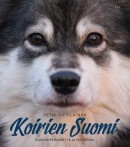 Koirien Suomi. Kansanperinnettä ja historiaa
[Dogs in Finland. Folk tradition and history]
Helsinki: Finnish Literature Society, 2014. 239 pp., ill.
ISBN 978-952-222-540-5
€32, hardback
Non-fiction writer Petri Pietilä is the author of the award-winning book Koirien maailmanhistoria (‘Dogs in world history’), which deals with the general cultural history of the dog. In the first half of this lively and fascinating new book he discusses the dog in Finnish folk tradition, while in the second half he gives an account of the history of the dog in Finland to the present day. Dogs have been domesticated in the North European region for thousands of years. In folk poetry, such as the national epic, the Kalevala, the dog is first and foremost a house guard and a partner in hunting. In Finnish folk tradition, the dog is viewed more leniently than in other countries, and stories about hellhounds are rare. Yet the attitude towards dogs in Finnish proverbs is not an exclusively positive one. Pietilä also says that the dog’s change of status has been linked to its becoming a helper and beloved pet, and today there are more than half a million of them in Finland. In addition, they are increasingly being used in various work and service roles. The book also presents the six Finnish dog breeds, and includes a dog name day calendar.
Translated by David McDuff
Decade of youth: the 1950s revisited
30 January 2014 | Reviews
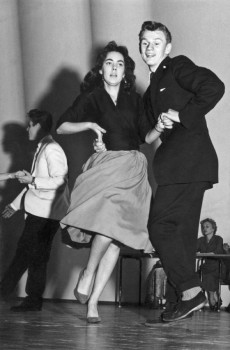
Rock around the clock in Helsinki, too! All photos here from Rasvaletti; photographer unknown, 1958
Rasvaletti. Valokuvia 1950-luvun Helsingistä /
Fotografier från 1950-talets Helsingfors
[Hair-grease. Photographs from 1950s Helsinki]
Työryhmä [working group]: Yki Hytönen, Tuomas Myrén, Riitta Pakarinen, Aki Pohjankyrö, Hilkka Vallisaari
Helsinki: Helsingin kaupunginmuseo, Helsinki City Museum,
2013. 211 pp., ill.
ISBN 978-952-272-499-1
€45, hardback
Onnen aika? Valoja ja varjoja 1950-luvulla
[Time of happiness? Light and shadow in the 1950s]
Toimittaneet [Ed. by]: Kirsi-Maria Hytönen & Keijo Rantanen
Jyväskylä: Atena, 2013. 249 pp., ill.
ISBN 978-951-796-924-6
38€, hardback
The 1950s rocked! They literally did – that is when the world got rhythm: Blue Suede Shoes by Elvis and the film Blackboard Jungle, with Bill Haley’s hit Rock Around the Clock, for example.
The development of new sound reproduction – long-playing records and tape recorders – was essential to the spreading of the gospel of rock and pop here, there and everywhere.
In Finland, the shocking new music was a smash hit among a group of young urban men called lättähatut, flathats, who also wore tight trousers, black overcoats and pointed shoes. Their girls dressed in angora sweaters and tight trousers or skirts. These teenagers, who hung around together very late in the evenings, were largely considered not only a nuisance but also a possible danger to the peaceful development of society (not only in Finland…). More…
Gorgonoids
31 March 1993 | Archives online, Fiction, Prose
From Matemaattisia olioita tai jaettuja unia (‘Mathematical creatures, or shared dreams’, WSOY, 1992). Introduction by Soila Lehtonen
The egg of the gorgonoid is, of course, not smooth. Unlike a hen’s egg, its surface texture is noticeably uneven. Under its reddish, leather skin bulge what look like thick cords, distantly reminiscent of fingers. Flexible, multiply jointed fingers, entwined – or, rather, squeezed into a fist.
But what can those ‘fingers’ be?
None other than embryo of the gorgonoid itself.
For the gorgonoid is made up of two ‘cables’. One forms itself into a ring; the other wraps round it in a spiral, as if combining with itself. Young gorgonoids that have just broken out of their shells are pale and striped with red. Their colouring is like the peppermint candies you can buy at any city kiosk. More…
A life at the front
30 September 2001 | Archives online, Fiction, Prose
Extracts from the novel Marsipansoldaten (‘The marzipan soldier’, Söderström & Co., 2001). Introduction by Maria Antas
[Autumn 1939]
Göran goes off to the war as a volunteer and gives the Russians one on the jaw. Well, then. First there is training, of course.
Riihimäki town. Recruit Göran Kummel billeted with 145 others in Southern elementary school. 29 men in his dormitory. A good tiled stove, tolerably warm. Tea with bread and butter for breakfast, substantial lunch with potatoes and pork gravy or porridge and milk, soup with crispbread for dinner. After three days Göran still has more or less all his things in his possession. And it is nice to be able to strut up and down in the Civil Guard tunic and warm cloak and military boots while many others are still trudging about in the things they marched in wearing. The truly privileged ones are probably attired in military fur-lined overcoats and fur caps from home, but the majority go about in civilian shirts and jackets and trousers, the most unfortunate in the same blue fine-cut suits in which they arrived, trusting that they would soon be changing into uniform. More…