

Search results for "Riikka/2010/10/mikko-rimminen-nenapaiva-nose-day"
Nothing but air
31 December 1994 | Archives online, Fiction, poetry
Poems from Ankkuripaikka (‘Anchorage’; WSOY, 1994) and Sormenjälkiä tyhjässä (‘Fingerprints in the void’, WSOY, 1992)
Images from nature
A sick fox recoils to the deepest corner of his hideout.
His coat’s moulting in tufts, rain’s drenching him, death’s on the way.
A pine stands sentry on the pile of stones, its bright green needles
adorned with dew for this last day. Somehow it’s a celebration.
A crow drops in, and sings a note. ‘Goodbye,’ the forest sighs, and
so does the whole world. A soul’s ecloding from its cellular pupa.
It yelps as it exits: ‘Why? Why are there still stars? Why must I fall so deep?’ More…
Letters from Klara
31 March 1992 | Archives online, Fiction, Prose
A short story from Brev från Klara (‘Letters from Klara’, Söderström & Co, 1991)
Dear Matilda,
you are hurt because I forgot your ancient birthday: that is unreasonable of you. To put it bluntly, you have expected my particular devotion all these years merely because I am three years younger. But let me now at last tell you that the passage of the years An Sich is no feather in one’s hat.
You pray for Higher Guidance – excellent. But until you receive it, it might perhaps be as well to discuss certain bad habits which are, as a matter of fact, not foreign to me, either. More…
Under cover
29 March 2012 | Extracts, Non-fiction
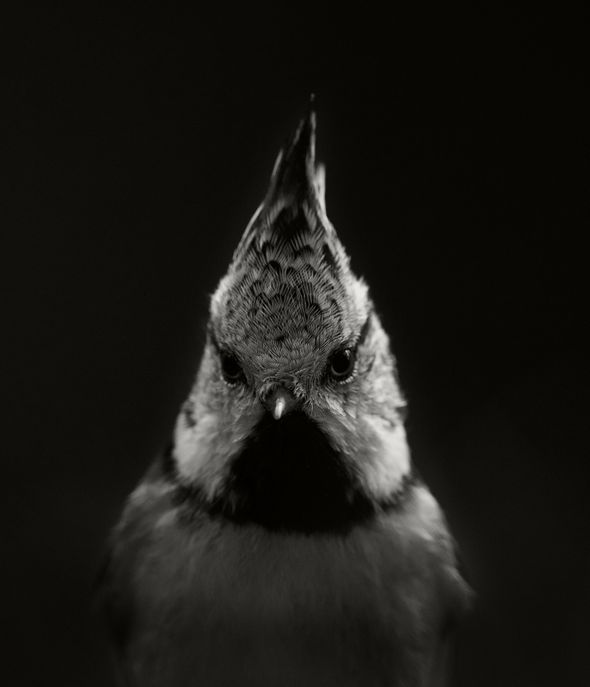
Soul-bird: crested tit. Photo: Heikki Willamo
The photographer and writer Heikki Willamo lived for a year in the forest – not full-time, but for long periods in all seasons, sleeping in his lean-to. This two-hundred, preserved hectare fragment lies in the midst of felled clearings, farmed forest and habitation in southern Finland.
Many Finns still say that being in a forest is a peaceful and empowering experience; Willamo recorded his thoughts on this as well as his black-and-white photographs in his book, Vuosi metsässä (‘A year in the forest’, Maahenki, 2012. See also extracts from Viimeiset vieraat [‘The last visitors’] here) More…
The attentive lover
31 December 1988 | Archives online, Fiction, Prose
In this short story, from his collection Pronssikausi (‘The bronze age’, 1988, on the Finlandia Prize shortlist in 1989), Martti Joenpolvi takes up the subject of the problematic transportation of a human cargo
He braked abruptly; the woman lurched forward, straining against the seat belt, and the car drove into the parking space. The only vehicle parked there was a solitary trailer loaded with timber: a resinous pulpwood-odour came wafting through their open window, so physical, it was as if someone were snooping into the car’s most intimate interior. When they stopped, they got the whiff of a yellow refuse bin, incubated in the heat of the day.
‘What’s up?’
‘We’ve got a problem.’ More…
A Note on Nine Contemporary Poems from Finland
31 March 1987 | Archives online, Articles, Fiction, Non-fiction, poetry
Contemporary Finnish poetry, translated and introduced by Anselm Hollo
The last couple of months, it has been my pleasure to browse around in a tightly packed shelf of books of poetry published in Finland in the last five years. On the showing of these, and of the excellent anthology Modern finlandssvensk lyrik (‘Modern Finland-Swedish poetry’, 1980), edited by Claes Andersson and Bo Carpelan, poetry certainly seems to be alive and well in the old homeland. In a way, the sheaf translated here is just first travel notes, individual works that struck my fancy seemed translatable: thus, by no means a ‘representative selection’.
Claes Andersson’s poem ‘When I was born, Helsinki was…’ was quite simply a direct hit (perhaps an unfortunate metaphor in that it deals, in part, with the WW2 air raids on Helsinki) – it brought back personal memories from my early childhood. But beyond those immediate circumstances, it is also a very moving evocation of the magnificent and terrifying world of magic children inhabit. Helena Anhava’s ‘These years…’, with its marvelous image of the great hinge turning in the human psyche at certain points familiar to anyone who has lived into middle age, seemed a fine example of her impressive body of meditative lyric poems, sharing a tenor of wistfulness not uncommon in Finland’s poetry with Bo Carpelan’s ‘You drive up…’, which is also a poem of the pangs of change. In Carpelan’s text, the clash between ‘wonderful clear Vivaldi’ on the protagonist’s car radio and the perceived tawdriness of the environment is beautifully balanced between genuine revulsion for the latter and a self-irony directed against the self-declared ‘finer sensibilities’ of the class that can afford them. Tua Forsström‘s ‘Do you want to hear something’ moves in a lovely dance figure from myth to everyday present: we see the interior world that is Nausicaa’s island shimmering through the exterior in which ‘someone’s/ balcony door whines all night like a cat’. More…
Eeva-Kaarina Aronen: Kallorumpu [Skull drum]
23 December 2011 | Mini reviews, Reviews
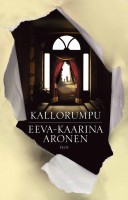 Kallorumpu
[Skull drum]
Helsinki: Teos, 2011. 390 p.
ISBN 978-951-851-413-1
€ 27.40, hardback
Eeva-Kaarina Aronen (born 1948) did not begin her writing career untill 2005, after a long career as editor of the newspaper Helsingin Sanomat. Her third novel Kallorumpu was shortlisted for the Finlandia Prize for Fiction 2011. Aronen’s interest in historical characters and themes that challenge historical truth was already evident in the of her first novel Maria Renforsin totuus (‘The truth of Maria Renfors’, Teos, 2005). At the centre of Kallorumpu is the legendary figure of Finland’s Field Marshal C.G. Mannerheim (1867–1951). The book concentrates on the description of one day in November 1935 by an old filmmaker, the narrator of the novel, who is showing his documentary to a small group of viewers in the present day. He comments on his own film, complementing it with stories about Mannerheim’s home in Helsinki. At home the Marshal’s staff – a cook, a maid and a valet – not only provide narrative twists and turns, but also an insight into the class divisions of the Finnish civil war. Aronen’s portrayal of her gallery of characters is an interesting one, and the novel’s demanding structure, with its alternating time zones, is sound.
Translated by David McDuff
It’s (virtually) Christmas!
28 November 2009 | This 'n' that
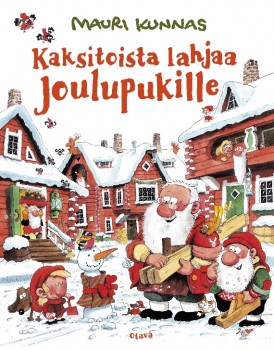
Father Christmas / Santa Claus by Mauri Kunnas
What to give the man who has everything? In prizewinning children’s author and illustrator Mauri Kunnas’s Twelve Gifts for Santa, Zac, one of Father Christmas’s little helpers, decides to give him twelve good deeds. Doing so is not as easy as it looks, however, and you can follow the twists and turns of the story on the Kidzone Finland advent calendar from Tuesday, 1 December, with one window opening each day until Christmas Eve.
Mauri Kunnas (born 1950) published the first of his popular picture books for children in 1980; entitled Koiramäen talossa (‘Doghill Farm’), it describes – with the accuracy of a treatise on folklore studies – life in a country farmhouse at the end of the 19th century. His hilarious canine characters, in more than forty books, have now found readers in almost thirty languages. More…
The devil has no clothes
31 December 2006 | Fiction, poetry
Poems from Idealrealisation (‘The ideal sale’, 1929)
Stockings
V
I thought:
it was a person,
but it was her clothes
and I didn't know
that it doesn't matter
and that clothes can be very
      beautiful
The lake
30 June 1988 | Archives online, Fiction, Prose
Järvi (‘The lake’), a short story, 1915. Introductions by Kai Laitinen and Pekka Tarkka
I travel the world, not out of any desire for adventure, but because that is the way things have happened. The best of my wanderings are in obscure, tucked-away regions, where life is humdrum and pitched in a low key. There I have no need to stave off nostalgia for the past by leading a hectic life: my days go by in stolid succession from season to season, I am an ordinary unimportant individual among all the rest. For long stretches of time my life does not strike me as being either dull or bright; I derive a certain satisfaction from its very emptiness. It is as though I were, by degrees and to the best of my ability, paying off a kind of debt. More…
A life of one’s own
31 March 1984 | Archives online, Authors
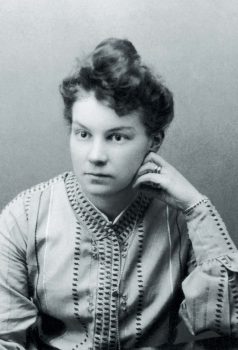
L. Onerva. Photo: Otava, 1907
When L. Onerva (1882–1972) published her novel Mirdja in 1908 she was twenty-six years old. Two previously published collections of poetry had already established a reputation for her as a promising young writer and she was also achieving a name as a first-rate critic. Her career thus began in circumstances which augured well for distinction and fame, both of which came to her, although her fame derives not only from her literary abilities – it is due in part to the notoriety of her private life. Her works, always thought to have a biographical element, are often read for glimpses of bohemian and artistic life at the start of the century.
In the puritanical climate of the period Onerva was unquestionably unusual, although Finland was not without independent and literary women. Onerva had many talents; she was well educated, and when she met Eino Leino, the most famous poet of the day, she had published her first collection of poems. This meeting changed the nature of Onerva’s life. She left her husband. Leino’s marriage also broke down and the couple ran away to Germany and Italy for a year. They were never married and both later married other people. Nevertheless, their profound friendship lasted until Leino’s death in 1926. More…
Contemplating the cosmos
30 September 2006 | Fiction, poetry
Poems from Valkoiseksi maalattu musta laatikko (‘A black box painted white’, WSOY, 2006). Introduction by Pertti Lassila
Good morning, murmuring universe,
dim tortuous thingamybob
with your moving and unmoving parts,
which every day need
new instructions for use
even though the previous ones
were not all that clear, because the article itself
is perpetually modifying its rules of behaviour.
There are threats that our details are being checked,
exhortations to be good, to wait,
wait and believe,
to stay outside at night
in abstract space
till the next numerical series. More…
Two men in a boat
The meaning of life, Bob Dylan, the broken thermostat of the Earth, the authors Ambrose Bierce and Aleksis Kivi…. Two severely culturally-inclined men set out to row a boat some 700 kilometres along the Finnish coastline, and there is no shortage of things to discuss. Extracts from the novel Nyljetyt ajatukset (‘Fleeced thoughts’, Teos, 2014)
The red sphere of the sun plopped into the sea.
At 23.09 official summertime Köpi announced the reading from his wind-up pocket-watch.
‘There she goes,’ commented Aimo, gazing at the sunken red of the horizon, ‘but don’t you think it’ll pop back up again in another quarter of an hour, unless something absolutely amazing and new happens in the universe and the solar system tonight!’
Aimo pulled long, accelerating sweeps with his oars, slurped the phlegm in his throat, spat a gob overboard, smacked his lips and adjusted his tongue on its marks behind his teeth. There’s a respectable amount of talk about to come out of there, thought Köpi about his old friend’s gestures, and he was right.
‘Sure thing,’ was Aimo’s opening move, ‘darkness. Darkness, that’s the thing. I want to talk about it and on its behalf just now, now in particular, while we’re rowing on the shimmering sea at the lightest point of the summer. More…
Maija & Anssi Hurme: Lepakkopoika [Batboy]
5 February 2015 | Mini reviews, Reviews
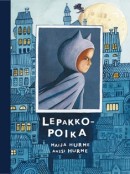 Lepakkopoika
[Batboy]
Kuvitus [Ill. by]: Maija Hurme
Helsinki: Schildts & Söderströms, 2014. 27 pp., ill.
ISBN 978-951-52-3361-5
€22.90, hardback
Fladdermuspojken
Kuvitus [Ill. by]: Maija Hurme
Helsinki: Schildts & Söderströms, 2014.
ISBN 978-951-52-3326-4
€28.90, hardback
Bat boy is a compact picture book with sparse text and abundant pictures that are well-balanced – there is never too much or too little of either. A six-year-old named Ilmari changes into a bat boy who stalks people in the dim of evening. The book describes the feelings of a boy approaching school age with sensitivity – the story deals with defiance of adult authority, rules and restrictions. Ilmari can also be thought of as a special child who experiences the world differently than other kids his age. The day care he attends is presented in both text and pictures as a prison and the adult day care workers as guards. Maija Hurme’s watercolour illustrations have an anarchic energy. The comic strip narrative supports Ilmari’s feelings of aggression. His fantasies are presented as blue-toned photographs with white borders, but the colours of the home and park settings glow with a message of safety, caring and trust.