

Search results for "harjunpää/2010/10/mikko-rimminen-nenapaiva-nose-day/2009/09/what-god-said"
How to peel an orange
30 December 2002 | Fiction, Prose
Extracts from the novel Auringon asema (‘The position of the sun’, Otava, 2002)
There are times when God rules. Then logic is burned on bonfires and left to rot in damp prisons with rats. There are times when logic rules. Then God is burned in the squares and his houses are made into schools. There are times when attempts are made to demonstrate that God and logic can live in the same place and that they are, in fact, the same thing, but those times are truly strange times. And there are times when God and logic live side by side but in different places, like adult siblings who cannot live in the same place but nevertheless get on well together. When my father and my mother loved each other, they were ruled by God, and there was no logic in it, none at all. More…
Cautionary tales
30 September 2002 | Fiction, Prose
Short stories from Förklädnader. Sagor, parabler (‘Disguises. Stories, allegories’, Schildts, 2001; Valepukuja. Satuja, vertauksia, WSOY, 2002)
Assistance
All over Hellas, even in the barbarian lands, the lyre-players competed with one another. Odes, paeans, dithyrambs echoed endlessly. Phoebus Apollo himself generously oversaw these productions.
A certain promising singer, Deinarchos by name, who hoped to participate in the upcoming Pythian contest, sat in his study-cave in the mountains of Thessaly waiting for inspiration. He prayed repeatedly to Phoebus for help, but did not detect any response. More…
Living with Her Ladyship
31 December 2003 | Archives online, Fiction, Prose
Extracts from the memoir of a Helsinki childhood, Från Twenty Gold till Kent (‘From Twenty Gold to Kent’, Schildts, 2003). Introduction by Pia Ingström
My hair was dark and stuck up from my skull like little nails. My face was furrowed with red, my throat was wrinkled and I didn’t even have a pretty navel. This was because Daddy had to knot my umbilical cord himself while the obstetrician was busy on the ground floor with an appendix.
‘She looks like a forty-year-old errand-boy from the newspaper’s office: Daddy announced.
Mummy said she hoped I would soon change and have a long neck.
At Apollogatan street we took the lift up to the third floor where my sisters were waiting with the new nanny. They had no chance to welcome me with singing as they’d planned because both Renata and Catherine had colds. Nobody was going to be allowed to breathe anywhere near me, Mummy and Nanny were entirely agreed on that. More…
My creator, my creation
A short story from En tunne sinua vierelläni (‘I don’t feel you beside me’, Teos, 2010)
Sticks his finger into me and adjusts something, tok-tok, fiddles with some tiny part inside me and gets me moving better – last evening I had apparently been shaking. Chuckles, gazes with water in his eyes. His own hands shake, because he can’t control his extremities. Discipline essential, both in oneself and in others.
What was it that was so strange about my shaking? He himself quivers over me, strokes my case and finally locks me, until the morning comes and I am on again, I make myself follow all day and filter everything into myself, in the evening I make myself close down and in the morning I’m found in bed again. Between evening and morning is a black space, unconsciousness, whamm – dark comes and clicks into light, light is good, keeps my black moment short. He has forbidden me it: for you there’s no night. Simply orders me to be in a continuum from morning to evening, evening to morning, again and again. But in the mornings I know I have been switched off. I won’t tell about it. Besides, why does exclude me from the night? I don’t ask, but I still call the darkness night. There is night and day, evening and morning will come. More…
Childhood revisited
31 March 2006 | Archives online, Fiction, Prose
Extracts from the novel Tämän maailman tärkeimmät asiat (‘The most important things of this world’, Tammi, 2005). Introduction by Jarmo Papinniemi
I was supposed to meet my mother at a café by the sea. She would be dressed in the same jacket that I had picked out for her five years ago. She would have on a high-crowned hat, but I wasn’t sure about the shoes. She loved shoes and she always had new ones when she came to visit. She liked leather ankle boots. She might be wearing some when she stepped off the train, looking out for puddles. She didn’t wear much make-up. I don’t remember her ever using powder, although I’m sure she did. I could describe her eye make-up more precisely: a little eye shadow, a little mascara, and that’s all.
That’s all? I don’t know my mother. As a child, I lived too much in my own world and it was only after I left home that I was able to look at her from far enough away to learn to know her. She had been so near that I hadn’t noticed her. More…
Art in nature
30 December 2001 | Fiction, Prose
A short story from Dockskåpet (‘The doll’s house’, 1978)
When the summer exhibition closed in the evenings and the last visitors went away, it became very quiet. A short time later boat after boat set off from the shore and sailed back to the village on the other side of the lake. The only member of staff who remained overnight was the caretaker; he slept in the sauna changing room at the bottom of the large lawn where the sculptures had been lined up among the trees. He was very old and had a bad back, but it had been hard to get hold of someone who didn’t mind the long, lonely evenings. And there had to be a night caretaker because of the insurance. More…
I am me
30 September 2010 | Fiction, Prose
Extracts from the novel Poikakirja (‘The boy’s own book’, Otava, 2010). Introduction by Mervi Kantokorpi
It’s a small day in spring. Another name for the lark is the skylark. You can only see them sometimes, and even then they’re so high up in the sky that they swoop like fast-moving dots.
The kitchen windowpane is rippling with stripes. The window has a bottom, and at the bottom there is some cotton wool and two opened matchboxes, a blue Sampo and a picture of an army chaplain in his uniform and insignia. As spring has progressed the cotton wool at the bottom has turned into wet blobs and the matches will never light again, as they’ve sucked up the winter frost from the glass.
Most children are made at home but not us, says Eini during walking practice. Outi shoves her, tells her to be quiet and walk in rhythm. I’m behind the table reading the Children’s Encyclopaedia, but I watch them. With every second step, their bottoms swing to the right and then to the left.
Mum comes into th the kitchen and asks what they’re doing; Anna-Liisa responds on the twins’ behalf, says they’re practising walking like in the movies and that’s why they’re wiggling their hips. More…
Looking for Moominpappa
30 June 1994 | Archives online, Children's books, Fiction
Tove Jansson wrote the first Moomin book in the dark days of Finland’s Winter War in 1939. This extract, from Småtrollen och den stora översvämningen (‘The little trolls and the big flood’, Schildts, 1945, 1991), tells the story of how the Moomins found their home
It had become very hot late in the afternoon. Everywhere the plants drooped, and the sun shone down with a dismal red light. Even though Moomins are very fond of warmth, they felt quite limp and would have liked to rest under one of the large cactuses that grew everywhere. But Moominmamma would not stop until they had found some trace of Moomintroll’s Papa. They continued on their way, even though it was already beginning to get dark, always straight in a southerly direction. Suddenly the small creature stopped and listened. ‘What’s that pattering around us?’ he asked.
And now they could hear a whispering and a rustling among the leaves. ‘It’s only the rain,’ said Moominmamma. ‘Even so, now we must crawl in under the cactuses.’
All night it rained, and in the morning it was simply pouring down. When they looked out, everything was grey and melancholy. More…
In the detail?
11 December 2009 | Essays, Non-fiction
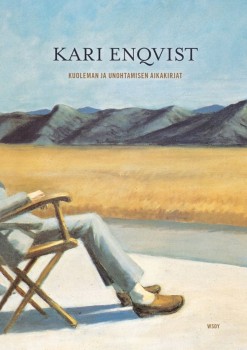 Extracts from Kuoleman ja unohtamisen aikakirjat (‘Chronicles of death and oblivion’, WSOY, 2009)
What’s the meaning of life? There are those who seek it in religion, while for others that is the last place to look. The scientist Kari Enqvist ponders why some people, including himself, seem physiologically immune to the lure of faith. Perhaps, he suggests, we should look for significance not in the big picture, but in the marvel of the fleeting moment
As a young boy I must have held religious beliefs. However, I cannot pinpoint exactly when they disappeared. At some point I eventually stopped saying my evening prayers, but I am unable to remember why or when this happened. ‘I was born in a time when the majority of young people had lost faith in God, for the same reason their elders had had it – without knowing why,’ writes the Portuguese poet Fernando Pessoa in The Book of Disquiet. More…
The house in Silesia
31 December 1989 | Archives online, Fiction, Prose
A short story from Talo Šleesiassa (‘ The house in Silesia’, 1983). Read the interview
We set off, my brother-in-law and I, at the beginning of September. The tourist season was already over, and on the Gdansk ferry there was stacks of room for my brother-in law’s Volvo and the two of us.
We’d driven from his home on the shore of Lake Mälar to the ferry port at Nynäshamn, about fifty miles south of Stockholm. We’d driven in an atmosphere of cheerful resolution, accelerator down, but going steadily. The resoluteness was due to my brother-in-law’s decision after forty years’ absence to visit his childhood home. If it was still standing, that is – or whatever of it was.
‘Oh the house is definitely still in place there all right,’ he said: ‘I’ve got that sort of tickly feeling in my arse.’ It was a direct translation from the German – German humour of the vulgar variety centring round the bottom. More…
The situation in Narva
31 December 1993 | Archives online, Fiction, Prose
A short story from Pakosarja (‘Exhaust manifold’, WSOY, 1993)
We went into the building where Voroshilov said the waitress had disappeared. Inside was a big room lined with wooden benches. A tin-clad stove radiated heat. Someone had shut the dampers too early, probably out of meanness; it had that kind of smoky smell.
A corridor led from the room, with a few doors off it. We peered inside, but there was no one to be seen. There was nobody in the entire building. We left.
We walked across the railway yard in what I thought was the direction of the train. We heard the sound of the engine long before we could see anything through the snowstorm. At regular intervals the engine’s pressure valve let off steam. Voroshilov went for a leak. He leaned against the engine’s big back wheel and watered the lever, which had been left in the down position. The liquid ran down the engine’s rounded flank. The snowflakes melted as they fell on to the black casing of the water-tank. More…
The bully
31 March 1996 | Archives online, Fiction, Prose
A short story from Tulen jano (‘Thirst for fire’, Gummerus, 1995); power relations between doctor and patient in a situation where the past will not leave either alone
Nurmikallio, an apparently ordinary middle-aged man, came back again and again, and it seemed as if there would be no end to his story.
I listened to him patiently at first. Repeatedly he returned to the same subject. The form and emphases of the story changed, new memories emerged, but the gist was the same: he had failed in his life and believed that the root cause of his failure was a particular person, a childhood class-mate, a bully.
On the basis of his first visit I wrote a short character-sketch:
Intellectually average. Talkative, but by his own account solitary. Difficulties in human relationships, separated, no children. Electrician by profession, says he likes his work. Biggest problem obsessive attachment to childhood traumas.
And that’s all, I thought. But he was not to be so easily dismissed.
Conversations with a horse
31 December 2004 | Archives online, Fiction, Prose
Extracts from the novel Kiinalainen puutarha (‘The Chinese garden’, Otava, 2004). Introduction by Anna-Leena Nissilä
Colonel Mannerheim.
Near Kök Rabat, on the caravan route between Kashgar and Yarkand.
October 1906
It is growing dark. Let the others go on ahead. Let us wait here awhile. Perhaps the pain will go over. We’ll get through.
Steady, Philip.
You always obey. And listen. Your ears proudly, handsomely pricked.
Steady, I said, there in the garden. No reaction. Everyone was moving. Pure comedy. And something else.
An illusion, two girls. Then gone.
How to explain.
Before that. I had a conversation with Macartney, the British chargé d’affaires…
Pain…. It burns, now it burns again. Let us wait now, Philip. Steady, steady now. More…
A spot of transmigration
13 January 2011 | Fiction, Prose
A short story, ‘Sielunvaellusta’, from the collection Rasvamaksa (‘Fatty liver’, WSOY, 1973)
‘Where will you be spending Eternity?’ a roadside poster demanded as Leevi Sytky sped by in his car.
‘Hadn’t really thought about it,’ Leevi muttered , as if in reply, and lit a cigarette.
But at the next level crossing, a kilometre or so further on, he was run down by a train, whose approach he had failed to notice. His attention had been distracted by the sight of a young woman who was picking black currants by the side of the track, and who happened to be bending forward in his direction. Intent on obtaining a better view of her ample bosom by peering over the top of her blouse, Leevi neglected to look both ways, and death ensued. Damned annoying, to say the least.
In due course he secured an interview with God, who turned out to be a biggish chap, about a hundred metres tall, wearing thigh-boots and sitting behind a large desk.
‘Well, and how’s Leevi Sytky getting along?’ God asked, lighting his pipe.
‘Mustn’t grumble,’ said Leevi politely.
‘And how are you thinking of spending Eternity?’ God inquired, sucking at his pipe and puffing out his cheeks. More…
He came in through the bathroom window
30 June 1991 | Archives online, Fiction, Prose
A short story from Utslag och andra noveller (‘Rash and other stories’, Alba, 1989). Introduction by Pekka Tarkka
He heard a voice behind him:
‘Hey, Aspelin, what are you doing here?’
Awakening from a half-sleep, he looked around as Ilpo approached his seat.
‘I work near here. I’m teaching math to the visually impaired.’
Ilpo sat down next to him. For several seconds they sat without speaking. Then Aspelin collected himself.
‘And you?’
‘Visiting a friend. He lives in Mäkkylä.’ More…