

Search results for "harjunpää/2010/10/mikko-rimminen-nenapaiva-nose-day/2009/09/what-god-said"
Funny stuff favoured
13 April 2011 | In the news
 In March the Bookseller’s Association of Finland’s list of the best-selling Finnish fiction was topped – for a change – by a collection of poems. Like all her collections, Heli Laaksonen’s Peippo vei (‘The chaffinch took it’, Otava) is written in a local dialect spoken in south-western Finland.
Perttti Jarla’s latest comics book, Fingerpori 4 (‘Fingerborg 4’, Arktinen Banaani) was number two – and, demonstrating the Finns’ love of cartoons and comics, another of his titles, Fingerpori book, Fingerpori – Kamppailuni (‘Fingerborg – My fight’) occupied fourth place, following Sofi Oksanen’s Puhdistus (Purge), published in 2008 and still number three on the list. More…
What God said
3 September 2009 | Fiction, Prose
Extracts from the novel Herra Darwinin puutarhuri (Otava, 2009; Mr Darwin’s Gardener, Peirene Press, 2013). Interview by Soila Lehtonen
The congregation sits in the church pews and the jackdaws caw in the belfry.
We smell of wet dog, the rain made us wet and it is cold but the singing warms us, the hymn rises to the roof and above the roof dwells God, Amen.
We saw Thomas Davies on the hill, he is working in Mr Darwin’s garden,
the atheist and lunatic, he stood in the field alone and the water lashed his face
an irreligious pit pony wandering in the darkness he is from Wales
does the godless man think he can stand in the rain without getting wet did he get an umbrella or bat wings from the devil
perhaps Thomas imagines that he can hold back the rain and the rain not hold him back, he thinks he is more exalted than God with his head in the clouds
The church’s hard pews press into posteriors, the poor man will not grow fatter, for there are no fat and lean years but only lean ones, and thin are the poor man’s sheep and cows and children too, but the rich man cultivates weeds for his amusement as Mr Darwin did and earns money and fame! More…
In a class of their own
31 December 2006 | Children's books, Fiction
Extracts from the children’s book Ella: Varokaa lapsia! (‘Ella: Look out for children!’, Tammi, 2006). Interview by Anna-Leena Nissilä
There was a large van in the schoolyard with a thick cable winding its way from the van into the school. It was from the TV station, and the surprise was that they wanted to do a programme about our teacher, believe it or not.
The classroom was filled with lights, cameras, and adults.
‘Are you the weird teacher?’ a young man asked. He had a funny, shaggy beard and a t-shirt that said ‘errand boy’.
‘Not nearly as weird as your beard,’ our teacher answered.
‘Can we do a little piece about you?’ the errand boy asked.
‘Of course. A big one even. I’ve been expecting you, actually. Is it some educational programme?’
‘Not exactly.’
‘A substantive discussion programme, though?’
‘Not exactly.’
‘A documentary about our contemporary educators?’
‘Not quite.’ More…
For love or money
30 June 1994 | Archives online, Fiction, Prose
Extracts from the novel Paratiisitango (‘Paradise tango’, WSOY, 1993). Introduction by Markku Huotari
The bishops’ dilemma
They are waiting for Blume in the front room of the office. On the sofa sits a man whom Blume has never learned to like. He himself chose and appointed the man, for a job not insignificant from the point of view of the company. Blume has good reasons for the appointment. If he employed only men he liked, the business would have gone bankrupt years ago.
Reinhard Kindermann gets up from the sofa and waits in silence while Blume hangs up his overcoat. Mrs Giesler stands next to Blume. She does not try to help her superior take off his coat, for she knows from experience that he would not tolerate it, but the old man does allow her to stand next to him and wait in silence, like a servant expressing submission. More…
The Othello of Sand Alley
31 March 1989 | Archives online, Drama, Fiction
Eeva-Liisa Manner’s Woyzeck is an independent ending to Georg Büchner’s fragmentary play. Introduction by Riitta Pohjola
PROLOGUE
(Dawn in the market square of Leipzig. A gallows looms, dimly visible in the distance. Brisk rumble of drums.)
1st WOMAN
What’s going on here?
1st MAN
They’re getting ready for an execution. Some villain’s going to be executed in public.
1st WOMAN
Who?
2nd WOMAN
Franz Woyzeck. I guess you know him, the barber. More…
Book-giving time!
12 November 2010 | In the news
 The few weeks before Christmas are when most books are bought in Finland, so shortlists of literary prizes start popping up in November.
All the juries of the three biggest prizes – worth €30,000 each, awarded by the Finnish Book Foundation – have now published their shortlists: the Finlandia Prize for Non-Fiction, the Finlandia Junior Prize and the Finlandia Prize for Fiction.
The winners, each chosen by one person, will be announced in December. This FILI – Finnish Literature Exchange newsletter link will take you to the jury members’ assessments of the shortlisted non-fiction and Junior Prize works.
The following six novels ended up on the Finlandia Prize for Fiction list:
Joel Haahtela: Katoamispiste (‘Vanishing point’, Otava), Markus Nummi: Karkkipäivä (‘Candy day’, Otava), Riikka Pulkkinen: Totta (‘True’, Teos), Mikko Rimminen: Nenäpäivä (‘Nose day’, Teos), Alexandra Salmela: 27 eli kuolema tekee taiteilijan (’27 or death makes an artist’, Teos) and Erik Wahlström: Flugtämjaren (in Finnish translation, Kärpäsenkesyttäjä, ‘The fly tamer’, Schildts). Here’s the FILI link to the jury’s comments.
No place to go
30 March 2008 | Archives online, Fiction, Prose
Extracts from the novel Lakanasiivet (‘Linen wings’, Otava, 2007)
The clothesline swayed in the wind. Helvi closed her eyes and felt herself flutter into the air with the laundry. She flapped her white linen wings, straining higher, now seeing below the whole small peninsula city, its damp rooftops glittering in the morning sun, the blue sighs of the chimneys, the steamboats toiling on the lake and the trains chugging on their tracks. The whole of heaven was clear and blue; only far off in the east were there white pillars roiling – whether smoke or clouds, Helvi could not tell.
She flew north on her linen wings and saw the great bridges leading to the city, on whose flanks the hidden anti-aircraft batteries gasped the fumes of gun oil and iron, and continued her journey over the land, following the straight lines of the telephone wires. She flew over wooded hills and deep green fields, finally arriving on the slope of the great hill where her daughter now lived, in hiding from the war. More…
Canberra, can you hear me?
31 March 1987 | Archives online, Fiction, Prose
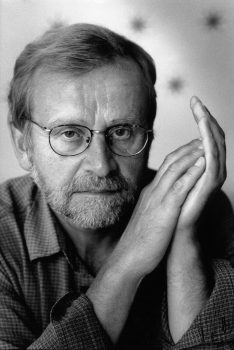
Johan Bargum. Photo: Irmeli Jung
A short story from Husdjur (‘Pets’, 1986)
Lena called again Sunday morning. I had just gotten up and was annoyed that as usual Hannele hadn’t gone home but was still lying in my bed snoring like a pig. The connection was good, but there was a curious little echo, as if I could hear not only Lena’s voice but also my own in the receiver.
The first thing she said was, ‘How is Hamlet doing?’
She’d started speaking in that affected way even before they’d moved, as if to show us that she’d seen completely through us.
‘Fine,’ I said. ‘How are you?’
‘What is he doing?’
‘Nothing special.’
‘Oh.’
Then she was quiet. She didn’t say anything for a long while.
‘Lena? Hello? Are you there?’
No answer. Suddenly I couldn’t stand it any longer. More…
Blind man’s buff
31 March 2002 | Fiction, Prose
An extract from the novel Laituri matkalla mereen (‘A jetty to the sea’, WSOY, 2001)
Ten steps along the path marked out by the poet
In a gravel pit illegally dug by the sand-king Gropius and later abandoned, the colonel and Henry were shooting at tin cans with pistols. The pit neighboured the Colonel’s home, and he was in the habit of carrying out target practice there with the help of Jovan, to keep his hand in.
The cans were placed at twenty-metre intervals in front of a sandbank and were raised on coil springs, so they swayed freely in the air. Each of them was attached to a long line; this, when pulled, swayed the cans, rattling stones inside them. Following the sound, the colonel identified the can’s position, aimed and fired. The hits he heard himself, the misses usually struck the pieces of hardboard behind the cans. These were divided up dartboard-fashion into sectors and rings, and Jovan used binoculars to spot the hits on them and announce the points of impact as clock-numbers and distances from the can’s central position, enabling the colonel to correct his aim. This he did with the aid of a rake. He held the rake upright, prongs downwards, so that its handle stood roughly perpendicular to the ground. Moving the handle sideways with careful estimation, and sliding his pistol hand up or down on the handle, he was able to make corrections with reasonable accuracy and determine his aim. More…
Star-Eye
31 March 1984 | Archives online, Children's books, Fiction
A story from Läsning för barn (‘Reading for children’,1884). Introduction by George C. Schoolfield
There was once a little child lying in a snowdrift. Why? Because it had been lost.
It was Christmas Eve. The old Lapp was driving his sledge through the desolate mountains, and the old Lapp woman was following him. The snow sparkled, the Northern Lights were dancing, and the stars were shining brightly in the sky. The old Lapp thought this was a splendid journey and turned round to look for his wife who was alone in her little Lapp sledge, for the reindeer could not pull more than one person at a time. The woman was holding her little child in her arms. It was wrapped in a thick, soft reindeer skin, but it was difficult for the woman to drive a sledge properly with a child in her arms.
When they had reached the top of the mountain and were just starting off downhill, they came across a pack of wolves. It was a big pack, about forty or fifty of them, such as you often see in winter in Lapland when they are on the look-out for a reindeer. Now these wolves had not managed to catch any reindeer; they were howling with hunger and straight away began to pursue the old Lapp and his wife. More…
The miracle of the rose
30 June 1997 | Archives online, Fiction, Prose
Extracts from the novel Naurava neitsyt (‘The laughing virgin’, WSOY, 1996). The narrator in this first novel by Irja Rane is an elderly headmaster and clergyman in 1930s Germany. In his letters to his son, Mr Klein contemplates the present state of the world, hardly recovered from the previous war, his own incapacity for true intimacy – and tells his son the story of the laughing virgin, a legend he saw come alive. Naurava neitsyt won the Finlandia Prize for Fiction in 1996
28 August
My dear boy,
I received your letter yesterday at dinner. Let me just say that I was delighted to see it! For as I went to table I was not in the conciliatory frame of mind that is suitable in sitting down to enjoy the gifts of God. I was still fretting when Mademoiselle put her head through the serving hatch and said:
‘There is a letter for you, sir.’
‘Have I not said that I must not be disturbed,’ I growled. I was surprised myself at the abruptness of my voice.
‘By your leave, it is from Berlin,’ said Mademoiselle. ‘Perhaps it is from the young gentleman.’
‘Bring it here,’ I said. More…
Relative values
31 March 2004 | Archives online, Fiction, Prose
Extracts from the autobiographical novel Nurinkurin (‘Upside down, inside out’, WSOY, 2003). Interview by Anna-Leena Nissilä
The soldier rides on a scarf
waving a donkey
‘Now it’s your turn to go on,’ says my brother on the back seat, turning his head toward the window so that he can concentrate on his poetic muse.
Father looks in the mirror, wrinkling his face in pain. ‘The object, in other words, is of no significance to you. What happened to your case endings and your grammar?’
From the back seat we shout eagerly: ‘The poet has special privileges which are not accorded to others.’
Father shakes his head: ‘You can be creative, but silly content and broken language do not make poetry.’
‘Oh yes they do. Don’t disturb our creative spirit. When you speak, our connection with her is broken. Don’t cut off the source of our inspiration.’ More…
The funeral
31 December 1988 | Archives online, Fiction, Prose
Hannu Salama’s short story Hautajaiset (‘The funeral’) – taking place in Pispala, Tampere – in the volume Kesäleski, ‘Summer widow’, was published in 1969. Introduction by Pekka Tarkka
On Tuesday Venla came round: as Sulo was being lowered into the grave Vihtori had had a heart attack. The next day a letter arrived from father: funeral on Sunday, and Gunilla and Timo want you to speak at the grave. I telegraphed back: ‘Vikki too close to me. Unable to speak.’ Outside the post office I realised I could have sent fifty words for the same money.
Irma ordered a flower arrangement. Did I want to put an inscription? Part of the last stanza of a revolutionary song went through my head:
Sowing makes the corn come into ear:
Hundredfold higher that happier age will be.
I said not to put anything, I’d say something at the grave if it seemed the thing to do. I told her to put mother’s, father’s and Heikki’s names on, and we’d take these off if they’d sent their own wreath. More…
Cruising
30 September 1993 | Archives online, Fiction, Prose
An extract from the novel Vieras (‘The stranger’, Otava 1992). Introduction by Pekka Tarkka
I lay there for a moment, motionless, eyes closed.
The bunk was damp. It felt damp around my thighs; I slid down lower – and there, it was really wet.
My sleeping bag was obviously soaked, and that meant that the mattress was soaked, too. Oh, rats. I couldn’t imagine having wet myself. Or – worse – had the boat sprung a leak, the water already rising up to the floorboards? I bounded to my feet: the rugs were dry. So was the cabin floor. I raised the boards, peered down: two fingers of water in the forward bilge, as usual. So, where the –? In the course of yesterday’s rough sailing, some water had seeped in below the windowframe. No more than a cupful, but it had trickled down inside the panel and then onto the mattress. I tried the other side of the bunk. It was dry. Well, I would just have to pick up the mattress and set it on its side. More…
Rainer Knapas: Kunskapens rike. Helsingfors universitetsbibliotek – Nationalbiblioteket 1640–2010 [In the kingdom of knowledge. Helsinki University Library – National Library of Finland 1640–2010]
9 August 2012 | Mini reviews, Reviews
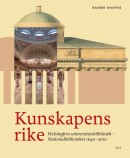 Kunskapens rike. Helsingfors universitetsbibliotek – Nationalbiblioteket 1640–2010
Helsingfors: Svenska litteratursällskapet i Finland, 2012. 462 p., ill.
ISBN 978-951-583-244-3
€54, hardback
Tiedon valtakunnassa. Helsingin yliopiston kirjasto – Kansalliskirjasto 1640–2010
[In the kingdom of knowledge. Helsinki University Library – National Library of Finland 1640–2010]
Suomennos [Finnish translation by]: Liisa Suvikumpu
Helsinki: Finnish Literature Society, 2012. 461 p., ill.
ISBN 978-952-222-272-5
€54, hardback
The National Library of Finland was founded in 1640 as the library of Turku Academy. In 1827 it was destroyed by fire: only 828 books were preserved. In 1809 Finland was annexed from Sweden by Russia, and the collection was moved to the new capital of Helsinki, where it formed the basis of the University Library. The neoclassical main building designed by Carl Ludwig Engel is regarded as one of Europe’s most beautiful libraries and was completed in 1845, with an extension added in 1906. Its collections include the Finnish National Bibliography, an internationally respected Slavonic Library, the private Monrepos collection from 18th-century Russia, and the valuable library of maps compiled by the arctic explorer Adolf Erik Nordenskiöld. Renamed in 2006 as Kansalliskirjasto – the National Library of Finland – this institution, which is open to general public, now contains a collection of over three million volumes as well as a host of online services. This beautifully illustrated book by historian and writer Rainer Knapas provides an interesting exposition of the library’s history, the building of its collections and building projects, and also a lively portrait of its talented – and sometimes eccentric – librarians.
Translated by David McDuff