

Search results for "harjunpää/2010/10/mikko-rimminen-nenapaiva-nose-day/2009/09/what-god-said"
Jacob’s Dream
30 September 1986 | Archives online, Fiction, Prose
An extract from Hänen olivat linnut (‘Hers were the birds’, 1967). Introduction by Pirkko Alhoniemi
‘It was Jacob’s Dream, Alma.’
How could she put it so Alma wouldn’t get hurt. Alma had ruined the surface of the painting. The pastor’s widow stood nervously in front of the window and tried to say what she’d had on her mind for several days but couldn’t quite come out with. When Alma went out of the house, the pastor’s widow would wander through the rooms and check on things. And the painting wasn’t the only object in danger, but also the birds. Their feathers were ruffled because Alma kept wiping them with a wet rag. How could she put it.
‘Alma.’
Alma turned to look at her.
‘It’s called Jacob’s Dream.’ More…
A roof with a view
27 August 2009 | Fiction, Prose
Extracts from the novel Mistä on mustat tytöt tehty? (‘What are black girls made of?’, Tammi, 2009) Introduction by Tuomas Juntunen
I’m a chimney sweep’s daughter, born October 1962 as a gift, a light to a darkened world. I’ve had lots of mothers, but none of them ever stuck around for good. One of them gave birth to me, so she’s Mother, not mother. Her name is Dewdrop, because water has spilled over the only photograph of My Mother and now her face has dissolved into a single translucent droplet; her nose, cheeks and chin are now a fat, shiny blob that looks like it’s about to fall out of the bottom of the picture. More…
A toast before dying
30 June 2005 | Archives online, Fiction, Prose
Extracts from the novel Voin jo paljon paremmin. Tšehov Badenweilerissa (‘I already feel much better. Chekhov in Badenweiler’, Loki, 2004). Introduction by Hannu Marttila
I went to meet them Friday and I did not plan to take other patients that week. They had a small but comfortable room with striped wallpaper.
The Russian was a tall man, but stooped. It soon became apparent that his wife spoke fluent German because she was of German descent. That made it much easier to take care of things.
Of course I knew who the patient was. I have always enjoyed literature and other forms of art. I could play several pieces rather well on the piano. When I was younger I had even written a couple of stories set in the mountains, though I had never offered them for publication. As for Chekhov, I had read a couple of his stories that had just come out in German translation, and I had liked them quite a lot in a way, even though they of course reflected that characteristic Russian nature, with its vodka and untidiness.
The patient’s wife seized both my hands when I entered. It was a bit confusing, but not necessarily unpleasant.
‘Our name is Chekhov. We have come from Russia,’ the woman said in a strong, carrying voice. ‘I trust you’ve been told?’ More…
The Onlookers
30 September 1978 | Archives online, Fiction, Prose
A short story from Naisten vuonna (‘In women’s year’, 1975). Introduction by Pekka Tarkka
The two elks came out on to the road through a gap between timber sheds. They began to cross the road, and the larger one was very nearly run into by a car. Cars stopped and horns tooted, till the elks turned and made off towards the harbour. Several cars swung round and drove along the cinder track in pursuit of the animals.
The elks headed across the rubble towards the power station; after circling some stacks of railway sleepers, they ended up on the flank of a coalheap sixty feet high. The cars pulled up and their occupants poured out, shouting that the elks wouldn’t go that way, it was a dead end. The elder of the two elks had indeed sensed this, and they moved off to the right, skirting the coal-heap and emerging among the timber-stacks. By this time the first cyclists and pedestrians had arrived on the scene.
“They’ll break their legs,” said a pedestrian to a motorist. “There’s all kinds of junk lying about.” More…
Picture this
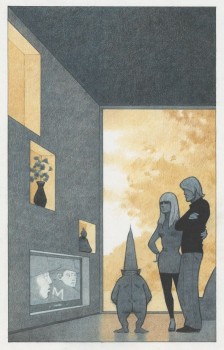 Accompanied by one or two sentences of the most gnomic kind, architect Mikko Metsähonkala’s illustrations speak volumes. The picture-stories in his book Toisaalta / (P)å andra sidan / In Other Wor(l)ds blend the real and the surreal using fairy tales, references to historical or fictional characters and episodes from everyday life.
(The Finnish composer Lauri Supponen was inspired by Metsähonkala’s ‘humaphone’ – see below –, and his composition The Dordrecht Humaphone was first performed at the Cheltenham Festival, England, in 2012, to favourable reviews.) More…
On Daniel Katz
31 December 1980 | Archives online, Authors
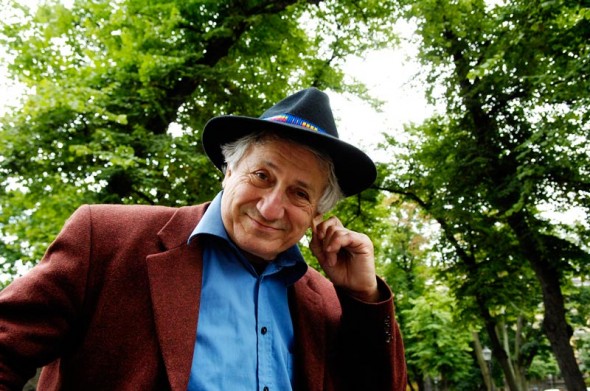
Daniel Katz. Photo: Veikko Somerpuro/WSOY.
Daniel Katz (born 1938) is a member of Finland’s small Jewish community and the first Finnish writer to emerge from that background. The publication of his first book coincided roughly with the appearance in America of a wealth of Jewish literature. Katz has much in common with American Jewish writers, particularly in his parodies of conventional religious practices, but the Jewish community he writes about relates to the general social environment in a very different way. Writers like Philip Roth are concerned with a social group that is tightly hemmed in by its own claustrophobic boundaries, whereas Katz’s Jews, living alongside the reserved and at times withdrawn Finns, stand out as exceptionally extroverted and sociable beings; their Jewishness is not a fetter but their innate key to freedom. More…
Coming up…
11 April 2013 | This 'n' that
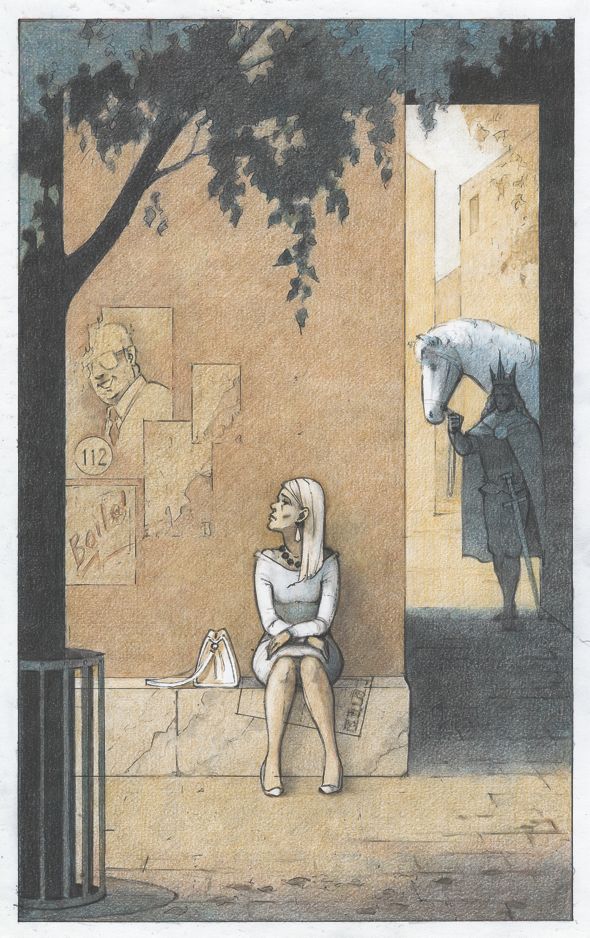
Illustration: Mikko Metsähonkala
‘Just before the meeting Ludwig chickened out. In the ad he had bragged that he was a “sporty male with a sense of humour”. Would Patsy accept his illiteracy, brutal table manners and cruelty towards the peasants?’
One picture, few words: Mikko Metsähonkala’s artwork creates a moment in a universe – recognisable or completely strange – providing it with a laconic textual subtext. We feature some of his stories published in Toisaalta / (P)å andra sidan / In Other Wor(l)ds.
Front-Line Tourists
30 September 1976 | Archives online, Fiction, Prose
An extract from the novel Nahkapeitturien linjalla (‘On the tanners’ line’, 1976)
Paavo Rintala (born 1930) published his first novel in 1954 and since then has brought out a new book almost every year. A merciless critic of the myths surrounding certain national figures and events, he has written about Marshal Mannerheim, against attempts to glorify war, and the ‘inevitability’ of Finland’s involvment in the German Barbarossa plan. He has made considerable use of reportage technique to produce anti-war documentaries and in more recent years worked with international subjects.
His books have been widely translated and are popular in East and West Europe. Paavo Rintala’s novel Sissiluutnantti (‘Commando Lieuenant’, Otava 1963) and its reception were the subject of a book by the ltterary critic Pekka Tarkka (Paavo Rintalan saarna ja seurakunta. ‘Paavo Rintala’s sermon and congregation’, Otava 1966). Paavo Rintala is chairman of the Finnish Peace Committee. The passage below is taken from Nahkapeitturien linjalla (‘On the tanners’ line’, Otava 1976) in which he again turns his attention to the war years. Rintala looks at the events of the years leading up to the war and the course of the war itself through the eyes of many different people – from the leading politicians of the day to the ordinary soldier.
The novel has already been acclaimed as the monument to the ‘unknown soldier’ of the Winter War.

Hessu duly presented himself at the Viipuri office of the Army Information Department (Visitors’ Escort Section), where it was implied that the expected visitors were Very Important People and that a singular privilege was being conferred upon Hessu and such front-line troops that the party might visit. Although His Excellency Field-Marshal Mannerheim made it a rule never to allow front-line visits by ordinary journalists or even by special correspondents, these gentlemen were, it seemed, such influential people that H.E. had agreed to their visit without demur. “You understand, Padre, what a great responsibility this will be for you? These are very high-up people.” More…
Rock or baroque?
30 April 2014 | Extracts, Non-fiction
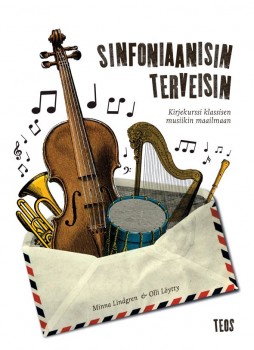 What if your old favourites lose their flavour? Could there be a way of broadening one’s views? Scholar Olli Löytty began thinking that there might be more to music than 1980s rock, so he turned to the music writer Minna Lindgren who was delighted by the chance of introducing him the enormous garden of classical music. In their correspondence they discussed – and argued about – the creativity of orchestra musicians, the significance of rhythm and whether the emotional approach to music might not be the only one. Their letters, from 2009 to 2013, an entertaining musical conversation, became a book. Extracts from Sinfoniaanisin terveisin. Kirjekurssi klassisen musiikin maailmaan (‘With symphonical greetings. A correspondence course in classical music’)
Olli, 19 March, 2009
Dear expert,
I never imagined that the day would come when I would say that rock had begun to sound rather boring. There are seldom, any more, the moments when some piece sweeps you away and makes you want to listen to more of the same. I derive my greatest enjoyment from the favourites of my youth, and that is, I think, rather alarming, as I consider people to be naturally curious beings whom new experiences, extending their range of experiences and sensations, brings nothing but good.
Singing along, with practised wistfulness, to Eppu Normaali’s ‘Murheellisten laulujen maa’ (‘The land of sad songs’) alone in the car doesn’t provide much in the way of inspiration. It really is time to find something new to listen to! My situation is already so desperate that I am prepared to seek musical stimulation from as distant a world as classical music. I know more about the African roots of rock than about the birth of western music, the music that is known as classical. But it looks and sounds like such an unapproachable culture that I badly need help on my voyage of exploration. Where should I start, when I don’t really know anything? More…
Briefcase man
31 December 2000 | Archives online, Fiction, Prose
Extracts from the novel Aura (Otava, 2000). Introduction by Mervi Kantokorpi
He was born in the Russian Grand Duchy of Finland the year the world caught fire. He learned to read the year of the revolution, and spoke two languages as his mother tongue border – language and enemy language, as he often used to say. He was proud of only one of his languages; the other, he loved secretly. He spoke one loudly, the other softly, almost in a whisper.
At night, on the telephone, he spoke far away – you could see it, even in the dark, from his expression, his half-closed eyes sometimes breaking into song. It was so beautiful and soft that I wept under the blankets and hated myself because of the effect that language had on me.
Stinking tinker Karelian trickster Russian drinker, little Russky’s dancing in a leather skirt, skirt tears and oh! little Russky’s hurt.
Count to ten, he said. But count in Finnish. Or Swedish, that’ll baffle them. And if they call you a Swedish bastard, it’s not so bad. I’ve taught you the numbers in Arabic and Spanish, too, but I don’t think you’ll be able to remember them yet. More…
Finlandia Prize for Non-Fiction 2010
19 November 2010 | In the news
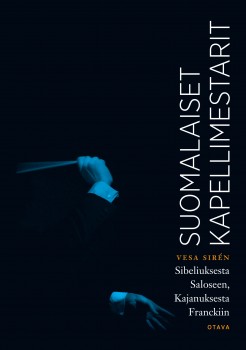 A massive tome running to 1,000 pages by Vesa Sirén, journalist and music critic of the Helsingin Sanomat newspaper, features Finnish conductors from the 1880s to the present day. On 18 November it became the recipient of the 2010 Finlandia Prize for Non-Fiction by the Finnish Book Foundation, worth €30,000.
The choice, from six shortlisted works, was made by economist Sinikka Salo. Suomalaiset kapellimestarit: Sibeliuksesta Saloseen, Kajanuksesta Franckiin (‘Finnish conductors: from Sibelius to Salonen, from Kajanus to Franck’) is published by Otava.
The other five works on the shortlist were Itämeren tulevaisuus (‘The future of the Baltic Sea’, Gaudeamus) by Saara Bäck, Markku Ollikainen, Erik Bonsdorff, Annukka Eriksson, Eeva-Liisa Hallanaro, Sakari Kuikka, Markku Viitasalo and Mari Walls; the Finnish Marshal C.G. Mannerheim’s early 20th-century travel diaries, Dagbok förd under min resa i Centralasien och Kina 1906–07–08 (‘Diary from my journey to Central Asia and China 1906–07–08’, Svenska litteratursällskapet i Finland & Atlantis), edited by Harry Halén; Vihan ja rakkauden liekit. Kohtalona 1930-luvun Suomi (‘Flames of hatred and love. 1930s Finland as a destiny’, Otava) by Sirpa Kähkönen; Suomalaiset kalaherkut (‘Finnish fish delicacies’, Otava) by Tatu Lehtovaara (photographs by Jukka Heiskanen) and Puukon historia (‘A history of the Finnish puukko knife’, Apali) by Anssi Ruusuvuori.
Troubled waters
31 March 2005 | Archives online, Fiction, Prose
Extracts from the novel Den amerikanska flickan (‘The American girl’, Söderströms, 2004). Introduction by Pia Ingström
Doris Night&Sandra Day, Sandra Night&Doris Day: those were their alter ego identities for the game, which also involved the smiles they’d practised in front of the mirror at the bottom of the empty swimming pool, in the house in the muddier part of the woods.
‘We’re two clairvoyant sisters,’ said Doris Flinkenberg. ‘We got that way because of tragic circumstances. The poltergeist phenomenon. Do you know what that is?’
Sandra Wärn shook her head, but looked expectantly at Doris, the perennial crossword – solver, with dictionary to hand, who continued. ‘It’s when the innocent child has been badly abused and has developed supernatural powers in order to survive. Powers to see behind what’s there,’ Doris Flinkenberg explained. ‘To see what no one else can see.’
‘You and I, Sandra,’ Doris confirmed. ‘We were badly abused. I with my scars and you with your tragic family background, your mother and her lover, all of that. You and I, Sandra, we know what it is to suffer.’ More…
A perfectly ordinary day
30 September 1997 | Archives online, Fiction, Prose
Extract from the novel Kello 4.17 (‘The time was 4.17’, WSOY, 1996). When time loses its meaning, real fear strikes like an iron glove. Aho writes about a man who is different but no outcast
I was lost to myself, if it is possible to be lost if you haven’t gone anywhere. Black birds curved through my mind and it felt as if no one needed me, no one or nothing: my mother bought clothes and make-up and did not seem to care; Uncle Lasse looked after the family business, steam coming out of his head, and kept shopkeepers and shopaholic customers happy; smiling bank managers slapped shy loan applicants encouragingly on the back, the gross national product grew without me having anything to do with it, or because I didn’t; and politics plodded onward as the mud squelched comfortingly. The machine of society hummed and ticked and Finland was as round and fat as a bomb. I looked at it and nothing changed, and on Sundays it was so quiet that you could look out of the window and see the Sahara.
That remarkable man
31 December 1988 | Archives online, Fiction, poetry
Poems by Lauri Viita. Introduction by Kai Laitinen
Alfhild
Mothers alone, endowed
with hope, see God.
They’re given strength and given will,
to climb in dream from under the cloud,
and look from a higher hill.
Alfhild, she who gave me birth,
nightly sailed away from earth
to where her Eemeli growled his say,
coming and going, as he did in his day.
Now they walk
the bright star track,
father and mother, looking back
at the little hill and the family home,
the cats, the dogs, the people they’ve known,
waving and calling as best they can
lest any of us trip on Pispala’s stone.
On a distant planet on a garden swing
under a rowan they linger and cling
and silently remember their light and dark
as a courting couple in Tampere Park –
and if it was payday, the extra fun
of tucking away a coffee and bun. More…