

Search results for "harjunpää/2010/10/mikko-rimminen-nenapaiva-nose-day/2009/09/what-god-said"
Dinner with Marie
30 June 2008 | Archives online, Fiction, Prose
Extracts from the novel Marie (WSOY, 2008). Introduction by Tuomas Juntunen
For once, Marie decided to plan a dinner without the same old roast beef, boiled potatoes, peas, red wine and berry kissel. And particularly no game. The thought of rabbit reminded her of the hunting trip to Porpakka, the hounds puking up rabbit skins onto the parquet floor, the smell of singed birds, the feathers that turned up even weeks later in a corner of the kitchen, the buckshot in the goose that broke her tooth. Mind you, she had to admit that brown sauce was quite good, especially as an aspic. She had tasted a spoonful once the morning after it was made, when Martta had gone out to buy milk and Marja was cleaning the drawing room, and then Martta had come back quite suddenly, and Marie had panicked and swallowed it the wrong way and had a fit of coughing. ‘Good heavens,’ Martta had said, ‘what’s the matter? I just came back to get my purse. I forgot it on the sideboard.’
The true reason for the plan was that she wanted to show them what a real French formal dinner was like, how much better it was. She planned the menu secretly for months, first in her mind, then in writing, at her bedroom dressing table – the only place she had to herself, although the door wouldn’t lock – at first on wrapping paper, which she later burnt in the tiled stove in the dining room when no one was home. More…
Arska
30 September 1982 | Archives online, Fiction, Prose
A short story from Kaksin (‘Two together’). Introduction by Pekka Tarkka
A landlady is a landlady, and cannot be expected – particularly if she is a widow and by now a rather battered one – to possess an inexhaustible supply of human kindness. Thus when Irja’s landlady went to the little room behind the kitchen at nine o’clock on a warm September morning, and found her tenant still asleep under a mound of bedclothes, she uttered a groan of exasperation.
“What you do here this hour of day?” she asked, in a despairing tone. “You don’t going to work?”
Irja heaved and clawed at the blankets until at last her head emerged from under them.
“No,” she replied, after the landlady had repeated the question.
“You gone and left your job again?”
“Yep.” More…
Digging for gold
30 June 1989 | Archives online, Fiction, Prose
Antti Tuuri has found his theme in the life of Finnish émigré communities and their experience in what used to be called ‘the New World’. Uusi Jerusalem (‘The New Jerusalem’, 1988), is about the Finns who migrated to Canada during the Depression, only to find that their utopian dreams had no basis in reality. In the following extract the narrator finds himself and his fellow mineworkers in the middle of the forest at night, on the way by foot to the Kirkland Lake gold mines, where they are going to be strikebreakers. The novel, an ironical tale of life in a new land, follows on from Pohjanmaa (‘Ostrobothnia’, 1982), Talvisota (‘The Winter War’, 1984), Ameriikan raitti (‘The American road’, 1986).
The train pulled up at Swastika station, many a mile from Kirkland Lake, and Hamina said we’d have to press on by foot from the station to the town.
Swastika, he said, meant the crooked cross, but he didn’t know whether there were any of those German Adolf-fanciers around, who were so keen on the sign. He was certain, in fact, the town had got its name long before anyone in Germany had heard of Adolf or his swastika.
We asked why we had to walk from here to the town. Hamina said we’d got to walk because even in Canada vehicles didn’t drive through the backwoods; moreover, it wasn’t a good idea to walk along the Kirkland Lake road: we might meet up with the kind of guys who’d make our arrival at Kirkland Lake seem very unwelcome. More…
Veikko Huovinen (1927–2009) in memoriam
23 October 2009 | Authors, In the news
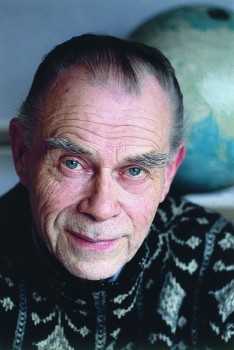
Veikko Huovinen (1927–2009). – Photo: Irmeli Jung /WSOY
Author Veikko Huovinen died on 4 October at his home in Sotkamo, in northern Finland, at the age of 82.
Huovinen was a graduate of the forest research programme at Helsinki University and worked for a period as a forest ranger. In the 1950s he began working as a full-time writer after his first novel, Havukka-ahon ajattelija (‘The thinker of Havukka-aho’, 1952), achieved great success.
Havukka-ahon ajattelija is the story of a stubbornly ruminative backwoods philosopher who ponders natural phenomena and the great political turning points that he hears about on the radio. The novel has been translated into six languages.
The soil that Huovinen’s works spring from is his northern community surrounded by deep forest, and his characters are modelled on its inhabitants: a self-sufficient business owner, a vagrant rascal, an ill-tempered hermit. They withdraw into the shelter of their homes, where the arctic winds and the evil of the world can’t reach them. Such humoresques might bring to mind Mark Twain or the early works of Nikolai Gogol. More…
What the snail thought
30 September 2005 | Fiction, Prose
Poems from Tapahtui Tiitiäisen maassa
(‘It happened in Tumpkin land’, WSOY, 2004)
Illustrations by Christel Rönns

Meritähti
Eli merenpohjassa Meritähti
tuhat tonnia vettä yllä.
      - Minä jaksan kyllä,
      sanoi Meritähti.
      - On terävät sakarat,
      ja litteät pakarat
ja paineenkestävät kakarat!
Hotel for the living
30 June 1984 | Archives online, Fiction, Prose
An extract from Hotelli eläville (‘Hotel for the living’, 1983). Introduction by Markku Huotari
Raisa and Pertti are a married couple with three children, Katrielina, Aripertti and Artomikko. When she discovers she is to have another, whom she names Katjaraisa, Raisa decides to have an abortion, because another child, even if welcome, would now jeopardise her career – she has been offered a job with an international company at the very top of the advertising world. Raisa is the successful entrepreneur of the novel – on the one hand coldly calculating, without feeling, on the other superficially sentimental, perhaps the most startlingly ironic of the characters in Jalonen’s novel. His image of the brave new woman?
During her lunch hour Raisa took a walk via the laboratory, asked reception for the envelope and thrust it unregarded into her handbag. She was aware of her already knowing, but short of the envelope, there would as yet be no restrictions, nor were there any decisions that would have to be made. She had called Tom Eriksson, discussed yet again the same points and particulars, and ended tracing a finger over the two beautiful pictures on her wall. ‘The loveliest of seas has yet to be sailed’ and ‘I am life! For Life’s sake.’
She thought of Katjaraisa, her features, the palms the breadth of two fingers, just as Katrielina’s had been, and the same button-eyed gazing look as Katrielina. More…
The monster reveal’d
31 March 1997 | Archives online, Fiction, Prose
Extracts from the novel Frankensteinin muistikirja (‘Frankenstein’s notebook’, Kirjayhtymä, 1996). Ern(e)st Hemingway and Gertrud(e) Stein – the narrator in these extracts – meet the famous creature in Paris. According to Juha K. Tapio in this, his first novel, Mary Shelley’s monster has been leading an interesting life during the past few centuries
My first impression was that there wasn’t anything particularly monstrous about him. I have already said that his age was hard to determine, but there was something about him that tempted one to apply the word ‘elderly’ to him. He was up in years, no doubt about that, but in a rather special, indefinable way – which made it hard to infer, at least from his outward appearance, what stage he had reached in terms of normal human life. It had to do with something outside of time. He was tall and a little more raw-boned than the average person, and this made one wonder, looking at him, what kind of body his very fashionable clothing concealed his suit and tie conformed to the latest style. This was certainly not the misshapen and monstrous creature I vividly remembered from Mary Shelley’s description.
It was obvious that the past decades had brought about an inevitable evolution. More…
And he left the road
30 June 1983 | Archives online, Fiction, Prose
Three short stories from Maantieltä hän lähti (‘And he left the road’). Introduction by Eila Pennanen
And he left the road
And he left the road, walking straight ahead across fields and ditches, past barns and through bushes growing in the ditch. From the fields he went on to the forest, climbed a fence, walked past spruce and pine, juniper bushes and rocks, and came to the edge of a forest and to the swamp. He crossed the swamp, going through small groves of trees if they happened to be in his way. He went on walking rapidly across rivers, through forests, over seas and lakes, and through villages, and finally he came back to the very spot from which he had started walking straight ahead.
In the same way he walked at a right angle to the direction he had first taken and after that, a few times between those two directions. Every time he would start from the road and in the end would always come back to the road in the same direction as when he’d started off. On his rounds, after walking a bit, he would stop and look up every now and then, and each time he looked he would see the sky and sun or the moon and stars. More…
Locomotive
30 June 1981 | Archives online, Fiction, Prose
A short story from Dockskåpet (‘The doll’s house’). Introduction and translation by W. Glyn Jones
What I am about to write might perhaps seem exaggerated, but the most important element in what I have to tell is really my overriding desire for accuracy and attention to detail. In actual fact, I am not telling a story, I am writing an account. I am known for my accuracy and precision. And what I am trying to say is intended for myself: I want to get certain things into perspective.
It is hard to write; I don’t know where to begin. Perhaps a few facts first. Well, I am a specialist in technical drawings and have been employed by Finnish Railways all my life. I am a meticulous and able draughtsman; in addition to that I have for many years worked as a secretary; I shall return to this later. To a very great extent my story is concerned with locomotives; I am consciously using this slightly antiquated word locomotive instead of loco, for I have a penchant for beautiful and perhaps somewhat antediluvian words. Of course, I often draw detailed sketches of this particular kind of engine as part of my everyday work, and when I am so engaged I feel no more than a quiet pride in my work, but in the evenings when I have gone home to my flat I draw engines in motion and in particular the locomotive. It is a game, a hobby, which must not be associated with ambition. During recent years I have drawn and coloured a whole series of plates, and I think that I might be able to produce a book of them some time. But I am not ready yet, not by a long way. When I retire I shall devote all my time to the locomotive, or rather to the idea of the locomotive. At the moment I am forced to write, every day; I must be explicit. The pictures are not sufficient. More…
Renaissance man
30 September 1990 | Archives online, Fiction, Prose
An extract from the novel Bruno (WSOY, 1990)
Since her first collection of poems, which appeared in 1975, Tiina Kaila (born 1951 [from 2004, Tiina Krohn]) has published four children’s books and three volumes of poetry. Her novel Bruno is a fictive narrative about the Italian philosopher Giordano Bruno, who was burned at the stake in 1600. It is the conflict inherent in her main character that interests Kaila: his philosophical and scientific thought is much closer to that of the present day than, for example, that of Copernicus, and it is this that led him to the stake; and yet he did never abandon his fascination for magic.
The novel follows Bruno on his journeys in Italy; France, Germany and England, where he is accompanied by the French ambassador, Michel de Castelnau. Bruno finds England a barbaric place: ‘…These people believe that it is enough that they know how to speak English, even though no one outside this little island understands a word. No civilised language is spoken here’
In the extract that follows, Bruno, approaching the chalk cliffs of Dover by sea, makes what he feels to be a great discovery: ‘Creation is as infinite as God. And life is the supremest, the vastest and the most inconceivable of all.’

I was leaning on the foredeck handrail, peering into a greenish mist. The bow was thrashing between great swells, blustering and hissing and shuddering like some huge wheezing animal: Augh – aagh – ho-haugh! Augh – aagh – ho-haugh!
Plenty of space had been reserved for our use on this new two-master cargo boat. Castelnau was transferring his whole family from France – his wife, his daughter, his servants, his library, his furniture, his past and me – to London, where, as you know, he had been appointed Ambassador of France. More…
The attentive lover
31 December 1988 | Archives online, Fiction, Prose
In this short story, from his collection Pronssikausi (‘The bronze age’, 1988, on the Finlandia Prize shortlist in 1989), Martti Joenpolvi takes up the subject of the problematic transportation of a human cargo
He braked abruptly; the woman lurched forward, straining against the seat belt, and the car drove into the parking space. The only vehicle parked there was a solitary trailer loaded with timber: a resinous pulpwood-odour came wafting through their open window, so physical, it was as if someone were snooping into the car’s most intimate interior. When they stopped, they got the whiff of a yellow refuse bin, incubated in the heat of the day.
‘What’s up?’
‘We’ve got a problem.’ More…
In the mirror
30 September 2003 | Archives online, Fiction, Prose
Extracts from the novel Helene (WSOY, 2003). Introduction by Leena Ahtola-Moorhouse
It was raining that day, and I was leafing through art books, as I often do, in the bookshop. Then I happened to pick up a work in which there was a picture; a bowl of apples, one of which was black.
Stories often begin like this, inexplicable as deep waters, secret as an unborn child which moves its mouth in the womb as if it wished to speak. For people do not seek mere understanding… people seek the sulphurous, tumultuous shapes of clouds; people seek bowls of apples of which one is black.
I bought the book and made an enlargement of the still life; on the wall, it was even more remarkable, for its correct position was standing up, tête à tête, looking straight at you, unblinking.
The apples seemed to move, to speak. I began to ponder them more and more. In the end I had to read everything I could lay my hands on about the still life’s painter. I had to visit Hyvinkää, where she lived for a long time, and touch her tree in Tammisaari with my hand. I had to travel as far as Brittany to see the rugged landscape that meant so much to her. More…
The day of mourning
6 November 2014 | Fiction, Prose
Extracts from the novel Katedraali (‘The cathedral’, Teos, 2014). Introduction by Mervi Kantokorpi
I am here now, at this funeral; I’m sitting on a puffy rococo chair which stands in the corner of this large living room – hall – on a Berber rug, one of a series of four pieces of furniture. The fourth is a curly-legged table, painted matt white. I wriggle like anything, trying to rid myself of my too-tight shoes. Fish thrash their tails in the same way. The lady in the dry cleaner’s told me she hates fish. She said that clothes that smell of fish and are brought into her shop make her shake with loathing but also bring her satisfaction because she can wash the awful stench away.
My shoes are impossibly small. They pinch my feet worse every moment. My back aches, too, despite the painkillers. You can’t swallow pills forever, so I just try to find a better position and put up with it. Finally my shoes leave my feet. I kick them underneath the table so that they can’t be seen. I can breathe again. In my shoes I felt as if I were sinking under the ground.
My father once showed me the Stephansdom catacombs. Thousands of people were buried here, before that, too, was forbidden by someone, he said. More…
For your eyes only
11 May 2015 | This 'n' that
Photo: Steven Guzzardi / CC BY-ND 2.0
Imagine this: you’re a true bibiophile, with a passion for foreign literature (not too hard a challenge, surely, for readers of Books from Finland,…). You adore the work of a particular writer but have come to the end of their work in translation. You know there’s a lot more, but it just isn’t available in any language you can read. What do you do?
That was the problem that confronted Cristina Bettancourt. A big fan of the work of Antti Tuuri, she had devoured all his work that was available in translation: ‘It has everything,’ she says, ‘Depth, style, humanity and humour.’
Through Tuuri’s publisher, Otava, she laid her hands on a list of all the Tuuri titles that had been translated. It was a long list – his work has been translated into more than 24 languages. She read everything she could. And when she had finished, the thought occurred to her: why not commission a translation of her very own? More…
The nursemaid
Lapsenpiika (‘The nursemaid’), a short story, first published in the newspaper Keski-Suomi in December, 1887. Minna Canth and a new biography introduced by Mervi Kantokorpi
‘Emmi, hey, get up, don’t you hear the bell, the lady wants you! Emmi! Bless the girl, will nothing wake her? Emmi, Emmi!’
At last, Silja got her to show some signs of life. Emmi sat up, mumbled something, and rubbed her eyes. She still felt dreadfully sleepy.
‘What time is it?’
‘Getting on for five.’
Five? She had had three hours in bed. It had been half-past one before she finished the washing-up: there had been visitors that evening, as usual, and for two nights before that she had had to stay up because of the child; the lady had gone off to a wedding, and baby Lilli had refused to content herself with her sugar-dummy. Was it any wonder that Emmi wanted to sleep? More…