

Search results for "harjunpää/2010/10/mikko-rimminen-nenapaiva-nose-day"
Money, Morals and Love
31 March 1980 | Archives online, Authors
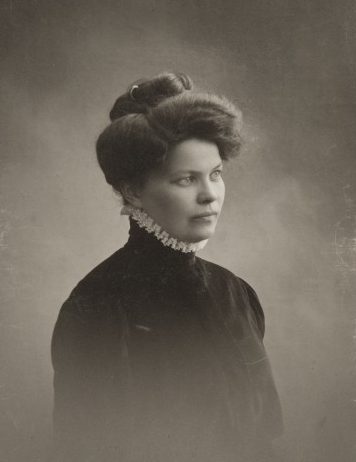
Maria Jotuni. Photo: Atelier Nyblin / CC-BY-4.0
Maria Jotuni‘s reputation as a writer rests on her daring and highly individual portrayals of women and on her gifts as a dramatist. Her works concentrate on analyses of the human condition, the contradictions, the frustrations, the fantasies. As the creative ‘observer’ she is both deeply sympathetic and ruthlessly revealing.
Maria Jotuni, whose centenary is celebrated this year, grew up in the eastern Finnish province of Savo and her early work draws richly on that background for subject matter and local colour. Her style, which over the years was honed and polished into a unique form of expression, certainly owes something to the lilting rhythms of the Savo dialect – and something to the lyricism of the Finnish Bible, with which she was familiar from her earliest years. Maria Haggrén, as she was born, was the second of six children; they lived in Kuopio, the home town of J. V. Snellman (1806–81), a man who did much to formulate the Finnish national identity, and of Minna Canth (1844–97), one of Finland’s major woman writers. The Haggréns were not wealthy, but they believed strongly in the pursuit of learning and knowledge. The home also provided a fruitful contact with rural life with opportunities to listen to the chatter and tales of the farm boys and servant girls. More…
A respectable tragedy
30 June 1988 | Archives online, Fiction, Prose
An extract from the novel Säädyllinen murhenäytelmä (‘A respectable tragedy’, 1941). Introduction by Kaija Valkonen. The central theme of the novel is love: young, old, passionate, innocent, proper, improper. The main characters are a middle-aged couple, the doctor and his wife Elisabet, his sister Naimi and the love of her youth, Artur. Hämäläinen’s fine irony, careful and thoughtful psychology and colourful language have made the novel a bestseller. Naimi, an aesthete and an uncompromising character, has left her husband Artur twenty years ago because of his infidelity. But slowly she begins to forgive: this tragic but compassionately told love story, not without tragicomedy and humour, ends in reconciliation
Embalmed passion
In that new Helsinki of the ‘thirties, which had opened like a garden flower, gaily coloured, sunlit, practical and impractical, in love with every novelty of the moment, which it thought astonishing, lived Naimi Saarinen, back from her exile, where she had been driven by wounded passion twenty years before. More…
Poems
30 June 1987 | Archives online, Fiction, poetry
Poems from Vattenhjulet (‘The water-wheel’, 1986). Introduction by Thomas Warburton
Together with time
One day the door to my room closed
and fate said to me: be still.
It was then that I discovered time.
It had lain hidden beneath a lid
of events and hasty decisions.
It was then that I raised the lid.
So strange! There time lay
completely unused, completely itself
smooth and fresh, as if resting.
I looked at time with reverence.
I saw myself new, I sank into
a miraculous eventlessness
together with time
listened to myself living:
a barely perceptible murmur.
The water-wheel
The old horse plods heavily with blinkered eyes
the wheel turns slowly and inexorably
creating time, a thing that is not visible
that is really nothing
			with the right to kill.
Words like songs
The Finnish poet Helvi Juvonen (1919–1959) often studies small things: moles, lichen, bees and dwarf trees; she ‘doesn’t often dare to look at the clouds’. But small is beautiful; her nature poems and fairy-tales mix humility and the celebration of life. Commentary by Emily Jeremiah
Cup lichen
Luke 17:21
The lichen raised its fragile cup,
and rain filled it, and in the drop
the sky glittered, holding back the wind.
The lichen raised its fragile cup:
Now let’s toast the richness of our lives.
From Pohjajäätä [‘Ground-ice’], 1952) More…
On the job
10 December 2010 | Extracts, Non-fiction
‘I like my pictures to be realistic and truthful, not that I can satisfactorily define what realism is. The real people in my pictures are in their real surroundings, even though they are posing for me. I see this as a series of encounters. The subjects present their “working role” for me, which I record‚’ says photographer Eija Irene Hiltunen. In these extracts she introduces her project and samples of her photography present people at work in contemporary Finland
Extracts from Työn tekijät. Muotokuvia suomalaisesta työstä. / Doing the job. Portraits of Finnish working life by Eija Irene Hiltunen. Texts: Pasi Alametsä. Translations: Joseph White. Layout: Petri Kuokka & Eija Irene Hiltunen (Avain, 2009)
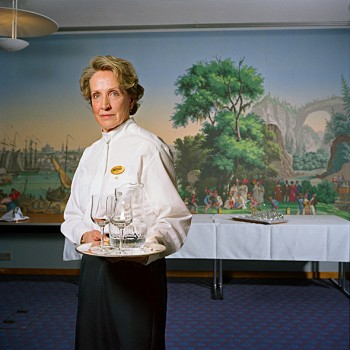
A waitress. Photo: Eija Irene Hiltunen, 2001
One of the most important aims of my portraits has been to record an image of the times. I chose work as the common denominator because it relates to the social structure on so many levels.
The ‘visual inventory’ of Weimar Germany by the classic photographer August Sander has been the major inspiration for my work. He made a huge impression on me during my student days. He told of the upheavals of his own time through his portraits, as the old class society broke down, and of the time before the Second World War and the birth of modern Germany. Sander beautifully depicted history through the individual, and his portraits have remained as testaments to life during that era. More…
Front-Line Tourists
30 September 1976 | Archives online, Fiction, Prose
An extract from the novel Nahkapeitturien linjalla (‘On the tanners’ line’, 1976)
Paavo Rintala (born 1930) published his first novel in 1954 and since then has brought out a new book almost every year. A merciless critic of the myths surrounding certain national figures and events, he has written about Marshal Mannerheim, against attempts to glorify war, and the ‘inevitability’ of Finland’s involvment in the German Barbarossa plan. He has made considerable use of reportage technique to produce anti-war documentaries and in more recent years worked with international subjects.
His books have been widely translated and are popular in East and West Europe. Paavo Rintala’s novel Sissiluutnantti (‘Commando Lieuenant’, Otava 1963) and its reception were the subject of a book by the ltterary critic Pekka Tarkka (Paavo Rintalan saarna ja seurakunta. ‘Paavo Rintala’s sermon and congregation’, Otava 1966). Paavo Rintala is chairman of the Finnish Peace Committee. The passage below is taken from Nahkapeitturien linjalla (‘On the tanners’ line’, Otava 1976) in which he again turns his attention to the war years. Rintala looks at the events of the years leading up to the war and the course of the war itself through the eyes of many different people – from the leading politicians of the day to the ordinary soldier.
The novel has already been acclaimed as the monument to the ‘unknown soldier’ of the Winter War.

Hessu duly presented himself at the Viipuri office of the Army Information Department (Visitors’ Escort Section), where it was implied that the expected visitors were Very Important People and that a singular privilege was being conferred upon Hessu and such front-line troops that the party might visit. Although His Excellency Field-Marshal Mannerheim made it a rule never to allow front-line visits by ordinary journalists or even by special correspondents, these gentlemen were, it seemed, such influential people that H.E. had agreed to their visit without demur. “You understand, Padre, what a great responsibility this will be for you? These are very high-up people.” More…
A hard day’s night
30 June 2008 | Archives online, Authors, Reviews
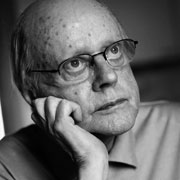
Arne Nevanlinna. Photo: Veikko Somerpuro/WSOY.
Marie Myhrborgh was born in Strasbourg on the last day of the 19th century. A hundred years later she is living her last days in a Finnish nursing home. Her mind wanders, searching for a vanished time in the landscapes of her childhood and her later life in Finland, where she was brought by a hasty marriage, formed amid the clamor of the First World War.
In his first novel Marie (WSOY, 2008) Arne Nevanlinna follows his protagonist’s associations and reminiscences, creating comic and ironic, as well as tragic parallels between the eras and the cultures that it describes.
With her marriage, Marie’s life as a Frenchwoman under the authority of the Germans changes to that of an outsider in the narrow social circles of the Finland-Swedish gentry, which her outsider’s eyes see in an ironic light. More…
A day at the zoo
23 December 2009 | Children's books, Fiction
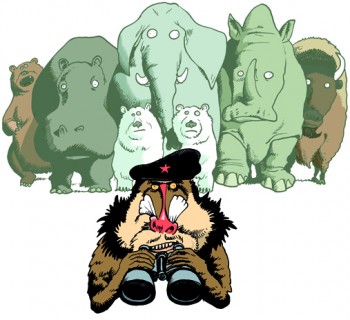
Extracts from the children’s book Zoo – eläimellinen tarina (‘Zoo – a bestial story’, WSOY, 2009, illustrated by Pertti Jarla)
The place: A zoo, once the property of the city, now privatised and accountable to corporate stockholders
The characters: The animals of the zoo, in particular Gandhi, a Sumatran tiger (false-teeth, poor vision, pacifist), Che, a male mandrill baboon (militant), and Mother Teresa, a hammer-headed bat (elderly); the zookeeper Sihvonen (stands up for the animals, recently fired); the new zoo director (whose main goal is to maximise profits); the shareholders’ committee (awaiting their earnings)
The action: after a demonstration in which all the animals played dead, the animals are staging a revolution to demand that Sihvonen be reinstated
The animals crowded into the foyer. The hallway was full of every kind of creature, with all of their skin, fur and feathers steaming in the warm indoor air. Che stood at the top of the the stairs, looked down at his troops, and gave the order in mime for everybody to be quiet.
‘Reconnaissance?’ he said, his voice subdued.
‘Ready!’ the leaf-tailed geckos announced.
‘Head in!’ Che commanded. More…
Not a day without pen and paper
14 March 2013 | This 'n' that
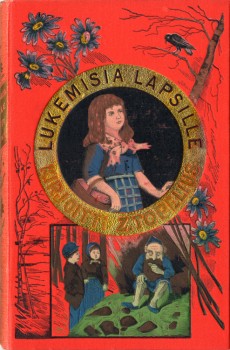
For use and fun: stories for children by Z. Topelius
Zacharias Topelius wrote every day for almost 70 years. His published works contain almost 16,000 pages.
As he was also the editor of the Swedish-language newspaper Helsingfors Tidningar which he published twice a week for 20 years, his output, counted in pages, is enormous.
Author, journalist, historian, critic and pedagogue Topelius (1818–1898) wrote poetry, hymns, travelogues, serials, articles, short stories, fairy tales, textbooks and plays.
As for Finnish translations, his historical serial Fältskärns berättelser (‘The barber-surgeon’s tales’, 1853–1867) and Läsning för barn (‘Reading for children’) are probably his most popular works.
In a bilingual (Swedish and Finnish), text-critical, annotated (and illustrated) project, entitled ‘Zacharias Topelius Skrifter’ (‘Z. T. writings’), Svenska Litteratursällskapet i Finland (the Society of Swedish Literature in Finland) will publish a large number of Topelius’s works in digital facsimile form. The selection grows continually.
Onward, downward!
31 March 1994 | Archives online, Fiction, Prose
Lauri Viita (1916–1965) was one of the self-taught writers who made his debut after the Second World War. His extensive, realist novel Moreeni (‘Moraine’, 1950) taking place in Viita’s native Tampere, begins with this prose poem
…over wolds, hummocks, ridges, between boulders, under branches, from cabin to cottage to manor, from coppice to fen, and ditch to puddle – down it drew us, the sloping earthcrust, southward the magnificent granite ploughland slanted.
Paths linked to paths, brooks joined brooks. Onward, downward! The roads widened, the currents strengthened. Bigger and bigger, heavier and heavier were the loads they could sustain. More and more trees, bread, potatoes, butter, meat, people and gravestones, huge boulders, rocks, went into the maw of those channels, and the hunger only redoubled. From channel to strait, from hour to hour, the lines of barges crawled along; from day to day the broad rafts of logs passed their sleepless summer on the long blue strip of Lake Näsijärvi. Spruce, pine, birch, aspen – different pieces for different purposes. How vast the supply and how vast the need! The months and days went by; in the depths of the lake, layer after layer, there wandered the shades of clouds, ships, faces. More…
‘ware bears!
30 September 1988 | Archives online, Children's books, Fiction
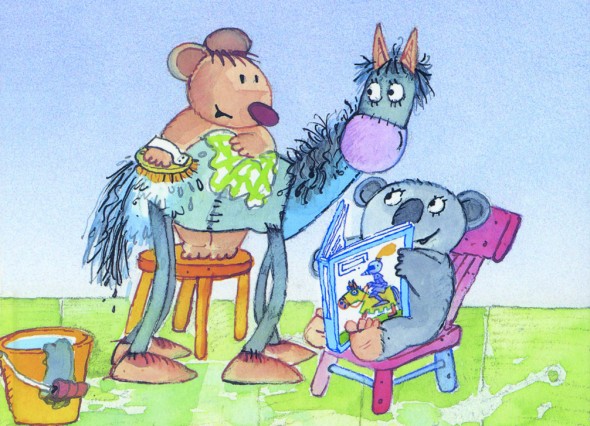
Illustration: Jukka Lemmetty
Urpo and Turpo are a pair of teddy bears. Their family – mother, father and three children – cannot imagine who it is that makes such a mess; the bears live their own absorbing lives in house. Hannele Huovi’s text and Jukka Lemmetty’s illustrations describe the bears’ antics in a way that appeals to the sense of humour of readers of all ages.
In the green house an ordinary family are living a perfectly ordinary life. There’s father, mother, The Big Daughter, The Son, and also The Baby as well. Mother keeps running back and forth all day long shouting, ‘Goodness gracious! Who’s responsible for this?’ For very funny things keep going on in the house. Who on earth is it – always getting up to some sort of hanky-panky?
Father harrumphs and says to The Big Daughter:
‘It was you, wasn’t it?’ But The Big Daughter shakes her head. Father turns to The Son:
‘So it must have been you, then?’ But the son shakes his head. No use asking The Baby. He shakes his head anyway, because he’s always imitating the others. Father and mother are completely stumped. More…
Breton without tears
31 March 1994 | Archives online, Fiction, Prose
Extracts from Euroopan reuna (‘The edge of Europe’, Otava, 1982). Introduction by H. K. Riikonen
I am reading a book, it says pour l’homme latin ou grec, un forme correspond à un être; pour le Celte, tout est metamorphose, un même individu peut prendre des apparences diverses, so it says in the book. A strange claim, considering that the word metamorphosis is Greek, and that the best-known book about metamorphoses, Ovid’s Metamorphoseon libri XV was written in Latin. In the myths of all peoples, at least the ones whose oral poetry was recorded in time, such as the Greeks, Serbs, Slavs, Finns, or Aztecs, metamorphoses play a very important part, the Celts are not an exceptional tribe in this respect. The author must mean that the Celts still live in mythical time, the time of metamorphoses when the human being assumed shapes, was able to fly as a bird, swim as a fish, howl as a wolf, and to crown his career by rising up into the sky as a constellation. Brittany is part of the Armorica Joyce tells us about in Finnegans Wake, that book is incomprehensible if one does not know Ireland, and now I see that Brittany is the key to one of the book’s locked rooms. I thought I already had keys to all the rooms after Dublin, the Vatican, and Athens, but one door was and remained closed, the key is here now, in my hand, I can get into all the rooms in the book, and I am home even if I should happen to get lost. The room creates the person, she becomes another when she goes from one room to another, this is metamorphosis, and when she leaves the house she disappears, she no longer exists. The legend on the temple at Delphi, gnothi seauton, know thyself, has led Occidentals onto the false track that is now becoming a dead end, polytheistic religions correspond to the order of nature, but as soon as the human starts to imagine that she knows herself, as soon as the metamorphic era ends, monotheism is born, the human being creates god in her own image, and that is the source of all evil. Planted like traffic signs at the far end of this cul-de-sac stand the hitlers and brezhnevs and reagans and thatchers, new leaves are appearing on the trees, the sun is shining. Landet som icke är* är en paradox: landet blev befintligt därigenom att Edith Södergran sade att det icke är. On the sea sailed a silent ship*, as I tracked my shoeprints across the sand on the beach, it was like walking on a street made out of salty raw sugar, I felt desolate. The wind bent the grasses, the sun warmed the back of my sweater, of course the sun always has the last word, I thought, things should be as they are, this thought gave me peace of mind. I walked past the cows, two of them already chewing the cud, the others still grazing, they stood in a line and raised their heads, stood at attention, as it were, as I walked past. I was not entirely sure that I was heading in the right direction, but then I saw the boucherie and knew that there was a café nearby. Madame greeted me in a friendly fashion, brought me a calvados and a beer and sat down for a chat, wanted to know if I liked the countryside here. I said that things looked the same here as in Ireland, she said that was true, but she had never been to Ireland. I finished my drinks and paid, left, decided to walk along the beach. I saw gun emplacements and two bunkers. I crawled into a bunker. Inside, it was dark and damp. I looked through the embrasure at the sea. I thought of the boys who had been incarcerated here. They had been given a death sentence. I examined a rusty object, what was it, I looked at it more closely, it was an axle from a gun’s undercarriage. As I arrive in my home yard, I note that the lilacs are beginning to bloom. More…
Leena Lander: Liekin lapset [Children of the flames]
23 June 2010 | Mini reviews, Reviews
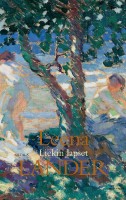 Liekin lapset
[Children of the flames]
Helsinki: Siltala, 2010. 419 p.
ISBN 978-952-231-022-1
€ 27.30, hardback
Novels by Leena Lander (born 1959) have been translated into more than 20 languages. Liekin lapset is a family saga, told in two parallel timelines. One is a portrait of a small coastal community in south-western Finland from the turn of the 20th century up to the end of the Finnish civil war in 1918 and the years following it. Life in the area is governed by a sawmill and a manor, socially dividing the community in two. Saida, Joel, Anders and Arvi grow up together, the future workers dreaming of socialism and the sons of the manor playing warlords. In the contemporary strand of the story, Sakari Salin, Saida’s grandson, begins researching his grandmother’s life. The documents reveal some rather remarkable events: here, the author defends the rights of those who were on the losing side in the civil war and creates a lively – as well as historically grounded – portrait of the times. The dialogues and characters in this novel work well, and the structure supports a complex system of psychosocial interconnections, in which the present finds an explanation in the past.
Toivo Flink: Kotiin karkotettavaksi: Inkeriläisen siirtoväen palautukset Suomesta Neuvostoliittoon [Exiled home: The return of Ingrian emigrants from Finland to the Soviet Union]
15 October 2010 | Mini reviews, Reviews
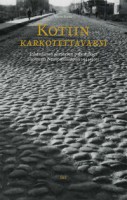 Kotiin karkotettavaksi: Inkeriläisen siirtoväen palautukset Suomesta Neuvostoliittoon 1944–1955
[Exiled home: The return of Ingrian emigrants from Finland to the Soviet Union, 1944–1955]
Helsinki: Finnish Literature Society, 2010. 320 p., ill.
ISBN 978-952-222-183-4
33 €, paperback
It has been 65 years since the Allied Commission operation to repatriate Finnic Ingrian emigrants from Finland to the Soviet Union was completed. During the Continuation War (1941–1944), 63,000 Ingrian civilians fled to Finland to avoid the war; 56,000 of them were returned to the Soviet Union at the order of the Russian-dominated Allied Commission. It is estimated that half of those remaining in Finland secretly fled to Sweden. Ingrians continued to be returned from Finland to the Soviet Union for ten more years. The Ingrians had been promised they would be returned to their former home areas around St Petersburg, but they were actually transferred to more remote parts of the Soviet Union. In this first study to deal exclusively with the travails of the Ingrians, Flink has used Russian archives to uncover how and where the population was moved. This subject has long been a sensitive issue both in domestic and foreign affairs. According to Flink, his research would not have been possible if the return of Ingrians to Finland had not begun in 1990. (There have been about 30,000 immigrants since, and now the state is planning to terminate the right of return.)