

Search results for "harjunpää/2010/10/mikko-rimminen-nenapaiva-nose-day"
Matti Yrjänä Joensuu: Harjunpää ja rautahuone [Harjunpää and the iron room]
19 November 2010 | Mini reviews, Reviews
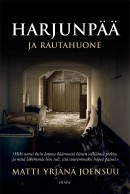 Harjunpää ja rautahuone
[Harjunpää and the iron room]
Helsinki: Otava, 2010. 302 p.
ISBN 978-951-1-24742-5
€ 26, hardback
This book’s shocking opening scene, a cot death, is not followed by anything that lightens the tone. Finland’s best-selling crime writer, Matti Yrjänä Joensuu (born 1948) – whose work has been translated into nearly 20 languages – focuses here on a criminal investigation conducted by Inspector Timo Harjunpää into the murderer of several wealthy women. The victims are linked via their purchases of sex; the detective’s attention soon falls on Orvo, a masseur who also turns tricks as a gigolo. Nearly every scene is shot through with themes of lovelessness, exploitation and the connection between malice and sex. Harjunpää is an empathetic, slightly rumpled cop who has an ambitious yet somewhat downbeat attitude to his job. Joensuu’s Harjunpää ja pahan pappi (Priest of Evil) was published in English in 2006. Joensuu himself is a retired police officer; his particular strength as an author is his extraordinarily precise, realistic portrayal of police work. But it’s not just about who did what; why they did it is equally important. One reason for Joensuu’s popularity is his extremely well-developed understanding of human nature. He observes and analyses, but never judges.
Tapani Bagge: Maalla [In the country]
31 January 2011 | Mini reviews, Reviews
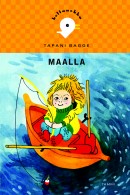 Maalla
[In the country]
Kuvitus [ill. by]: Hannamari Ruohonen
Helsinki: Tammi, 2010. 64 p.
ISBN 978-951-31-4748-8
€9.50, hardback
There have been plenty of books for beginning readers with action-packed plots full of breathtaking twists and turns. Fortunately there are still books that leave room for a more ‘easy does it’ reading style. One of them is this, the sixth title in Tapani Bagge’s series about a girl called Kaisa. Kaisa travels to the countryside with her father and her father’s partner Sirkka. Their journey is overshadowed by the death of Kaisa’s grandmother, and the little girl believes that nothing at her grandma’s place will ever be the same again. Bagge’s extensive work on this material is evident in his spare, finely tuned prose. He portrays the grieving girl’s differing shades of emotion beautifully. Kaisa believes that her grandma has changed into a butterfly following her death. So the butterfly fluttering around in the attic needs to be saved – but this of course has further-reaching consequences…. Hannamari Ruohonen’s black-and-white illustrations provide a lovely depiction of care and protection in the family.
Translated by Ruth Urbom
Asko Sahlberg: He [They]
28 June 2010 | Mini reviews, Reviews
 He
He
[They]
Helsinki: WSOY, 2010. 120 p.
ISBN 978-0-36170-2
€ 24.10, hardback
The Finland-Swedish author Asko Sahlberg (born 1964), who lives in Gothenburg in Sweden, has had an interesting, if uneven, career over the past decade. Sahlberg’s particular strengths lie in his precise use of language and the rhythm of his prose. Since his debut novel, Pimeän ääni (‘The sound of darkness’, 2000), part of Sahlberg’s output has been concerned with meditations on existence and the purging of emotions, with the rest delving into historical themes, such as his 2004 novel Tammilehto (‘Oak Grove’) which is set in the year 1918, and He, his ninth book, which takes place in 1809. (An extract from his novel Eksyneet (‘The lost’) was published in Books from Finland, 2/2002.) In He Sahlberg uses a first-person narrative technique with multiple narrators, which feels justified in this highly distilled portrait of a family. The plot is set against the backdrop of the Finnish War (1808–1809), waged by King Gustav IV Adolf of Sweden and Alexander I, Emperor of Russia. Henrik and Erik are brothers fighting on opposite sides, their mother drowns her sorrows hard liquor, and Anna, the neighbour’s daughter, ends up with the wrong brother. The end of this novella is surprising, dealing with the anatomy of revenge and deceit.
Jansson’s temptations
27 November 2009 | This 'n' that
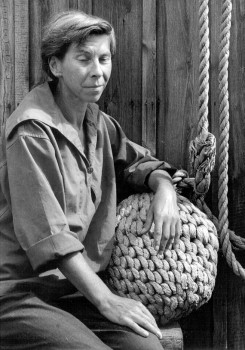
Tove Jansson (c. 1950)
If Tove Jansson’s Moomin books are, as we certainly believe here at Books from Finland, strangely little known in the wider world, the same is even truer of her books for adults.
Incredibly, the Moomins celebrate their 65th birthday in 2010, and have been translated into 40 languages. Jansson (1914–2001) wrote her last Moomin book – there are nine altogether – in 1970. Over the last thirty years of her life, she also wrote a total of 11 volumes – novels and short stories – for grown-ups. (Books from Finland published stories from many of them as they appeared. They will become available again as our digitisation project gets underway; meanwhile, here’s a story from Dockskåpet [‘The doll’s house’, 1978].)
Back out there in the wider world, the tiny, Hampstead-based press Sort Of Books has since 2001 been introducing Jansson’s lesser-known works to British readers. Latest to appear is her bleakly unsettling novel The True Deceiver (Den ärliga bedragaren, 1982), the story of a strange young woman, Katri, who breaks into an elderly artist’s house and attempts to befriend her, for reasons of her own. More…
Winning stories of alternative realities
10 February 2011 | In the news
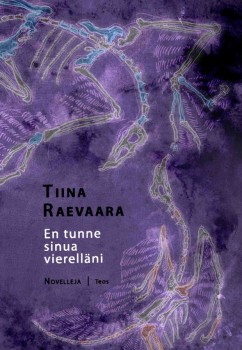 The Runeberg Prize for fiction, awarded this year for the twenty-fifth time, went to a collection of short stories by Tiina Raevaara.
Her En tunne sinua vierelläni (‘I don’t feel you beside me’, Teos, 2010) mixes fantasy and realism, dealing with, for example, animal kingdom, human mind and artificial intelligence. See the introduction and translation of a story which we ran here on the Books from Finland website.
Raevaara (born 1979) holds a doctorate in genetics; the prizewinner is her second work of fiction. The prize, worth €10,000, was awarded on 5 February – the birthday of the poet J.L Runeberg (1804–1877) – in the southern Finnish city of Porvoo.
The jury – representing the prize’s founders, the Uusimaa newspaper, the city of Porvoo, both the Finnish and Finland-Swedish writers’ associations and the Finnish Critics’ Association – chose the winner from a shortlist of eight books: a collection of poetry, Vagga liten vagabond (‘Swing, little wanderer’, Söderströms) by Eva-Stina Byggmästar, the novel Poikakirja (‘Boys’ Own Book’, Otava) by Olli Jalonen, the novel Kiimakangas (WSOY) by Pekka Manninen, two collections of essays, Kuka nauttii eniten (‘Who enjoys most’) by Tommi Melender and Halun ja epäluulon esseet (‘The essays of desire and suspicion’) by Antti Nylén (both publlished by Savukeidas), a collection of poetry, Texas, sakset (‘Texas, scissors’, Otava) by Harry Salmenniemi and another collection of short stories, Apatosauruksen maa (‘The land of the apatosaurus’, WSOY) by Miina Supinen.
Jean Sibelius kodissaan. Jean Sibelius, i sitt hem. Jean Sibelius at home
19 August 2011 | Mini reviews, Reviews
 Jean Sibelius kodissaan. Jean Sibelius, i sitt hem. Jean Sibelius at home
Toimittanut [Edited by] Jussi Brofeldt
Helsinki: Teos, 2010. 103 p., ill.
ISBN 978-951-851-364-6
€ 29, hardback
The composer Jean Sibelius (1865–1957) disliked being photographed. This book contains 50 stills selected from the documentary film Jean Sibelius at home, a compilation of cinematographic material in which the composer is seen at home in 1927 and 1945. Some of the shots were originally cut, and have not been previously published. The film was made by the brothers Heikki Aho and Björn Soldan, who were neighbours of Sibelius in their childhood – their father was the author Juhani Aho, a friend of the Sibelius family. Founded in the 1920s, the film company Aho & Soldan was influenced by the experimental spirit of the Bauhaus and became known for its commissioned work aimed at spreading the image of Finland abroad. The Sibelius film offers a rare peek into the composer’s home life at his villa of Ainola. In addition to the photographs, the trilingual book also contains seven articles on Sibelius and the film. Heikki Aho’s daughter, the pioneer photographer Claire Aho relates her own memories of the 1945 filming. Jussi Brofeldt, the book’s editor, is her son.
Translated by David McDuff
Siri Kolu: Me Rosvolat [Me and the Robbersons]
27 January 2011 | Mini reviews, Reviews
 Me Rosvolat
[Me and the Robbersons]
Kuvitus [ill. by]: Tuuli Juusela
Helsinki: Otava, 2010. 222 p.
ISBN 978-951-1-24393-9
€13.80, hardback
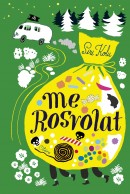
Me Rosvolat by Siri Kolu (born 1972), winner of the Finlandia Junior prize, is a clever combination of the spirit of the Norwegian children’s classic When the robbers came to Cardamom Town by Thorbjørn Egner and the fashionable road movie genre. A ramshackle gang of robbers kidnaps ten-year-old Vilja, who is in the middle of a holiday with her family. The Robbersons like to pounce, Robin Hood-like, on petty bourgeois types who ‘think they’re just regular people, but who’ve got plenty of nice things, like a car, good eats and clothes.’ In a carnival style that appeals to children’s sense of justice – and is reminiscent of Astrid Lindgren’s Pippi Longstocking – Kolu describes the Robberson family’s innocent-seeming raids on kiosks selling old-fashioned treats and the pick ‘n’ mix sections of video rental shops. Vilja and the Robberson family’s summer-long jaunt is filled with humour, sticky situations and thoughts on family relationships.
Translated by Ruth Urbom
Liisa Kallio: Pikku Papu [Little Papu]
31 January 2011 | Mini reviews, Reviews
 Pikku Papu
[Little Papu]
Kuvitus [Ill. by]: Liisa Kallio
Helsinki: Tammi, 2010. 31 p.
ISBN 978-951-31-5242-0
€10.30, hardback
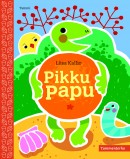
In 2009, Finnish publisher Tammi launched its Tammenterho (‘Acorn’) series of picture books written by established Finnish authors to run along its Tammen Kultaiset kirjat (Tammi Golden Books series, modelled after a US imprint dating back to the 1940s). Pikku Papu is a jolly wandering tale for the smallest children. Papu the Tortoise notices that his shell, which he left on the beach while he went for a swim, has shrunk. In his search for a solution to his problem, he encounters a number of animals. Papu tries to cover himself with a glove he finds on the beach, but it proves to be too warm, and an eggshell he is given by a bird cracks. Fortunately, of course, everything works out in the end. This gentle story lets children identify colours and shapes and recognise various animals. The collage illustrations are attractive, and the text is simple, calmly told and appropriately short.
Translated by Ruth Urbom
Laura Lähteenmäki: Aleksandra Suuri [Alexandra the Great]
1 February 2011 | Mini reviews, Reviews
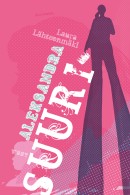 Aleksandra Suuri
[Alexandra the Great]
Helsinki: Tammi, 2010. 180 p.
ISBN 978-951-0-36522-9
€18, hardback
Laura Lähteenmäki’s novel for young people is a rare, rollicking tale of independence whose treatment of even heavy topics is guaranteed to make readers laugh, sometimes through their tears. Tim, a Dutch exchange student, shakes things up in 16-year-old Alexandra’s family when he comes to stay. She is used to being the centre of attention in her family and circle of friends, but self-confident Tim brings Alexandra’s status into question. As in her previous novels for young people, Laura Lähteenmäki presents a briskly paced drama of interpersonal relationships. Events are filtered through Alexandra’s eyes as the first-person narrator. Readers can easily get behind her point of view: Tim is truly a jerk. The portrayal of complex family relationships following a traumatic divorce makes this book worthwhile reading for adults as well, even if Lähteenmäki does resort to somewhat clichéd solutions in her portrayal of minor adult characters.
Translated by Ruth Urbom
Markus Majaluoma: Hulda kulta, luetaan iltasatu! [Hulda dear, let’s read a bedtime story!]
27 January 2011 | Mini reviews, Reviews
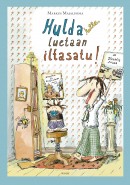 Hulda kulta, luetaan iltasatu!
[Hulda dear, let’s read a bedtime story!]
Helsinki: WSOY, 2010. 24 p., ill.
ISBN 978-951-0-36284-6
€ 23.20, hardback
Since 1996, illustrator Markus Majaluoma (born 1961) has written and illustrated 17 children’s books. His picture books have been translated into six languages. In this, the third book of its series, Jalmari reads a bedtime story chosen by his strong-willed baby daughter Hulda – one that they’ve read a hundred times before, children being famously conservative in this regard. In the story, a wasp stings a bear. Jalmari falls asleep, but as clever little Hulda knows how the story ends, there will be a surprise for the snoring dad. The stripped-down little narrative is fleshed out with plenty of details in Majaluoma’s highly original illustrations (the wasp playfully stings with its snout) often standing in humorous counterpoint to the text, an amusing bonus for the adult reading it as a bedtime story.
Translated by Ruth Urbom
Reetta Niemelä & Salla Savolainen: Sinisen kärpäsen sirkus ja muita runoja [The blue fly circus and other poems]
3 February 2011 | Mini reviews, Reviews
 Sinisen kärpäsen sirkus ja muita runoja naapurinötököistä
[The blue fly circus and other poems about neighbourhood creepy-crawlies]
Kuvitus [Ill. by]: Salla Savolainen
Helsinki: Otava, 2010. 40 p.
ISBN 978-951-1-24002-0
€20, hardback
Reetta Niemelä has provided a breath of fresh air in Finnish children’s poetry with her collections Makkarapiruetti (‘Sausage pirouette’, 2005) and Kakaduu (‘Cockatooo’, 2009), whose onomatopoeic sounds and whimsical grammar are reminiscent of children’s language play as they learn to speak. This book opens up the secrets of the world of earthworms and the tiniest of insects to the reader, revealing natural wonders at (literally) grass-roots level. The most delightful aspect, however, is to be found in its illustrations: Salla Savolainen employs a painstaking, richly nuanced woodcut technique, which puts a natural finishing touch to the collection. This sort of delicacy has not been seen in children’s book illustration in a very long time! Savolainen’s images seem light, breezy and lively – each little bug has its own charismatic personality.
Translated by Ruth Urbom
Timo Parvela & Jussi Kaakinen: Taro maan ytimessä [Taro at the centre of the Earth]
3 February 2011 | Mini reviews, Reviews
 Taro maan ytimessä
[Taro at the centre of the Earth]
Kuvitus [Ill. by]: Jussi Kaakinen
Helsinki: WSOY, 2010. 24 p.
ISBN 978-951-0-36718-6
€22, hardback
Illustrator Jussi Kaakinen (born 1978) is known for, among other things, his illustrations for the graphic novel version of Risto Isomäki’s sci-fi work Sarasvatin hiekkaa (‘The sands of Sarasvati’, 2008) and two children’s non-fiction books, Suomen lasten historia (‘A Finnish children’s history’, 2005) and Suomen lasten taidehistoria (‘A Finnish children’s art history’, 2009). Taro maan ytimessä is his first picture book in his own right. Kaakinen employs an experimental illustration style here, borrowing from comic book techniques, to create an appropriately fast-paced text. The children in the story are curious to find out whether they can dig deep enough in their sandbox to reach the other side of the world. Taro has a bear for a friend who constructs a machine out of old junk that can dig into the Earth and then into outer space. On their daredevil journey, the pair encounter a greedy monster worm with a sweet tooth. Their adventure ends when Taro returns home, although the space worm, making a racket in the sewers, ought to be hidden from his parents…. Taro maan ytimessä is a pacey, visually striking adventure that will be especially enthralling to boys.
Translated by Ruth Urbom
Sirpa Kähkönen: Vihan ja rakkauden liekit. Kohtalona 1930-luvun Suomi [Flames of love and hatred. Finland in the 1930s as destiny]
20 January 2011 | Mini reviews, Reviews
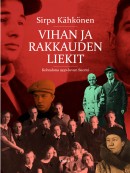 Vihan ja rakkauden liekit. Kohtalona 1930-luvun Suomi
[Flames of love and hatred. Finland in the 1930s as destiny]
Helsinki: Otava, 2010. 287 p.
ISBN 978-951-1-24275-8
€ 32, hardback
In this non-fiction book, novelist Sirpa Kähkönen (born 1964) tells the story of her grandfather Lauri Tuomainen (1904–1971) in the context of Finnish politics of the 1920s and 30s. Tuomainen spent more than seven years in a labour camp at Tammisaari in south-western Finland, where Communist prisoners were sent after the Finnish Civil War of 1918. He was imprisoned in 1926 following his desertion from the Finnish Red Army officers’ academy in St Petersburg, and again in 1932 in the aftermath of planned public protests. The rise in political extremism and the worldwide economic depression made conditions in the prison camp extremely harsh. Kähkönen makes use of many archival sources in her descriptions of the hunger strike in the summer of 1933 and violence inflicted by the prison guards. In 1938 Tuomainen was released a broken man. One of the intriguing figures in this book is Mary Rhodes Moorhouse, from a wealthy British–New Zealand family, an enthusiastic supporter of the women’s rights movement and Communism; she married Eino Pekkala, a member of Finland’s left-wing political elite.
Shortlist for Finlandia Prize for Non-Fiction 2014
13 November 2014 | In the news
 The shortlist for the Finlandia Prize for Non-Fiction 2014 – worth €30,000 – was announced on 5 November by the chairperson of the jury, Susanna Pettersson, Director of the Ateneum Art Museum. The works on the list of six are as follows:
Pohjolan leijona, Kustaa II Adolf ja Suomi 1611–1632 (‘The lion of the North. Gustavus II Adolphus and Finland 1611–1632’, Siltala) by the historian and author Mirkka Lappalainen deals with the implications of actions of the mighty Swedish king on the part of the kingdom that was known as Finland.
Herkkä, hellä, hehkuvainen – Minna Canth (‘Sensitive, gentle, radiant – Minna Canth’, Otava) is a fresh biography of the Finnish pre-feminist author (1844–1897), a popularised version of a dissertation by Minna Maijala.
Karanteeni. Kuinka aids saapui Suomeen (‘Quarantine. How Aids came to Finland’, Siltala) by Hanna Nikkanen & Antti Järvi records the history of the disease, its arrival and consequences in Finland.
Operaatio Elop (‘Operation Elop’, Teos) by Pekka Nykänen & Merina Salminen is the story of the mobile phone company Nokia in its declining years and its Canadian CEO (2010–2013) Stephen Elop, who did not become the saviour of the company on the global market.
Usko, toivo ja raskaus. Vanhoillislestadiolaista perhe-elämää (‘Faith, hope and pregnancy’, Atena) by Aila Ruoho &Vuokko Ilola focuses on the family life, particularly the status of the woman, of a fundamentalist religious community in Finland.
Tulisaarna. Einojuhani Rautavaaran elämä ja teokset (‘Fiery sermon. Life and works of Einojuhani Rautavaara’, Teos) by Samuli Tiikkaja (journalist, music critic and researcher) is a biography of the composer Einojuhani Rautavaara (born 1928).
The winner – according to the rules of the prize, it will be given to a deserving Finnish generalist non-fiction book – will be chosen by Heikki Hellman, journalist and Dean ofthe School of Communication, Media and Theatre in Tampere, on 19 November.
Good school, bad pupils, or vice versa?
21 December 2012 | This 'n' that

Number one: Finland. The Pearson analysis, 2012
Finland is used to feeling pretty good about itself when it comes to education. In the widely respected PISA tests – the Organisation for Economic Co-operation and Development’s exams in science and literacy – Finnish schoolchildren have, since the turn of the century, been outperforming most of their peers.
A shock came in 2009 when the tests revealed that Finnish kids were only third-best at reading, and sixth in maths; but by this time they were competing against the newly participating Asian countries, with their huge concentration on education.
Now, however, a new league table, drawn up by the education publishers Pearson, places Finland right at the top (2006–2010, 40 countries). Second place is held by South Korea; third is Hong Kong. The Pearson analysis uses a broader set of criteria, using not just test results but broader measures such as how many people go to university. In a result that is causing some puzzlement in the United Kingdom, Britain is rated sixth. Entirely, say critics, because British universities are so easy to get into.
The results are indeed flattering to Finland – but Finnish children’s motivation to learn is among the weakest in the survey’s countries. In reading, mathematics and the sciences Finns’ attitudes and application were low. It looks as if Finnish children consider school a place to hang out with their friends, not a place for teaching and learning. Countries where competition is stronger breed different attitudes.
So here’s the Finnish paradox: kids here hate school – yet still end up at the top of the list.
Must be something in the water.