

Search results for "kjell west"
Time walks slowly
30 June 2002 | Fiction, poetry
When Eira Stenberg (born 1943) began writing in the heat of of Africa, her pen sank into the paper like a tattooing needle into the skin, she says. Her experiences there are alive in her book of poems entitled Siksi seurustelen varkaiden kanssa (‘That’s why I consort with thieves’, Tammi, 2002)
The journey
Wheels clattering, landscape speeding by the window to the past
notebook on lap she understood the journey’s essence,
that it’s a lap she lost in early childhood
when she stood up and set off walking
away from the arms that had carried her from room to room
giving views from on high as if from a mountain:
the apparitions of things, the furnishings, the tints of pictures
and the bedroom mirror they arrived in,
mother and a child, a holy image she met
again in churches and on altars everywhere
as if it were the purpose of the journey: More…
The Mermaid Café
30 June 2000 | Archives online, poetry
From Cafe Sjöjungfrun (‘The Mermaid Cafe’, Söderströms, 1999). Introduction by Peter Mickwitz
Caesura
Yesterday we had the first evening of autumn
even though it is still July. The cool
moist darkness lights that seemed
softer, the Esplanade’s octagonal cone
lit up red, yellow and green above
the underground tunnel from restaurant
to hotel. In the row of lime trees
worn garlands began to show, more
than a third of their light bulbs gone, broken
lines of burning dots gently
swaying. Farther away
sun-bleached awnings, some oily
neon, it, too, segmented,
and people moving
at a calmer pace, already anonymous,
close to unreal reflected in glass panes,
entryways, street lamps shaped like big hooks.
Traffic noise becomes more explicit
as if in an echo chamber or does it
grow more dense as if we walked about
with yellowing wads of cotton in our ears
or a window or a door was closed
and voices a moment ago
distinct, or at least partly,
are transformed into a numb buzz,
all that remains of the message
are ups and downs, a caesura when the conversation, at regular intervals,
reaches a rhythmic point of rest.
Translation prize to Angela Plöger
23 October 2014 | In the news
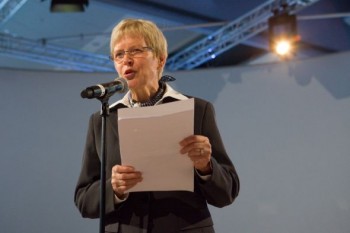
Angela Plöger, Frankfurt Book Fair, 8 October. Photo: Katja Maria Nyman
The 40th Finnish State Prize for the Translation of Finnish Literature of 2014 – worth €15,000 – was awarded to the German translator Angela Plöger at the Frankfurt Book Fair on 8 October.
Dr Angela Plöger (born 1942) studied Finnish and Fennistics in Berlin; she first came to Finland in the 1960s after having become interested in the Finnish language as a result of learning Hungarian.
‘I had been to the restaurant at the Helsinki Railway Station where Bertolt Brecht was thinking how the noblest part of a man is his passport, and how Finns are a people who keeps silent in two languages.’
Plöger then defected to West Germany, starting her career anew. She has also translated texts from Hungarian and Russian. In her speech in the Finnish Pavilion of the Book Fair Plöger said that in her opinion translating literature is the most fascinating profession in the world.
Her first translation of a Finnish novel was Tamara, by Eeva Kilpi, published in 1974. Among the most recent of the 40 novels Plöger has translated during the past five decades from Finnish are the novels Kätilö (‘Midwife’, 2011) by Katja Kettu and Kun kyyhkyset katosivat (‘When the doves disappeared’, 2012) by Sofi Oksanen. Among the other works Plöger has translated are novels by Leena Lander, Eeva-Kaarina Aronen, Anja Snellman, Kaari Utrio, Johanna Sinisalo, Risto Isomäki and Antti Tuuri, as well as a number of drama texts by Laura Ruohonen, Juha Jokela, Aki Kaurismäki, Pirkko Saisio and Sofi Oksanen.
The Minister for Culture and Housing, Pia Viitanen, thanked Plöger for her extensive and multi-faceted work in the field of language and literature and in promoting Finnish literary culture in Germany.
The prize, worth € 15,000, has been awarded by the Ministry of Education and Culture since 1975 on the basis of a recommendation by FILI – Finnish Literature Exchange.
Troubled waters
31 March 2005 | Archives online, Fiction, Prose
Extracts from the novel Den amerikanska flickan (‘The American girl’, Söderströms, 2004). Introduction by Pia Ingström
Doris Night&Sandra Day, Sandra Night&Doris Day: those were their alter ego identities for the game, which also involved the smiles they’d practised in front of the mirror at the bottom of the empty swimming pool, in the house in the muddier part of the woods.
‘We’re two clairvoyant sisters,’ said Doris Flinkenberg. ‘We got that way because of tragic circumstances. The poltergeist phenomenon. Do you know what that is?’
Sandra Wärn shook her head, but looked expectantly at Doris, the perennial crossword – solver, with dictionary to hand, who continued. ‘It’s when the innocent child has been badly abused and has developed supernatural powers in order to survive. Powers to see behind what’s there,’ Doris Flinkenberg explained. ‘To see what no one else can see.’
‘You and I, Sandra,’ Doris confirmed. ‘We were badly abused. I with my scars and you with your tragic family background, your mother and her lover, all of that. You and I, Sandra, we know what it is to suffer.’ More…
From Bosnia with love
31 March 2002 | Authors, Reviews

Photo: Pertti Nisonen
Daniel Katz’s new novel Laituri matkalla mereen (‘A jetty to the sea’, WSOY, 2001), tells the story of the impossible romance between the Bosnian wife of a blind Finnish colonel and a history teacher. Introduction by Tuva Korsström
At some point 250 years ago, a Swedish monarch decided to grant town status to some villages in the estuary of Kuhnusjoki (‘Sluggish river’) on the south-west coast of Finland.
There the little town lies today and is, with its environs, the setting for Daniel Katz’s novel Laituri matkalla mereen (‘A jetty to the sea’). It’s the late 1990s, early autumn, and this year the autumn gales come early. The history teacher Henry Loimu goes down to the bank of the river to repair his jetty in the gusts of wind. More…
A level gaze
30 September 2003 | Archives online, Articles, Non-fiction
The artist Helene Schjerfbeck created her own form of modernism, giving pride of place to emotion, writes Leena Ahtola-Moorhouse. Throughout her solitary life, permanently affiicted by a physical handicap resulting from a childhood accident, Schjerfbeck looked into the mirror for inspiration. In her novel Helene the author Rakel Liehu takes a look at Schjerfbeck’s mirror images and the painter’s long life
Helene Schjerfbeck (1862–1946) was passionately interested in human beings and their inner lives – the riddle of the face.
She was one of the few artists of her generation who both created masterpieces in the naturalistic and impressionistic style of her youth and was also able to shift to an entirely modern, expressionist mode. Intensity and control only increased in the avant-garde paintings of her late period. These bear comparison with the work of Picasso, Modigliani and Rouault. More…
Across Europe
30 June 1990 | Archives online, Fiction, Prose
Mika Waltari (1908–1979) was a prolific writer, journalist and translator. In addition to historical novels, he wrote short stories, travel books, thrillers, plays, books for children, film scripts and poetry. The newly independent Finland of the 1920s, as it emerged from a traumatic period of civil war, declared that its windows were open to Europe, and Waltari’s first novel Suuri illusioni (‘The great illusion’), written in Paris when he was only 19, represents urban romanticism and the world of European capitals.The optimism and enthusiasm for modern life of the 1920s are strongly present in Waltari’s travelogue, Yksinäisen miehen juna, (‘Lonely man’s train’; 1929), an account, both ironic and engagingly naïve, of a great adventure in Europe after the post-1918 redrawing of the continent’s map. The book’s motto is a phrase from Paul Morand, a writer Waltari admired: ‘How is it possible to remain stationary when time slips like ice through our hot hands.’ This work of Waltari’s youth has never before been translated. The author travels by ship and train as far as Turkey; in the following extract, he has reached Hungary
Yksinäisen miehen juna (‘Lonely Man’s train’)
How adorable express trains are – the mighty engines, the rhythm of the rails, the sway of the carriages, the flashing-by of the milestones, the gravel embankments contracting into speeding lines. A train is the only place you can be completely at ease, free from heartache, free from longing, free from tormenting thoughts. Whenever I die, I hope it will be on a train flashing towards some unknown town at eighty miles an hour, with mountains looming on the horizon, and the points lighting up in the descending dusk…. More…
Joni Krekola: Maailma kylässä 1962. Helsingin nuorisofestivaali [The world comes to visit in 1962. Helsinki’s youth festival]
3 August 2012 | Mini reviews, Reviews
 Maailma kylässä 1962. Helsingin nuorisofestivaali
[The world comes to visit in 1962. Helsinki’s youth festival]
Helsinki: Like, 2012. 310 p., ill.
ISBN 978-952-01-0757-4
€ 27.10, paperback
In the summer of 1962, in the middle of the Cold War, a week-long youth festival was held in Helsinki. Behind the scenes of the event a propaganda war between East and West was being waged, something not uncommon at such festivals, which were the venue for meetings of the International Union of Socialist Youth (IUSY, founded 1907). The main organisers were the World Federation of Democratic Youth (WFDY, 1945), generally regarded as a Soviet propaganda agency, and the International Union of Students (IUS, 1946). The Finnish government’s initially lukewarm attitude to the event turned more positive as a result of the influence of the the Soviet Union. Helsinki hosted some 12,000 guests from all over the world at the ‘Peace and Friendship’ festival, with a couple of thousand Finns taking part. To Finns, the festival introduced colourful and exotic foreign life, a novelty in the country at the time. Resistance to the festival sparked youth riots which were suppressed by the police, and a smaller shadow event was organised mainly with CIA funding. Although the press condemned the unrest, it kept fairly silent about the festival itself. According to Joni Krekola, however, it was a success; in his interesting book he studies a major event that historians have overlooked, its diverse programme, its side- and after-effects, and its wider impact on society.
Translated by David McDuff
Funny stuff
1 April 2009 | In the news
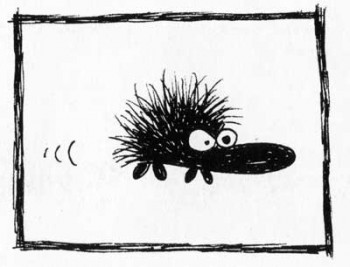
Milla Paloniemi's swearing hedgehog
For the first time, comic books rule the latest bestsellers list of Finnish fiction.
A cartoon series called Fingerpori by Pertti Jarla evidently tickles the Finnish funny bone, as three of his collections occupy the second, sixth and eighth places on the February top ten list, compiled by the Booksellers’ Association of Finland. More…
In defence of small people
15 November 2012 | Non-fiction, Reviews
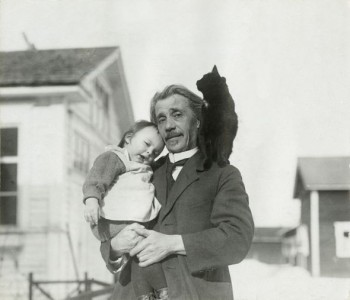
Teuvo Pakkala with grandson Teuvo-Pentti and Mirri the cat. Photo: F. Suomela / Otava, 1922
The best-known work of author Teuvo Pakkala (1862–1925) is Tukkijoella (‘On the log river’, 1899), Finland’s most-performed play. The song-studded comedy set in motion a phase of ‘logger romanticism’ in Finnish literature which later spread to film as well. Like the cowboy of the old west, the wandering lumberjack became the prototype for the Finnish masculine adventurer.
The entertaining musical play was a blockbuster. Pakkala’s works of more literary significance, however, encountered more difficulty. His short story collections on the lives of children – Lapsia (‘Children’, 1895) and Pikku ihmisiä (‘Little people’, 1913) – were greeted with flattering acclaim, but marked the author as hopelessly ‘effeminate’, as the critics put it. The stories were read as a kind of child-rearing guide, or even as tales for children. It wasn’t until much later, in the second half of the 20th century, that these psychological studies of children were re-examined as early gems of the short story form by a contemporary of Freud. More…
An officer and a gentleman
31 December 2004 | Archives online, Authors, Reviews
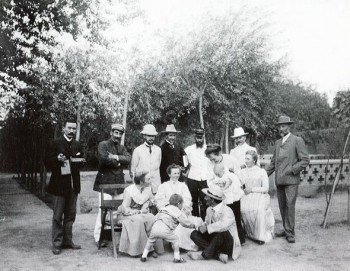
A moment in the Chinese garden: from left, Eric Macartney. Kashgar, China, 1906. Photo: C.G.E. Mannerheim
A photograph from 1906 prompted Markus Nummi to write a 500-page novel about the people of the caravan route in China. One of his characters, the Finnish photographer and spy-explorer Carl Gustaf Mannerheim, in reality later became Finland’s sixth president. Where does fiction end and history begin? Anna-Leena Nissilä investigates
The city of Kashgar in Chinese Turkestan in the year 1906: a group of French explorers and a crowd of Swedish missionaries from the local province, along with other members of the European community and their children, have gathered together in an orchard to take a picture. Midilimanglar, keep still, says the photographer, Baron Carl Gustaf Mannerheim, and presses the shutter release. The admonition is without effect; the picture turns out restless. Little Eric can’t hold still; a baby girl is grabbing at a man’s hat; the adults are looking past the camera. For some reason the host of the event, an Englishman named Macartney, is standing a pace away from the rest of the group.
Almost a century later, the author Markus Nummi (born 1959) runs across Mannerheim’s snapshot and becomes inspired. He tells how the expansive and thematically wide-ranging historical novel Kiinalainen puutarha (‘The Chinese garden’, Otava, 2004) began to form around the photograph:
‘The photograph is the starting point for everything, the intersection and blink of an eye in which all of my story’s central characters are close to another. I was fascinated by the picture’s bustle: people looking every which way, all the fumbling about. And when you look at the picture more closely, you start to see different kinds of connections; when you look at where these people were coming from and where they went in their lives, you can start to imagine what is hidden behind the picture. I started to contemplate what the photographer saw at the moment the picture was taken, maybe angels?’ More…
Antti Kujala: Neukkujen taskussa? Kekkonen, suomalaiset puolueet ja Neuvostoliitto 1956–71 [In the Soviets’ pocket? Kekkonen, the Finnish political parties and the Soviet Union 1956–71]
17 April 2014 | Mini reviews, Reviews
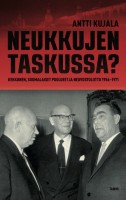 Neukkujen taskussa? Kekkonen, suomalaiset puolueet ja Neuvostoliitto 1956–71
[In the Soviets’ pocket? Kekkonen, the Finnish political parties and the Soviet Union 1956–71]
Helsinki: Tammi, 2013. 392 pp., ill .
ISBN 978-951-31-7347-0
€39, hardback
In this book, which partly cites new sources in Russia, associate history professor Antti Kujala describes the nature of the policy pursued by President Urho Kekkonen during his term of office from 1956 to 19971 (he resigned in 1981). The parties were divided among themselves, and also to some extent internally. In political plotting secret support was sought after from both the Soviet Union and the West. Kekkonen was able to achieve a strong position, which he made use of. He sought to safeguard Finland’s interests with regard to the Soviet Union and created a good relationship with its leaders. At home, however, he used his position as a weapon against his opponents and tried to restrain criticism that could easily be interpreted as anti-Soviet. The Soviet Union viewed Finland as lying within its sphere of power and was able to influence many Finnish politicians and union leaders, as well as the composition of the government. The section of the book in question contains an account of the central phenomena of Finland’s political history: the influence of the Soviet Union, as manifested by the ‘night frosts’ and the so-called ‘Note Crisis’, and Finland’s reactions to the occupation of Czechoslovakia by Soviet troops in 1968.
Translated by David McDuff
The gender of the soul
Scenes from the play Kuningatar K / Queen C
Characters:
Christina, the Queen
Friend
The Queen Mother
Karl Gustav, the Count [Christina’s suitor, the King-to-be]
Descartes, philosopher
Official
Man
The King
Oxenstierna, Per Brahe
A choir of midwives
The play can be performed with six actors (3 female, 3 male). Other ways of dividing the roles are possible. All stage directions may be altered.
1. Prologue
The eels’ court
CHRISTINA
If eels had a court then a great female eel would sit in the centre and the little males would writhe about like seaweed around the throne. However they would not be envious of the queen, because they would know that if they swam up into rivers and lakes, into fresh waters, they themselves would gradually become females, great and heavy, and would be able to rule and close into their great embrace all the small little gentlemen. They just have to wait.
KARL GUSTAV
I don’t know. What I do know is that a great black eel, as thick as a rope, was pulled out of the well last night and the Queen looked at its silver stomach and its thrashing tail, but the eel looked the Queen in the eyes and in the heart and since then she has never been the same. More…
Fruits of reading
30 December 1998 | Authors, Interviews

Photo: Promedia
This is an edited version of an interview published in Leva skrivande. Finlandssvenska författare samtalar (‘Living by writing. Finland-Swedish writers in conversation’), edited by Monika Fagerholm (Söderströms, 1998)
Bo Carpelan is one of the most translated of Finnish writers; his novel Axel (1986) attracted international attention when it was published in English translation. Here, in our occasional series of interviews with writers, he is in conversation with fellow poet Mårten Westö
Mårten Westö: The American writer Paul Auster has said: ‘A young person who wants to be an artist or a writer is above all influenced by art. But a young writer has nothing to say. One has a love of literature, but one can only imitate other writers to begin with. It takes a long time before one finds one’s own way.’ What do you think of that statement?
Bo Carpelan: Of course there’s a lot in what he says. At the same time I am convinced that one must have at least the shadow of one’s own voice from the very outset, otherwise what one writes turns out to be merely plagiarism. But to start with one does probably tend to work in close association with tradition. That was also true of me, but in my own view I didn’t continue – as has often been asserted – in the wake of Finland-Swedish modernism. It is of course quite possible that later on I returned to it, but the basis of my activity was probably the American New Criticism: the large anthologies on criticism and poetry that I read in the 1950s. Those influences have left their clearest traces in the very comprehensive bibliography of my academic work on the Finland-Swedish poet Gunnar Björling. In the last chapter of the dissertation I also tried to draw my own guidelines as to what I mean by poetry: that it is concrete and synthetic. More…