

Search results for "tommi+musturi/2010/05/song-without-words/2009/09/what-god-said/2011/04/matti-suurpaa-parnasso-1951–2011-parnasso-1951–2011"
Matti Suurpää: Parnasso 1951–2011 [Parnasso, 1951–2011]
21 April 2011 | Mini reviews, Reviews
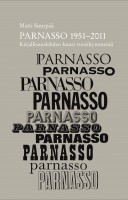 Parnasso 1951–2011. Kirjallisuuslehden kuusi vuosikymmentä.
[Parnasso, 1951–2011. Six decades of a literary journal]
Helsinki: Otava, 2011. 559 p., ill.
ISBN 978-951-1-23368-8
€ 45.90, hardback
The 60-year history of Parnasso, Finland’s longest-running literary journal, is a chronicle of the assimilation of ‘the modern’ into Finnish literature. Matti Suurpää – a long-time contributor, and former head of the SKS publishing house – singles out the 1958–1965 period under the editorship of Kai Laitinen (professor of literature, Editor-in-Chief of Books from Finland from 1976 to 1990) as the era with the broadest editorial scope. Finnish modernist literature, developed during the 1950s, had by then staked out its territory, and the journal consolidated its power to promote it. Laitinen published an excellent themed issue on Finland-Swedish literature to rehabilitate and reintegrate writing by Swedish-speaking authors into the field of Finnish literature. Subsequent editors considered it important to include translations of foreign literature in Parnasso. As the archives of the journal have been lost, Suurpää carried out a close reading of the annual volumes. The result is an eminently clear and readable work in which a wealth of extracts of writing and discussions illuminate the story of the modernisation of Finnish literature.
Translated by Ruth Urbom
Being God
30 September 2006 | Fiction, Prose
Extracts from the novel Gud (‘God’, Schildts, 2006)
Side by side, wolves and antelopes graze on the juicy grass.
A deer playfully chases a lion through the bushes.
‘Can you do this?’
Adam crosses his arms in front of his chest and folds his hands back to front so that the right hand is on the left and the left hand is on the right. With his hands folded he twists them downwards and holds them out. Now they point to Eve, still folded, and still with the right hand on the left.
Eve tries. She succeeds, and laughs with delight.
A gentle breeze is blowing from the east, just strongly enough for the couple not to be troubled by the heat, but not so they would feel the need for clothes to keep them warm. More…
Serial fun, or comics celebrated
24 January 2011 | In the news
The art of comics celebrates its first centenary in Finland this year. The first Finnish picture story was a book called Professori Itikaisen tutkimusretki (‘Professor Itikainen’s expedition’, WSOY), by Ilmari Vainio, published in 1911; see our post on the Books from Finland website.
By the way, comics in Finnish is sarjakuva, ‘serial picture’, covering the modern usage of ‘comics’ – including serious, graphically impressive stuff such as the newish genre of the graphic novel.
The annual Helsinki Comics Festival, organised by Finnish Comics Society (founded 1971), is the biggest event in the field in northern Europe; this year’s festival will take place in September. In 2011 comics exhibitions will take place at the Finnish Design Museum, the Finnish Post Museum and the National Library of Finland.
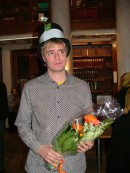
Tommi Musturi. Photo: the Finnish Comics Society
The Society awarded its Puupää prize 2011 to Tommi Musturi (born 1975) – take a look at an extract from his Walking with Samuel which we ran on the Books from Finland website in May 2010.
Among Musturi’s publications are ten anthologies entitled Glömp; he has also worked for Kuti magazine and Huuda Huuda publisher. The jury remarked, in particular, on their appreciation of Musturi’s highly original, often wordless, stories and their graphic brilliance.

The prize: Puupää's hat
The prize is not money but a honorary hat, and is named after a classic Finnish cartoon character, Pekka Puupää (‘Pete Blockhead’), created by Ola Fogelberg and his daughter Toto. The Puupää comic books were published between 1925 and 1975, and some of the stories were made into film.
Lauri Timonen: Lähikuvassa Matti Pellonpää [Matti Pellonpää in closeup]
16 July 2009 | Mini reviews, Reviews
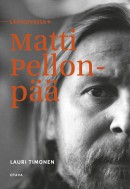 Lähikuvassa Matti Pellonpää
[Matti Pellonpää in close-up]
Helsinki: Otava, 2009. 335 p., ill.
ISBN 978-951-1-22903-2
€ 25, hardback
Matti Pellonpää (1951–1995) was one of the trusted actors, almost a trademark, of the film director Aki Kaurismäki. In 1993 he won the Felix Prize for best European male actor at the Berlin Film Festival for his role in La Vie de Bohéme. With his characteristic restrained empathy Pellonpää mostly played bohemians, unemployed people and outcasts. This portrait is built on the recollections of his friends and colleagues, as well as on the interviews by the author. These conversations deal with Pellonpää’s theatrical career and the musical experiments of his highly original band, Peltsix. The actor spent most of his free time in restaurants, where he eavesdropped on table talk and watched the eccentric personalities he encountered; the reader is also offered a sample of Pellonpää anecdotes.
Lucky strikes
12 August 2010 | This 'n' that

Stumbled upon: readers find Tommi Musturi's comic strip (June 10–June 18)
When Books from Finland was a printed journal, it was relatively easy to define its readership – now it is different: we are a part of the internet’s ecosystem, its surging and multifarious mass of knowledge.
Those who visit our pages may have the most diverse motives for wanting to read our articles – and they may travel surprising itineraries before arriving on Books from Finland’s pages, as we found out recently: StumbleUpon is still a fairly little-known service in Finland. Thus it took a while before we realised why so many of the comments about our piece on Tommi Musturi’s wordless comic strip, on colour and friendship, began with the words ‘I stumbled upon’… More…
Tellervo Krogerus: Sanottu. Tehty. Matti Kuusen elämä 1914–1998. [Said. Done. The life of Matti Kuusi, 1914–1998]
22 May 2014 | Mini reviews, Reviews
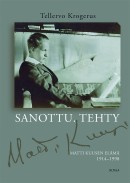 Sanottu. Tehty. Matti Kuusen elämä 1914–1998
[Said. Done. The life of Matti Kuusi, 1914–1998]
Helsinki: Siltala , 2014. 856 pp., ill .
ISBN 978-952-234-194-5
€31.50, hardback
The folklorist Matti Kuusi vied for the status of the world’s leading researcher of proverbs with the Californian scholar Archer Taylor, his work extending from the shores of the Baltic Sea to Namibia’s Ovamboland. Proverbs revealed to him the deep structures of the human mind and showed that the nations of the world possessed a basis for mutual understanding. As a young man Kuusi read Spengler and predicted the destruction of the Western world. According to his ‘Kalevalan imperialism’, the Nordic region was to be the new world power. The war brought him to his senses: he understood that patriotism was mainly a matter of bland resilience. Professor Kuusi was a rigorous scholar, but also a provocative man of ideas who showed that pop music was today’s folk poetry. That idea received a mixed reception, but nowadays his department studies both rap music and ancient folk song. This biography by Tellervo Krogerus creates a rich portrait of a complex personality.
Translated by David McDuff
The engineer’s story
30 June 1981 | Archives online, Fiction, Prose
A short story from Maailman kivisin paikka (‘The stoniest place in the world’, 1980). Introduction by Pekka Tarkka
Coffee was going to be served down by the river. The engineer took my elbow and led me across his paved courtyard and over his lawn; we settled ourselves down in cane chairs under the trees. Mirja came out of the house with a tray of coffee and coffee-cups, a loaf of sweet bread, already cut, some marble cake and some biscuits. The engineer said nothing. My eye wandered over the ample weeping birches by the river, the mist creeping up in the cool of the evening and shifting in the cross-pull of the breeze and the current, and I watched Mirja moving under the trees back to the house and then down again to the riverbank.
As we sipped our coffee we spoke about chance, and the part it plays in life, about my husband – for I was able to speak about him now: enough time had gone by. The engineer eased himself into a comfortable position, gave me a quick look and then launched off into an account of his own, about his trip abroad:
I spotted the news item as I was going through the morning paper on the plane. I sat more or less speechless all of the first leg, listening to Kirsti and her husband confabulating. I didn’t say anything during the stop-over in Copenhagen, either, where they wanted to get some schnapps and, of course, some chocolate ‘if Kirsti would really like some’. We came rushing back into the plane just as the last English, German and Danish announcements were coming over, and then we sat waiting for the take-off. That was delayed too because of a check-up (not announced), and then we were off again for Zurich, me without a word and they whispering together. Then it was the bus as far as the terminal, and after that a taxi to the hotel. Quite clearly Kirsti hadn’t heard a thing about it yet, and probably hadn’t had much contact with Erkki for quite some time, her new husband even less. More…
Song without words
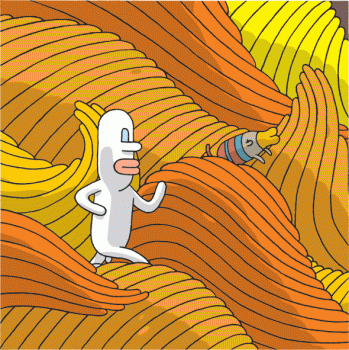
The episode we feature here is from Samuelin matkassa (‘Walking with Samuel’, Huuda Huuda, 2009; the book has been also published in Germany, Belgium, Sweden and Portugal)
Our lives are now more surrounded with images – moving or still, narratives or icons, emblems and symbols – than ever before – but do we know how to interpret them? How well can we read pictures?
Try this: Samuel is a cartoon character, created by Tommi Musturi, who wanders through time and a fantastically colourful universe of his own. His story is told in pictures, not words – and the details speak volumes. It tells, as you will find if you ‘read’ it carefully, about friendship between man and… another creature. More…
Des res
Extracts from the novel Juoksuhaudantie (‘The Trench Road’, WSOY, 2002)
Matti Virtanen
I belonged to that small group of men who were the first in this country to dedicate themselves to the home front and to women’s emancipation. I feel I can say this without boasting and without causing any bickering between the sexes.
A home veteran looks after all the housework and understands women. Throughout our marriage I have done everything that our fathers did not. I did the laundry, cooked the food, cleaned the flat, I gave her time to herself and protected the family from society. For hours on end I listened to her work problems, her emotional ups and downs and her hopes for more varied displays of affection. I implemented comprehensive strategies to free her from the cooker. I was always ready with provisions when she got home exhausted after a day at work. More…
Blind man’s buff
31 March 2002 | Fiction, Prose
An extract from the novel Laituri matkalla mereen (‘A jetty to the sea’, WSOY, 2001)
Ten steps along the path marked out by the poet
In a gravel pit illegally dug by the sand-king Gropius and later abandoned, the colonel and Henry were shooting at tin cans with pistols. The pit neighboured the Colonel’s home, and he was in the habit of carrying out target practice there with the help of Jovan, to keep his hand in.
The cans were placed at twenty-metre intervals in front of a sandbank and were raised on coil springs, so they swayed freely in the air. Each of them was attached to a long line; this, when pulled, swayed the cans, rattling stones inside them. Following the sound, the colonel identified the can’s position, aimed and fired. The hits he heard himself, the misses usually struck the pieces of hardboard behind the cans. These were divided up dartboard-fashion into sectors and rings, and Jovan used binoculars to spot the hits on them and announce the points of impact as clock-numbers and distances from the can’s central position, enabling the colonel to correct his aim. This he did with the aid of a rake. He held the rake upright, prongs downwards, so that its handle stood roughly perpendicular to the ground. Moving the handle sideways with careful estimation, and sliding his pistol hand up or down on the handle, he was able to make corrections with reasonable accuracy and determine his aim. More…
On Matti Pulkkinen
30 June 1978 | Archives online, Authors
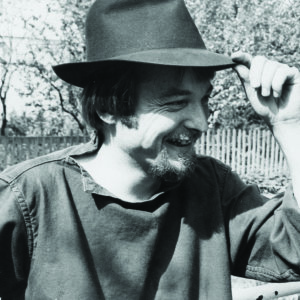
Matti Pulkkinen. Photo: Gummerus
Matti Pulkkinen’s grandfather was born in 1842 in a forest village close to the Russian border, in an area which could only be reached by water. When he grew up he became a tar-burner, a traditional occupation in north-east Finland. Pulkkinen’s father worked for the Otava Publishing Company in the early years of the present century, a time when ordinary Finns were beginning to show a real interest in literature. In his home in one of the most remote parts of North Karelia, he assembled a library which ranged from Mark Twain to the detective stories of G. K. Chesterton. He was 70 when his youngest son, Matti, was born in 1944. Dostoyevsky and Nietzsche were the two writers whose works did most to stimulate Matti Pulkkinen’s enthusiasm for literature. After leaving school he set out to see the world. He worked as a lumberjack, a primary school teacher, a statistics clerk in a gynaecological hospital, a bank teller, an accounts clerk, and later as a carpenter, took part in the restoration of the medieval church at Vanaja. From 1969 to 1971 Pulkkinen worked as a nurse in mental hospitals in Frankfurt, West Berlin and Bern. While in Switzerland he became interested in Jungian psychology and modern group therapy.
Pulkkinen’s novel, Ja pesäpuu itki (‘And the nesting-tree wept’, Gummerus), published in 1977, was awarded the J.H. Erkko Prize for the best first novel of the year and the Kalevi Jäntti Memorial Prize. It rapidly became a best seller and has already had two reprints. More…
Serious comics: Angoulême 2011
24 February 2011 | This 'n' that
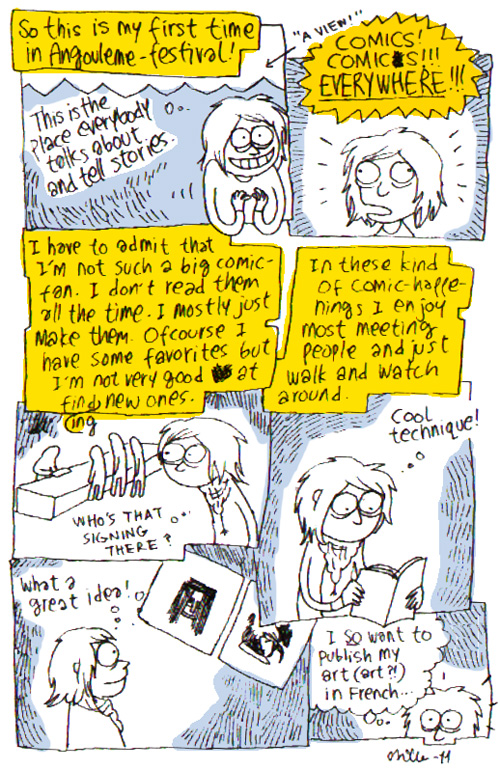
Graphic artist Milla Paloniemi went to Angoulême, too: read more through the link (Milla Paloniemi) in the text below
As a little girl in Paris, I dreamed of going to the Angoulême comics festival – Corto Maltese and Mike Blueberry were my heroes, and I liked to imagine meeting them in person.
20 years later, my wish came true – I went to the festival to present Finnish comics to a French audience! I was an intern at FILI – Finnish Literature Exchange, and for the first time, FILI had its own stand at Angoulême in January 2011.
Finnish comics have become popular abroad in recent years, which is particularly apparent in the young artists’ reception by readers in Europe. Angoulême isn’t just a comics Mecca for Europeans, however: there were admirers of Matti Hagelberg, Marko Turunen and Tommi Musturi from as far away as Japan and Korea.
The festival provides opportunities to present both general ‘official’ comics, ‘out-of-the-ordinary’ and unusual works. The atmosphere at the festival is much wilder than at a traditional book fair: for four days the city is filled with publishers, readers, enthusiasts, artists, and even musicians. People meet in the evenings at le Chat Noir bar to discuss the day’s finds, sketching their friends and the day’s events.
As one Belgian publisher told me, ‘There have always been Finns at Angoulême.’ Staff from comics publisher Kutikuti and many others have been making the rounds at Angoulême for years, walking through the city and festival grounds, carrying their backpacks loaded with books. They have been the forerunners to whom we are grateful, and we hope that our collaboration with them deepens in the future.
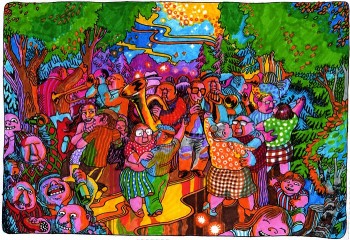
Aapo Rapi: Meti (Kutikuti, 2010)
This year two Finnish artists, Aapo Rapi and Ville Ranta were nominated for the Sélection Officielle prize, which gave them wider recognition. Rapi’s Meti is a colourful graphic novel inspired by his own grandmother Meti [see the picture right: the old lady with square glasses].
Hannu Lukkarinen and Juha Ruusuvuori were also favorites, as all the available copies of Les Ossements de Saint Henrik, the French translation of their adventures of Nicholas Grisefoth, sold out. There were also fans of women comics artists, searching feverishly for works by such artists as Jenni Rope and Milla Paloniemi.
Chatting with French publishers and readers, it became clear that Finnish comics are interesting for their freshness and freedom. Finnish artists dare to try every kind of technique and they don’t get bogged down in questions of genre. They said so themselves at the festival’s public event. According to Ville Ranta, the commercial aspect isn’t the most important thing, because comics are still a marginalised art in Finland. Aapo Rapi claimed that ‘the first thing is to express my own ideas, for myself and a couple of friends, then I look to see if it might interest other people.’
Hannu Lukkarinen emphasised that it’s hard to distribute Finnish-language comics to the larger world: for that you need a no-nonsense agent like Kirsi Kinnunen, who has lived in France for a long time doing publicity and translation work. Finnish publishers haven’t yet shown much interest in marketing comics, but that may change in the future.
These Finnish artists, many of them also publishers, were happy at Angoulême. Happy enough, no doubt, to last them until next year!
Translated by Lola Rogers
Human Freedom
30 June 1986 | Archives online, Fiction, Prose
Mika Waltari. Photo: SKS Archives
Extract from lhmisen vapaus (‘Human Freedom’, 1950)
‘Where are we?’ Yvonne asked. ‘This isn’t the right street either. Somewhere between Alma and Georges V, they said. But there’s no sign of an aquarium.’
‘Talking of aquariums’, I suggested, ‘there’s a dog shop near here where they wash dogs in the back room. If you like, I’ll take you to see how they wash a dog. It’s a very soothing experience.’
‘You’re crazy’, said Yvonne.
My feelings were hurt. ‘I may sleep badly’, I admitted, ‘but I love you. I walk up and down the embankments all night. My heart aches, my brain is on fire. Then comes blissful intoxication, and for a little while I can be happy. And all you can do is to keep nagging, Gertrude.’
She wrinkled her brow, but I went on impatiently, ‘Look, Rose dear, just at present I have the whole world throbbing in my temples and in my finger-tips. Age-old poems are bubbling up within me. I am grieving for lost youth. I am boggling at the future. For just this one moment it is given to me to see life with the living eyes of a real human being. Why won’t you let me be happy?’
‘I have walked two hundred kilometres’, said a low, timid voice at my elbow. I stopped. Yvonne had stuck her arm through mine. She, too, stopped. We both looked down and saw a little man. He doffed a ragged cap and bowed. Flushed scars glowed through a grey stubble of beard. He was wearing a much-patched battle-dress from which the badges had long since disappeared. His face was wrinkled, but the little eyes were animated and sorrowful. More…
Daddy’s girl
30 September 2004 | Archives online, Fiction, Prose
Extracts from the novel Maskrosguden (‘The dandelion god’, Söderströms, 2004). Introduction by Maria Antas
The best cinema in town was in the main square. The other was a little way off. It was in the main square too, but you couldn’t compare it to the Royal. At the Grand there was hardly any room between the rows, the floor was flat and there was a dance-hall on the other side of the wall, so that Zorro rode out of time with waltzes, in time with oompahs, out of time with the slow steps of tangos and in time with quick numbers. The Royal was different and had a sloping floor.
Inside, the Royal was several hundred metres long. You could buy sweets on one side and tickets on the other. From Martina Wallin’s mum. She was refined. So was everyone except us: Mum, Dad and me. More…
Summer child
30 September 1988 | Archives online, Fiction, Prose
A short story from Resa med lätt bagage (‘Travelling light’, 1987). Introduction by Marianne Bargum
From the very beginning it was quite clear no one at Backen liked him, a thin gloomy child of eleven; he looked hungry somehow. The boy ought to have inspired a natural protective tenderness, but he didn’t at all. To some extent, it was his way of looking at them, or rather of observing them, a suspicious, penetrating look, anything but childish. And when he had finished looking, he commented in his own precocious way, and my goodness, what that child could wring out of himself.
It would have been easier to ignore if Elis had come from a poor home, but he hadn’t. His clothes and suitcase were sheer luxury, and his father’s car had dropped him off at the ferry. It had all been arranged over the phone. The Fredriksons had taken on a summer child out of the goodness of their hearts, and naturally for some compensation. Axel and Hanna had talked about it for a long time, about how town children needed fresh air and trees and water and healthy food. They had said all the usual things, until they had all been convinced that only one thing was left in order to do the right thing and feel at ease. Despite the fact that all the June work was upon them, many of the summer visitors’ boats were still on the slips, and the overhaul of some not even completed. More…